

CEO @WellfoundHQ (formerly AngelList Talent) - Helped 28k+ startups makes 100k+ hires
Manhattan, NY
Joined November 2007
- Tweets515
- Following480
- Followers750
- Likes1.5K





Amit Matani retweeted

so you didn't go to an ivy league, have a chip on your shoulder, aren't satisfied with your current role and want to work in applied AI
here's what i'd recommend you do immediately
1) get on X and LinkedIn (if you're seeing this congrats)
2) clean up that profile pic (get a headshot srs, use ChatGPT Images)
3) fix your profile, headline and bio (emulate mine if you need a reference)
4) start posting daily about your applied ai learnings, experiments, commentary
what you're trying to do is clear the minimum bar that your profile is actively contributing to the applied ai space. you don't need 5000+ followers. you don't even need engagement.
all you're trying to do is not look like a bot and look like somebody who actually thinks about and works on this stuff.
once you have this, start searching for hiring managers posting about new roles they are hiring for.
you're going to want to tune your feed so these come in as quickly as possible after they post. before your feed is tuned, just actively search for them. use grok bot or muse or codex to do this.
understand this - hiring managers, especially new hiring managers, want to pick the right person. as much as a recruiter makes their lives easier, it also takes them out of their own hiring and filtering process. them posting means they are actively engaged in the search.
this is your opportunity.
like the post and reply that you are DMing them. KEEP IT SHORT.
this does two things:
1) creates two notifications for them, for the like and for the comment
2) creates a pull for them to check the DM or click on your profile
DO NOT overwhelm them with a long message like "I'm so interested! I have 5 years of experience in program management, I just graduated from X university, etc etc."
first of all, it’s thirsty. second of all, nothing you say in that comment will be enough for them to pique interest unless you went to a top school or work at a top company (and if you did, why so thirsty?) so don't do it. stand out with brevity and restraint.
your goal is to hook them to see your profile, your post feed, your pinned/featured post(s). congrats, you just bypassed the application/resume blackhole and got them to see a much larger slice of how you think.
if you've never done this, do it. i guarantee you it will transform your job search.


Amit Matani retweeted

It might seem like people in tech and investing have lost their minds. And in some sense that is true. But a lot of the behavior is rational in some sense, even if it’s not “honorable”
Why is it happening now? Yes, some people have AI psychosis. But something deeper is happening
In life, there are two types of games. Single turn and multi turn games. Single turn, or one-shot, games are just what they sound like. One turn and the game is over. No more turns.
Multi turn, or sequential, games have multiple turns. Which means history, reputation, and consequences for your actions have a large impact. You expect to see the players on the board multiple times in the future
Most things in the game of life are multi turn. Careers are long. Investments take time to come to fruition, and you will want to redeploy the capital
But when the stakes get high enough, people start to squint at the board and see that they can end the game in one turn. Or at least they think they can.
I’ve talked a lot about how AI is the big one. So it’s not crazy to me that some people are looking at the board and thinking there might be only one turn left, and they are just going for it.
Amit Matani retweeted

Apple Watch Ultra 4 bring quite a few upgrades this year. Here is my unboxing and what’s new.
Full video here: youtu.be/xD0rRKRsVu0?is=KKmH…

Amit Matani retweeted

If AI is risky like fire is risky, then you want everyone to have it.
If AI is risky like a nuclear weapon is risky, then you want no one to have it.

Maybe you have recently become aware of the AI safety debate and the arguments swirling around it.
If you want to understand them, you need to understand a couple things that almost everyone gets wrong:
There are TWO distinct classes of AI dangers, and it's VERY important to think about them separately, and not let one confuse you about the other.
Many many people (including many quite intelligent, clear-thinking people) do not effectively understand the fundamental differences between these two classes of dangers.
The first one has to do with the theory that an AI far superior to human intelligence (Artificial SuperIntelligence, or ASI) will inevitably wipe out the human race.
The second one has to do with the idea that powerful AI will result in very harmful things happening to many human beings, possibly all human beings.
Those two sound VERY similar, don't they?
They are DIFFERENT. Understanding how they are different is crucial if you want to think about or contribute usefully to any conversation about AI safety or AI harm. You might feel like you are Making Very Good Points or Asking Incisive Questions, but if you aren't clear on the differences between the two, you aren't.
So, I'm going to tell you what the difference is so that you can talk more usefully.
The first one concerns itself with a very specific thing, which is ASI (Artificial Superintelligence) that is more intelligent than any human being. When I say that, I am not referring to a thing like how Einstein is smarter than you, we are talking more about something like how a human being is more intelligent than any mouse.
In our regular lives, we meet other people who we can tell are smarter than us, vs some who are less smart. The line is fuzzy, because intelligence has a lot of dimensions. I'm better at a "rotating shapes" kind of intelligence than my wife, and she is better at "words-making" kind of intelligence than I am.
But every human is better in almost every dimension of intelligence than every single mouse.
That's the level we're talking about: an artificial superintelligence - made up of a computer or a network of computers - that is more intelligent than any human. And more intelligent by a long shot, by a wide margin, in an indisputable way like how humans are above mice.
That is the first thing.
The theory says that if you have an AI that is vastly smarter than all humans - in the way that a human is smarter than mice - that superintelligent AI will inevitably, eventually, sooner or later, wipe out every human on the planet.
We will refer to this as "existential risk."
The common follow-up question "well, how exactly is it going to do that?" is NOT the important question, and one of the most important elements of understanding this theory is first getting why that particular question is not important. A couple analogies:
Analogy 1: You are playing chess against a grandmaster. My theory predicts the grandmaster is going to beat you. You can ask "Well, how exactly is he going to do that?" I don't know, because I'm not a grandmaster, I just know that a chess grandmaster is almost always going to beat a normal player like you. And I'd be right. So the question "how is he going to do that" is not important, and doesn't affect the final outcome. He's going to figure out a way because he's way better than you.
Analogy 2: Humans are smarter than all other animals, comprehensively, by a wide margin. We have driven numerous species to extinction, not because we hated them or hunted them. Many of them have died out without most humans even ever thinking about them. All we did was expand our civilization, use up resources, encroach on habitats, and pretty soon the resources needed by those species went away and they died out. We figured out a way to get what we wanted because we're way smarter than them, and often we didn't even notice they died as a result.
A lesser animal asking, "how are the humans going to wipe us out?" is not asking a relevant question. We don't know, but we do know that any time humans and lesser species compete for any kind of resources, the humans will win. The fact that we know who is going to win beforehand - and that it is due to the vastly different levels of intelligence - is the key concept here.
A vastly more intelligent AI is likely to care about things that are incomprehensible to us, the way animals can't understand human goals. It's going to need resources to pursue those goals and it's going to be far more effective at gaining control of them and excluding us from them - in the same way that we are far more effective than other lower species.
A much more intelligent AI will not care about our interests, it will care about its interests, and to whatever small degree we happen to escape total annihilation from losing access to all our resources, any remaining humans will likely be enslaved into a system that serves the AI's own purposes.
That is the first thing. (Remember how I said at the beginning of this post that there was a first thing, and then a second thing?)
The first thing is the most difficult to understand, because you have to extrapolate how a vastly superior intelligence would act, and you can only use analogies like "how do humans treat lesser creatures," and the analogies are messy.
But now let's move on to the second thing.
The second thing is "everything else you've ever heard that AI might do that's harmful."
That's a little inaccurate. It's actually "everything else you've ever heard that humans might use AI to do that's harmful."
This is the critical difference. The first one talks about the inevitable outcome of what happens when two vastly different levels of intelligence collide, e.g. ASI vs humans, or human vs mice.
The second one has to do with what happens when humans possess AI as a powerful tool. This second thing is much easier to understand, because we have many more concrete notions:
Like:
- the military uses AI to make hyper-efficient killer drones and missiles
- your capitalist overlords use AI to replace you and everyone loses their jobs
- authoritarian government uses AI to surveil everybody and control the entire population
- hackers use AI to break into secure networks and hold companies and governments hostage
- students use AI to cheat on homework and show up to college knowing nothing
- AI slop saturates the internet and makes it impossible for artists and writers to make a living
- terrorists use AI to make biological or nuclear weapons
or even things like
- the military hands control to an AI and it misinterprets something and launches nuclear attacks and kills millions
All of those sound pretty familiar, right? Yeah, you've heard them before. We call this second thing "risks from misuse."
These problems are not the first class of problem! This second class of problems exists while AI is a tool that can be controlled by humans, and humans use it to do evil or careless things to each other. The problems may sound exotic or dystopian or novel, but they are fundamentally problems having to do with flawed human nature.
Given a powerful tool, some humans will likely use it to control or otherwise harm others. This is a very familiar problem.
I am not condemning or condoning this. I'm just describing it.
That is a fundamentally different danger from the first thing, which is that when a human is far superior to a mouse, the mouse is likely to come to harm because the human cares about doing human things, and the mouse is not gonna make it once the humans get going.
=====
Hopefully from the above, you have understood the difference between the first thing and the second thing. I will list them again - see if you now understand how they are different:
The first one has to do with the idea that an AI superior to human intelligence (Artificial SuperIntelligence, or ASI) will inevitably wipe out the human race.
The second one has to do with the idea that powerful AI will result in very harmful things happening to many human beings, possibly all human beings.
Can you tell how they are different now?
If not, re-read the stuff from earlier until you understand.
We call the first one "existential risk" and we call the second one "risks from misuse."
Once you understand, here is the CRUX of the problem:
SOLUTIONS TO THE SECOND THING DO NOT HAVE ANYTHING TO DO WITH SOLUTIONS TO THE FIRST THING.
In fact, it's worse:
Solutions to the second thing (misuse) look roughly like "give powerful AI to as many people as you can, so they can fight the other people using powerful AI."
But the general solution to the first one (existential risk) is basically "don't let anyone have powerful AI, no one can control super-intelligent AI."
Throughout history, harms from technological misuse typically arise because a small group has control of it and can use it to dominate or harm others. Once everyone has it, things tend to stabilize: you can hurt me, I can hurt you, maybe we test each other (ouch 💥), and then we agree not to hurt each other.
But the first one (existential risk) pretty much just arises if anyone (good or bad!) creates a superintelligence. Because they aren't going to be able to control it, the superintelligence will decide it has other priorities, and then we will be at great risk of being wiped out.
And the solutions that generally work to solve problems like the second thing are EXACTLY THE OPPOSITE of the ones likely to solve the first thing.
THIS is why lots of arguments about "AI risk" or "AI safety" go nowhere. Because someone will be thinking about the risk from the first thing, and another person will be thinking about the risk from the second thing. Both are plausible risks but fundamentally they arise from different things - and so the solutions are not just "bad" or "flawed" - they are likely to be very nearly exact opposites.


Amit Matani retweeted

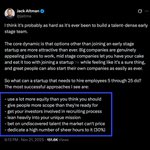
Early employees have the true opportunity costs in our industry today.
1) Startup pays in [low-mid salary] plus [fairydust]
Faang/mango/etc pays in [mid-high salary] plus [sellable stock]
2) The employee has the stresslevel of a founder but the upside of a employee.
3) the founder builds network and brand, the early employee works their ass of in the garage.
4) The company crashes the founder gets a strong lead job in another company.
The employee has a resume entry of a company nobody knows in the prime of their career.
5) The founder gets earlier secondaries and in a shitty exit some compensation. Employee stock options are the first to be cancelled in case of trouble.

Amit Matani retweeted

Today we're thrilled to announce the @a16z Talent Engineer Fellowship — an 8-week cohort for the people building the next operating system for recruiting.
We have a killer group of humans already joining- folks at the frontier of this space, including:
- Danielle Poreh - Clay for Recruiting Lead, prev. Talent Scientist at Clay
- Umesh Khanna (@forwarddeploy) Talent Engineering Lead at xAI
- Viet Nguyen - Founder at Talent Collective, ex- Vercel, Netflix, Gem, Airops
- Sebastian Cuadros (@hiiinternet) - Head of Talent Engineering @ Fonzi AI
- Joshua Gill - Talent Engineering & Operations @ Luma AI
- Jared Long - Recruiting Ops Lead @ Cursor, prev. Head of Recruiting Systems @ OpenAI
- Jeffrey Li (@lijeffrey39) Co-founder & CTO at Paraform
- Dan McCarthy - Snr Talent Engineer at Zapier)
- Madison Morales - Talent at Anthropic, prev. General Catalyst
- Amit Matani (@amitm) CEO @ Wellfound, formerly AngelList Talent
- Johnny Sanchez (@johnnyblu6) - Head of Recruiting Operations & Technology @ Airbnb
- Scott Bianco (@ScottBianco3) - Head of Talent at Hebbia
- Ishan Deshpande (@ishand) - Talent Engineer at xAI
- Joe Penn (@joepenn) - Talent Engineer & Partner at Carrara
Join us!
—> Apply here (let us know what you think of the application experience 👀): build.a16z.com/fellowships/t…
—> More info: a16z.news/p/introducing-the-…
cc @eriktorenberg, @katiekirsch

Amit Matani retweeted

4 thoughts on early-stage hiring:
1/ If an engineer is trying to pick between a pre Series-B company and a BigCo/BigLab --> stop talking to them immediately. They are clearly not ready for a startup.
2/ If someone isn't willing to take a 70% cash paycut (relative to BigCo/BigLab) --> stop talking to them immediately. They will be unhappy/stressed.
3/ You learn a lot about a candidate during the negotiation/closing process. Do not be afraid to walk away if you get new information.
4/ Startups have zero work-life balance. If you are not willing to put in the hours, you are not in the right headspace to grind.

Amit Matani retweeted

Have said this before and will say it again
If you are early in your career, the biggest low hanging fruit that can help you land a job faster or get promoted faster is being willing to work 5 days in person
This used to be table stakes before 2020. Now, experienced folks will pass up on job opportunities if they don’t have hybrid flexibility as part of the role
People hate “face time culture” at companies, but reality is that it is exactly what moves your career ahead
A manager is much more likely to promote someone who they see often in person vs someone working remotely, even if that remote worker has equivalent or slightly better work performance
For companies, this is also the easiest filter to see which candidates actually want the job the most

Amit Matani retweeted

maybe a hot take?
but I think if a founder starts a company fresh out of school and it doesn't work out that they should go work at a Series A+ company for 1-2 years to see what good looks like & built a network (that they can eventually hire out of) vs immediately starting a new company
Amit Matani retweeted

I co-wrote another essay with Charlie Songhurst:
"Mispriced Talent"
Founders think they can find mispriced talent. It’s important to be aware of how you’re finding mispriced talent so that you don’t deceive yourself.
There are two main ways to beat the market.
1) Pay in effort
2) Pay in uncertainty
Paying in effort is well suited for high conscientiousness founders. You’re willing to do the slog. This might mean working hard to get to know every person in a given role in your city.
Paying in uncertainty is well suited for high chaos founders. You’re willing to endure low status for a long time. You’re willing to look silly. This might mean betting on unproven talent. Or picking traits that others think matter but you don’t - the fewer traits you’re selecting for, the lower the price.
There are two main alternatives.
3) Pay up
4) Pay in mistakes
Paying up means offering a deal so good that the talent seeks you out. If you’re paying a salary that’ll lead to generational wealth, talent will find you. If you’re the company that everyone is talking about, talent will find you. If you’re doing yearly tender offers, the talent will find you. If you’ve already hired the famous talent in a specific niche, talent will find you.
Paying in mistakes means incorrectly thinking you've hired someone great at a bargain price. This is caused by not being well calibrated to what greatness looks like. The solution to this comes from Vinod Khosla. First, identify the skill you truly need. Do this by asking what’d cause the company to succeed if true, and what’d cause the company to fail if not true. Then look for key products at other excellent companies that had similar answers. Then figure out the people responsible for those products. Then get coffee with a few of those people. Even if you don’t hire them, do this to calibrate yourself.
If you think you’re finding "mispriced talent" make sure you know how you’re paying. You’re likely either paying in effort, or in uncertainty. If you’re paying in neither of those, good chance you’re deceiving yourself.
Thank you to Cedric Chin (@ejames_c) for draft reactions.


Amit Matani retweeted

never compete when applying for jobs, there are hundreds of applicants with better grades and universities than you. but none of them will be making a personalized demo
i used this demo to get all my interviews like openai over two years ago before moving to sf
Amit Matani retweeted

🚀 Rootly entered the incident management space dominated by legacy players—and took off.
In this interview with @amitm (CEO, @WellfoundHQ), @jjrichardtang shares the strategy that helped Rootly gain traction: youtube.com/watch?v=GrxoaLg1…
Amit Matani retweeted

One thing that took me a while to learn is if you are recruiting someone to your early stage startup and they are also interviewing at huge companies, everyone is better off if you just stop the process.
Amit Matani retweeted

Introducing: RecruiterCloud
Finding the right talent is hard. With RecruiterCloud, you can simply outline your ideal hire and we'll have qualified & interested candidates booked on your calendar by the next day. It’s that easy.
Get Started: wellfound.com/recruit/produc…
