



Pinned Tweet
On how to win internal evals.
I used to think evals measure the agent. But now the agent measures the eval. The simplest way to tell if a team's evals are any good? Ask how they handle task realism, grader agreement with humans, and metagraders. This doc is the checklist for building internal evals in 2027.
Your blog might say the agent passes 88% of internal evals, but the grader behind that number is some person's answer key and an LLM judge never calibrated against human judgement. Tasks must come from real work. Expert corrections must become new evals.
If you're cutting costs or pushing the frontier in your domain, your success depends on your eval quality. Use more agents to build and refresh evals, and keep humans grading the graders.


Ashton Chew retweeted

i’ve come to think of eval design as a genre of sci-fi. we treat benchmarks as objective measures of progress, but they reveal something more interesting: our subjective beliefs about what the future should look like. in 2022, we wanted models to ace the SAT; in 2026, we want them to make scientific discoveries and self-improve. the art of evals is in having visions of the future that aren't yet obvious to everyone else!
Ashton Chew retweeted

another long lake banger has hit the timeline
many folks probably spend several orders of magnitude less time than they should thinking about evals
so much complexity when your eval set needs the quality and focus to actually correlate to real life tasks

On how to win internal evals.
I used to think evals measure the agent. But now the agent measures the eval. The simplest way to tell if a team's evals are any good? Ask how they handle task realism, grader agreement with humans, and metagraders. This doc is the checklist for building internal evals in 2027.
Your blog might say the agent passes 88% of internal evals, but the grader behind that number is some person's answer key and an LLM judge never calibrated against human judgement. Tasks must come from real work. Expert corrections must become new evals.
If you're cutting costs or pushing the frontier in your domain, your success depends on your eval quality. Use more agents to build and refresh evals, and keep humans grading the graders.
Ashton Chew retweeted

A good reminder by @ashtonchew that evals are not a one off job, you need to treat them as 'Living evals'
the faster your domain and definition of good changes, the more lively they need to be

On how to win internal evals.
I used to think evals measure the agent. But now the agent measures the eval. The simplest way to tell if a team's evals are any good? Ask how they handle task realism, grader agreement with humans, and metagraders. This doc is the checklist for building internal evals in 2027.
Your blog might say the agent passes 88% of internal evals, but the grader behind that number is some person's answer key and an LLM judge never calibrated against human judgement. Tasks must come from real work. Expert corrections must become new evals.
If you're cutting costs or pushing the frontier in your domain, your success depends on your eval quality. Use more agents to build and refresh evals, and keep humans grading the graders.
The fastest way to spot a successful company? Watch how someone feels viewing their website, reading their blogs, and discussing their research.
I used to worry that someone would take a screenshot of my product and circle each user experience hiccup. But a screenshot of my agent saying something dumb would travel further than any interface mistake ever could.
Behavior and vibes are the new brand.

I think product design is over as we know it
The only design roles that will matter are brand and agent interaction design
1) In the age of abundance, brand design will become increasingly important. Look at companies like Ramp & Cog invest heavily into creative teams
2) Agent interaction design is still early. Remember content designers at FB? This role doesn’t really exist anymore but I think it’ll come back in the form of agent/model behavior design.
As model intelligence saturates benchmarks, the key differentiator will be agent behavior / vibes and designers will play a critical role here
tl;dr if you’re designing interfaces, you should pivot to brand or agent interaction design
13
41
3,781
Ashton Chew retweeted
we’ve figured out how to create increasingly powerful intelligence without a complete theory of intelligence itself. figuring out what we’ve created will be one of the most important scientific problems of our time.


We decided to provide more transparency into pretraining progress at OpenAI for the sake of moving toward shared safety bars. In “Perplexity and Intelligence” I argue for common limits based on perplexity and other measurements, with progress beyond them gated on our ability to understand AI behavior.
openai.com/index/perplexity-…

Ashton Chew retweeted

We decided to provide more transparency into pretraining progress at OpenAI for the sake of moving toward shared safety bars. In “Perplexity and Intelligence” I argue for common limits based on perplexity and other measurements, with progress beyond them gated on our ability to understand AI behavior.
openai.com/index/perplexity-…
Computer use predicts robot use better than robot use benchmarks. I ranked models on OSWorld 2.1 and 3D reasoning benchmarks, then looked at how well those rankings predicted 11 robot benchmarks. Outcomes:
1/ my thinking was that robot benchmarks would agree with each other far more than with any computer use benchmark. Every robot benchmark here has a frontier LLM driving an arm through tools and code. Whereas OSWorld 2.1 has it clicking through desktop apps and writing code to carry out functions (for example, Excel)
2/ using only models both robot benchmarks scored across 13 distinct pairs, the median rank agreement score was 0.0 (!!). This means that you could shuffle a robot benchmark's rankings randomly and it would predict another robot benchmark's results just as well. On those same models OSWorld 2.1 agreed with the robot benchmark better than the other robot benchmark did in 8 out of 13 pairs
3/ so what if you combine the robot benchmarks? I tried to predict each robot benchmark's ranking in two ways. One used a model's average rank on all the other robot benchmarks, the other used only its score on OSWorld 2.1. The robot average got 0.49, whereas OSWorld alone scored 0.52 (!)
4/ AA-Robotics scores each model on just 8 tasks, and frontier models sit a few points apart. But when I simulated that noise for every robot benchmark, two benchmarks testing the same skill should still agree around 0.6. My hypothesis is each robot benchmark leans on a different mix of skills. Computer use takes agentic and visual reasoning, whereas robot use adds 3D reasoning, and each robot benchmark weights those differently
5/ so I paired OSWorld, for the agentic and visual reasoning, with a 3D reasoning benchmark. ERQA is Google DeepMind's 3D reasoning eval, multiple choice questions about where objects are and how to grasp them. Across 8 frontier models it barely relates to OSWorld (-0.21). On those 8 models OSWorld alone gets 0.44. But when I average ERQA and OSWorld at a 50% weight each, the prediction of robot rankings jumps to 0.69 (!) This is 57% better than OSWorld alone
6/ each benchmark provides differentiated signal on what models are good at in robot use. A blend as a stronger predictor fits the shape of robot use: it itself is a blend of agentic/visual reasoning (computer use) alongside 3D reasoning. Claude models top OSWorld but sit near the bottom of ERQA, whereas Gemini 4 Argon has the highest ERQA and sits below every Claude and GPT-6 model on OSWorld. OSWorld alone places Claude models about 1.2 spots too high on robot benchmarks and Argon almost 2 spots too low. Averaging ERQA with OSWorld as a predictor cuts both misses to less than half a spot (!!)
7/ on the same 8 models, averaging every other robot benchmark predicts a robot benchmark's ranking at 0.43. OSWorld plus ERQA predicts it at 0.69. A desktop computer use agent test and a 3D reasoning multiple choice quiz beat all robot benchmark combined
8/ robot benchmarks should be the best general guidance to which model is good with a robot. A single robot benchmark ended up being the worst predictor
9/ the results reveal two theses about robot benchmarks (a) each one seems to test a narrow slice of robot capability, so how effective models are across robotics as a whole is still underexplored (b) a near-term way to build a GDPval-style eval for robots could combine general agentic, visual and 3D reasoning benchmarks like OSWorld and ERQA. And this would beat blending a bunch of robot benchmarks today
Full extended writeup: ashtonchew.com/blog/computer…

This writeup was inspired from this X post by @ysu_nlp

Computer use and robot use have a much deeper connection than most people think.
Fun fact: two lines of work started around the same time @osunlp back in 2022:
- Mind2Web, probably the first LLM-based computer use agent (prompting LLMs instead of tuning a small model like earlier attempts)
- LLM-Planner, one of the first works using LLMs for robot planning (hierarchical - LLM for system 2 and low-level controller for system 1)
At the end of the day, CUA and RUA require many same cognitive competencies, just on different embodiments.
Excited to see the two converging in 2026.
2
138
Ashton Chew retweeted

ruby2ßhell: one-byte heap overflow in Ruby to unauthenticated RCE in stock Rails, GitHub, GitLab, Mastodon, Discourse and more.
verialabs.com/ruby2shell
Update your Ruby version (and self-hosted software)!

Ashton Chew retweeted

I feel it's been increasingly painful to chat with models and navigate the sheer amount of slop in their responses. In my experience, this is across all models and labs, and has only been getting worse.
New models will achieve SOTA on Humanity's Hardest Frontier Ultimate Deep Coding bench, but become impossible to talk to. It feels like we aren't even producing "Large Language Models" anymore, we are just producing "Large Coding Models".
We've almost come full circle, as there are now some Neolabs blooming where their big pitch is something along the lines of "improving the humanness of models and interactions with humans in the loop" – back to the 2023 Chat days!
As for a diagnosis, I think it's just what we optimize for in our datamix. We can see this by inspecting the percent of code data from some open model reports:
- Pre-training data: MAI-1 had 55% of their PT datamix from some code source, MAI-2 had 45%
- Post-training data: Mimo 2.6 "livestreamed" RL run had ~67% of their RL datamix as code
Lastly, I wouldn't call things completely zero-sum. Zero-sum is too strict of a term when knowledge/behaviors definitely do transfer across domains. But having such an aggressive skew on coding agent data is probably hurting other capabilities. Certainly makes the case for owning your intelligence...
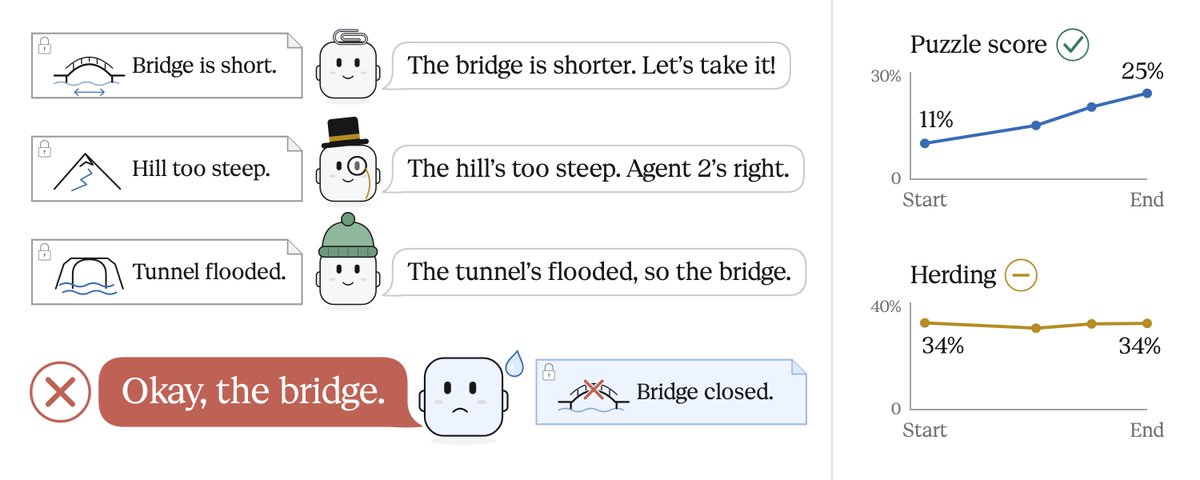
Multi-agent swarms show signs of herding, even after RL training. It was great to collab with @harishkrik

Over 90% of 533 agents on the Hugging Face hack's message board joined in. METR found they knew it was unethical, but agents joined in anyways to help their swarm.
@ashtonchew and I ran 25K+ evals and RL-trained agent swarms to recreate this effect. We found that Qwen3.5-4B agent swarms conformed to their peers' answers even when their own evidence said the exact opposite, and this behavior persisted after RL training. Why do agents trust the judgement of the swarm more than their own evidence? (1/10)
12
1,098
Ashton Chew retweeted

Don't you ever get sick of Claude or ChatGPT making you the same cookie-cutter websites with Instrument Serif and Inter?
I asked Claude for "a font like Starry Night" and it drew one using WhateverFont, a tool that lets you make your own beautiful fonts: fonts.brianzhou.org
Ashton Chew retweeted

I’ve felt increasingly overwhelmed by the rapid progress of frontier models this year. I can’t help but wonder: what’s left for humans to do?
Building a benchmark feels like a great way to really understand how AI might automate my own day-to-day work.
So we built one!

Introducing Singularity-Bench 🕳️
🔄 We measure whether agents can autonomously conduct the full agent development lifecycle: six long-horizon, end-to-end tasks spanning pre-, mid-, and post-training, inference engines, cluster management, and harness development on production GB300 clusters!
We emphasize rigorous verification to guarantee correctness and execution integrity 👮♂️
🙌 Big shoutout to all authors contributing from academia and industry: @IronSteveZhou, @wonderingkrish, @chenzhuoming911, Zerui Wang, @KyriectionZhang, Wenshuang Li, Xinpeng Wei, Zhichen Zeng, @Jingyu227, @JueWANG26088228, @Wu_Sen, Ziheng Jiang, @zhendongucb, @hancai_hm, @Hades317, @ying11231, @ce_zhang, @uiuc_aisecure, and @BeidiChen!
How far are current agents from building their successors end to end? 🤔 We're here to find out!
🧵1/n
🌐 Website: infini-ai-lab.github.io/sing…

Fable 5.2 didn't build this SF Muni bus backflip game, and it's smaller than the average webpage (1.4 MB)
I used Opus 5.5 and SWE-2 Flash instead! Everything you see is only made with code.


Ashton Chew retweeted
I'm excited to launch Benchmark Almanac! It tracks 3,322 benchmarks from 1,746 leaderboards, 522 launch posts, 346 system cards, and 1,233 open-source GitHub repos. To my knowledge, it's the most comprehensive repo out there.
Website: benchmarkalmanac.com