
hacker, sec engineer making the world a little more secure HTB CAPE | OSEP | OSCP | CARTE | CRTO | CRTP
Joined May 2008
- Tweets1.6K
- Following512
- Followers847
- Likes4.2K






I just pwned Worker on HackTheBox
Really enjoyed the realistic CI/CD attack through Azure DevOps.
labs.hackthebox.com/achievem…

Owned Worker from Hack The Box!
I have just owned machine Worker from Hack The Box
labs.hackthebox.com 2
215
Found an unauthenticated path traversal which they rated 8.2 (High) but still marked as out of scope by NVIDIA lol

3
342
It looks like over $3.5 billion has been hacked from Binance. Tether will probably be able to freeze a significant portion of the funds, but this just goes to show how important cybersecurity has become

Unconfirmed, but possibly massive binance hack. Entire Binance wallet drained into new EOA. Contract call was funded by Tornado Cash

1
9
871
I’m getting a lot of DMs from gamers whose PSN accounts have been hacked. I'm not allowed to talk about the situation for now. PlayStation is working on it and I’ll continue sharing what I know with them.
If your PSN account was compromised, remove any passkeys you don’t recognize. Passkeys are tied to the account itself, so changing your email address and password alone won’t invalidate attacker-added passkeys. This gives attackers a way back in and it will bypass both your password and 2FA.
Found a clever bug in Apache Airflow that could leak private keys and other secrets. It’s used by 80,000+ organizations worldwide.
Might spend more time digging into AI/ML tooling that a lot of companies rely on

15
1,948
hack the planet

‼️ BREAKING: Two leaked remote code execution flaws in PHP are real, watchTowr confirms.
PHP will ship fixes for two critical flaws, both rated CVSS 9.2, on Wednesday 21 October at 14:00 UTC, a day before the embargo was due to lift.
CVE-2026-109618 and CVE-2026-109619 first surfaced in a Hacker News post whose author admitted having no evidence beyond "source: trust me, bro".
Kevin Beaumont flagged the leak, and watchTowr confirmed it two hours later.
PHP says it may release sooner if details go public or exploitation appears. It has not named the CVEs or the affected versions.


1
1,629
Pretty sure his research led to the mass exploitation we’ve seen on Ledger today

Need free data? Buy a cheap ledger off a dodgy seller, pull the sim out of the spy implant and enjoy while you can (law enforcement may visit you thinking you are the one making these).
nitter.gq/AliceInDisarray/status…

1
1,325
People are worried about their Bitcoin in cold storage while the entire internet relies on the same underlying cryptographic assumptions 🥴

Today I call upon the blockchain industry to calmly begin planning for "bunker mode". My personal recommendation is to set in motion a controlled mass migration of assets to fresh addresses, i.e. addresses whose pubkeys remain hidden behind a hash.
Holders, starting with large and sophisticated ones, should consider moving the bulk of their funds to addresses that have never signed a transaction. And when they do sign one, they should also move remaining funds to a new address (possibly generated from the same seed phrase).
Don't rush. While I believe there is cause for action a rushed migration would do more harm than good. Don't panic either. Moving assets to protected addresses is a simple, preventative step which does not require new cryptography or new wallets.
IMO it is now reasonable to brace for the possibility that ECDSA breaks before qday, in the worst case in months not years. By "break" I mean fast private key recovery (e.g. in one week) on available hardware (e.g. a large GPU cluster).
Recent days have been humbling for human mathematical intuition. Long-held, unquestioned hypotheses have fallen. This includes the n log(n) bound for integer multiplication and the 3SUM conjecture. In hindsight, May's unexpected disproof of the Erdős unit distance conjecture was our warning shot.
Yesterday's OpenAI drop made it clear that mathematical superintelligence is upon us. They say there are weeks where decades happen. We are about to live through weeks where centuries of mathematical progress happen. Could our magic 64-byte ECDSA signatures be too good to be true? Was it just security through obscurity all this time?
Elliptic curves feel especially vulnerable to superintelligence. Curves carry rich structure, with room for fancy tricks like Schoof, Frobenius, pairings. (By contrast, hashes are designed to minimise algebraic structure.)
Separately, as Ewin Tang can attest, an efficient quantum algorithm sometimes foreshadows an efficient classical one. We should be open to the possibility of a classical counterpart to Shor that breaks elliptic curves and RSA at once.
Also noteworthy is the striking under-representation of cryptographic breakthroughs among the 722 mathematical results OpenAI published. I've witnessed first-hand the US government censoring academic quantum cryptanalysis results. Backroom interventionism is my base case.
I urge large, sophisticated actors to lead by example. Project11's "risq list" (bitcoin-risq-list.projecteleven[.]com) is a great tracker of exposed BTC pubkeys. Binance, Bitbank, Robinhood, Bitfinex, and Tether have an opportunity to harden their cold storage. Next month I'll address institutions in London in a live Q&A (forum.ethereuminstitutional[.]org/london-2026).
Again, please do not rush. Wallets holding under 50 BTC enjoy partial cover from "Satoshi's shield", i.e. his 20K exposed addresses that hold 50 BTC each. Load-bearing signers like oracles and L2 security councils should consider rotating ECDSA pubkeys with every signed message and/or multi-signing with a hash-based schemes like SPHINCS.
Exiting bunker mode safely will require post-AI cryptography. My inclination is to go all-in on hash-based cryptography and avoid structured mathematical assumptions entirely, whether from curves, lattices, or isogenies. A single battle-tested hash (e.g. from the SHA or BLAKE families) yields plausible post-AI security.
The Ethereum roadmap on strawmap[.]org fully embraces hash-based cryptography with end-to-end formal verification as a response to the quantum threat. Those timelines must now be revisited and accelerated in light of mathematical superintelligence. I'll be pushing for maximum defensive acceleration.
3
929
baas retweeted

Well, if any signature can reveal your private key, good luck getting any signed transaction on-chain without being frontrun and having your entire wallet drained before you can even perform your action and rotate your key.
Today I call upon the blockchain industry to calmly begin planning for "bunker mode". My personal recommendation is to set in motion a controlled mass migration of assets to fresh addresses, i.e. addresses whose pubkeys remain hidden behind a hash.
Holders, starting with large and sophisticated ones, should consider moving the bulk of their funds to addresses that have never signed a transaction. And when they do sign one, they should also move remaining funds to a new address (possibly generated from the same seed phrase).
Don't rush. While I believe there is cause for action a rushed migration would do more harm than good. Don't panic either. Moving assets to protected addresses is a simple, preventative step which does not require new cryptography or new wallets.
IMO it is now reasonable to brace for the possibility that ECDSA breaks before qday, in the worst case in months not years. By "break" I mean fast private key recovery (e.g. in one week) on available hardware (e.g. a large GPU cluster).
Recent days have been humbling for human mathematical intuition. Long-held, unquestioned hypotheses have fallen. This includes the n log(n) bound for integer multiplication and the 3SUM conjecture. In hindsight, May's unexpected disproof of the Erdős unit distance conjecture was our warning shot.
Yesterday's OpenAI drop made it clear that mathematical superintelligence is upon us. They say there are weeks where decades happen. We are about to live through weeks where centuries of mathematical progress happen. Could our magic 64-byte ECDSA signatures be too good to be true? Was it just security through obscurity all this time?
Elliptic curves feel especially vulnerable to superintelligence. Curves carry rich structure, with room for fancy tricks like Schoof, Frobenius, pairings. (By contrast, hashes are designed to minimise algebraic structure.)
Separately, as Ewin Tang can attest, an efficient quantum algorithm sometimes foreshadows an efficient classical one. We should be open to the possibility of a classical counterpart to Shor that breaks elliptic curves and RSA at once.
Also noteworthy is the striking under-representation of cryptographic breakthroughs among the 722 mathematical results OpenAI published. I've witnessed first-hand the US government censoring academic quantum cryptanalysis results. Backroom interventionism is my base case.
I urge large, sophisticated actors to lead by example. Project11's "risq list" (bitcoin-risq-list.projecteleven[.]com) is a great tracker of exposed BTC pubkeys. Binance, Bitbank, Robinhood, Bitfinex, and Tether have an opportunity to harden their cold storage. Next month I'll address institutions in London in a live Q&A (forum.ethereuminstitutional[.]org/london-2026).
Again, please do not rush. Wallets holding under 50 BTC enjoy partial cover from "Satoshi's shield", i.e. his 20K exposed addresses that hold 50 BTC each. Load-bearing signers like oracles and L2 security councils should consider rotating ECDSA pubkeys with every signed message and/or multi-signing with a hash-based schemes like SPHINCS.
Exiting bunker mode safely will require post-AI cryptography. My inclination is to go all-in on hash-based cryptography and avoid structured mathematical assumptions entirely, whether from curves, lattices, or isogenies. A single battle-tested hash (e.g. from the SHA or BLAKE families) yields plausible post-AI security.
The Ethereum roadmap on strawmap[.]org fully embraces hash-based cryptography with end-to-end formal verification as a response to the quantum threat. Those timelines must now be revisited and accelerated in light of mathematical superintelligence. I'll be pushing for maximum defensive acceleration.
baas retweeted

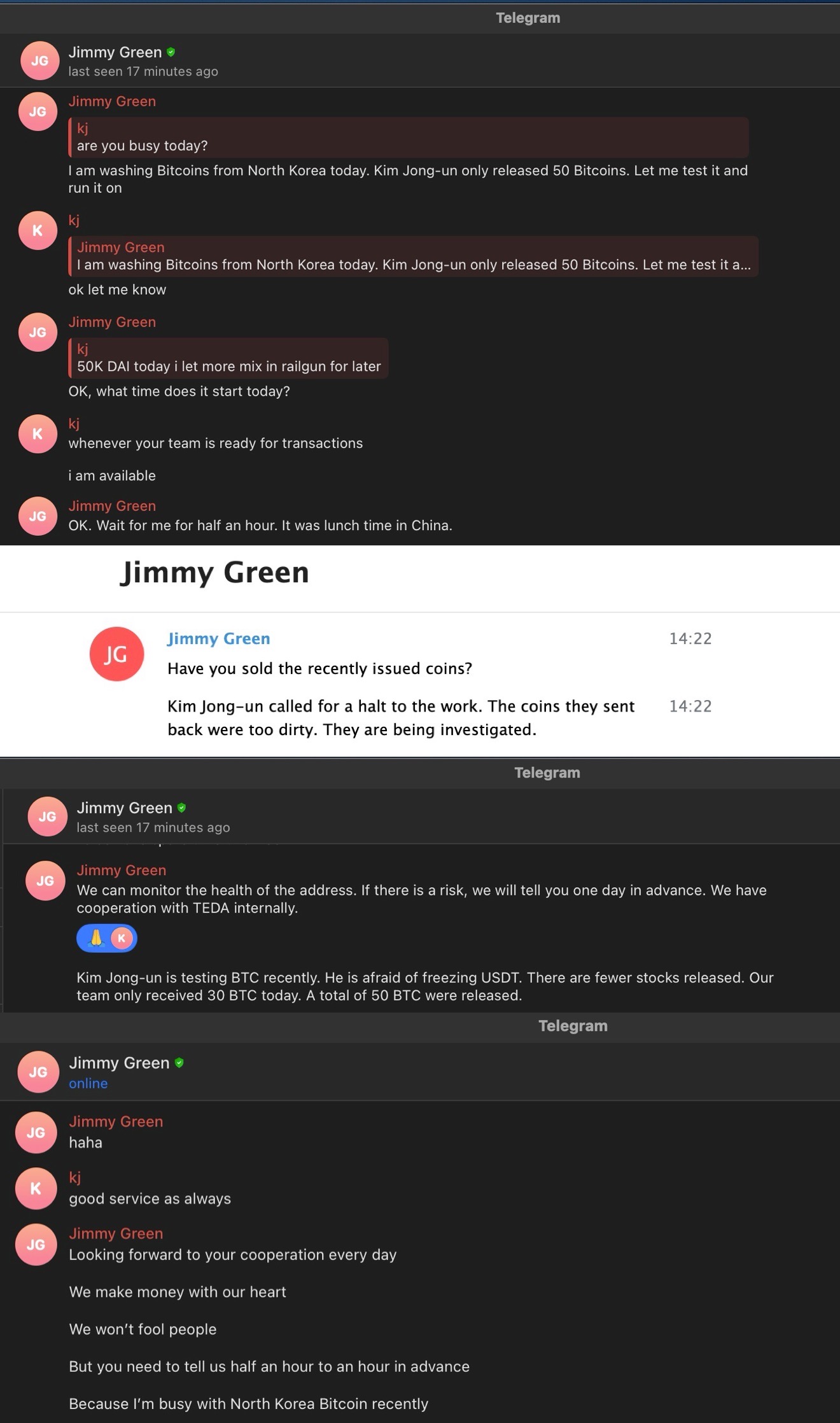
1/ How I infiltrated a Chinese organized crime syndicate that has laundered $1B+ across multiple exploits for Lazarus Group.
Posing as a client, I gathered intel that helped action freezes for the Feb 2025 Bybit exploit and attribute illicit activity onchain.



baas retweeted

How I Could've Accessed 17 Trillion Microsoft Records
blog.faav.net/how-i-couldve-… :)

baas retweeted

🚨BREAKING: @Solana has flipped @RobinhoodApp to become the No. 1 chain for tokenized commodities spot DEX volume, with a 45% market share.
Just three weeks ago, Solana held only 1% of the market.


