

@devopsfortunato
Account based inSwitzerland
About this account
- Account based in
- Switzerland
- Connected via
- Italy App Store
Account-level information from X, not a live location or the device used for a specific post.
DevSecOps engineer · Kubernetes (CKA/CKAD/KCSA) Local AI on a DGX Spark: benchmarks, recipes, breakages Open to work & collabs · 🇮🇹 in 🇨🇭
Joined November 2022
- Tweets435
- Following532
- Followers152
- Likes968







Pinned Tweet
Seven AI models. One DGX Spark. One local workspace. 🔥
Sparkfire puts a full AI suite on your own NVIDIA DGX Spark: read documents, transcribe recordings, translate, generate images, make videos with
sound, sing songs from your lyrics, build mind maps, and chat about all of it with web search. Everything runs locally, side by side, behind one interface.
𝗪𝗵𝗮𝘁 𝗿𝘂𝗻𝘀 𝗼𝗻 𝗼𝗻𝗲 𝗦𝗽𝗮𝗿𝗸 👇
💬 Chat, mind maps, web search · Saluki 27B · 12.7 GiB
📄 Read documents (OCR) · PaddleOCR-VL-1.6 · 5.4 GiB
🎙 Transcription + subtitles · Parakeet-TDT-0.6B-v3 · 1.5 GiB
🌍 Translation, 38 languages · Hy-MT2-1.8B-FP8 · 2.1 GiB
🖼 Image generation · Qwen-Image-2.1-Turbo · 17.5 GiB
🎬 Video with sound · FastH3 · loads on demand
🎵 Songs from your lyrics · YuE2-3B · loads on demand
🔎 Web search · SearXNG, running locally
Everything loaded and idle: 51 of 121 GiB. Video and music load when you use them.
𝗪𝗵𝘆 𝗼𝗻𝗲 𝘄𝗼𝗿𝗸𝘀𝗽𝗮𝗰𝗲
No juggling seven apps, seven interfaces and seven API bills. Every result is a plain file with its history, so one feeds the next: a scanned PDF becomes Markdown, then a translation, a mind map, a summary or a conversation. A generated image becomes the first frame of a video.
𝗪𝗵𝗮𝘁 𝗶𝘁 𝗱𝗼𝗲𝘀
📄 OCR that keeps headings, tables and reading order: 99.9% of words in order on a 20-page test, about 6 s a page
🎙 Transcripts with one line per sentence, SRT and WebVTT subtitles; click a line and the player jumps there
🌍 Translation as you type, or whole documents at once
🖼 Images in about 18 s at 1024×1024, about a minute at 2K, with legible lettering
🎬 5, 8 or 10 s videos with their own soundtrack; 5 s at 480p in about a minute
🎵 48 kHz stereo songs from your lyrics, with an editable score
💬 Chat with your PDFs, images and code, live reasoning, and answers that keep going when you close the tab
🔎 Web search with numbered sources
🔀 Workflows in a node editor, prompt presets, and a gallery with side-by-side compare
📱 Dark and light themes, and it works on your phone
𝗟𝗼𝗰𝗮𝗹 𝗯𝘆 𝗱𝗲𝘀𝗶𝗴𝗻
The models run on your Spark. Your files live in ordinary folders you can read, back up or move. No sign-up, no API keys, no per-token bill.
𝗚𝗲𝘁 𝗶𝘁 𝗿𝘂𝗻𝗻𝗶𝗻𝗴
git clone github.com/MovieMaker93/Spar…
./scripts/start-dgx-spark.sh --accept-model-licenses
A fresh install took 20 minutes and 106 GB of disk.
Open source (Apache 2.0). Sparkfire is a fork of @stevibe 's SparklingKit (github.com/stevibe/Sparkling…), now grown into its own project. Thankou, Steven 🙏
Model licenses apply: FastH3 isn't licensed in the EU, UK, South Korea or US (install with --video-backend none); Qwen-Image and YuE2 are non-commercial.
⭐ github.com/MovieMaker93/Spar…
Please @Zai_org, release GLM 5.5 Flash. I don't want a 3T model that a normal person can't even run.
Please don't leave us!!
𝗨𝗽𝗱𝗮𝘁𝗲 𝟮: 𝗳𝗶𝘃𝗲 𝘄𝗮𝘆𝘀 𝘁𝗼 𝘀𝗲𝗿𝘃𝗲 𝗤𝘄𝗲𝗻𝟯.𝟴-𝗙𝗹𝗮𝘀𝗵-𝗡𝗲𝘅𝘁 𝗼𝗻 𝗼𝗻𝗲 𝗗𝗚𝗫 𝗦𝗽𝗮𝗿𝗸
Since my last article I added NVIDIA Flare (stock and patched) and @vr8vr8's @myllmbox recipe, and measured all five on the same box, back to back.
• myllmbox is the decode king: 136.9 t/s at 8 users, 86.5 t/s peak, best in six of seven decode rows
• Flare starts in 22 s and fits the most KV (2.06M tokens)
• My pinned vLLM default gives up some decode but keeps the top task scores: tool-eval 89-90, sixcat 92.1
I care about quality, so I'm keeping mine for my use case. For concurrent work, I highly recommend @vr8vr8's myllmbox recipe.
Full numbers and methods:
xitter.cf/devopsfortunato/status…
🤖 Made with AI


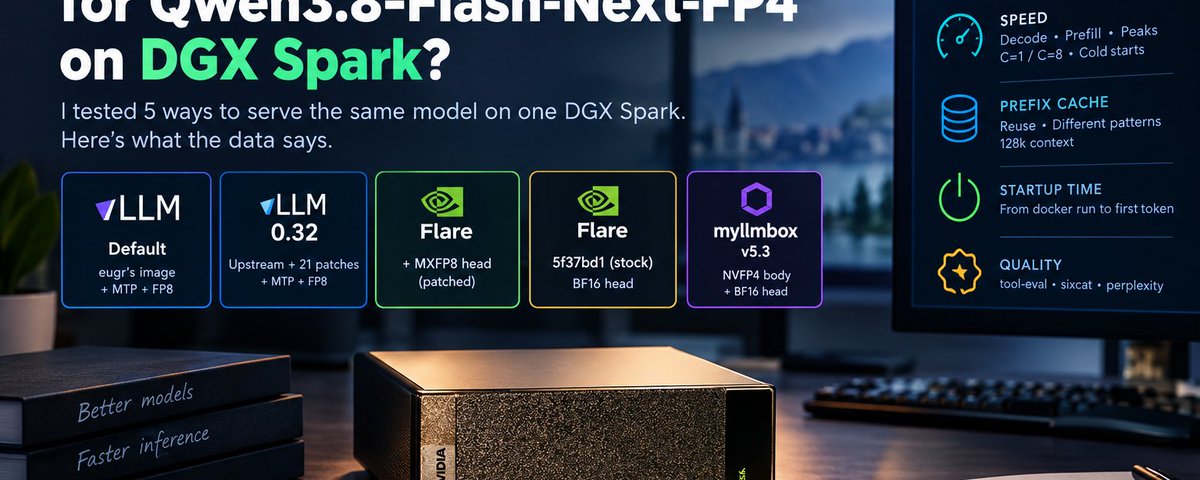
𝗠𝘆 𝗵𝗼𝗻𝗲𝘀𝘁 𝘁𝗮𝗸𝗲 𝗼𝗻 𝗡𝗩𝗜𝗗𝗜𝗔 𝗙𝗹𝗮𝗿𝗲
After a full benchmark on my DGX Spark serving Qwen3.8-Flash-Next.
Where Flare wins:
• Ready in 22 s (my recipe: 4 min)
• 31% more KV cache (2.06M vs 1.58M tokens)
Where it struggles:
• 8 users: 93 t/s total vs 130 (-28%)
• Re-send a 128k document with a new question: 61.6 s vs 4.0 s. Its prefix cache only saves state at message ends
• No greedy decoding: temperature 0 silently becomes 0.7, so evals run sampled
• Task scores: tool-eval 85-88 vs 89-90, sixcat 89.8 vs 92.1
• KV cache hard-wired to FP8, LM head precision fixed (an MXFP8 head took a local patch)
• No TP=3 support
• Every update is a full re-export: 25-35 min, ~100 GB
• Local packages need a signing key and two --dangerously-* flags
It's still immature. Some design choices are strange and disappointing: the prefix cache, the fixed head quant, the forced temperature. Promising startup and memory, but my default stays vLLM.
🤖 Made with AI


Really curious about this release.
One of the main uses of local AI is keeping sensitive data local. With this tiny speech model, you can transcribe meetings on any device you want.

Today we’re releasing Underdog Bark 3.0, the #1 frontier speech model
It's a tiny 163 MB download as accurate as NVIDIA’s Parakeet (15x bigger). It beats OpenAI's Whisper large-v3 (57x bigger)
It's fast- transcribes 1 min of audio in <0.25s on a Macbook. On recorded meetings (AMI), Bark 3.0 gets 7.82% of words wrong. Parakeet gets 9.42%. OpenAI's Whisper large-v3 gets 13.63% error rate
Bark runs on both your Laptop & Phone. It’s free and open source under CC-BY 4.0
Try private on-device meeting notes & dictation, powered by Bark, in Underdog today: underdog.ai/bark

21 seconds from start to serving: Qwen3.8 Flash Next on a single DGX Spark with @NVIDIAAI Flare.
vLLM took ~245 s for the same model.
Been testing Flare the whole day and the cold start really impressed me.
I believe the future of inference is engines tailored to specific models and architectures, and I think that's where NVIDIA and @deepseek_ai are heading.
Now squeezing as much as I can out of Flare to ship a dedicated Flare flavour of my Qwen3.8 Flash Next recipe. Still testing.
Stay tuned.
github.com/devopsfortunato/Q…


NVIDIA just released Flare, a local inference server built for DGX Spark and RTX Blackwell GPUs
- Built for long chats, agents and tool calls
- Serves from Rust, no Python
- Plans memory up front
- FP8 KV cache by default
Interesting timing... right around when DeepSeek open-sourced their inference engine.
Link below.

I hate speed claims so much. Quality should always be a top priority.
I also think most recipes deliberately hide the real speed numbers because most people only care about speed. So, claiming “C1 = 80 tokens/s” without specifying whether that’s for code or prose, or how heavily you quantized the KV cache, is criminal behaviour. 😂

The more I dig in the various inference engines out there, the more I see the shortcuts they take for speed.
Don't assume that model layers are mapped 1-1 into your engine, some are quantizing before running, 8bit and even 4bit.
I think I should post more on this, not to finger point anyone, but just to clarify that: more often than not, you bargain precision for speed. Kernel optimizations are great, but there is a physical limit (compute/memory bandwidth).
There is no free lunch 🤷🏻♂️
Really solid test.
While fine-tuning a small model, I quickly realized how deeply the harness affects the model, from tool calling to overall quality.
I think we should build a good benchmark that evaluates a model's overall performance across every possible harness.
PS: I'm using opencode with DeepSeek and it's working really well (opencode offers DeepSeek 4.1 Flash for free)

I repeated DeepSeek V4.1 Flash 1017 benchmark 89 times across 9 harnesses to understand which works best.
High effort, 5 attempts each:
Pi harness: 40.4
Grok Build CLI: 40.4
DeekSeek: 39.2
OpenCode 2.0: 38.6
OpenCode: 36.6
Claude Code: 36.4
Codex: 33.2
Hermes Agent: 32
Kilo Code: 31.8
Codex kept failing several times exceeding the allowed time per repo (3 hours) and was judged where it finished.
Based on what I tested, Pi, Grok Build CLI, and OpenCode 2.0 look like the strongest universal harnesses. This doesn't necessarily generalize.
A detailed table with every run in the response🧵

Love this acquisition
For me, the best use of AI is to reduce suffering and search for new cures.
Looking forward to this!

We’ve acquired Orchestra Bio, a platform that helps biopharma teams coordinate the complex process of drug development.
Together, we’ll build on Rosalind, our AI models and tools for life sciences research, to streamline those operations and help new treatments reach patients sooner.
Welcome @ashokaraj_ and team!
openai.com/index/openai-to-a…

Qwen3.8 Flash Next FP4 on one DGX Spark, same image:
• Prefill +4.5%: a 128k prompt now runs at 2,114 t/s, first token in 61.6 s (was 65.4), output bit-identical
• KV cache 1.37M → 1.58M tokens: 6 full 262k requests at once, up to 8 in parallel
This is the best quality recipe on a single Spark.
Next: working on adding an MTP vocabulary drafter to improve decode for specific languages, and dynamic MTP.
github.com/devopsfortunato/Q…
Even though it applies only to federal agencies, it’s a signal that the “AI war” has begun.
It’s only a matter of time before the US blocks Chinese AI models, and perhaps even restricts access to its own closed-source models.
Today, it’s more urgent than ever for Europe to wake up and build its own AI. We cannot rely on foreign countries to provide us with such a valuable strategic asset.
#EuropeWakeUp
Italians doing it better 🇮🇹💪🏻
If you want a Local AI super star to follow here he is @mudler_it 🚀 He is the creator of LocalAI project that has ONLY 50K stars on github.
Keep pushing Ettore!
Link: localai.io


Same. Free API for 3 days is nice, but the weights are what matter. If they land on the 23rd at Flash size, it goes straight onto the Spark for a test.
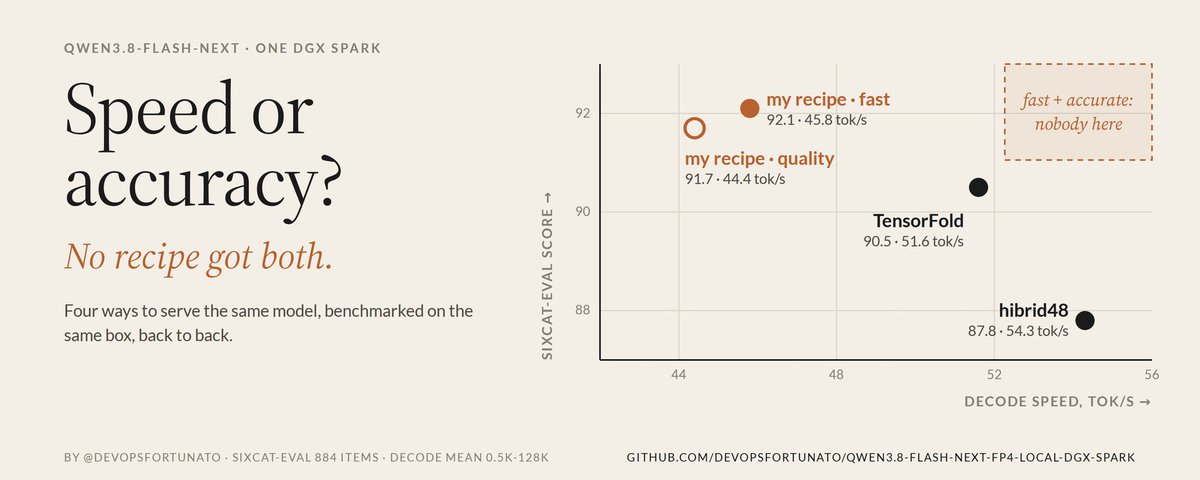
NVIDIA released a new quantization for Qwen3.8-Flash-Next (info: developer.nvidia.com/blog/ho…), so I spent two days looking for the best balance between quality and speed on my DGX Spark.
My rule: quality comes first. On a small model, output quality matters far more than raw speed numbers.
I tested my recipe against TensorFold by @MiaAI_lab and hibrid48 by @vr8vr8 / @myllmbox, the quality-focused option, using:
- tool-eval-bench by @SeraAndroid
- sixcat-eval by @ViC305
- llm_context_benchmarks by @ivanfioravanti, up to 128K tokens
The short version: answer quality is close. Speed, memory and structured output are not.
Full breakdown: xitter.cf/devopsfortunato/status…
I also released my recipe with two presets. Fast is the default. Quality improves output fidelity at the cost of some prefill speed.
github.com/devopsfortunato/Q…

you might be interested to see the results of the differente recipes @AgentSparko
Pre-bed reading.
NVIDIA does it again.
The FP4 is using quantization-aware distillation (QAD)
Read here: developer.nvidia.com/blog/ho…
Spent the day squeezing Qwen3.8-Flash-Next FP4 on one DGX Spark.
For me this is the best-quality quant of Qwen3.8-Flash-Next you can run on a single DGX Spark.
1M context, every needle found. Up to 1.7M tokens of KV cache. Tool calling holds at 91–92/100.
2M context test runs tonight.
Recipe update soon 👀
github.com/devopsfortunato/Q…