







ℤ∊ⓟℏ൮ṙ 🌬️🍃 retweeted

You’ve been warned.
$QNT


Decentralised oracles could lower manipulation in #DeFi but integrating trust in an inherently trustless system needs more than full decentralisation. Crypto-based #DeFi is likely to remain the preserve of cryptoassets, not real-world assets bis.org/publ/bisbull76.htm


ℤ∊ⓟℏ൮ṙ 🌬️🍃 retweeted
Read what Citigroup's report says 👇.
DTCC provides the asset leg (US Treasury), while The Clearing House provides the cash leg (tokenized deposits).
Remember that Quant provides the entire TCH infrastructure, so $QNT is the cash leg for the settlement of DTCC securities 🤯


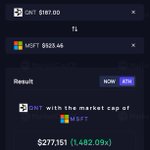
$QNT Overledger OS and Microsoft Windows $MSFT are fundamentally alike in three ways:
• Abstraction:
Both hide massive underlying complexity. Windows shields developers from handling raw computer hardware; Overledger shields them from handling different blockchain code languages.
• Standardized APIs:
Both provide a uniform toolkit. Windows gives developers standard commands to save files or print; Overledger gives them a single API gateway to read and write data across completely different networks.
• Application Platforms:
Both exist to host ecosystems. Windows is the foundation for traditional apps (like Office); Overledger is the foundation for multi-chain applications (mApps).
So, the question remains.
Could $QNT achieve the same level of global adoption that Microsoft currently has in place?
I guess time will tell.
I'm here for it.


$QNT is quietly becoming the universal translator that could stitch together every blockchain, bank ledger, and central bank digital currency into one seamless global financial nervous system.
If that connective tissue locks in as the default infrastructure for the multi-trillion-dollar tokenized economy, network effects and enterprise lock-in could catapult it into the exclusive club of trillion-dollar companies the way TCP/IP once defined the internet itself.

ℤ∊ⓟℏ൮ṙ 🌬️🍃 retweeted
The Quant x The Clearing House hints have been there since the beginning.
ethereum:0x4a220e6096b25eadb88358cb44068a3248254675


ℤ∊ⓟℏ൮ṙ 🌬️🍃 retweeted

According to RBC Capital Markets, SpaceX could acquire Tesla in an all-stock deal valued at $480 per share, creating a combined company worth $3.74 trillion 🔥
Under the hypothetical buyout, $TSLA investors would receive roughly three SpaceX shares for each share they own, securing a 30% premium paid entirely in equity 🔥
That swap would give Tesla shareholders a 48% ownership stake in the merged giant, down from the 54% RBC calculated in July despite the offer price remaining unchanged. The ultimate payout and ratio would still hinge on prevailing market prices and finalized agreement terms 🔥


ℤ∊ⓟℏ൮ṙ 🌬️🍃 retweeted

Tesla and SpaceX are currently worth $3.7 trillion combined.
In a merger, there is no doubt the company will become the most valuable in the world.

ℤ∊ⓟℏ൮ṙ 🌬️🍃 retweeted

JUST IN: Elon Musk says SpaceX $SPCX could generate $1 trillion in annual revenue by the end of 2027.


They will keep raising their target.
There is no ceiling.
Understand this.
$SPCX

BREAKING: JPMorgan more than doubles SpaceX price target to $500.
J.P. Morgan raised its December 2027 price target from $240 to $500 following Q3 2026 earnings, maintaining its Overweight rating.
Here’s the full breakdown of the note:
• AI computing capacity: SpaceX ended Q3 with 1.7 GW, expects 2.2 GW by late October and targets 2.5–3.0 GW by year-end. J.P. Morgan models 2.8 GW.
• GPU deployment: SpaceX is adding roughly 200,000 GPUs per month, or approximately 600,000 during Q4, with each drawing around 2 kW.
• Bigger 2027 ambitions: Management expects to add approximately 10 GW of computing capacity next year, reaching around 13 GW by year-end, above earlier expectations of 5–10 GW. J.P. Morgan takes a more conservative view at 10.1 GW.
• Power and cooling: SpaceX targets 20 GW of supporting infrastructure by the end of 2027.
• Rocket engineering meets energy: SpaceX is using its rocket metallurgy and casting capabilities to manufacture gas-turbine blades and vanes in-house, helping bypass industry supply delays of 12–18 months.
• Faster data center construction: The company is pursuing prefabricated computing, power and cooling units, alongside solar and wind projects.
• Starlink keeps growing: Consumer subscribers reached 13.6 million, adding 1.6 million during the quarter. Average monthly revenue per consumer increased approximately 5% to $69.
• Starlink Mobile: An early 2028 launch remains on schedule, supported by the agreement to acquire Grain’s spectrum in the 800 MHz band, alongside EchoStar’s S-band licenses.
• Mobile network strategy: The design expects 85–93% of traffic to use Wi-Fi, supplemented by compact radios at existing subscriber sites that connect through satellites. J.P. Morgan believes conventional cell towers will eventually be needed to compete directly with established carriers.
• Starship’s next milestone: SpaceX plans to attempt tower catches of both Super Heavy and the upper-stage Ship. After three successful booster catches, catching Ship would be a historic first and a critical step toward full vehicle reusability.
• Potential Tesla combination: Special committees at both companies are evaluating a possible business combination. Terafab, Megapack deployments and shared AI engineering provide existing connections.
• Merger hurdles: J.P. Morgan highlights regulatory approval and Tesla shareholder approval as major challenges, particularly given Tesla’s wholly owned manufacturing operations in China and SpaceX’s U.S. defense ties.
• Investment is accelerating: Q4 capital spending guidance increased to $35–$40 billion, compared with J.P. Morgan’s previous $19 billion estimate. The note puts full-year 2026 spending at $87.2 billion and models $294.6 billion for 2027.
• Funding the expansion: Management says it is not considering raising public equity. Funding is expected to come from substantial available borrowing facilities and growing operating cash flow.
• Cash flow outlook: J.P. Morgan forecasts operating cash flow of $38.9 billion in 2026, $213 billion in 2027 and $358 billion in 2028.
• Valuation: The $500 target reflects roughly 20 times J.P. Morgan’s projected 2028 GAAP earnings of $24.41 per share.

