

✝️ Adopted 🍰 Muchos RTs, mi TL es una “Repostería”
Colombia
Joined June 2010
- Tweets6.3K
- Following527
- Followers907
- Likes1.4K






Pinned Tweet
Hago parte del 𝟲𝟮% 𝗱𝗲 𝗰𝗶𝘂𝗱𝗮𝗱𝗮𝗻𝗼𝘀 que todavía no sabe por quién votar, según una medición de Cifras y Conceptos publicada a finales de 2025. Por eso asistí con interés al panel «PresidencIA»... medium.com/el-pipenillo/13m-…

28
Felipe Peña 🥒 retweeted

Un investigador de Anthropic acaba de decirle a una sala llena de doctorandos que su plan de carrera ya no existe.
La charla se titula "El fin del Antropoceno" y los datos son brutales:
→ El cómputo para entrenar modelos se multiplicó por 10 millones en la última década
→ La duración de las tareas que una IA completa sola se duplica cada pocos meses
→ Desde hace 7 meses los modelos resuelven problemas abiertos de Erdős que los matemáticos no habían logrado cerrar
→ En San Francisco, tener "timelines largos" significa pensar que la AGI llega en 10 años
Su proyección: el cómputo de 2030 será 10.000 veces mayor que el de 2025.
Todavía estamos al principio de la exponencial.
Sus 3 consejos para los estudiantes:
1. Usa la IA cada día. Si estás sobre la exponencial, nunca te quedas atrás de ella.
2. Elige proyectos que mejoren cuando el cómputo escala. El resto quedará resuelto antes de que los termines.
3. Deja de planificar tu carrera como si fuera estable. La opción segura ya no compra seguridad, ya no existe.
Y una frase que resume todo:
"Escribir es pensar. Si externalizas tu escritura, externalizas tu pensamiento."
La charla completa aquí ⬇️
Felipe Peña 🥒 retweeted

A CS undergrad asked me where he could have most effect in the AI age. I said probably at either extreme: either close to the technology, actually making LLMs, or close to the customer, using AI to give them exactly what they want. Or maybe both if you can stretch that far.
Felipe Peña 🥒 retweeted

a researcher told me why he abandoned his second brain after six months. “the more i added, the more i had to maintain. it became a second job.”
he is not the exception. he is the rule.
90% of personal wikis are abandoned within three months. not because people lose motivation. because the system breaks them.
there is a turning point that happens to every second brain. maintenance cost crosses value. you spend more time filing than thinking. more time updating than using. the library gets bigger and slower at the same time.
the compiler architecture flips this.
raw holds the source materials. unstructured. immutable. ground truth. wiki is where the model converts everything in raw into structured, linked, evergreen knowledge. the human reads it. the model writes it. output is where finished work lands. built from compiled knowledge, not from memory.
at the center: CLAUDE.md. identity, preferences, goals, project context. the model reads it before every session. automatically. you never explain yourself again.
the loop closes through update. every new source gets ingested, compiled, linked, and integrated. the system improves with every cycle automatically.
five automations run the whole thing. ingest captures and extracts. write retrieves and drafts. manage links decisions to context. review summarizes and reflects. maintain prunes and improves.
the researcher who abandoned his second brain was doing all of this by hand. every link. every tag. every update. every contradiction check.
the compiler does it for him now.
retrieval answers questions. compilation builds understanding.


Felipe Peña 🥒 retweeted
How Universities Should Prepare Founders: paulgraham.com/prepare.html
Felipe Peña 🥒 retweeted

Bertrand Russel's ten commandments of critical thinking themarginalian.org/2012/05/0…


Felipe Peña 🥒 retweeted

YOU CAN BUILD AN AI SECOND BRAIN IN 15 MINUTES.
No coding experience. No $1000 course.
Here is the entire setup.
Step 1: Download Claude Desktop.
Step 2: Download Obsidian.
Step 3: Create a new vault and start dropping .MD files into it.
Step 4: Tell Claude Code to connect to your vault using Karpathy's prompt: gist.github.com/karpathy/442…
That is it.
Your entire knowledge base becomes searchable, connectable, and queryable by the most powerful AI model on earth.
Every note you have ever written.
Every idea you have ever captured.
Every resource you have ever saved.
Claude reads all of it, finds connections you missed, and surfaces insights from your own thinking that you FORGOT you had.
Most people use Claude as a search engine.
The people building second brains use it as an INTELLIGENCE LAYER on top of everything they know.
That gap is the gap between asking Google a question and having a research partner who has read everything you have ever written.
Bookmark this.
Build it tonight. Follow @cyrilXBT


Felipe Peña 🥒 retweeted

Andrej Karpathy just explained the 5 shifts turning LLMs into agentic systems.
00:00 - Memory turns chat into personal AI
06:41 - Multimodal AI reads the world
16:58 - Thinking models solve harder tasks
24:51 - Search makes LLMs live
30:58 - Tools turn LLMs into workers
Most people are still treating LLMs like chatbots.
Karpathy is showing the full stack:
Memory → Vision → Reasoning → Search → Tools
Prompting is the old workflow.
Agentic systems are the new one.
This 40-minute talk is worth more than most paid AI agent courses.
Bookmark and watch it before everyone catches up.
Then read how to turn LLMs into self-improving agent loops below


Felipe Peña 🥒 retweeted
An Anthropic engineer shared the exact system they use as a second brain.
Three folders. One file. One evening to build.
Most people use Claude the same way every day. Open a new tab. Rebuild context. Get an answer. Close the tab. Tomorrow it remembers nothing. You are still the one holding all the context. You are still the one resetting.
This architecture solves that problem.
The system is built around three folders and one file.
raw/ holds everything unstructured. Articles, transcripts, PDFs, voice memos, screenshots. Drop it in and never touch it again. Immutable ground truth.
wiki/ is where Claude converts everything in raw into structured, linked, cross-referenced knowledge. Clean. Organized. This is the folder Claude actually thinks from. The human reads it. The model writes it.
output/ is where finished work lands. Reports, posts, documents, presentations. Everything Claude builds using the wiki as its source.
At the center is CLAUDE.md. Not a prompt, but a persistent layer of identity, preferences, goals, and project context. Claude reads it before every session. You never explain yourself again.
Five automations run the system.
Ingest captures and extracts new sources into the wiki. Write retrieves context and drafts outputs. Manage links decisions to context. Review summarizes and updates. Maintain prunes and improves connections.
Every session adds to the system. Every source makes the wiki smarter. The returns compound over time.
One month in, context stops disappearing. Three months in, the vault surfaces ideas you forgot you had. Six months in, the gap between compounding and resetting becomes impossible to ignore.
Build once. Maintain daily. Let it compound.
Bookmark this.


Felipe Peña 🥒 retweeted

Claude Shannon, a juggler, a tinkerer, the Einstein of communications - the man is an inspiration on how to live a life full of curiosity.
Reading this #book, it’s clear that Claude never boxed himself into a category. He will build things with his hands, prove theorems, and dream of a future (full of AIs and robots).
When a journalist asked about his secret for living an easy life, he replied: “I don’t care for being useful. I do whatever comes naturally to me”.
This modest attitude from someone who dropped the bombshell that information theory is unmatched against other scientific giants who took themselves way too seriously.
Read the biography. It’s a detailed glimpse into his inspiring attitude towards life.

Felipe Peña 🥒 retweeted

Don't waste 2 years learning to become an AI agentic engineer in 2026.
Andrew Ng, the godfather of AI, gave the complete playbook to become one from scratch.
1 hour course. Free:
• 00:00 - AI agent basics
• 12:12 - AI Agentic workflows & design patterns
• 53:27 - Practical tips for building AI agents
• 1:20:30 - self-improving AI agent loops
• 1:30:19 - multi-agent AI systems
I watched it last night.
Halfway through, I realized I could get into Anthropic in weeks, not years.
Bookmark now. Watch it. Then build your own AI agent with the guide below.


Felipe Peña 🥒 retweeted

The point of a startup is to make usable technology for others. When you make software, you have to watch at least 10 people use it. Sit next to them and say absolutely nothing. Force yourself to marinate in the failure of your product design.
Every version 1 of any software will be absolutely destroyed by first interaction with users. You need to watch your new creation be absolutely misunderstood by users to reform version 1 into the one that actually works.
There is only one path: figuring out where the sharp edges, the places people get caught, the assumptions you make as a builder that turn out to be wrong, and then relentlessly sanding it down so that anyone can use it.
That is good design. That is the key to a good product. There is no shortcut for this.
WATCH USERS AND CRINGE AND THEN FIX IT.
SAND DOWN THE EDGES.
Felipe Peña 🥒 retweeted

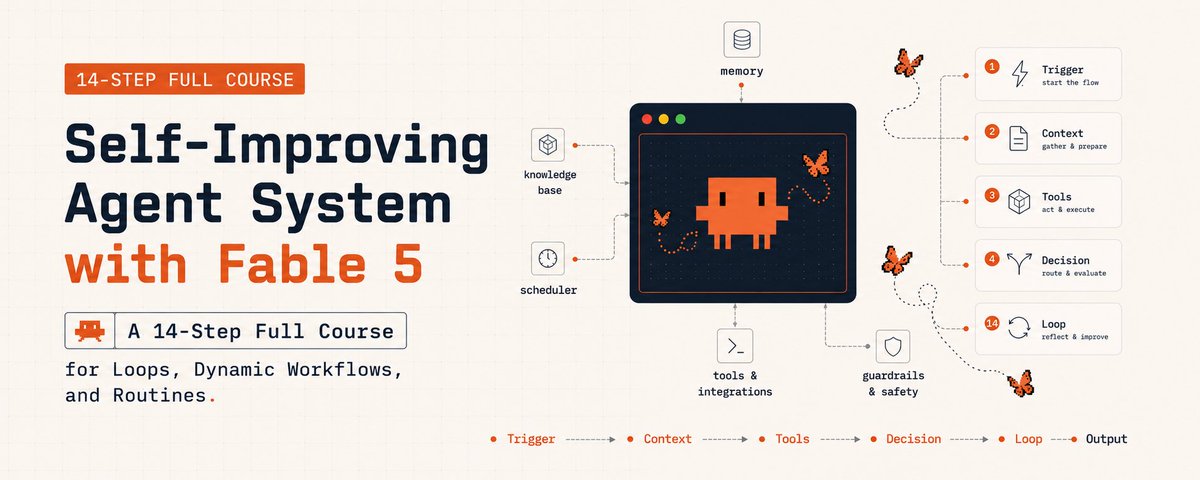
Andrew Ng just dropped a 3-hour course on how to become an AI Engineer in 2026:
• 00:00 - How to build agentic AI systems
• 04:25 - Future of AI engineering
• 23:38 - AI Prompting full course
• 2:52:17 - Creating an app with AI in 30 minutes
This 3-hour watch could replace 10 AI engineering courses on the internet.
Watch it today, then read how to run a self-improving system in the article below.

Felipe Peña 🥒 retweeted

“Loop engineering” is a hot buzzphrase after mentions of it by Boris Cherny (Claude Code’s creator) and Peter Steinberger (OpenClaw's creator) went viral on social media. Loops are now a key part of how we get AI agents to iterate at length to build software. In this letter, I’d like to share my 3 key loops, shown in the image below, for building 0-to-1 products. These loops guide not just how I build software, but also how I decide what software to build.
Agentic coding loop: Given a product specification and optionally a set of evals (that is, a dataset against which to measure performance), we can have an AI agent write code, test its work, and keep iterating until the code is bug-free and meets its specification. This idea of closing the loop took off around the end of last year, and it has been a game changer in enabling coding agents to work longer productively without human intervention. For example, over the weekend, I was building an app for my daughter to practice typing, and my coding agent could easily work for around an hour, using a web browser to check what it had built multiple times before getting back to me, without needing my intervention.
The engineering loop executes quickly. Every few minutes, the coding agent might build and test a new version of the software. I hear frequently from developers who are finding new ways to engineer more effective engineering loops. This is an active area of invention!
Developer feedback loop: In this loop, a developer examines the current product and steers the coding agent to improve it. Last year, a lot of developers (including me) were acting as the QA (quality assurance) function for our coding agents, manually finding bugs and then asking the agent to fix them. But with coding agents much more able to test their own code, the amount of time we need to spend on this function has decreased significantly. This allows us to make higher-level product decisions, such as what key features to offer, where the UI needs improvement, and so on.
The developer-feedback loop operates over time intervals between tens of minutes and hours — that's how frequently a developer might review a product and give feedback. In the case of the typing app, I changed my mind a few times about the visual design, what cat costumes she can unlock as she learns (she loves cats), and the user flow for a grown-up to log in and steer the child's learning experience.
When a developer has a clear vision for what to build, it is still a lot of work to translate that vision into a specification for a coding agent to implement. Further, after the developer has seen an implementation, they might update (or perhaps clarify) the spec to steer it toward what they want. If you find that the system repeatedly runs into certain problems, building a set of evals for the agent becomes useful.
AI-native teams are increasingly using AI to help shape product direction, for example, automating the gathering and analysis of usage data, summarizing written and verbal customer feedback, or carrying out competitive analysis. However, for pretty much all the products I’m involved in, I see humans as having a significant context advantage over current AI systems — we know a lot more than the AI system about the users and the context the product has to operate in — and thus humans play a critical role. Many people describe this human contribution as “taste,” but I prefer to think of it as humans having a context advantage, since that gives us a clearer path to helping AI systems get better. This also speaks to why this step can’t be automated: So long as the human knows something the AI does not, human-in-the-loop is needed to to inject that knowledge into the system.
External feedback loop: This includes a wide range of tactics like asking a few friends for feedback, launching to alpha testers, or putting the code into production with A/B testing. These tactics are usually slow, rarely taking less than hours and sometimes taking days or even weeks. This data informs the developer vision, which in turn continues to drive the detailed product spec, which in turn drives the coding agent.
With coding agents speeding up software development, more engineers are starting to play a partial product management role. For many engineers who are growing into this role, the hardest part is shaping the product vision and striking a balance between building (bridging the gap between vision and spec) and getting user feedback to evolve the vision. It is important to do both!
I will write more about how to do this in future posts, but for now, I find it encouraging that engineers are playing an expanded role (just as product managers and designers now do more engineering).
[Original text: The Batch]


Felipe Peña 🥒 retweeted

Head of Engineering Shopify:
"AI writes the code, AI reviews the code. Your job is just to write the loops around it."
26 minutes on how AI changed the way 3,000 engineers work inside a single company.
Ignoring it while everyone else uses AI to do more is the fastest way to fall behind.
Watch it, then read the step by step guide on loops below.


Felipe Peña 🥒 retweeted

Karpathy just wrote the manual for Claude + Obsidian as a real second brain.
Most vaults die the same way. A year of saved articles and highlights. None of it linked. The graph rots while it still looks impressive.
So he moved the upkeep to the model. You curate sources and ask questions. Claude files, links, and reconciles. You keep judgment. It keeps the books.
raw belongs to you and never gets edited. wiki belongs to Claude. It isn't RAG. Your sources compile once into linked pages and compound from there.
9 rules. Start with 10 sources, not 10,000.
Most people hoard notes. This turns them into a brain that maintains itself.


Felipe Peña 🥒 retweeted

Google CEO, Sundar Pichai:
"If you don't learn to how to orchestrate agents now, you'll spend 2027 catching up to people who started today"
In 30 minutes he explains why the best engineers stopped writing code and started running agents.
Watch the interview, then save the exact setup below 👇

