


Aditya Pachwaria retweeted

A Stanford professor took two average stocks, rebalanced them daily, and turned $100,000 into $7 million without predicting a single price.
Bookmark & watch today, no matter what.
Readers added context they thought people might want to know
Thomas Cover's example used two specific volatile stocks; the ~$7M from $100k is the best hindsight constant-rebalanced return on 1963-1985 data, not his causal universal portfolio's result.
youtube.com/watch?v=wsd8ns…
gwern.net/doc/statistics…


Aditya Pachwaria retweeted

In 1986 a guy got kicked out of every casino in Vegas for counting cards. So he flew to Hong Kong with $180,000 and started betting on horses instead. He walked away with almost $900 million.
It's Bill Benter. He figured horse racing was just another counting problem. Same math, more moving parts.
He and a partner showed up with $180k and a computer. Benter spent years teaching that computer to guess one thing, the real chance each horse had to win. If his number was better than the odds the bookies gave, he bet. If not, he skipped it.
That's the whole trick. Expected value.
EV = p · b − (1 − p)
Only bet when your win chance p, at odds b, is worth more than your chance of losing.
This recording was never meant to be some hidden gem. Nobody expected Professor Tsitsiklis to hand the whole foundation away in 45 minutes, but that's exactly what happens on the board. Students in that room pay over $80,000 a year to sit through it. It's free right here. It's free right here.
Every quant, every professional bettor, every hedge fund analyst started with this exact hour. Benter just watched it and actually did the homework.
Almost nobody knows this lecture even exists. Watch it before it gets taken down.
The answer is in this video.
Readers added context they thought people might want to know
The video shows basic introductory probability concepts from a publicly available MIT lecture recorded long after Benter's work. Benter developed sophisticated models based on specific 1980s academic papers, large datasets, and custom programming—not EV from this class.
en.wikipedia.org/wiki/Bill_Bent… bloomberg.com/news/features/… ocw.mit.edu/courses/6-041s…
Aditya Pachwaria retweeted

A dead MIT professor accidentally destroyed the $20 billion executive coaching industry with one hour of lecture, and ten million people have already watched him do it.
He filmed it once in January 2018 and died eighteen months later.
Executive coaches charge fifteen thousand dollars a session to teach a third of what he covered in that one hour for free.
His name was Patrick Winston. He ran the MIT Artificial Intelligence Laboratory from 1972 to 1997 and wrote the AI textbook every computer science major in the world read for thirty years.
Every January for four decades, he gave a lecture called "How to Speak."
His entire framework fits on a napkin.
Do not read. Be in the image. Keep images simple. Eliminate clutter. Start with an empathetic connection. End with a punch line the audience can repeat over dinner. Never open with a joke. Never end with "thank you."
That last rule alone has probably cost the executive coaching industry a hundred million dollars.
"Your success in life will be determined largely by your ability to speak, your ability to write, and the quality of your ideas. In that order."
That is the actual opening line of the lecture. Winston believed it strongly enough to spend fifty years teaching computer scientists how to talk.
Founders spend $80,000 on an MBA and then hire a communications coach to teach them the same material Winston filmed once for free. Engineers write brilliant code and lose promotions to teammates who watched this lecture on the train.
The lecture is free on MIT OpenCourseWare. The textbook is free on his page.
Winston died in 2019. Almost none of the ten million viewers have actually implemented the four rules on the napkin.
The napkin is free. The willingness to actually use it in your next meeting is the entire edge.


Aditya Pachwaria retweeted

Manipulations during CAS. SEBI investigates but will it find anything?
Does it even matter?
The regulator shall see what ought to be. Looking in the wrong direction here?
Aditya Pachwaria retweeted

Sharing my views on how CAS is impacting option traders.
From indicative prices and spoofing risk to sudden premium resets and execution disadvantages.
Would be interested to hear from traders who have experienced these issues firsthand.
Aditya Pachwaria retweeted

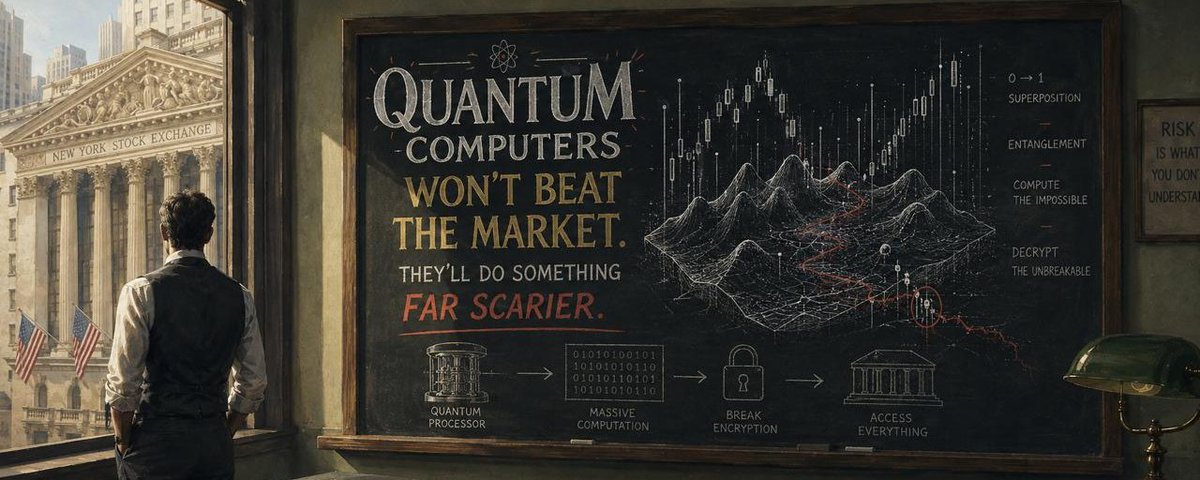
A single particle can be in two places at once.
Not a metaphor. The actual fact the entire quantum machine is built on.
Leonard Susskind stood at a Stanford chalkboard and spent 96 minutes on it. 1.4 million people watched. Almost nobody connected it to their money.
So connect it.
That same strangeness, one system holding many states at once, is how a quantum computer tests every factor of a number in a single shot.
And factoring one number is the only thing standing between a stranger and every bank account on earth.
RSA locks all of it. Easy to multiply two primes. Impossible to pull them apart. Until a machine that walks every path at once turns impossible into an afternoon.
Superposition is not a party trick. It is the crowbar.
Susskind hands you the physics for free. Funds pay $400K for people who understand it. Wall Street is already tearing out its locks because of it.
1.4 million saw the lecture. The ones copying your encrypted data right now were just the few who understood what it meant.

Aditya Pachwaria retweeted
David Jerison, the mathematician who spent decades teaching the exact method for finding the optimal choice when the odds are stacked against you:
"I used to think the best decision was whichever option looked strongest at first glance. Then I proved that the real answer almost always hides at a point nobody would guess just by looking, and checking only the obvious choices gets you the worst possible outcome, not the best."
this is the exact method quant desks lean on to find the one allocation that survives every constraint thrown at it, and it's been sitting free in a public MIT lecture for almost twenty years.
strip away the notation and the mechanism is simple. every optimization problem has a handful of candidate points where the best or worst answer could be hiding, and the obvious middle-of-the-road guess is almost never one of them.
check only the points that feel natural, and you don't just miss the best answer. you can land on the exact opposite, the worst possible one, without ever realizing it.
nobody presenting a "risk-optimized" portfolio out loud admits how easy it is to stop checking one step too early.
zoom out to how this plays out sizing a position or allocating risk under real constraints today. the instinct is to test the option that feels balanced and call it done, when the actual edge is almost always sitting at an extreme nobody thought to check.
the industry sells a clean, confident number as proof an allocation is optimal. but that number means nothing until every boundary has been checked, because the same method that finds the best case can just as easily hand you the worst one in disguise.
the right answer was never the one that looked most reasonable. it was the one nobody bothered to check.

Aditya Pachwaria retweeted

An Indian physicist put the entire secret behind Renaissance's $100 billion on one chalkboard: a coin that barely beats 50/50.
he is V. Balakrishnan, and his lecture went viral years after he recorded it. it has been free the whole time. almost nobody who trades has watched it.
lecture one is the humblest thing in all of finance. a coin that lands your way a little more than half the time. that is the entire edge. that is all Renaissance ever had.
the post above is the one equation for what to do with that coin. not what to bet. how much. bet too little and you die of old age. bet too much and one flip ends you.
that same coin is every trade, every hand, every prediction market. a tiny edge, flipped a million times. the whole machine fits on his board, and he charged nothing for it.
no slides. no notes. one coin and a stick of chalk.
a quant I know says this old Indian lecture taught him probability better than his entire degree.
the coin is free. the equation is free. the discipline to size it is the only thing left to earn.


Aditya Pachwaria retweeted
Aditya Pachwaria retweeted
Traders: If CAS has affected your trading, please take two minutes to fill out this form.
forms.gle/wEWJMJrWZo5uYppx8
You can share how it has impacted your trading, especially options trading and suggest practical solutions, if any.
Please keep your feedback respectful, factual and free from derogatory language.
