Gaál Sándor (@gmac4247) header
Gaál Sándor (@gmac4247) profile picture

Live to win

Szentendre
Joined July 2020
Photo by Gaál Sándor (@gmac4247)Photo by Gaál Sándor (@gmac4247)Photo by Gaál Sándor (@gmac4247)Photo by Gaál Sándor (@gmac4247)Photo by Gaál Sándor (@gmac4247)Photo by Gaál Sándor (@gmac4247)Photo by Gaál Sándor (@gmac4247)Photo by Gaál Sándor (@gmac4247)Photo by Gaál Sándor (@gmac4247)Photo by Gaál Sándor (@gmac4247)
I have to set the record straight regarding an important detail. It doesn't fit into a single post, so it will be a short thread. It's a recurring issue, that some claim that I claim "pi=3.2". That is false. It's the same with the Indiana Pi Bill. ...
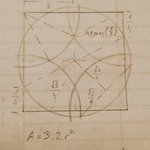
3.2radius² is the exact area of a circle. From that 3.2diameter is the exact circumference. Confirmed via measurements. The wise insist that can't be, because their theoretical circumscribed polygon limits it to about 3.14. Their polygon is not as circumscribed as they think.
1
1
1
13
I got the focus messed up when I wrote that. The issue is that the Hungarian — my native language — word for the tangent line already suggests single-point tangency. It's that bad. The English word tangent is fine. The concept of single-point tangency is fundamentally wrong.
Replying to @gmac4247
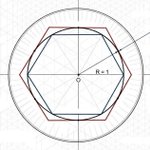
Mainstream geometry insists that a tangent line can always be drawn. A tangent line coincides with a circle only at a single point. Yet, when attempting to circumscribe a 24-sided polygon about a circle, each side coincides with the arc along a significant section.
2
11
Angolul "tangent line", ami magyarul "érintô". Az találó, mert ha osztom egy kör sugarát cos(x)-szel, egy sokszög átlójának a felét kapom. Azt szorzom sin(x)-szel — mint ha egy nagyobb kör sugara lenne —, egy érintô szakasz felét kapom. Sin / cos = tan.
1
11
Ôk is egy pontos érintésben gondolkodnak, de a "tangent" elnevezés egy valós tulajdonságból ered. Szóval a magyar "érintô" kifejezés eredendôen hibás, mert a téves egy pontos érintés elméletén alapszik. Közben valójában több pontos átfedés, illetve szelés van.
7
The shape of the arc doesn't enable a single-point coincidence with a tangent line. Yet, it became a fundamental conventional concept so badly, that the Hungarian word for the tangent line reflects the single-point condition rather than the tangent property.
1
7
That becomes critical in the definition of circumscribed polygons that rely on it entirely. All those different concepts and conditions woven into the definitions make communicating them properly quite challenging for me. Basically, I'm replacing invalid concepts with valid ones.
5
So, what the mathematical constant pi really stands for is the expression n×sin(180°/n)<pi<n×tan(180°/n). With n approaching infinity, that is 3.14... But that is not the true circumference to diameter ratio; it's just a failed approximate of it. ... nitter.gq/BasicGeometry/status/2…
Replying to @gmac4247
Mainstream geometry insists that a tangent line can always be drawn. A tangent line coincides with a circle only at a single point. Yet, when attempting to circumscribe a 24-sided polygon about a circle, each side coincides with the arc along a significant section.
1
1
7
That is why the pi is not — and never will be — 3.2. And that's why the pi shall never be associated with the properties of a circle. Denoting the circumference to diameter ratio as pi is just a bad convention by extremists who pretend to be much smarter than they actually are.
3
Don't fall for this type of fraud. The true volume of a sphere equals the cubic value of the square root of its cross-sectional area — just like a cube —, which is about a third larger than the result of this worthless, primitive, exaggerated approximate. Measure it.
The sphere’s true volume is revealed by what remains after the cones are removed. Every horizontal slice of the sphere is a disk of radius √(r² − z²). The cylinder with its double cone subtracted leaves an annulus of outer radius r and inner radius |z|. Both areas equal π(r² − z²). Cavalieri’s principle therefore equates the volumes. Subtract the two cones from the cylinder: 2πr³ − 2·(⅓πr³) = ⁴⁄₃πr³. The sphere occupies exactly two-thirds of its enclosing cylinder. Geometry finds equality in the slices we choose to compare.
1
1
7
I still can't find any video proving that Archimedian "V=r³4pi/3" formula. Can you? Of course you can't, because it's about one third off. Measure it and see for yourself. nitter.gq/gmac4247/status/192125…
12
I got this latest addition wrong last week. - I confused tangent with sine, and - I calculated the left side on the double. That was presented inaccurately for almost a week. I'm sorry about that. I wanted to get it done fast, and I lost my focus. I got it fixed. Job's done.
I finished development today. — Mostly. 🏞️🫠
20
3.2radius² is the exact area of a circle. From that 3.2diameter is the exact circumference. Confirmed via measurements. The wise insist that can't be, because their theoretical circumscribed polygon limits it to about 3.14. Their polygon is not as circumscribed as they think.
3
1
2
3
169
The arc intersects the sides exactly at their quarters only if side / radius = 4 / √5.
13
Angolul írtam mindent a mértanról — kivéve néhány szakkifejezést, amire az angolban is latin, vagy mit tudom én milyen szót használnak —, mert a célközönség nemzetközi és mostanság a mûszaki irodalom nemzetközi nyelve jellemzôen az angol. Vannak egész jó fordító alkalmazások.
1
42
Tavaly le is írtam a nagyját magyarul, de azóta volt amit átfogalmaztam. A lényeg, hogy egy darabig nem lesz igazán jó magyar nyelvû szöveg. De nem is kell. Az ábrák és az egyenletek a lényeg. Nem író vagyok. A hagyományos mértan is a szövegnél ment félre.
1
25
Vannak akik úgy állítják be, mint ha a jól megfogalmazott szöveg valami tekintélyt parancsolna, vagy ilyesmi. Ettôl nagyobbat nem is tévedhetnének. A mértanra sokkal inkább jellemzô az a mondás, hogy egy kép felér ezer szóval. Talán egyszer leírom magyarul is, de nem mostanában.
24