

Postdoctoral Research Associate in Space Technology @UofGlasgow.
- Tweets1.3K
- Following1.8K
- Followers295
- Likes12.8K












ALT Artist's concept annimation of NASA's Advanced Composite Solar Sail System in low Earth orbit. The CubeSat spacecraft has four equal-sized solar panels creating a cross formation, with sunlight glinting off the right solar panel. Earth's horizon is a hazy blue outline in the lower background. Artist credit: NASA/Aero Animation/Ben Schweighart

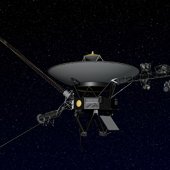


ALT After receiving data about the health and status of Voyager 1 for the first time in five months, members of the Voyager flight team celebrate in a conference room at JPL. About 15 members of the team sit around a long conference room and are shown cheering and clapping upon receiving the good news.


ALT This paper discusses a space debris removal mission in low Earth orbit in which, for a preliminary design, a solar sail is used as a chaser satellite to reach, capture and de-orbit a debris object. The sail, which exploits the solar radiation pressure as its main source of thrust, is subject to the effects of aerodynamic forces, Earth’s oblateness and eclipse occurrence. Locally-optimal laws are used to control the transfer with the aim of maximizing (or minimizing) the rate of change of a specific orbital element or a suitable combination of them, depending on the transfer phase. When blended control laws are used to target the debris, the optimal weighting factors are calculated with a genetic algorithm to assess the relative importance of each orbital element. Numerical simulations show the effectiveness of locally-optimal laws in driving the sail towards the target even in the presence of the above-mentioned orbital perturbations...


