




Toni Morales retweeted

Some data we recently assembled on entrepreneurship/compute in Europe: eudata.vercel.app.
We hope that one of the useful roles that Stripe can play is in collecting and publishing empirical data pertaining to entrepreneurship and industry in Europe. There's growing appetite to get Europe on a better footing, and cross-sectional comparisons can often shine light on where opportunities lie. If you're interested in this kind of thing, we publish more at stripeeconomics.substack.com.


Very excited for this given all the hard work that has gone on during the last few months. Onwards!
Tokenized Stocks are coming to @arbitrum on @Uniswap.
10 tokenized stocks will launch on day one, bringing 1:1 backed tokenized stocks onchain to the world’s largest decentralized exchange.
This is the first step toward making capital markets more interoperable, programmable, and accessible onchain.
Coming August 24. More info ↓

Today, most of what is being built in the market is 💩, regardless of how much brand credibility some of these issuers have.
I will not name any names in particular because it seems to be an industry-wide phenomenon. I also won’t suggest that these players are necessarily bad actors, though some definitely take more liberties than others. Rather, they are working within the confines of what is possible today.
Because the world’s systems of accounting do not sit on blockchains, tokenized asset issuers have to build complex legal wrappers in order to tokenize these assets.
That is the first problem.
If the asset is offchain, the ownership record is offchain. The cashflows are offchain. The accounting is offchain. The legal claim is offchain. So the issuer has to create some structure that links the token to the asset.
That means funds, SPVs, notes, contractual claims, administrators, reports, redemption mechanics, side letters, legal opinions, and whatever else is needed to make the thing work.
And those structures often lead to worse legal recourse for end users, which ultimately translates into worse products than their offchain counterparts.
This is normal though. In order to tokenize these assets properly, the issuer needs to have some form of legal structure that makes sense. That also leads to added costs. Those costs ultimately get passed down to the end user.
Think of it in the same way as when you buy secondaries in a venture deal. Would you rather buy them direct, or through an SPV?
Direct is better than SPV because the SPV has an additional layer of fees, an additional layer of legal complexity, and an additional layer between you and the underlying asset.
Tokenized RWAs today often have the same issue.
You are not necessarily getting a better product because it is tokenized. In many cases, you are getting an offchain product with more wrappers around it.
But because it is tokenized and novel and running a points campaign, retail (that’s you!) ends up believing that these products are good.
Study the offchain re-insurance market for a bit to understand that what you’re being sold as tokenized re-insurance is not as good as the offchain version, even if you’re looping.
And by the way, looping just means you are taking on more risk. It does not magically make the underlying product better.
The second problem with these legal setups is that prices are pushed onchain in a very “trust me bro” way.
Platforms such as @AccountableData are building tooling to try to increase transparency, and that is directionally good. But even so, most of the vault or tokenization infrastructure provided by players such as @enzymefinance and @upshift_fi comes down to:
“this is my NAV, and now I’m posting it onchain.”
Again, I want to be clear: I am not saying they are bad actors. It is just that if the assets sit offchain, the data has to be pushed onchain somehow.
The borrower performance is offchain. The collateral is offchain. The covenants are offchain. The administrator marks are offchain. The real liquidity of the asset is offchain. So when that NAV gets posted onchain, what exactly is being verified?
In many cases, the oracle is not verifying that the loans are money-good. It is not verifying that the collateral can be liquidated. It is not verifying that there is real liquidity at that price. It is just relaying a NAV that was produced somewhere else.
That is why the RWA credit facility blow-up scenario is so plausible.
You can have a token that looks fine onchain while the borrowers are deteriorating offchain. You can have a NAV that mechanically increases at par plus coupon while the actual credit quality is getting worse. You can have looped positions that look safe until a delayed markdown finally hits. Then suddenly everyone realizes that the “liquid” token is only liquid until people actually need liquidity.
This is not a DeFi-native risk. It is an offchain risk being imported into DeFi.
And because DeFi treats the onchain price as truth, the whole thing can get very ugly very quickly.
@enzymefinance actually used to have a product called Enzyme Blue that was a fully onchain vault infrastructure where the NAV of the vault was programmatically calculated based on the value of the assets.
Good product, but probably a bit too early for its time.
It is telling that they have moved onto Onyx, a product that is more aligned with where the industry is today, where pricing of assets and data has to be moved across in a clunky way.
That is the state of the market.
So what we think of today as tokenization, i.e. real world assets that exist on the blockchain and are composable so “DeFi lego” can occur, will only be possible once a critical mass of stablecoins sits onchain.
That is when the actual transition begins.
Once entities start holding stablecoins on their balance sheets, receiving payments in stablecoins, paying suppliers in stablecoins, and managing more of their financial activity onchain, the data that backs assets can also start to move onchain.
Payments, receivables, cash balances, collateral movements, defaults, recoveries. All the boring accounting stuff that actually matters.
In the same way that we went from paper -> Excel, and sometimes API, we are now (hopefully) going to go from Excel -> onchain.
Only when this transition happens will RWAs be as good as their counterparts that sit offchain. And only then will they actually be able to reap the benefits of composability.
Until then, there is work to be done.

How an RWA credit facility blows up
1. You deposit USDC into an onchain credit facility and get a yield-bearing stablecoin in return ("USDX"). USDX is backed by a portfolio of loans to offchain borrowers, according to the marketing.
2. USDX's issuer creates a Morpho market where you pledge USDX and borrow USDC, up to a 91.5% LLTV. You go to Morpho, post your USDX, borrow USDC, buy more USDX, and repeat. You now have 10x leverage.
3. Morpho values USDX using the portfolio’s NAV, relayed onchain by a “Verified NAV Oracle.” The oracle doesn't verify that the loans are worth that amount, or that the collateral can be liquidated. They pass along the issuer's self-reported NAV, which increases mechanically at par plus the coupon rate. If you bought on Day 1 at $1.00, and the annual coupon was 7%, it would be worth $1.07 on Day 365.
4. The borrowers begin to deteriorate offchain, payments stop flowing in, covenants are busted. Your Morpho position looks fine because the USDX price from the oracle continues to increase.
5. Finally the issuer marks down the NAV, on the quarterly schedule. Assuming a 91.5% liquidation threshold, a position at 90% LTV only needs a 1.64% decline to be liquidated. Several looped positions immediately fall underwater.
6. The markdown causes a run. USDX holders submit redemptions at the published NAV. The issuer pays the first redeemers from its cash sleeve, leaving the remaining token supply backed by a less liquid loan book.
7. Once the cash is exhausted, the issuer pauses redemptions, or begins selling loans at a discount. USDX is listed on DEXs - to facilitate orderly liquidations in situations like this - but it trades far below NAV because it can no longer be converted into cash.
8. On Morpho, USDC suppliers withdraw the remaining liquidity, causing borrowing rates to spike and pushing the debt positions further underwater.
9. A liquidator shows up and buys USDX, repaying a portion of the debt. They try and trade it on the DEX but it can't absorb the volume. They try and redeem directly with the issuer but they are stonewalled. They find out the token doesn't actually represent a legal claim on the collateral, or really anything, despite what the marketing said.
10. No other liquidators show up. At a 91.5% LLTV, the liquidation bonus is only ~2.6%, not nearly enough to step in and pursue recovery.
11. You lose your initial investment. The CEX "Earn" depositor who unknowingly funded the whole operation (via an embedded curator vault), loses their entire position.


Good little explainer here from the folks at @gauntlet_xyz

Fresh off a $125M Series C, @gauntlet_xyz runs every allocation through one question first: can the capital come back out.
@CarsonMBrown breaks base:0x000000000001cdb57e58fa75fe420a0f4d6640d5 down end to end: how markets get picked, monitored, and exited when an exploit hits.
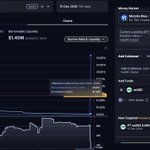
Below is an example of why I'm so excited about @Morpho Midnight. Variable rate lending means that looping, one of the main DeFi composability unlocks, is very challenging to do well. See PT-reUSD-10DEC2026 looping frontend on @pendle_fi below.
The borrowing rate has gone from an average of 8.2% to 24.67% in seconds. This is because the vaults that supply this market have had significant sudden withdrawals.


If you ever needed a reason to stop and take Bitcoin seriously… the UK’s number 1 joke has something to say about it

I've long suspected Bitcoin is a giant Ponzi scheme and now I'm hearing tales of woe that make me fear I'm right.
mol.im/a/15643681

Readers added context they thought people might want to know
Ponzi scheme issuers promise artificially high rates of return with little or no risk.
law.cornell.edu/wex/ponzi_sche…
Bitcoin has no issuer and its value is purely determined by the free market. The code is totally public and opt-in. Nobody can force you to run any particular version.
github.com/bitcoin

Toni Morales retweeted

your timeline convinced you AI is in a bubble. talk to a boomer above the age 35 for 5 minutes.
most people don’t even know what claude is.
kind of wild when you zoom out.

Been running a lot of interviews recently. The single best question I ask candidates that help me learn about them:
“If I were to call up your colleague and ask them to describe what it's like to work with you, what do you think they would say?”.
Curious what other people ask 👀
Come listen to what going to happen day1 mainnet on Monad with some of the ecosystem apps!

🎙 Monad Roundtable #1
MevX x @flapdotsh x @MondayTrade_ x @printr x @something AMA
Monad mainnet drops 24/11.
That's why we bringing top-tier launchpads & DEXs to shill you alpha and many more!
Set your reminder.
Wen: 2 PM UTC - Sat, Nov 22
Location: nitter.gq/i/spaces/1BdGYZWeDkAJX
Dont miss it 🫵

Toni Morales retweeted

🎟️ Perps Beta Access Codes are LIVE
1,000 early traders will have access to Monday Trade Perp Beta — going live on Monad Mainnet Day 1.
Here’s how codes will be distributed 👇


Excited to share that we're hiring aggressively over the next 2-4 weeks. The best time to join @SynFuturesDefi
was yesterday, and the second best time is today!
Check out the latest on our job notion page. ⬇️
