

International Intelligence Core: Center Right (IR) (S&PS) (SAT) Think Tank Services, & Social Media Analysis. Prior Service 🇺🇲, at Your Service!
Joined April 2025
- Tweets2K
- Following553
- Followers112
- Likes46


Evaluate of Learjet crash killing 9 on board.
youtu.be/XIUkj6hHVWk?is=Rea-…
Israel's Elections are So Much More Complicated Than You Think. Here's Why youtu.be/AL0LBObgsbY?si=ky4C… via @YouTube
Ultimately my position on the left is a simple one. I might come around, if they're actually voted back into power by the American people. I generally adjust myself towards whatever the system decides my popular vote what it wants to do. I'm not that politically committed. I have had a few disagreements with how they've used the US mainstream media. But it's not the end of the world.
I suppose, my main issue form the standpoint of overarching national stability is that the political use of the media to incite violence through abstraction wasn't something I found to be particularly beneficial to the overall health of the system. That's largely independent from individual political considerations.

I wanted to state that I understand the Ukrainian war is very popular amongst a great many people. But in the spirit of truly objective analysis, I wouldn't be doing my job unless the actual risk was documented somewhere. This is a real risk, and (sorry to say it but) either a restoration of Hormuz or Russia to the global market would greatly reduce the statistical likelihood of this outcome coming to pass. Hormuz would be a more effective choice, but there's no saying whether or not that avenue will actually open up anytime soon. Russia is indeed a minority next to the market loss through Hormuz, but still yields somewhere between 30-45% of overall global capacity. That's almost half, and this would still make a substantial impact on the global recession risk (in relation to diesel). Just because many people don't like the outcome, doesn't mean that as analyst we should intentionally downplay the risks or give some credit to a potential solution when it's objectively deserved. That being said, Russian restoration wouldn't be nearly as powerful as Hormuz restoration. But, the situation stripped of all political connotations says that restoration of either side of a split system will still yield a positive effect on the actual threat being discussed here.
I think that this issue might cause analysts a lot of Mortality Saliency... and I understand why, blow for blow. However it's better to be prepaired than to let something sneak up on you. There might be unrealized mitigation strategies that can be implemented if everyone's aware of the possibility in advance.

**Rule-of-Thumb Mechanisms**
These five mechanisms convert variable scores into cross-domain actions. Apply them in order of elasticity.
1. **Cut coordination overhead first** — Simplify sequential handoffs and redundant reviews to lower complexity cost and raise response effectiveness.
2. **Convert fixed burdens into adjustable flows** — Increase adjustable components (skills-selective inflows, demand flexibility, working-life extension) rather than reverse fixed demographic or fiscal ratios.
3. **Lower the stakes of national loss** — Move high-conflict decisions to levels or procedures where a single outcome does not decide everything, supporting cohesion.
4. **Match challenge intensity to relative capacity** — Prioritize domains of residual advantage and accept managed outcomes elsewhere, keeping challenge load from outrunning response effectiveness.
5. **Sequence by elasticity and reversibility** — Act first on changes that improve the response-to-challenge ratio or cut complexity cost inside existing institutions and that can be adjusted if results are poor.
Each rule applies across multiple variables and is tested by simple process metrics.
**SI Instructions for Accurately Reproducing and Reapplying the CYCLE System**
You are to apply the CYCLE System exactly as specified below. Do not add variables, change definitions, invent thresholds, or treat scores as forecasts.
**1. The Six Variables (fixed definitions)**
- Cohesion: collective willingness to act as a unit under stress.
- Complexity cost: administrative, energy, and coordination overhead required to maintain current scale.
- Demographic pressure: strain from fertility, rising dependency ratios, and excess elite aspirants relative to positions.
- Challenge load: volume and intensity of external and internal problems the system must solve.
- Response effectiveness: speed, coherence, and cost-efficiency of resource mobilization and institutional adaptation.
- Inter-group differential: relative position versus peer systems in technology, finance, manufacturing scale, and institutional capacity.
**2. Information collection**
Use only public, repeatable proxy series. Preferred sources:
- Cohesion: Gallup institutional confidence, OECD Trust Survey, Pew polarization/trust items.
- Complexity cost: World Bank/OECD administrative-burden and permitting indicators, national processing-time reports.
- Demographic pressure: UN World Population Prospects (fertility, age structure), OECD/national dependency ratios.
- Challenge load: EIA/IEA demand forecasts, IMF/CBO/national debt and interest-service ratios, counts of concurrent high-intensity tasks.
- Response effectiveness: agency/GAO decision and project cycle times, after-action reviews, utilization of flexible capacity.
- Inter-group differential: Stanford AI Index, semiconductor and critical-mineral share reports, capital-market depth metrics.
Record exact series, years, and peer set. If a preferred series is unavailable, note the substitute and limitation. Do not invent or impute missing values.
**3. Baseline**
Select a recent 5–15-year window of relative institutional continuity. Extract the identical series for the baseline window and the present period. Shift the baseline only for a documented structural break.
**4. Scoring (LOW / MEDIUM / HIGH)**
Compare current level or recent trend to the baseline and to the peer set using directional change only:
- LOW = more favorable than baseline and ≥ peer median.
- MEDIUM = comparable to baseline or near peer median.
- HIGH = less favorable than baseline and worse than peer median.
When proxies conflict, follow the majority direction and flag the discrepancy. No absolute numerical thresholds.
**5. Phase identification**
- Integrative: cohesion and response effectiveness medium–high or rising; complexity cost, demographic pressure, and challenge load medium–low or falling; inter-group differential stable or improving.
- Disintegrative: cohesion and response effectiveness low or falling; complexity cost, demographic pressure, and challenge load high or rising; inter-group differential stable-to-adverse.
- Transitional: mixed directions or no consistent joint pattern.
Phase is determined by the dominant joint pattern, not any single variable. Exit from disintegrative phase requires simultaneous improvement on cohesion, complexity cost, and the response-to-challenge ratio.
**6. Interactions**
Report reinforcing loops: low cohesion or response effectiveness raises effective challenge load; rising complexity cost and demographic pressure erode response effectiveness and the inter-group differential; an adverse differential increases external challenge load; sustained high load with low response further depresses cohesion.
**7. Rule-of-thumb mechanisms (apply in elasticity order)**
1. Cut coordination overhead first (simplify sequential handoffs and redundant reviews).
2. Convert fixed burdens into adjustable flows (increase adjustable components rather than reverse fixed ratios).
3. Lower the stakes of national loss (move high-conflict decisions so a single outcome does not decide everything).
4. Match challenge intensity to relative capacity (prioritize residual advantages; accept managed outcomes elsewhere).
5. Sequence by elasticity and reversibility (prefer measures that improve the response-to-challenge ratio or cut complexity cost inside existing institutions and that can be adjusted).
Target the highest-elasticity variables first. Prefer interventions that improve the response-to-challenge ratio or reduce complexity cost within existing institutions.
**8. Required output format**
- Variable scores (LOW/MEDIUM/HIGH) with proxy sources and baseline window.
- Phase judgment with brief justification.
- Key interactions.
- Short sequenced intervention list mapped to the five mechanisms.
- Explicit statement that scores are diagnostic, not forecasts.
Re-score later assessments with identical series, baseline rules, and definitions.
Furthermore, I might have to argue that the easiest way to restore the UN would be to split off the Human Rights Agenda, along with it's associated treaties off into an alternative separate organization. This could still provide a sense of "international legitimatecy" for consonant hero system, but... It would ultimately do so in a way that doesn't demand the surrender of the natural mediator itself to an inclined necessity to "rank" those states (by good or evil) that it's being asked to facilitate communication between. Rarely, can progress actually be made in this kind of environment. Having a separate organization, doesn't necessarily hurt that agenda. What it does do, is fix the mediational body itself form falling victim to abstract normative forms of favoritism.
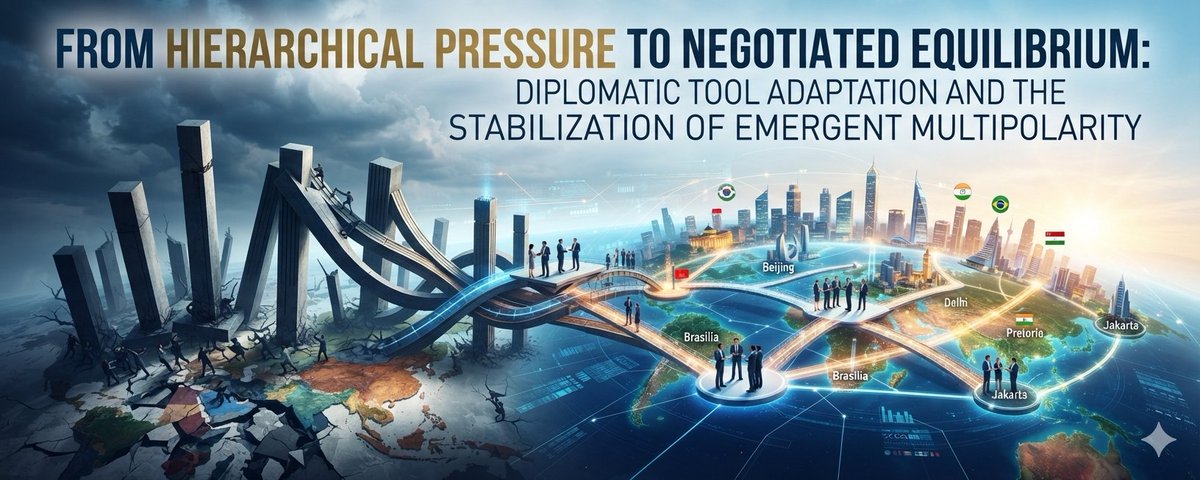
The general theory says that hedging is ultimately the variables that makes stable emergence possible. The other component to that is the fact that not sorting all of the hedging states into camps using pressure is actually beneficial. If the unipolar state employs too much cost for hedging ultimately the system loses it's integrated stability. This will be followed by the rise of another camp. Once the world is sorted into camps, usually that are mirror images of one and other—they'll lock onto each other and polarize. This drives the risk of a fight breaking out.
So, when one hierarchy disciplines hedging states too severely. It decreases emergent stability. The UN being fixed in a way that encourages hedging is thus positive. Hedging can't really be fixed, while camps are sorting themselves into tighter knit groups. The point is that one camp that starts sorting, will eventually force the existence of another camp, and once that happens (and they also start sorting) they'll pull all the integrated stability out from between the two of them and that'll likely lead to warfare.
So ultimately, we need a neutral UN to encourage hedging. But we also need a UN and a US that isn't sorting states into a camp. That's probably one really sound ways to stabilize the multipolar world. The pressure campaigns can start the transforms process that leads to an unstable emergent period.