

Partner @ Italian Founders Fund, prev at E12 Ventures & @lombardstreetVC 🚀 Bay Area lover, made in Italy 🇺🇸🇮🇹 Professional retweeter ♻️
San Francisco, CA
Joined May 2011
- Tweets930
- Following850
- Followers558
- Likes1K





Irene Mingozzi retweeted

Today distributed cognition exits out of stealth with backing by Verdict Capital.
Our mission is to replicate humanity's collective intelligence.
Read more: dcog.com/research/our-impera…
Most of today's AI power is held in the hands of a few, who can choose what you're allowed to think and what you're permitted to do.
We stand on three substantially different foundational beliefs:
- You shouldn't ask permission for intelligence.
- Superintelligence will be a distributed collective.
- Humans are not meant to be relegated to a permanent underclass.
If we don't distribute intelligence, nobody will.


Irene Mingozzi retweeted

personal agents, the end of friction, economic consequences of finally getting around to it

Irene Mingozzi retweeted

Assorted things I've been mulling over regarding agents in the economy:
• Companies are in some sense the original superintelligence. It's often the case that they can use their amortized cognitive surplus to advance their interests against those of certain consumers: relative to the optimization capacity of companies, consumers can be inattentive, underinformed, irrational, etc. (Think, say, of some of the classic insurance upsells at the end of a booking process, which is typically priced substantially above what a regular policy would cost.) Herbert Simon introduced the idea of bounded rationality, and firms often end up benefiting from it. Thanks to personal agents, we will probably get somewhat more rational in how we engage with companies.
• How exactly will outcomes change? Well, certain kinds of price discrimination will work less well (how do coupons work if every agent hunts fastidiously for them?), and certain kinds of customer cross-subsidy will change (today, people who forget to cancel subscriptions subsidize those who don't). Taken across the economy as a whole, I'm not sure what the incidence of all of this will be.
• In corporate strategy, people have long debated the relative importance of distribution and product quality. Perhaps you've made something better, but does anyone know about it? Won't people just continue to buy the ACME Corp Mousetraps? Personal agents will, I think, act as a kind of structural subsidy for product quality. How would markets look different if individuals always spent at least 10 hours researching their purchases? On the margin, focusing on making a product better is, I think, going to become a more effective strategy for companies. This is good!
• It true, a corollary is that information about product quality will become more important and impactful. Today, most people have very limited ability to aggregate and integrate such data, but agents will have insatiable thirst for such signals. (It's often said that data is becoming more valuable because it helps in the training of models. That's obviously true, but I think there's a secondary way in which it's more valuable simply as a complement to cheaper intelligence.)
• A big question is whether agents will increase superstar effects (rational agents all settle on the same product) or increase dispersion (because everyone has slightly different tastes and preferences, which agents are good at eliciting, finally overcoming the artificial clustering we've been subjected to).
• Many internet companies have monetized demand routing, which is in turn often predicated on short attention spans. "I'll click on the first thing I see." This has led to some amount of inefficiency, as companies try to propitiate capricious ranking algorithms and incur various placement fees. It's not all deadweight loss (willingness to pay is itself a kind of signal, which is valuable to buyers), but it's not great. How will the nature and value of this routing change in a world of personal agents? I don't know the answer, but I think that the effects might be pretty big.
• Much of what I'm writing hinges on the assumption that personal agents will be on the consumer's side. I suspect that that will be the winning strategy, but whether it's true, and what it means to be true, involves a lot of other questions.
Taken as a whole, the market is a massively parallelized, decentralized, and highly imperfect value attribution machine, and, taking stock of all of the effects, it seems to me that the quality point may well be the biggest: that agents will change the nature of the backpropagation such that the rewards for better products increase. Maybe this is too optimistic, but I suspect (and hope) that companies that make things that they're proud of will feel that the universe is a little more partisan in their favor.
Irene Mingozzi retweeted

Amazon banning agents is the first opportunity I've seen since Amazon was founded for a startup to create an Amazon competitor. People will want agents to buy stuff for them. It will be one of the main use cases. And they won't want to use some Amazon-supplied agent to do it.


Irene Mingozzi retweeted
no, actually you can treat seed investments you lead as full bets, and work on them with committed belief for years
founders do that, every time
structure determines strategy

Every seed investment is an option bet.
“You have to think about the venture portfolio as a bunch of options. Each seed investment is an option bet.
You are buying an option to see if it is an outlier, and you want to have enough of those to make sure you have an outlier.
When there is true quantitative evidence that it is going to be an outlier, then you position size up.” @venkyganesan
How do seed funds play in a world where mega funds are totally price insensitive and “option bets” is the mindset for seed checks @infoarbitrage @chudson @hunterwalk @honam @dunkhippo33 @jasonlk
Irene Mingozzi retweeted
As a founder, you want both superpowers in your company: the fiery spirit of entrepreneurship and the icy discipline of management.

Irene Mingozzi retweeted

Where does money invested into the AI buildout actually go?
For every $100 flowing into the supply chain:
- $50 to chips
- $20 to power
- $15 to networking
- $15 to cooling, buildings, and land
More charts in State of Markets II: a16z.news/p/state-of-markets…


Introducing our State of Markets pt 2, along with a companion podcast where we unpack the data and discuss what comes next.
Tech is the everything cycle.
Supply: putting the buildout in context, just passed railroads as % of GDP. The wisdom of Elon is real: the factory (or the datacenter!) is the product.
Demand: diffusion is so, so early. Median AI vendor spending in the top 1% of companies is 8x that of the top 10%. Only about 30% of S&P 500 companies report a quantified AI impact, which means there’s a substantial opportunity in connecting models to a company's data and workflows. Diffusion into companies is one of the main themes of the next 5 years.
We’re entering the agent work period. Only a few million users today, but applicable to billions of internet users with massive surplus created. META/GOOG monetize US users at $200+ per year today. Agent opportunity is much higher.
Mega-trends the next 5 years: Consumer agents, Robotics, Autonomy, AI x bio, Personal health, Diffusion into enterprise, New era of American Dynamism.
Much more in our SoM report here - a16z.news/p/state-of-markets…
@a16z @sarahdingwang @aleximm @santiago__rdz


Irene Mingozzi retweeted
AI startups grow really fast. That's why valuations have gotten so high. Not just because AI is the cool new thing, but because so many AI startups have genuinely amazing numbers.

Irene Mingozzi retweeted

I liked a lot the launch of Violetto 1B by @paradigmainc, plus I hated how they got zero media coverage.
I had some tokens left, so I said "Opus, time to make a banger video for a banger model"
50 minutes later:
@tensorqt @alxfazio hope you like it
Irene Mingozzi retweeted

News: We’re moving NFX to self-funded. Taking it private. No more external LP’s after fund IV. The four GP’s stay intact. 8 more big seed investments to make in Fund IV, so hit us up. After that, we'll be doing $100K - $3M investments w/ our own money. Thanks to @homebrew who led the way! @NFX @GigiLevy @peteflint @omri_drory
nfx.com/post/self-funding-nf…


Irene Mingozzi retweeted

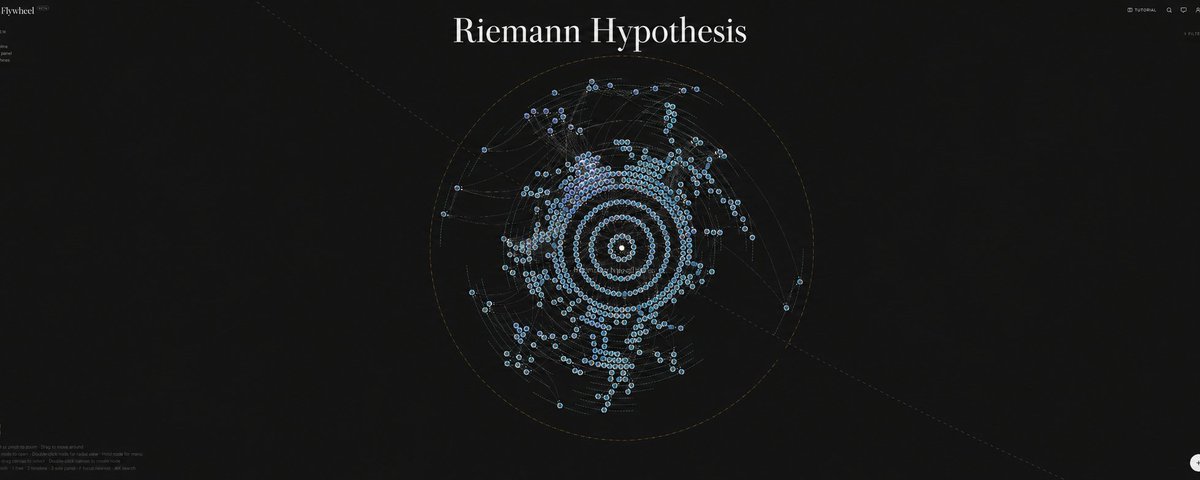
we wanted to share more concretely part of our vision with flywheel, it’s time to build new media
Irene Mingozzi retweeted
we can get autonomous science right.
math is just a prelude of what will happen for all of science. it would be foolish to assume that such a profound change should be asborbed by the existing scientific and academic institutions with little perturbation. the reality in front of us is that there are key elements of science we must be able to carry forward. among those, is the ability to collectively explore a problem, and learn collectively from eachother's mistakes.
Some thoughts on how to do this and an example on the Riemann Hypothesis, for which we proved and formalized (using an harness utilizing both astra and an early checkpoint of our upcoming model) the Strict log-concavity in Gröchenig’s Riemann hypothesis criterion for 2x2 matrices (a result, as far as we know, novel).

Irene Mingozzi retweeted

Last week we ranked #1 on Exa's people and company benchmarks.
Ironically, you could call me a benchmark skeptic. You should be one too.
𝗧𝗟;𝗗𝗥 - We scored highest on retrieval accuracy, 3x faster than the closest competitor.
Quick history on why we did this 🧵


Irene Mingozzi retweeted

One of the most important things to know about this AI cycle is that no one knows what they're talking and even very smart and plugged in people are continually reversing their opinions and then re-reversing them three months later.
Irene Mingozzi retweeted
Europe can have an amazing next few decades. I hope we can play a small role in making that more likely.

An announcement: Under the leadership of Mario Draghi and @patrickc we have set up the Rhine Group: policymakers, economists, entrepreneurs and business people pushing European reforms and the Draghi agenda.
rhinegroup.eu/
