


John Koetsier retweeted

@standardbots just launched AI skills (Agent, Locate, Inspect), so any frontline worker can program a robot from an iPad.
What used to take weeks and cost tens of thousands of dollars now takes seconds.
Great story by @johnkoetsier in @Forbes: forbes.com/sites/johnkoetsie…

John Koetsier retweeted

Thrilled to announce that @origin_autonomy has raised $20M in total funding, co-led by @Accel and @ZacuaVentures.
Excited to be building this with @ashishxdaga, @tusharmakkar08 and the super talented team at @origin_autonomy. We’re building general-purpose robots for interior construction.
Special thanks to @johnkoetsier at @Forbes for covering our journey.
News Article: tinyurl.com/ym2vj7ts

John Koetsier retweeted
"A robot shouldn't be harder to use than your iPhone."
-- @evanbeard on @johnkoetsier's podcast.
Only 6% of US manufacturers use robots today. Robotics needs a ChatGPT moment where anyone can unbox a robot and train it—and @standardbots is shipping that today: youtube.com/watch?v=ohgQWfUl…

John Koetsier retweeted

The simplest robot you (or your five-year-old!) will ever use. No code. No robot knowledge required. Perfect for automating clean-up duties.
Great job, Jack! And thank you to Standard Bots Sales Engineer Nicole Bing for capturing this moment!

John Koetsier retweeted

Boston Dynamics just showed the shop floor where it builds Atlas.
Machining, assembly, and repairs all happen under one roof. When suppliers can’t meet the required tolerances, they make critical parts in-house. Engineers can tweak a design, machinists can make the part, and the team can fit and test it the same day.
Building an Atlas currently takes about a day. The target is one hour next year, then eventually minutes.
That pace is tied to Hyundai’s bigger plan. Hyundai Motor Group is targeting a US robot factory with annual capacity for 30,000 units by 2028, alongside plans to deploy more than 25,000 Atlas robots across Hyundai and Kia plants worldwide.
All Atlas output for 2026 is already allocated to Hyundai’s RMAC training center and Google DeepMind. External customers are expected to start receiving robots in 2027.
RMAC sits at Hyundai’s Metaplant in Georgia, giving Atlas a real automotive factory to work in. Initial tasks include sorting parts, with factory operations targeted for 2028 and assembly work to follow.
The factory deployments could also feed data back into DeepMind’s models. Better models could help Atlas take on harder tasks, generating more real-world data in turn.
Boston Dynamics also has an existing customer base for Spot and Stretch, plus its dealer and integrator network. Hyundai has discussed the possibility of using its car dealership network to sell robots, too.
The plan still has to clear some big hurdles: manufacturing cost, reliability, and whether factory data can translate into consistent performance.
Getting build time down from a day to an hour is one piece. The harder test is whether Atlas can do reliable work on the line.
John Koetsier retweeted

30 minutes. One take. No cuts.
We put Natura-1’s zero-shot generalization to the test with complex spoken instructions and unfamiliar tasks and environments.
It responds to new requests, adjusts and retries when an action fails, and keeps going autonomously.
Insane!
Frontier models are revolutionizing humanoid robot training.
Gemini 4 Argon ...
- watched 1 video of a human playing cornhole
- built its own sim
- practiced
- got Apptronik’s Apollo to sink 7 straight
And it's just the beginning
humanoidmegahub.com/news/one…
🤖 Made with AI

John Koetsier retweeted

I wonder if this is an EDU Unitree G1 variant in that costume. It’s definitely not Atlas.
They could have built a platform from scratch but that is unlikely in the amount of time they’ve had.
The G1 EDU has up to 43 moving joints which is what Hugo has.
I can’t think of a reason why they wouldn’t use it other than the fact that Boston Dynamics has gone scorched earth on Unitree.


It is hard for people to resist cute, character-like robots.
Meet Hugo--a fluffy purple Tyrolean mountain troll from Dynamic Creatures, the startup Boston Dynamics' former chief strategy officer launched last month.
Hugo is meant to notice you and react to you, not replay a fixed show for the crowd. Built for theme parks, hotels, cruise ships and museums.
The company builds characters on platforms like Spot and Atlas, says they can deploy in months with leasing, and wants its own humanoid hardware next. It's already working with a large theme park and a retailer (names not disclosed).
John Koetsier retweeted

I’m still half in disbelief
We asked Gemini Argon to teach the Apollo humanoid to play cornhole, and it zero-shotted it
All we gave it was a video of a person doing it. It then took control of the robot, generated its own sim env, performed some sysID, and trained launches on the real robot.
It took it a few real shots to improve and then land many consecutive airmails.
The process was so long and articulated that we asked the robot itself to explain what it did to us, as you can see at the end of the video. It even came up with the gestures
Great demo for a great model @googledeepmind @apptronik
Super-impressed:
Nature Will releases 50-billion parameter general foundation model for robot intelligence
The big question:
Is the robotics industry wasting billions on training as the frontier models & this foundation model get better and better?
forbes.com/sites/johnkoetsie…
John Koetsier retweeted
Affordable humanoid robots share hands with humans.
Most humanoid hands sit behind a paywall so high that only labs and big companies get to play. Yeah Hand, by Italian engineer Vittorio Lumare, tries the opposite.
Mostly 3D-printed. Five servos per hand. Fishing-line tendons, like yours, with the motors in the forearm, not the fingers. PTFE guides keep friction down; in tests it opened and closed 800 cycles without getting close to overheating. It can lift up to 8 kg and put about 5 kg of grasp force into a power grip. Silicone pads for smooth stuff, tiny thumbnails for fine picks.
Two flavors: a robotic version with ROS and mounting flanges for common arms, and an experimental prosthetic for research. A flex-sensor glove lets you mirror your own hand.
On Tindie right now it's still in beta--kits from about $217, assembled around $581.
John Koetsier retweeted

Today we are announcing our biggest bet yet on our own silicon.
Starting next calendar year, we will scale our Maia family to multi-gigawatt deployments, making it the primary inference system for our own product and services.
And we’re introducing Maia 300, which delivers 40% more tokens per watt compared to leading GPU-based systems.
We are already deploying Maia 200 across the US, Europe, and Australia, delivering up to 1.7x more tokens per watt across experiences in Teams and Copilot.
Our goal is to build on the full-stack efficiency gains we’ve already seen, while continuing to bring the latest innovations from across the ecosystem into our fleet.

John Koetsier retweeted
Introducing Natura-1, our first general foundation model for the physical world.
It follows natural-language instructions zero-shot and turns them into action with dexterous hands.
Natura-1 is a 50-billion-parameter mixture-of-experts (MoE) model pretrained on one million hours of egocentric human experience.
On top of this foundation, we conduct efficient post-training on a limited amount of robot data to adapt pretrained world knowledge to dexterous manipulation, yielding a model that generalizes to a wide range of unseen scenarios.
Natura-1 follows complex natural-language instructions zero-shot, reasoning through spatial constraints, multi-object relationships, and negative conditions.
It can also autonomously carry out long and continuous workflows to perform long-horizon executions.
Natura-1 provides early evidence that generalization—and even emergent behavior—can coexist with the complexity of dexterous hands.
Further progress depends on the full stack: infrastructure for faster training and real-time inference, pretraining data at greater scale and coverage, and models that transfer to robots with less adaptation.
We expect it to be a long-term research and engineering effort.
John Koetsier retweeted

I got my Beni from Mondo Robotics, and this thing is WILD!
Best consumer robot ever made. The unboxing is great and setup “just works”. The remote works well and is instant, and the app is snappy and streams video while controlling the bot. Video quality is great too!
John Koetsier retweeted

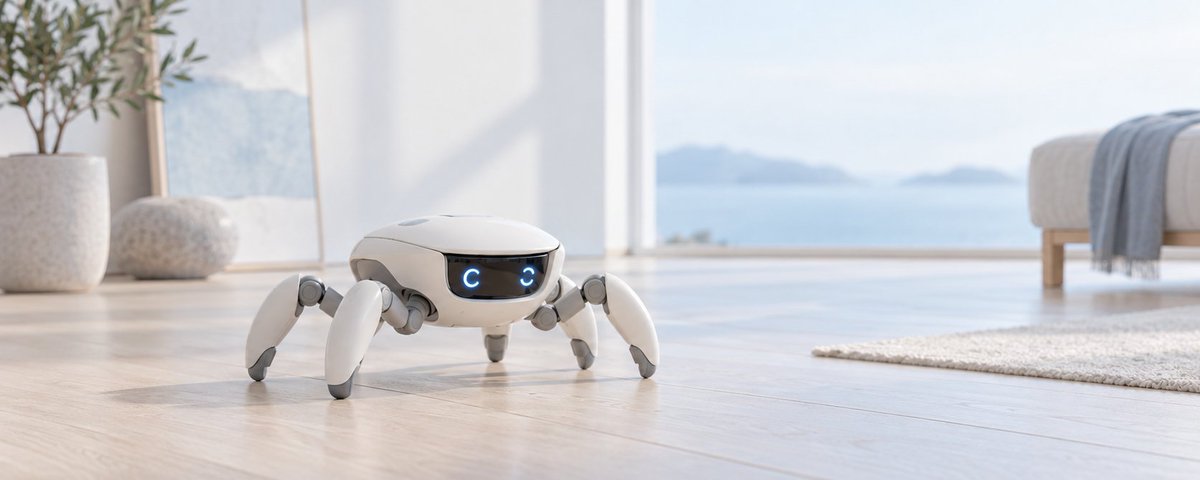
Beijing encoder and servo maker KingKong Technology has open-sourced the simulation, reinforcement learning and deployment toolchain for Jumper, its 1.8 kg crab robot.
John Koetsier retweeted
A humanoid robot that can catch a moving cup
Most robots freeze the second something starts moving. Cup on a belt, shifting grasp, anything not stuck in place --and they miss.
Long-WAM from NVIDIA (with MIT, HKU, UCSD) went after that. On a Unitree G1, stacking a cup rolling past on a conveyor: 19 out of 20. π0.5 and Fast-WAM? Zero. Even at 7.5 cm/s it still hit 90%, where both baselines blanked every try.
What's different under the hood?
It keeps ~19 seconds of what the robot just saw, quickly guesses what happens next (no full video render), then moves. Remember, imagine, act — in that order.
Here's the part that actually matters: longer memory only helps if the model first learned to predict video forward in time. Do that, and RoboCasa GR-1 climbs to 78.7% with 19.2s of context. Skip it, and the extra history barely moves the needle.
It runs on the edge too--RTX 5090 down to Jetson AGX Thor--as fast as 107 ms per action chunk.
Factories, warehouses, any place where stuff doesn't sit still. This is the kind of memory humanoids have been missing.
Generalist physical AI?
1 AI brain, 6 domains ... Odyssey-3 just demonstrated a single world model controlling:
🤖 Humanoids
🦾 Robot arms
🚗 Self-driving cars
🚁 Drones
🎮 Video games
🌎 AI training environments
This is pretty huge if it works.
🤖 Made with AI

The autonomous driving demo is also !!!!
Odyssey gave ONE researcher 20 hours of driving data from India.
20 hours!
The task: teach Odyssey-3 to drive Indian roads.
It worked, according to co-founder Oliver Cameron, who previously spent 8 years building self-driving cars.
The money behind Odyssey:
💰 $310M Series B: June 2026
💰 $1.45B valuation
💰 ~$337M total funding
And the investors:
• Amazon
• AMD Ventures
• Google Ventures
• Natural Capital
More on HumanoidMegahub:
humanoidmegahub.com/news/gen…