

Genomics technology developer. Developmental biology adult learner. Professor at @uwgenome @HHMINEWS @BrotmanBaty SeaHub @AllenInstitute /him.
Seattle, WA
Joined May 2011
- Tweets591
- Following338
- Followers14.6K
- Likes2.8K




Pinned Tweet
Thrilled to post thread re: new single-cell lineage of mouse embryo reconstructed w/ DNA Typewriter. One animal, zygote to late organogenesis (E13.5). Tree has 1,340,794 transcriptionally profiled, annotated tips (cells), 1,142,588 dated internal nodes, rooted at zygote
1/n
Jay Shendure retweeted

Recent research papers report distinct approaches to track mouse embryogenesis at a scale and resolution that suggest that “Sulstonian” cell lineage trees of mammalian development may be on the horizon. Such lineage trees could uncover fundamental rules of developmental plasticity and how mammalian bodies are formed.
Learn more in a new #SciencePerspective: scim.ag/3X3vGuz

Jay Shendure retweeted

We recently wrote about the complementary milestones achieved by @JShendure's group and @JswLab. With AI and other progress, we are in a truly exciting moment. Biology will transform over the next decade, and the kind of data generated here will be key.

Recent research papers report distinct approaches to track mouse embryogenesis at a scale and resolution that suggest that “Sulstonian” cell lineage trees of mammalian development may be on the horizon. Such lineage trees could uncover fundamental rules of developmental plasticity and how mammalian bodies are formed.
Learn more in a new #SciencePerspective: scim.ag/3X3vGuz
Pioneer factors are more complicated than the textbook picture! Our latest, led by the phenomenal Aidan Keith in collaboration with @sdomcke: in a multiome CRISPRa screen of 60 developmental TFs, chromatin opening is autonomous, opportunistic, or hierarchical. Thread by Silvia 👇

Excited to share our latest preprint with @JShendure, led by Aidan Keith. We wanted to know which, where and how TFs open chromatin when they are newly expressed in a given cell state, using CRISPRa and single cell multiome. 1/7 biorxiv.org/content/10.64898…

Ribosomal (rDNA) repeats are the final 0.2 miles of the Human Genome Project, unresolved even by T2T genomes. 25 yrs after the HGP's initial draft, our latest from the brilliant @XiaoyiLi10, Jakob Wallentin & @zhaoshudi nails these w/ prime editing-based saturation barcoding


Excited to share the second piece of my postdoctoral work with @JShendure. We solved the last remaining "tangle" -- the nucleolar organizer region (NOR) -- in the telomere-to-telomere assembly of the human genome with gene editing. (1/n)
biorxiv.org/content/10.64898…

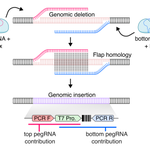
Our latest, sent on behalf of the outstanding but X-less Aidan Keith: OPTIMuS PRIME-Del uses paired prime editing to program targeted deletions at candidate enhancers, while concurrently replacing them w/ a molecular tag to verify & quantify deletions 1/7
biorxiv.org/content/10.64898…
Looking forward, we anticipate taht modeling of CREs getting good enough to inform design of programmed deletions. Here, we used CREsted (Stein Aerts) predict accessibility losses and found these predictions consistent with observed expression decreases at LPIN1 and SLC39A3. 6/7

1
1
740

A phenomenal team-lead opportunity at the new @AllenInstitute AI BioDesign accelerator, please feel free to share to potential applicants!

We’re looking for a team-builder/proteome editor designer! If that sounds fun, check out: alleninstitute.org/careers/j….

Jay Shendure retweeted

When genome editing got going, the ability to trace a mammalian embryo's development to organ generation in exquisite detail was not envisioned. Now it's been accomplished by 2 independent groups. A big week in developmental biology
science.org/doi/10.1126/scie… @JShendure @ScienceMagazine
cell.com/cell/fulltext/S0092… @jonathanweisman @CellCellPress
nature.com/articles/d41586-0… @nature @ewencallaway

Jay Shendure retweeted

..and have a look at the highly related paper from @arjunrajlab biorxiv.org/content/10.1101/… with complementary experiments that reinforce the point and reveal multicellular #memory


An aptly titled paper shows, for the first time, the significance of heterogeneities of gene expression in the construction of complex systems : fate decisions are group decisions. Previously @biorxivpreprint
cell.com/cell/fulltext/S0092… #MustRead @Jshendure lab

Jay Shendure retweeted
An aptly titled paper shows, for the first time, the significance of heterogeneities of gene expression in the construction of complex systems : fate decisions are group decisions. Previously @biorxivpreprint
cell.com/cell/fulltext/S0092… #MustRead @Jshendure lab
Jay Shendure retweeted

How does a single cell become a mouse? 🐭 Our new paper reconstructs mouse development in a timed tree of 1.28M cells from the zygote using DNA Typewriter! 🌳
My favorite part: <5% founder cells at day 7 contribute >50% of cells at 13.5 - clonal dominance during gastrulation!

Jay Shendure retweeted

Scientists at Seattle Hub for Synthetic Biology just built the largest cellular family tree ever for a mammal, tracing how a single egg divided into 1.28 million cells. bit.ly/4zqcRjh
Jay Shendure retweeted

OpenAI’s intellectual cannon is so good at Math because Math can be expressed very precisely as a language, and training on Math can be made very effective through Lean formalization and proof checking.
These factors are not there in the same way for medical research. It is unclear why being extremely good at Math should make these models equally good at curing cancer. This kind of consideration is probably bad for IPO.
Proving the Riemann Hypothesis by Halloween 2026 would be fantastic PR and, at the same time, would tell us very little about curing cancer (or sending people to space, which seems to be another favorite of AI-enthusiasts these days).
In the meantime, me and others are trying to make clear that modern Math is a very complex (and imperfect!) system, with tens of thousands of people involved in different roles, and years of training needed before someone is in a position to do creative work.
This setup was not built because someone planned it. It grew over decades through changing traditions of mentoring and research. In 20 years of Math I have definitely seen huge changes in how research works, well before LLMs. Things can adapt, but with time to adapt.
If you stop forming new people, the whole thing collapses. And once it has collapsed, you are not going to rebuild it at whim. You are just going to have very few people around who even know how human Math research used to work.
We have no model for machines training humans to replace the human system that trained the machines.
To me, it all seems like a very rushed and very risky bet.
Jay Shendure retweeted

Excited to share two works online today from the Shendure Lab, with a contribution from the Big Green 🌲! We applied DNA Typewriter to trace mouse development from zygote to late organogenesis.
Exciting day for DNA Typewriter w/ 2 papers from the lab & SeaHub out today :)
1. Mouse lineage from E0 to E13.5
science.org/doi/10.1126/scie…
2. A fluctuation test for gastruloid heterogeneity
cell.com/cell/fulltext/S0092…
Paper #1 covered in quoted thread. More on paper #2 here. 1/n

Jay Shendure retweeted

Excited to share Shotgun Genetic Engineering, developed by @julie_trolle, out in @NatureBiotech!
Read on to learn how Julie enabled mammalian cells to grow without 2 essential amino acids for the first time in >500 million years using highly multiplexed metabolic engineering!

Highly multiplexed mammalian metabolic engineering with a shotgun approach - @sudpinglay @JefBoeke nature.com/articles/s41587-0…
