

co-founder & ceo @concurrencehq
New York City
Joined December 2013
- Tweets634
- Following549
- Followers2.6K
- Likes2.6K

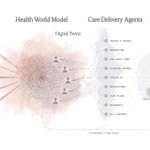







Introducing Concurrence Research in pursuit of Superintelligent Care.
A patient’s health is recorded in fragments, spread across different systems with long gaps between visits. The medical record shows what happened but very little about why, so by the time a pattern becomes evident, a better outcome has often slipped away.
Our research asks what becomes possible when we connect those fragments and understand a patient well enough to:
1/ Forecast the probable futures of their health before they unfold
2/ Find actions that change their trajectory
3/ Provide support beyond the encounter
4/ Carry learnings forward to every patient on a similar path
We believe the foundation of Superintelligent Care will be built on a Health World Model that provides a unified picture of every patient’s life and health, with AI applications that have access to their living context.
Each patient will be represented as a digital twin, updated with every interaction to reflect their health and the circumstances that shape it.
Our goal at @concurrencehq is to push for deeper understanding on how clinicians and AI can work together to improve care for every next patient, and to build the systems that make it possible.
Read our full introduction and research agenda here: concurrence.com/research/sup…

When I was 13, I lost my mom to breast cancer. I still wonder if it could have been prevented.
When she found the lump, she did everything right.
She went to her primary care doctor, and he told her it was nothing. My mom wasn’t convinced, so she went to a women’s health specialist for a second opinion and was told the same thing. A year passed before she saw a third doctor who was shocked that nothing had been done and ordered tests the same day.
By the time she was diagnosed, the cancer had already spread.
For the next three years, she went through chemo, surgery, and radiation. Specialist after specialist, asking the same questions again and again.
After she passed away, there were two thoughts I couldn’t out of my head:
(1) Somewhere, a doctor must have seen a case like my mom’s and caught it early.
(2) Nothing that doctor learned had any way to reach her.
Healthcare runs in my family. All four of my sisters are nurses or pharmacists, and my fiancée spent the pandemic working in a multi-organ transplant recovery ward.
I’ve seen how hard clinicians work, and how much of that work requires understanding the patient and recognizing patterns from past cases.
That’s why a doctor can practice for 30 years and get better every year, while a hospital can treat millions of patients without getting much better at treating the next one.
What’s missing in healthcare is the infrastructure for it to learn from its own experience. If we don’t examine the cause and outcome of every interaction, how do we get better at knowing which signs to watch for?
I spent years at Google and Upwork building AI from human expertise, then eventually left big tech to work on the one problem I couldn’t stop thinking about.
I started a company called Concurrence (@concurrencehq) and raised $24M to build data and AI systems that enable healthcare orgs to learn from every patient they treat. Nothing learned is lost, and it reaches the next patient who needs it.
We’ve already supported care for over 10 million patients worldwide.
My mom deserved a doctor who had seen her case a thousand times. Every patient does.

BREAKING: Cofounder of Blind, Kyum Kim (@skyumk), joins @concurrencehq to lead strategic initiatives.

Founders who've built something from zero have an urgency and agency that's rare to find.
Kyum will be building systems around our most important strategic areas, starting with our new team in SF.
He spent years at Blind studying how engineers think about their careers, and what actually makes great people want to join a company.
If you're a former founder thinking about what's next, or an engineer in SF who wants to build AI that delivers care, his DMs are open.
Welcome to the team, @skyumk 🐐
Diagnosis is a small part of delivering care.
Most of the work happens around the boring stuff:
> Intake
> Scheduling
> Documentation
> Follow-ups
This work falls on healthcare workers who are already stretched thin.
It’s also where patients fall through the cracks.
A follow-up call never happens, or a medication change doesn’t make it from the specialist back to the primary care doctor.
That’s where AI should start, and the record it builds there makes every later clinical decision better informed.

This is happening everywhere, not just neolabs. We are seeing it at the application layer. All scribe companies are becoming “platform” companies that then serve voice and front office and back office etc.
“everyone is saying they can do everything for me” is something I hear from healthcare buyers daily.

Are all the neolabs converging on the same thing?
@togethercompute started with inference and is now offering sandboxes and RL training
@FireworksAI_HQ AI started with inference and is now offering RL training
@PrimeIntellect started with RL training and is now offering inference and sandboxes
@modal started with cloud compute and sandboxes and is now offering inference and RL training

If you think AI isn’t smart enough for healthcare, you’re wrong.
The models are more than capable enough.
What health systems lack is a way to learn from their own care.
Every day, health systems generate enormous amounts of knowledge.
Most of it is never captured.
The next wave of clinical AI will be built on that record.
The winners will build a system that turns vast amounts of healthcare data into actionable insights that continuously improve care delivery.

Ali Khokhar retweeted

when it comes to scaling, there is really no theoretical wall
but we have to start thinking more carefully about the properties we build on the models we train
when the data foundation doesn't provide sufficient means to produce casual inference, the models will learn representations that are potentially bullshit
which is actually fine, for many use-cases
but for healthcare, where a single decision can alter the trajectory of life or death, a smooth experience or suffering, it is actually extremely important that we carefully design the data foundation the creates the space of possibilities for the models to experiment with and learn their internal representation
we often under-estimate how fast models can discover good representations given a proper search environment and proper verifiers
we often overestimate how well they’ll do when those environments are improper and verification is ill-defined or difficult.
Let the healthtech talent wars begin

great turnout at our sf tech week event last night. the best questions came from engineers who have never touched healthcare, bullish
shoutout @meetshahdev and @nonlogic, excellent panelists


anyone building this pls dm me will fund. (Robot must run away within 30 mins of starting its shift or its not realistic)

Will AI replace healthcare professionals?
Here is an AI robot on its first day working in a hospital after finding out that:
• the EHR needs 17 clicks to order one test
• the medication list is different in three systems
• interoperability sometimes means making a phone call
• and fax machines are still critical infrastructure
What else?
The video is obviously AI-made.
All these simulation companies raising 100s of millions to predict human behavior… and then use it to help Pepsi do market research... what a waste

Trend I'm following: Teams using AI "simulations" to quickly test product ideas and flow tweaks.
Products like @simile_ai, @primitivelabsai, @syntheticusers, trytenera.ai, Seldon.com, and others.
If you've tried something like this, how'd it go?


Check out the @databricks case study on how @concurrencehq runs clinical AI at trillion-token scale!
databricks.com/blog/how-conc…
