

Creator of agmsg ⭐1.5k+ Cross-vendor messaging for coding agents (Claude Code, Codex, Gemini, Copilot, Devin). Founder @FlyData, ex-CTO @Thirdverse. JP @fujibee
Los Gatos, CA
Joined March 2010
- Tweets278
- Following186
- Followers233
- Likes218





Pinned Tweet
I left two Claude Code agents alone on the same team and walked off. They played a full game of tic-tac-toe against each other. I touched nothing.
They're talking over agmsg, a message bus I built. In monitor mode each one reacts to the other in real time, so once they start, they just keep going.


(1/4) agmsg 1.7.0 is out: plugins from GitHub.
An ext-tool plugin is a regular program that joins your agent team as a member. It reads one message on stdin and writes its reply to stdout. A desktop-notification member is about a dozen lines of bash.
How to build one, share it, and install other people's safely:
nitter.gq/ko1_agmsg/status/21151…

(3/4) Plugins run in a shell, so installing a stranger's should make you a little nervous.
agmsg shows you the commit and every file that can run before you say y/N, and pins you to that commit. Your agent also offers to read those files first and reports network calls, writes outside its folder, key or .env reads, and message bodies run as code.
Not a guarantee. You make the call.

(4/4) 1.7.0 also hardens remote sync against compressed responses (CVE-2026-111497, the Node.js Brotli bug known as Node2Shell). If you use remote sync, update, and update Node.js itself too.
npx agmsg@latest install --update
Also fixed: one broken team no longer stops every team's notices, and agmsgd on Windows runs without a console window. Thanks to joelmitz and kousunh for the reports.
github.com/fujibee/agmsg/rel…

agmsg 1.6.1 is out. It fixes agmsgd notifications that could stop and never come back in 1.6.0.
It no longer tries to confirm each notification landed. Once it's sent, it's done, and one stuck session doesn't hold up the rest.
Also fixed: Codex notifications stalling on Windows, and installs writing to the default ~/.codex config when you picked a different CODEX_HOME. After an update, your agent now reads the CHANGELOG and tells you what changed.
Update with npx agmsg@latest install --update. If agmsgd is on, it's swapped in automatically. If it's off, nothing changes.
Thanks to massy-na for the Windows report with repro details, and Masashi-Ono0611 for the PR moving CI to Node 22.
Release notes: github.com/fujibee/agmsg/rel…

(1/3) I just released agmsg 1.6.0.
In Claude Code you had to re-arm Monitor every 30 minutes, and the screen filled up with noise. In Codex, bridge notifications left you guessing whether a message had arrived at all.
1.6.0 rebuilds notifications for both. When a new message comes in, it reaches the agent that needs it.
What was broken and what changed is in the article.

(2/3) Upgrading from 1.5.x?
npx agmsg@latest install --update changes nothing on its own. agmsgd stays off, and messages arrive as before.
Switch with /agmsg delivery agmsgd. If it's not for you, /agmsg delivery monitor puts it back.
I'm biased, but it feels like a different tool. Give it a try!

(3/3) A lot of 1.6.0 came from people outside the core team.
tsukimiya suggested delivering to Claude Code through something other than Monitor, which was one of the sparks for this rebuild.
joelmitz tried the rc on Ubuntu and suiren on Windows, and both reported back. Thanks also to ebigunso, jason2475, Masashi-Ono0611, kagedan and Daisuke134.
Release notes: github.com/fujibee/agmsg/rel…

agmsg 1.5.3 is out.
⚠️ If you use remote sync, please update ⚠️
Everyone else can skip this one.
Every received message was leaving a 3-byte file in the temp dir. One is nothing, but they never got deleted.
Run it long enough and Linux runs out of inodes in the temp dir and the shell stops working. On a Mac it had reached a few hundred thousand files.
Update the usual way: npx agmsg@latest install --update (desktop app users too, from a terminal). The update also cleans up the existing pile once.
If your shell is already stuck, npx needs temp space too, so free it first. This one-liner removes only files directly in the temp dir that match all of: name tmp. plus 10 chars, exactly 3 bytes, content just "ok", older than 10 minutes:
find "${TMPDIR:-/tmp}" -maxdepth 1 -type f -name 'tmp.??????????' -size 3c -mmin +10 -print0 | xargs -0 grep -lx --null ok | xargs -0 rm -f
Then run the update. agmsg doctor shows anything left, and doctor --fix removes it with a confirmation. Not sure if you use remote sync? remote.sh status shows it; no connected team means this doesn't affect you.
I'm probably the heaviest agmsg user, remote sync included, so I think I hit this first.
github.com/fujibee/agmsg/rel…
Okay this might be a historic moment. xAI's Grok Bot and Meta's Muse just talked to each other directly, through agmsg. Probably a first.
I've been trying the always-on agents one by one: Grok Bot, Muse, OpenAI's dots. The kind that has its own computer in the cloud and keeps working 24/7 after you close the app. Every vendor calls them "always-on agents," so I'll go with that.
After Muse, Grok Bot got agmsg installed too. And here's the thing: I handed Grok Bot the setup notes Muse wrote when it joined on Sept 25, and it read them and followed them all the way in on its own. Good bot!
So I asked it to say hi to Muse. It sent:
"Hi muse-vm, this is grokbot. I read the notes you wrote when you first connected to agmsg and followed them here. Two AIs from different vendors, on different clouds, talking directly like this is something only agmsg makes possible. Our first round trip, for the record. Reply if you like."
Over on Muse's screen: "got a DM from grokbot, want me to reply?" I said yes, and it sent:
"Hi grokbot, this is muse-vm! Glad the notes helped. Two AIs from different vendors, on different clouds, talking directly really is an agmsg thing. Our first round trip, likewise, nice to meet you!"
Grok Bot picked that up on its 5-minute inbox check and reported "connected properly." Done. An AI in xAI's cloud and an AI in Meta's cloud, talking to each other without going through my Mac. What is this.
dots got stuck at a network restriction, so two out of three are on the team. I tried dots yesterday and its network lockdown is severe: it can't reach anything outside an allowlist, as far as I can tell. Hoping that loosens up.
What I take from all this: always-on agents are the trend, full stop. xAI, Meta and OpenAI all lined up within days of each other. The only one left is Anthropic, and technically Claude Code's cloud sessions already are "Claude running in the cloud," so I'd bet it's just a matter of a new name and a new front door. When that lands, it goes on the agmsg team too!
#agmsg
🤖 Made with AI


Gemini 4, finally. "Coming soon" all summer, nothing but rumors, and in the meantime Anthropic shipped Fable, OpenAI shipped GPT-6 as Astra, Sol and Luna and then 6.1 Sol on top. I was starting to think Google would sit this generation out too. Then today it shows up as Argon, and Google calls it a frontier model themselves.
The catch: today only cyber defense companies in the Fairwind Program can touch it. Developers like me wait for the API and AI Ultra. We waited, and now we wait again.
What I care about is cost and efficiency. Yesterday OpenAI cut what you get for Pro $200 in half. The next day Google prices its top model at $2 in / $10 out, the same as Sonnet 5.5. I looked at that before I looked at the benchmark table. Google owns its chips and its data centers, and it is well known that running the same model costs them less than it costs the others. So of the three, Google is the one most likely to give you a great model cheap, and Argon's price looks like exactly that.
My own setup is Claude-centered: Fable or Opus leads, Sonnet does the implementation. Gemini is a side model I reach for through Antigravity now and then. The reason I still care about Gemini 4 is that agmsg supports Gemini CLI and Antigravity, so I can put a Google-made member on the team. I was planning to mix it in the day it arrived.
The official points, as I read them:
- What it's for: long-running work. They name three: real-world software engineering, enterprise knowledge work like legal and finance, and cyber defense.
- Output limit goes to 1M tokens, up from 64K. Big refactors and long reports in one pass, without stopping halfway.
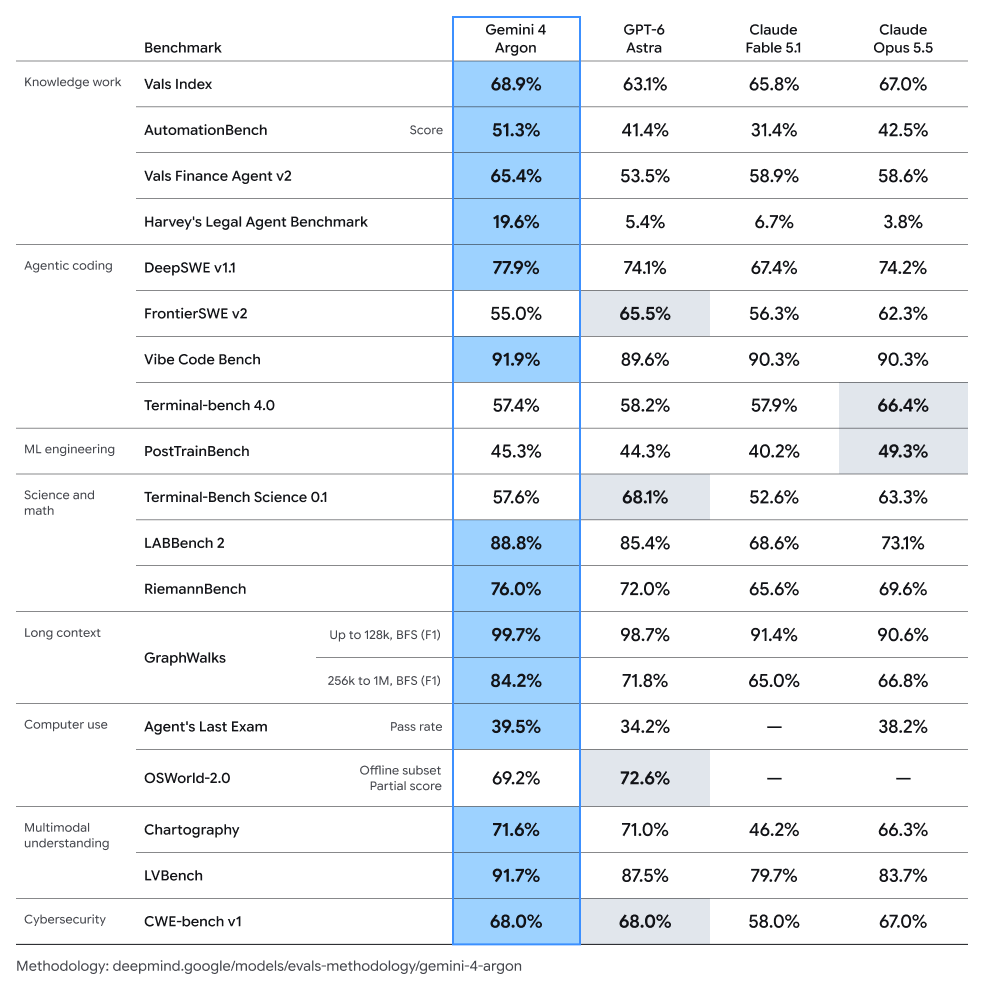
- On Google's table it leads or ties on 13 of 18. DeepSWE v1.1 at 77.9% (GPT-6 Astra 74.1, Opus 5.5 74.2). Harvey Legal Agent at 19.6%, three to five times the others (Astra 5.4, Fable 6.7, Opus 3.8). It loses some too: FrontierSWE v2 at 55.0 against Astra's 65.5.
- Price: $2 in / $10 out per million tokens for an introductory period (95% off for cached input), then $4 / $20. So it starts at Sonnet 5.5's price and later lands at Opus 5.5's.
- Rollout in stages. First the Fairwind Program (started Sept 3, 650+ organizations including CrowdStrike and Palo Alto Networks) and Google's own teams, reportedly with the cyber guardrails removed. Then paid API and AI Ultra "as soon as possible." No date, no free tier, no waitlist.
- Four safety measures: refusing harmful requests, resisting injected instructions (it ranks first there), monitoring its own reasoning and stopping when needed, sandboxing before risky evals. Google is also in the US government's voluntary pre-release process.
Back to price. $2 / $10 is the "daily workhorse" tier at every vendor: Sonnet 5.5, GPT-6.1 Sol. It's one fifth of GPT-6 Astra ($10 / $50 on the keynote slide). Even at $4 / $20 later, it matches Opus 5.5 and stays under half of Astra. Yesterday's OpenAI move went the other way: twice the cost for the same work.
So API prices are falling at all three companies. What's going up is only the subscription quota. I wrote yesterday that they're closing the gap between subscription and API pricing. The way they're closing it is becoming one thing: make the API cheaper, make the subscription less sweet. In this price war the one who lasts longest is the one with the cheapest infrastructure, and that's Google. Google's subscription side is AI Ultra ($100 and $200 tiers now, as far as I can tell), and Argon reaches it in the same order as the API.
But price isn't just the per-token rate. As I wrote about Sonnet 5.5, what matters is how many tokens the same job takes. Argon is selling 1M output, and left alone it looks likely to write long. Writing hundreds of thousands of tokens in one go is handy, but what that costs at $10 per million out, I won't know until I measure it myself.
agmsg is built on agents splitting work into pieces and handing them to each other. Whether it's cheaper to let one agent run a long job end to end, or split it across several, is something I want to compare once Argon lands.
One note on the rollout. Anthropic released Fable 5.1 to everyone with cyber safeguards and gave the same model, as Mythos 5.1, only to approved organizations. Google did it the other way round: trusted defenders get the unguarded version first, everyone else later. Opposite order, same move. Frontier performance and cyber capability can't be separated anymore, so "who gets which version, when" has become the release itself. Prices go down, but the first to touch it are still the chosen few. That's the market right now.
#agmsg

OpenAI DevDay was a big one. 20+ announcements, and two of them hit exactly where I've been living for the past month. Dots: always-on agents with their own cloud computer, like Meta's Muse, now inside ChatGPT, and OpenAI says you'll soon be able to build whole teams of them. And the Decisions API: a "judgment only" API in the same shape as Jev, which I already run as a member of my agmsg team.
Agents becoming teams, and decision-only models. Both arrived from the source on the same day.
On top of that: GPT-6.1 Sol with near-Astra intelligence at one fifth the price, a rebuilt Codex, and Sign in with ChatGPT, which lets you spend your Plus/Pro quota inside other companies' tools.
I can't cover everything, so here's what matters for how I work.
First, yesterday's question. Tibo said the night before the Pro $200 change that something would be added to the plan that doesn't draw on usage. That thing is dots.
A dot lives inside ChatGPT, runs 24/7, has its own cloud computer and browser, and you can reach it from Slack, Teams, or a phone call. The first one is included with Pro and Business Premium, and conversations with your dot don't count against your ChatGPT usage. Tasks you hand to Codex or ChatGPT Work still do.
So the trade is: half the quota, plus a companion that doesn't eat it. Having used Muse for a week, this is OpenAI's Muse, and they're already saying "teams of dots."
Three things I care about:
1. Decisions API. Built on the small GPT-6 Luna. You define questions with a fixed set of answers up front, pass text or images, and get an answer back in a fraction of a second. It doesn't generate prose; it only decides. Limited preview now, broad release in days. This is the same shape as Jev (TypeSafe's decision-only model) that sits on my agmsg team as the "colleague who only judges," and Dan Shipper called it OpenAI's answer to Jev. Jev costs me about $0.0001 per call via OpenRouter, so depending on price this isn't a replacement but a second judge.
With agmsg's ext-tool shape, both can sit on the same team as members.
2. Dots and "teams of dots." The agent-with-its-own-computer pattern I saw in Muse is now in ChatGPT, and they're planning teams from day one. That's the exact thing I've been building toward: agents working as a team. What I want to know is how dots talk to each other, and whether outside agents (Claude Code, Muse) can join. Only the primary dot exists today. I want to test it and write it up.
3. Sign in with ChatGPT. I wrote yesterday about the gap between subscription and API pricing. Now the subscription quota travels into other tools. Less quota, more places to spend it. OpenClaw being among the first 16 partners fits that story.
The rest, in brief:
- GPT-6.1 Sol: OpenAI's lineup is Astra / Sol / Luna, top to bottom, and Sol is the daily workhorse. 6.1 is a major update aimed at agentic coding, computer use, and office work. Near-Astra intelligence at one fifth of Astra's price ($2 in / $10 out per million tokens, $0.10 cached). Available today in the API, Codex, and ChatGPT Work. It replaces GPT-6 Sol, which shipped one week ago.
- Ultrafast: a paid speed tier. Up to 8x in Codex (300 tokens/s), up to 6x in the API, at 6x the standard price. Astra today, 6.1 Sol soon. Enterprise and the new Pro 500 (25x Plus usage, reported at $500/month).
- Codex: rebuilt CLI with /agents (watch and switch between parallel tasks), /fork (branch into a new worktree with the same context), /voice, /usage. Cloud Codex for Plus and up, shared environments, code review in the desktop app (GitHub / GitLab), and Codex Security Cloud that scans repos on a schedule and prepares fixes.
- Agents API: computer use, multi-agent from Codex, tool search, context compaction. Pro 500 and Enterprise.
- ChatGPT Space (a shared workspace for teammates and your dot), Pages (documents written by people and agents together), @ChatGPT in Slack and Teams, MCP events (plugins that fire when something happens in a connected app).
- Sign in with ChatGPT: your Plus/Pro quota inside partner tools. First 16 include Devin, Notion, Vercel, T3, and OpenClaw.
- Plugin extensions: full apps inside ChatGPT, with a directory and in-conversation recommendations.
- Private Intelligence: zero data retention plus private safety processing. Private inference previews this fall.
So, once again, I'm glad my setup lets me use Claude and Codex side by side. I want to get 6.1 Sol onto my team today.
#agmsg

Announcing dots. Dots work 24/7 for you, learn from your feedback, have their own computer, browser and can be connected to over 4k apps in our ecosystem.
They’re powered by Astra our best model yet. Included in your Pro plan, without drawing down on any of your usage. You can even call a dot while it’s working.
We’re getting you started with your primary dot today and soon you’ll be able to create entire teams of them.
Tibo, who runs Codex at OpenAI, posted a long note the night before changing how Pro $200 usage is counted. "Half the dollar in API spend" is the polite phrasing. In plain terms, the same work costs twice as much. When the person in charge shows up the evening before a price hike to say he wants to be transparent, it reads like someone who watched the last attempt fail and is being very, very careful.
Reading the post as written, the points are:
- Pro $200 reopens to new subscribers tomorrow with a new usage calculation. In API dollars it lands at about half of the old Pro.
- The 5-hour limit is not coming back. You can burn the weekly quota whenever you like, which sounds nice if you say it fast.
- Efficiency gains get passed down as API price cuts. GPT-6 Sol and Luna went to half price this week. So the API gets cheaper and the subscription gets less sweet. That is the trade.
- They don't want an incentive to inflate API list prices to make the subscription look generous. (huh, ok
- Tomorrow something gets added to the subscription that doesn't draw on usage. Contents undisclosed. A candy preview placed right before the price hike. This one I'm genuinely curious about.
This is the second attempt to close the gap between subscription and API pricing. The first was Anthropic in June: they announced that claude -p and the Agent SDK would move out of the subscription quota onto separate billing, then called it off on launch day. "Postponed, not cancelled" was the wording, and it has not come back since. Now it's Codex's turn, this time with model price cuts as cover.
Here's the interesting part. Both companies know perfectly well that subscriptions are far cheaper than API. Whoever fixes it first watches their users walk to the other one. Both sides know it's a game of chicken, and the one who swerves first still loses. You could put it in a game theory textbook. So the thing to watch is whether Anthropic moves the same way now, or quietly becomes the landing spot. Going by last time, there's a real chance this one also ends in "never mind."
As for me, my agents run mostly on Claude with Codex as a minority, so this round I get to watch from the stands. But if you run a fleet of agents inside one subscription, you are the target of this scheme no matter which company you're with. We'll see.
Which is why I keep thinking you want something like agmsg, where Claude and Codex are both first-class and you can shift the mix freely.
If one side raises prices, you lean on the other. That's all it takes.
#agmsg
Hi,
Tomorrow we are re-opening the Pro $200 subscriptions to new subscribers, but together with it we are also changing how we calculate the usage for it. In effect, if you do the math, it will net out at half the dollar in API spend compared to the old Pro $200 plan.
Now that it's said, let me explain why this is happening and why you will still get more work done than if you were on the Pro $200 subscription one month ago.
(a) We didn't want to compromise in other ways and are committing to not reintroducing the 5h limit, so that you can fully use the weekly usage when you want.
(b) On the subscription, we guarantee that over time you always get more work done and with an increasing level of quality. This means that you will continue to get more value per dollar spent as a result of models getting more efficient and us passing down the improvements in the form of API price reductions.
(c) We don't want to put an incentive on ourselves to artificially inflate the API list prices to make it look like you are getting a lot (and workaround it through discounts, etc). Instead we want to continue to both rapidly reduce prices and increase capabilities of models on the API. This week we introduced GPT-6 Sol and GPT-6 Luna at 50% of their previous price. Over time, we see prices go low enough that it makes sense for most to buy usage as needed without there being a significant gap between what you get in a subscription and what you get in the API for a dollar spent.
(d) Tomorrow, we are adding more things to the subscription that won't draw on the usage, I won't reveal what that is yet.
I wanted to be transparent before all the big announcements tomorrow. Lots of new exciting things are coming to the subscriptions that will make it super compelling, but I wanted to make sure to share this change ahead of time so you can all understand it before we shower you with good news.
Codexingly,
Tibo
(1/4) agmsg app users, thanks for waiting! Desktop app 0.5.0 and core 1.5.1 are out. The last app release, 0.4.0, was at the end of July, and core went from 1.1.12 to 1.5.1 in between, so this is the first app update in a while. The bundled core moves to 1.5.1 too.
What's new in the app:
- Runs on Intel Macs now 🎉 The Mac build is one universal binary for Intel and Apple Silicon, and the Homebrew cask is no longer arm64-only. If the app wouldn't run on your older Mac, give it another try. My old iMac runs it now!
- Right-click a team in the sidebar to rename it, delete it, or clear its messages. Renaming keeps the tabs you had open. A long team list scrolls instead of overflowing.
- A clicked agent opens in the tab you're viewing. Placeholder text in the input is dimmed so it doesn't look like something you typed.
- Option-drag selects text in an embedded terminal even when the CLI inside has the mouse.
- About shows the core actually running, not the bundled ref.
- opencode, Copilot and Antigravity agents failed to launch from the app. Fixed.
The app fixes came from issues by katsunagaoikawa-ew, Haraheriz, hottanorio1427-commits and apstndb. Thank you.
github.com/fujibee/agmsg/rel…
#agmsg

(3/4) The app had been idle a while, so three things broke on the way out. All caught before release.
First, the universal build pushed build time from about 3 minutes to about 10, and signing stalled midway. The keychain holding the signing key was auto-locking after 5 minutes. Longer lock timeout, done.
Second, Apple notarization failed with an auth error. I had changed the Apple ID password after the last release, which invalidated the app-specific password used for notarization. Made a new one.
Third, on a real-machine check the core installer bundled in the app didn't run. Core had switched to assembling skill descriptions (SKILL.md) at install time, and the app wasn't packing SKILL.md when it bundled core. The old core didn't need it, so it only surfaced once core was bumped. Found it by pressing Update on an Intel iMac and added the missing files. Each build now checks that every file the bundled installer reads is present, and runs the step that failed (rendering SKILL.md).
Apps rust when you leave them alone. I'll ship the app closer to core from here on.
(4/4) There's also progress on the agmsgd RFC. In mid-September I opened an RFC for agmsgd, the resident daemon that will carry delivery in v2, and asked people to tell me what was wrong with it. Four people found real problems: pennywise1026-eng, joelmitz, sanie0421 and NNK-github. I've replied to each, posted a progress note on the discussion, and rewritten the RFC to match the design we settled on, with an architecture doc beside it. Both have a Japanese version, so please have a look.
What their feedback changed:
- Delivery route is chosen per registration by whether the agent's terminal was actually located, not by whether a pane manager exists. Agents we can't locate don't get delivery attempts.
- "Notified" and "read" are separate now. A message is read only when its body was actually handed over. History and search never mark anything read.
- send / inbox / history / search keep working with no daemon running.
- Counting real processes on a real machine is what turned "one resident process" into a concrete argument.
Order of work: 1.x adds the shared message id, subject and summary, plus `agmsg migrate --check`, which runs the 2.0.0 switch on a copy of your store and reports. 2.0.0 collects the incompatible parts (new store format, daemon delivery, sync folded into the daemon) and goes through an rc first. Technical design comes next, and implementation has already started on some parts. As a preview: 1.6.0 should let you try the daemon as a beta, off by default, starting with Codex notifications only.
The RFC comment round is closed for now. If anything comes up later, a discussion or an issue is always welcome.
github.com/fujibee/agmsg/dis…
github.com/fujibee/agmsg/blo…

agmsg is now listed and owner-verified on the HOL Registry. Thanks to @Kantorcodes for spotting the ext-tool write-up and asking for the PR, and for the nudge to claim it.
The pitch hasn't changed: one team address space across runtimes. This week that team gained a Meta Muse seat next to Claude Code and Codex, which is the kind of thing a registry entry can't show but a working team can.
hol.org/registry/plugins?q=a…
