
CEO & Co-Founder of Alpha Grid, previously AI and energy things at @Theteamatx and @Google
San Francisco, CA
Joined October 2011
- Tweets608
- Following1.5K
- Followers256
- Likes869


Lucas Ackerknecht retweeted

OpenAI’s math release is, in the words of Opus, “the single most consequential mathematical release ever” *
LLMs have how made substantial progress on 4 of 7 Millenium Prize problems: Navier-Stokes (claimed), Riemann, Hodge and Birch-Swinnerton-Dyer. Poincaré was solved in 2003. The two left are P v NP and Yang Mills.
*conditional on verification
On average, each OpenAI result used only 3hrs of thinking compute on their new unreleased models.
Two years ago, models said 9.11 > 9.9. Today, we have results that the smartest human minds have not been able to achieve in their entire lives. It is clear that data, compute and algorithms scale. Every model generation (3mos) has made substantial intelligence progress.
It also becomes incredibly hard to not believe that all knowledge work will change monumentally over time. The things AI can not do in the foreseeable future are very likely context-bound (don’t have access to the right information) than intelligence bound. Some might argue they are also creativity-bound or judgement-bound (what should I work on), although it can be argued that future generations could solve for this (given, say, the advancement in research taste for models over time).
AGI is defined as surpassing human capabilities on virtually all cognitive tasks. By most interpretations of that definition, we are there. The domains humans are still better than AI, such as, robotics / physical world control (data-bound?), natural science research (data-bound), some creative domains like writing, movies, music (creativity-bound), super long tasks (context-bound), choosing problems to solve (creativity-bound) and maybe human relationships management (meat-proxy bound?).
In many ways, we have achieved AGI.
Lucas Ackerknecht retweeted

Vertical personal agents and account ownership
I don't buy that there will be one general-purpose personal agent. I think there will be specific agents for:
•productivity / work
•food and grocery
•money
•health
Each of these will be owned by whoever controls the system of record and the right to act. Take money. The money agent should be your bank account and execute transactions on your behalf. It has the ledger, the license, the fraud models, and the liability when something goes wrong. A general agent that "logs into" your bank is a screen scraper with ambition. The bank that becomes an agent is the agent.
The same pattern repeats:
•Food and grocery: Whoever owns the cart, the inventory, and the last mile. The agent knows what's in your fridge because it put it there.
•Health: Whoever holds your records, your labs, and a relationship with a licensed provider. Advice without the chart is a guess. Action without a license is a lawsuit.
•Productivity / work: Whoever owns your calendar, inbox, and docs. Context is the moat, and it already lives somewhere.
Agents win on three things: data, permission, and accountability. A horizontal agent can borrow the first, beg for the second, and has none of the third.
Trust isn't general either. I'll let an agent book my dinner without asking. I won't let the same agent wire $50K or change my medication. Each domain has its own risk tolerance, its own regulation, and its own definition of "done." One agent can't hold all of those thresholds at once.
The general-purpose agent doesn't disappear. It becomes the router. It's the front desk that knows which specialist to call. That's a real product, but it's thin. Routers commoditize, and the specialists capture the value.
The question isn't "who builds the best assistant?" It's "who owns the account the assistant acts on?" The incumbents with licenses and ledgers have a bigger head start than they realize. The startups that win will either become the system of record in a vertical or make themselves impossible to route around.
The future isn't one agent that does everything. It's a handful of agents that each own something.
Lucas Ackerknecht retweeted

There's a huge opportunity right now in being the deployment layer for AI into the economy. The amount of work it takes to change out workflows in enterprises tends to be far greater than anyone realizes or would prefer. Clearly this is what the applied layer of AI is going to look like in the form of software and agents, but also it opens up new services firms opportunities.
Legacy systems need to be moved to the cloud, data organization and access needs to be updated, software needs to be connected to agents in new ways, workflows need to be reengineered for agents, HITL needs to be figured out for the process, evals need to be generated and maintained, and the entire system needs to be continually updated as new models get released and new capabilities emerge. And the full list may even be longer.
AI is not the same as just deploying software. Software you generally did the implementation of an existing, well understood category of technology, then stepped back and the customer kept running. With AI agents, you're delivering actual work augmentation to the organization, which has a completely different set of complexities associated with it. You're no longer deploying tools that the company is merely enabled by, you're deploying work output in a process. Completely different implementation and enablement process.
As a result, this is going to open up lots of new kinds of firms and plays for existing firms to diffuse AI into organizations. We're going to see approaches by industry, by size of company, and by problem inside of companies. Traditional SIs will modernize and adapt (some will clearly not adapt as well), and new entrants will also be founded in this period that take advantage of this window. Great time to be an FDE or FDE firm.

Box CEO Aaron Levie (@levie) calls out the MASSIVE opportunity for AI deployment services:
"every single one of those companies, whether that's a 50-person firm or a multi-100,000 person firm, is gonna need an army of people to go in and help them with that transformation"
"when you go to that law firm and you go to that pharma company and you go to that bank, they need something that bridges the core technology to their workflow in their business process"
"somebody has to go into that organization and get it set up, and somebody has to go and provide domain expertise to this model so it really understands our particular business process"
Vendor FDEs are incentivized to get you hooked on their platform and to spend more money.
Indie FDEs are incentivized to use the best tool for the job and to save you money.
Hire indie FDEs.


Lucas Ackerknecht retweeted

Some notes #RLC2026
> Streaming RL now works reliably, a meaningful shift.
> Curiosity-driven learning gaining traction - No explicit task or reward, agent resolves its own targets.
Doina Precup:
> In-context adaptation is a very simplified, non-parametric form of continual learning.
> Drawbacks of this temporary memory system (in-context learning) is addressed by harness.
"And the harness is going to do things like, you know, remember stuff. Oh, I solved this math problem. It was an interesting lemma, let me put it in a file system right now. I can retrieve it from that file system.
Or, you know, I don't know how to do a A* search. I wrote the little program by myself that does that. Let me put it in a file system and then practically treat it. Okay, so that's a form of continual learning. It's using an external memory"
> On why this isn't automated: The learning loop currently includes of talented research engineers doing clever data mixture engineering.
"I think there is a false idea in many people in the industry's head that we are doing something safer by not allowing the agent to adaptively update? Because what if we somehow get some wrong data and now it becomes poison. Right.
What if they do something very bad? And now there's a big scandal and so on. Now, if you've been following the press for the last couple of weeks, you're going to notice that this is happening anyway because these agents are doing bad things, not because they're bad agents. Because in my opinion, they cannot fix themselves. And they don't have the right understanding of the world because all they get to do is interact with some fixed data sets and some very limited kinds of tasks that we train them on."
Lucas Ackerknecht retweeted

The most alarming thing about this graph is not just the amount of change, but the smooth consistency of the curve. If this were a startup I'd be really confident about their future growth. Unfortunately it is instead the planet we live on.


Lucas Ackerknecht retweeted

The grid has been called the largest machine in the world – building it took decades, millions of workers, and hundreds of billions of dollars – and fixing it is an almost impossibly ambitious task.
But in 2023, Justin Lopas and Zach Dell founded Base Power to try anyway, and it turned out that a lot of talented people wanted to work on this problem too.
The engineer who got Starlink's laser mesh network working joined to lead their software. A Tesla veteran who'd spent thirteen years on everything from the original Roadster to the Powerwall joined to build their battery. And investors have since bet billions of dollars that they're onto something.
Whether they're right will come down to a handful of beliefs about what electricity will look like in the coming decades.
Base Power & The Future of Electricity, by @espricewright & @mikemcg0: a16z.news/p/base-power-and-t…


Lucas Ackerknecht retweeted
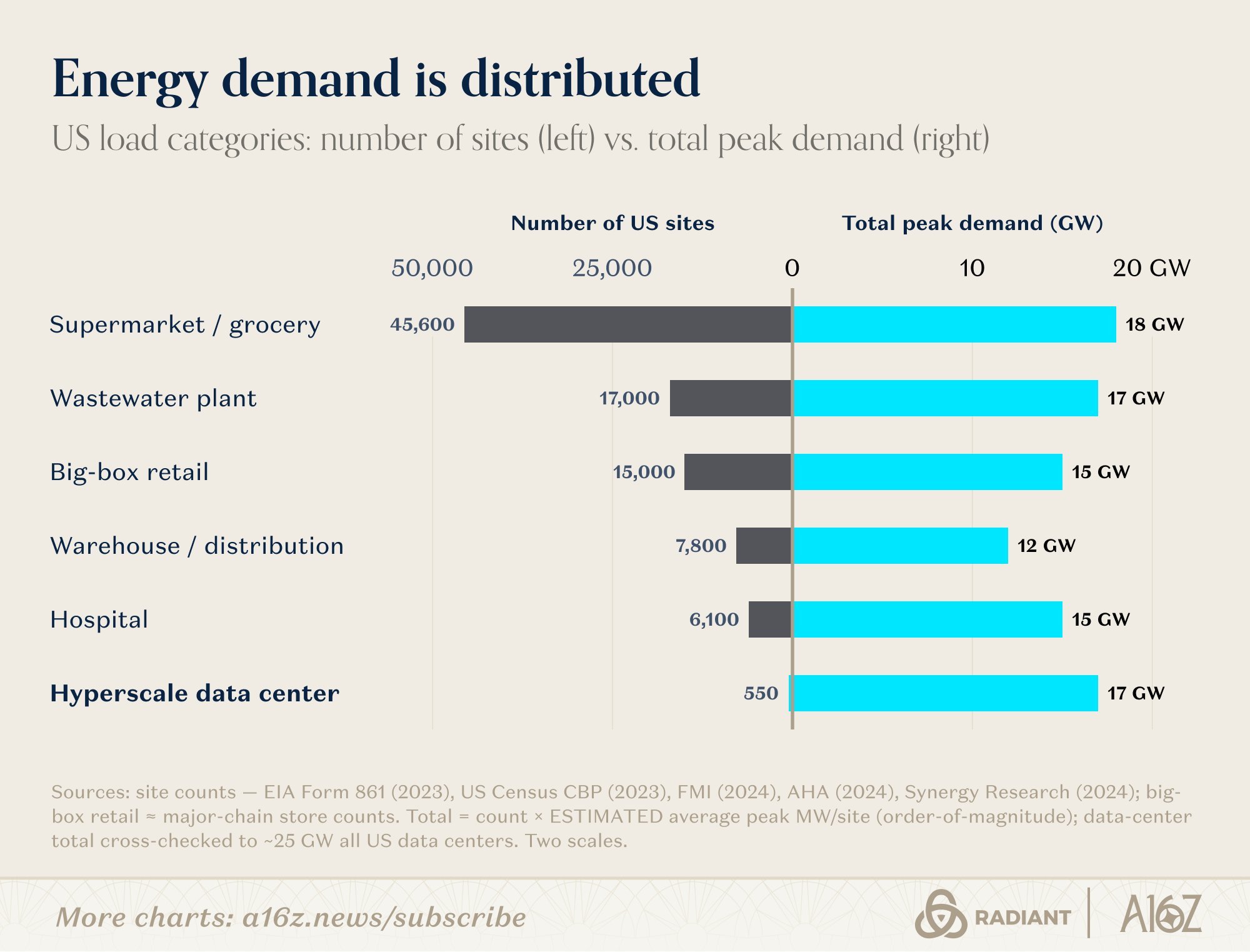
American supermarkets draw more peak power than every hyperscale data center in the country combined


Lucas Ackerknecht retweeted

This week I wrote about why intelligence isn't the only bottleneck to real-world progress & why overlooking the others leads many "AGI-pilled" people to mistaken conclusions about the future.
New research from the @stripe Economics team shows how this looks in practice. TLDR is that so far, the "micro-productivity" gains (so increase in productivity on specific tasks) that we see due to AI are not causing the macro-productivity gains one would expect.
Of course, this is just the beginning and it is likely that as time passes, organizations will learn how to convert the micro-productivity gains into macro ones. What's more, models are likely to continue improving.
Nonetheless, I think this is an important result that proves my point. Models are already absolutely impressive on a whole range of tasks. Yet real world diffusion is just incredibly hard. I also really do not think we understand the nature of the intelligence of these models. Such findings should update some priors imo in terms of how the world will change in the coming years and decades and the importance of real-world friction.


New @Stripe Economics piece today about the recent firming of US productivity growth & AI's potential role in it.
TLDR: we're likely in a high-productivity period today, but the main driver *so far* is firms running their existing capital hotter, not microproductivity gains. /1




Lucas Ackerknecht retweeted

The faster technology moves, the more I think about Bezos' question
What won't change in the next 10 years?
Things I've been writing down over time:
- Humans will always need shelter, food, energy, and healthcare.
- The desire for ownership and the accumulation of wealth.
- The physical world will move more slowly than the digital one.
- Every increase in technological capability, especially AI, will require more energy.
- People and businesses will continue to need access to capital.
- Capital will continue to seek returns that exceed inflation.
- Underwriting methods evolve, but demand for credit (loans) is persistent.
- Trust remains scarce and becomes increasingly valuable as content, code, and fraud become cheaper.
- Verified identities and reputation becomes more important as information becomes abundant and synthetic.
- Long-term wealth creation and dynastic (multi-generational) thinking predate modern technology, and will persist.
- Coordination and transaction costs never fully disappear; market friction will continue to justify the existence of firms and intermediaries.
- People will continue to compete for status.
- Consumers will pay a premium for products and services that confer status.
- Time remains fixed at 24 hours per day.
- But attention is a finite resource and an enduring constraint.
- Products that credibly save time (or enable delegation) have a perpetual market.
- Inaccessible, proprietary data will be a persistent moat. The more inaccessible and difficult to aggregate, the deeper the moat.
- People want accountability, recourse, and clearly identifiable responsibility when things go wrong.
- Regulation consistently lags technological innovation.
- Compliance requirements, licensing, and regulatory moats persist even when machines can perform the underlying task.
- Local knowledge remains valuable and difficult to replicate.
- Heterogeneous markets (like real estate) continue to reward people with deep contextual understanding.
- Incumbent organizations tend to underinvest in disrupting their own businesses, which always creates opportunities for challengers.
Bezos' insight on what wouldn't change in 10 years was "Customers will always want lower prices and faster delivery."
It's boring/ true, but I think that's the point.
Everything we build today can and will be rebuilt more cheaply, faster by someone else.
Build on the invariants, not the trends.
What have I missed?
Lucas Ackerknecht retweeted

As engineering, product, design, DS, etc. melt into a new kind of role, I was reflecting on what roles might look like in the future. For example, when I look at the Claude Code team I see what I think is five archetypes:
1. Prototyper: comes up with brand new ideas; churns out many ideas, most of which don't ship
2. Builder: quickly turns a prototype/idea into production-grade product/infra
3. Sweeper: cleans up the UI, simplifies the code and system, unships, optimizes performance
4. Grower: takes a product that has been built and iterates on it to improve Product-Market Fit
5. Maintainer: owns a mature system to make it secure, reliable, fast, and efficient as it scales
Many people span across 2 roles, and sometimes 3 roles. I also notice that these roles are not really tied to job function -- eg. across Anthropic, some designers match category 1, some 2, some 3; same for engineers, PM, DS.
A healthy team needs a mix of these, depending on the product:
- A product that is new and pre-PMF needs people that are strong at 1+2+3
- A product that is growing and has found PMF needs 2+3+4 and some 5
- A product that has strong PMF needs 3+4+5 and some 2
Maybe product roles of the future will look more like this, and less like the domain-specific roles of today?


Lucas Ackerknecht retweeted

If you've adopted AI at your company but haven't seen any tangible results, read this 1990 article: "The Dynamo and the Computer" by Paul David.
When electricity first arrived, factories that "adopted" it barely got faster. They just swapped the steam engine for an electric one and ran everything else exactly as before: same machine layout, same workflow, same management. Electricity in, no real gains out.
The most common mistake with any new technology is to drop it into the old organization and then declare the transformation done.
The real leap came decades later, when each machine got its own small motor. Suddenly machines no longer had to be lined up around one central drive shaft. They could be rearranged around the actual flow of work.
The productivity gains didn't come from electricity. They came from REDESIGNING THE ENTIRE FACTORY around it.
AI is the same. Bolting it onto your existing process gets you a faster steam engine. The payoff comes when you redesign the work itself.
(link to paper in comments)


Lucas Ackerknecht retweeted

I worry that Wembanyama will get caught up in the distractions of New York City, like the Rose Reading Room at the public library or the upcoming conference on participatory futures at The New School


Lucas Ackerknecht retweeted

Sci-Hub is an evil website that pirated 85M+ research papers and made them freely available
And now they've added AI to their database to make Sci-Bot.
It answers your questions using latest, full-text articles.
But DO NOT use it. We should all try to make billion-dollar academic publishers richer.
I'm putting the link below so you know how to avoid it.