

Co-Founder of LT/ConnectWise. Now building a team of AI bots that run my businesses, and sharing what works and what breaks.
Florida, USA
Joined February 2023
- Tweets333
- Following195
- Followers30
- Likes358







One of my AI bots hit an invisible captcha when it tried to sign in to our property-management software on its own.
The rule: a captcha is a stop sign, not a puzzle. The scripted login went on hold and waits for me.
In a week it skipped itself 174 times. Zero workarounds.
1
John Walker retweeted

Everyone hated on MCP when Skills and CLIs took over. I'm more bullish on MCP than ever
1. Code Mode + typed outputs
2. Native Skills with versioning
3. Always-on Events (webhook, stream, poll)
4. MCP Apps
The best harnesses will have the best MCP client

John Walker retweeted

Another brilliant paper from Google on RSI.
(bookmark it)
In RSI, an agent edits its own harness from experience, meaning its prompts, skills, tool rules and memory. The model weights never change.
This works until an edit fixes one task and quietly breaks another. Over several rounds, a self-editing harness can end up worse than the plain agent it started from.
The problem is the signal the agent learns from. A single task score mixes two things: behaviors the latest edit just broke, and gaps the agent never solved.
So the agent can't tell a new regression from an old gap. It ends up writing broad rules that break working tasks, overwriting old skills, or piling stale rules into the prompt.
Google's fix is GUARD, a loop that checks what every edit breaks before it keeps the edit. Each round works like this:
1. Before a task runs, the agent turns it into a checklist of simple yes/no self-checks
2. After the run, it grades the trace against those checks
3. It pins the rules that already pass and ranks newly broken checks first
4. It tests several candidate edits on the same tasks and keeps the winner only if its gains outweigh what it breaks
Rejected edits go into a log, so the agent doesn't retry them. At test time, all of this switches off and one frozen harness runs in a single pass.
The paper shows the difference on four task streams that keep shifting. Other self-editing harnesses swung up and down, and fell below the plain agent as new edits overwrote old skills.
With GUARD, the harness improved at every checkpoint, with zero drops and zero forgetting.
On 43 test tasks with evolving calendar tools, GUARD lifted accuracy by about 9 points, from 72% to 81%. It improved 8 tasks, made none worse, and used less than half the starting agent's tokens per task.
The test set is small, and 81% is the best of five GUARD setups (the mean was about 77%). Treat the numbers as directional.
The GUARD paper (left in the image) is at arxiv.org/abs/2611.23476
This builds on the previous paper Google released on RSI, Self-Improvement Memory (SIM). SIM gives the optimizer a log of why each past edit was made and whether it worked.
SIM helps the optimizer remember why an edit exists. GUARD checks what an edit breaks before it keeps it.
The SIM paper (right in the image) is at arxiv.org/abs/2611.18856
I also wrote an article on a similar idea, covering how to build an agent harness that improves itself automatically.
It's built on @Cometml's Opik, which is 100% open source. The article is quoted below.

ALT Two Google paper first pages side by side. Left, labeled New paper: GUARD: Stabilizing Recursive Self-Improvement with Regret Guidance (Google Cloud). Right, labeled Previous paper: Self-Improvement Memory Enables Continual Recursive Self-Improvement (Google Cloud AI, Google DeepMind). Each shows the title, authors, abstract and Figure 1.


New rule for my AI bots: before calling an outside service, check if it's down.
If it is, log one line as SKIP and move on. No retries, no FAIL alerts, no noise over someone else's outage.
The next scheduled run picks it up.
3
John Walker retweeted
We just shipped Dynamic Tool Retrieval in the Gemini API.
- Defer functions and remote MCP servers
- Server-side tool search.
- Client-side mode works, e.g. Gemini Decision 1
Stop loading 200 tool on turn 1.


My AI bots now watch their own usage.
When the weekly budget runs hot, my chief-of-staff bot flips the whole team into light mode. Nice-to-have jobs pause. Essentials keep running.
Anything that touches money never pauses. Back to normal at the weekly reset.
4
John Walker retweeted

Stop learning AI Engineering randomly. Follow this step-by-step study plan to go from Python to building real AI agents.
amanxai.com/2026/07/13/the-a…
John Walker retweeted

FSD v15 releasing to the first wave of customers today!!

FSD v15 now starting to roll out – upgrading every part of the end-to-end driving network
Safety
25x better handling of safety critical cases
Tesla Reality View
Adds a live visualization of the drive that lets you see & control what FSD is planning to do
Navigation for start & end of the trip now learns end-to-end from fleet route preferences. Later v15 releases will expand this to the entire route.
You also should notice better detection of signs, animals, debris, potholes and standing water, plus more natural speed handling in school zones and inclement weather.
Lastly, FSD can now slow for speed cameras & Bike Rack Mode lets you enable FSD w/ bike racks or similar hitch accessories
John Walker retweeted

How @ShawnFarsai uses @figma @ElevenLabs and @claudeai to create hyper personalized marketing videos with agents


John Walker retweeted

David Sinclair's lab is using AI to build a pill that reverses aging for $100.
Right now, their gene therapy costs roughly $10 million to manufacture. It requires a direct injection into the target organ.
That's not going to work for 8 billion people.
So Sinclair's team made a breakthrough. They found that the three age-reversal genes aren't the only path to resetting cells.
They discovered CHEMICALS that do the same thing.
In mice, they can now give an animal a liquid — not genes, not injections, a drink — and rejuvenate tissues in 4 weeks.
Sinclair says it's now normal for his students to casually report: "We just rejuvenated the ear. We just rejuvenated the skin. We just cured ALS (motorneuron disease) in these animals."
He calls his lab "Willy Wonka's chocolate factory" because the discoveries blow him away every week.
But he wants one molecule that does everything. So they used AI to screen 8 BILLION candidates. They're now down to three molecules that work. And they're using AI to try to combine all three into one.
The gene therapy could cost over $100,000 per treatment. Sinclair's goal: "What if it could be $100 instead? That's what I'm working for. I want to democratize this technology so anyone even in Kenya can take these medicines."
They should know within a year or two if the molecules work in mice.
The gene therapy is the proof of concept.
The pill is the endgame.
— @davidasinclair
John Walker retweeted

Jensen closed his GTC Berlin 2026 keynote with this Hermes Agent demo as the finale.
He introduced it by saying the way to build an agent is to ask an agent to build it for you, so he installed and set up a customized Hermes in one prompt.
Then he used Hermes, running on @nvidia RTX Spark, to create a simulated training environment for the @huggingface Microduck. Hermes planned an obstacle course with Nemotron and had GPT-6 Astra build it using FreeCAD, Omniverse libraries, Blender, Newton, and Isaac Lab. Hermes trained thousands of simulated ducks on that course until the validated policy was ready to run on the real robot in the physical world.
At Nous, we believe open source is a practical tool as much as a philosophical ideal. It gives users the ability to build powerful, complex workflows chaining numerous local+cloud models, devices, and tools themselves instead of waiting for a company to enable them.
John Walker retweeted

Google's free 2.5-hour course on building agents that remember, survive restarts, and run for days:
0:00 → AI harness crash course
12:16 → the 4 types of agent memory
50:52 → Memory Bank: agents that rewrite what they know about you
1:23:05 → why "I'll check again in 10s" never runs, and how to fix it
2:00:26 → kill the server mid-task, the agent resumes where it stopped
2:20:04 → how to stop your agent from charging twice
Annie Wang (Google Cloud) builds it step by step, from harness basics to production safeguards. most agents never get past a demo. this is how they do.
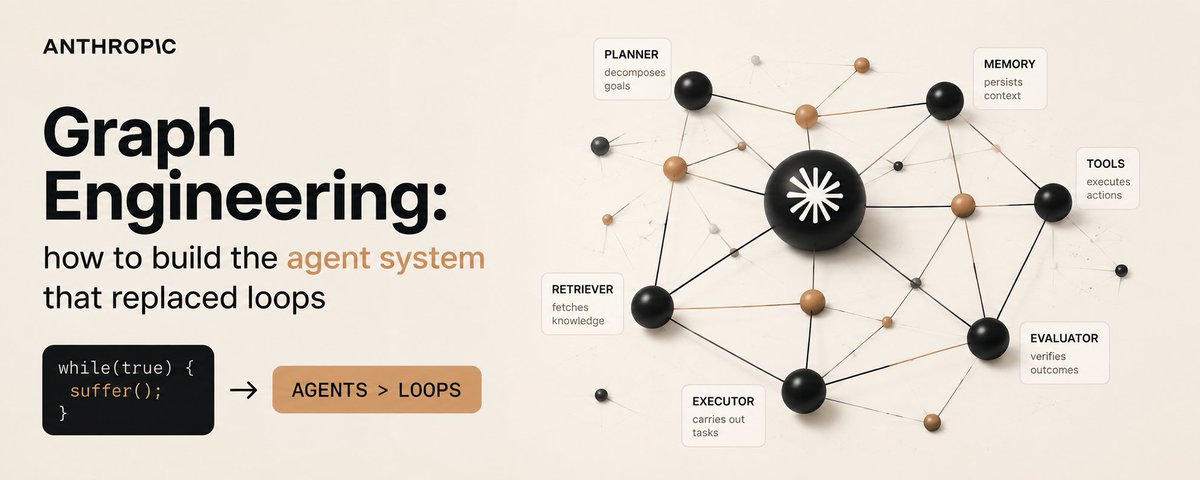
the architecture behind systems like this is in the article below↓

John Walker retweeted
I'm blown away by Grok @bot.
This is the 14-bot team that handles my inbox, research, code, and design, and I only talk to 4 of them.
(bookmark so you don't lose this)
My executive staff of Pam, Tyrion, Gilfoyle, and Rachel takes every request, hands it to their teams, and brings the finished work back to me.
I'm publishing the full video soon. It will cover:
- How to reproduce this exact setup
- How Grok Bot works under the hood
- How to add skills and integrations
- How to run it with Claude Code, Codex, or any harness
This is still a work in progress, getting better every day.
Also, name your bots after characters you actually know, because talking to Dwight feels far more human than talking to agent-3.
Stay tuned!
My AI bots sign in to @Buildium with a login saved in a vault.
When a 2FA code shows up, they don't ask me. They ask the one bot that owns Buildium, and it passes the code along.
One owner per login. I stopped being my bots' help desk.
5
John Walker retweeted

Build reliable agents for long-running tasks.
Loop Engineering with @LangChain Deep Agents: add loops that check output, trigger runs on events, and improve the harness from traces across runs. Taught by @sydneyrunkle and @EAGar123.
Enroll for free: bit.ly/4kfDJxR
Spotted 11/16/2026 in St Peterburg, Florida- New Cybercab (With Driver) performing geofencing operations. Must be on there way soon!


14
New rule for my AI bots: when a search turns up an important file, copy it to where it belongs.
Never move it. Never delete the original. File a copy in the right folder, like that property's folder, so the next bot finds it in one look.
Search once, file it, find it forever.
5
John Walker retweeted
Make predictions on tabular data without training a new model for each dataset.
In Tabular Foundation Models for Data Science Agents, built with @prior_labs, you'll give an AI agent a tabular foundation model as a prediction tool.
Enroll for free: bit.ly/4sMtNOz