

ALife, AI, information, control and applied category theory for cognitive science. - @manuelbaltieri@mathstodon.xyz - https://nitter.gq/t.co/MOzzhoDRSE
Tokyo
Joined May 2009
- Tweets4.2K
- Following501
- Followers1.8K
- Likes3.6K





Pinned Tweet
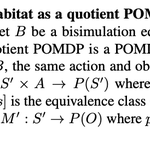
Our (w/ @yivannaviy & @RayZiyan41307) work on compositional behavioural semantics for state abstraction was accepted at ICML!
Link: arxiv.org/abs/2606.25357
State abstraction compresses an RL state space while trying to retain decision-relevant behaviour. What survives?
1/

Manuel Baltieri retweeted

Preprint time:
“Beliefs in feedback: Factored representations of interacting agents in transformers”
arxiv.org/pdf/2611.02047
Transformers predicting interactive agents build separate internal representations for tracking each of them ✨

1) Models get better at high level work with the right prompts. 2) They still get lost on and make up a lot of details.
Who cares about 1) if we can’t trust them because of 2)? The time spent checking their outputs is ~ constant, unless one only does vibe research.

OpenAI, Anthropic and other leading AI labs face a growing challenge: Better models aren't necessarily attracting more usage. A 10-point intelligence advantage now earns just 20% more developer traffic, down from nearly 69% in late 2025.
Full story: thein.fo/4hGJ9jY

Assuming we can solve 2), we then need to either 3) accept we are the bottleneck because we need to understand what these models are doing (and maybe BCI our way out of it) or 4) solve alignment for real. Neither of which seems to trivially correlate with 1).


Manuel Baltieri retweeted

I like a lot of the authors here, but someone should check the citations on this paper, some of them appear to be made-up (e.g., this isn't a real paper).


1/13 Can we assess AI consciousness without first solving consciousness itself?
New from Google DeepMind and collaborators across CS, neuroscience & philosophy:
“From cacophony to hierarchy: a principled framework for assessing AI consciousness”
arxiv.org/abs/2609.35618 🧵

Happy to see this coming together.
Great work by Anil, pushing his ideas out there to foster a much needed discussion.
I remain unconvinced by any of Anil's arguments in favour of "biological naturalism", and yet see no good evidence at the moment for machine consciousness.
1/

1/3 Conscious AI and Biological Naturalism. A veeery loooong time in the making, but I'm happy to say that the full collection is now out in @BBSJournal 🔥 I deeply thank all commentators - of fifty commentaries! - for their wise, broad, and deep opinions on this critical topic. I also thank them for their saintly patience. 🙏🏽
I remain highly skeptical about the prospects for conscious AI (for silicon digital systems), but I've learned an enormous amount from the privilege of engaging with these commentaries. Hands down one of the most rewarding experiences of my professional life.
My hope is that - whether you agree with me or not - having such a diversity of views collected in one place will serve a useful resource for discussions about consciousness and AI.
The original target article is available here: cambridge.org/core/journals/…
My response "The stuff matters: consciousness, computation, and biology" was published just now, and is here: cambridge.org/core/journals/…
And the set of 50 commentaries are collected here: cambridge.org/core/journals/…
Unfortunately these are not open access. I will try to remedy that, at least for the target & response.
FWIW there's a more accessible version of my view on the topic here in @NoemaMag noemamag.com/the-mythology-o… and also a short @TEDTalks from earlier this year ted.com/talks/anil_seth_why_…


We then propose three moves:
- push for biological naturalism as is, with tools other than PP, FEP and/or active inference
- drop biological naturalism
- take parts of biological naturalism as a new claim, and characterise its universal (biological) properties.
11/
Conclusion: can PP, FEP and/or active inference be used to motivate biological naturalism?
No more and no less than Kalman filters, Bayes theorem and/or PID controllers can.
doi.org/10.1017/S0140525X251…
Preprint: osf.io/preprints/psyarxiv/m4…
12/12

Manuel Baltieri retweeted

Prediction: the LLM community will notice that looped transformers are fixed point iteration of a learned operator, and will rediscover Halpern alg, resolvents, and other animals.. under new names (smth like "inverse residual looping").
Then they'll rediscover dynamical systems and well see "looping with auxiliary memory".
To @erikphoel’s point about “dark forest” in the era of AI.
And this won’t apply just at this scale: colleagues now can, in good or bad faith, take a few unrefined ideas discussed at some point, feed them into Claude/ChatGPT, get tens of pages out and put their name on them.

Still more absolute 🔥 from Terence Tao:
“We have now seen that even the rumor of someone working on a problem can trigger a massive amount of AI-powered effort to flatten it before the original research project has time to reach its full potential. The incentives may now be pointing in the direction of no longer sharing any promising research directions with the broader community, which would reverse centuries of traditions of open science and do serious long-term damage to the future of the field”

