

Discover the world of space, AI, and engineering.
Europa
Joined May 2021
- Tweets1K
- Following514
- Followers424
- Likes4.2K









maximum retweeted

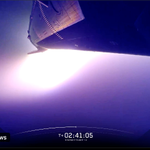
The most incredible footage of Starship in space, brought to you by @Starlink.



maximum retweeted

Getting America underway on nuclear power in space is about more than the Moon.
It is a critical step toward extending American leadership deeper into the solar system and ultimately sending our astronauts to Mars and bringing them home safely.
That next giant leap beings with SR-1 Freedom.
maximum retweeted
Correction: new fcc filing shows the booster is now also attempting RTLS (return to launch site) on flight 14, not a gulf splashdown as I said above. So this could be a double-catch attempt - booster and ship, both landing on the tower.

UPD: SpaceX is about to attempt something no rocket has ever done: catch an orbital-class upper stage out of the sky.
Flight 14 will send Ship 41 all the way around Earth - the first fully orbital Starship flight - then try to land it back on the launch tower's arms.
Why now: Ship 40's splashdown on Flight 13 was precise enough that Musk confirmed it "would have been caught by the tower arms." That cleared the engineering bar SpaceX set before risking a catch over land.
The hard part isn't the booster (already caught multiple times since 2024). It's the ship - it has to bleed off full orbital velocity, survive plasma reentry, then flip from a horizontal belly-flop to a vertical hover with centimeter-level precision between two steel arms.
Booster 21 will still splash down in the Gulf - no tower catch for the booster this time, until SpaceX nails down what went wrong on Flight 13's landing burn.
If it works: full reusability gets real. If it doesn't: still the most ambitious catch attempt in spaceflight history.
maximum retweeted
Elon Musk personally gave a tour of the Tesla factory in Fremont, California to Israeli Prime Minister Benjamin Netanyahu and his wife Sara.
During the visit:
- They walked through the production lines
- Discussed Tesla’s latest developments
- Took a ride in a Cybertruck prototype
- Later held a public conversation on artificial intelligence (which was broadcast live)

maximum retweeted

SpaceX is hiring exceptional engineering & skilled trades talent to build & operate the most powerful AI supercomputer clusters on & off Earth.
If interested, please email 3 bullet points demonstrating evidence of exceptional ability & your resume to [email protected].
maximum retweeted
I really love reading about space technology, and here's one of them:
"But, Houston, we have a problem 😅😊
🚀 NASA's Moon Spacesuit Won't Work on Mars — It Needs to Be 40% Lighter a fully loaded xEMU spacesuit weighs around 170 kg (375 lbs).
On the Moon, that's not a huge issue—it only feels like 28 kg, thanks to lunar gravity being just 1/6 of Earth's. But on Mars, where gravity is 3/8 of Earth's, that same suit would effectively weigh 64 kg on an astronaut's shoulders.
According to engineers from NASA and its contractors, that's simply too much.
At the 55th International Conference on Environmental Systems (ICES) in Puerto Rico, the team presented a clear conclusion:
The current generation of lunar spacesuits is not suitable for Mars.
To find the target weight, researchers modeled a 50 kg astronaut (a conservative safety case).
After accounting for occupational safety limits and the suit's internal pressure, they concluded that a Mars EVA suit should weigh no more than 104 kg—roughly 40% lighter than today's xEMU.
Why is this so important?
Imagine an unpressurized rover breaking down several kilometers from the habitat.
The astronauts now have to walk back.
Every extra kilogram means more oxygen consumed, and the oxygen supply inside the life-support backpack is strictly limited.
Even with a lighter suit, NASA recommends keeping astronauts within a 30-minute return window—about 1.8 km (1.1 miles) from the rover at a walking speed of 3.5 km/h.
So where can they cut 40% of the weight?
Today, roughly 60% of a spacesuit's mass comes from the Portable Life Support System (PLSS), while the remaining 40% is the pressure suit itself.
NASA's engineers suggest abandoning the highly modular design of xEMU and returning to a more integrated architecture—similar to the Apollo A7L suit—where structural components served multiple purposes, dramatically reducing overall mass.
The trade-off?
Less redundancy:
Apollo suits were designed to tolerate one major failure, while xEMU is built to survive two.
The first humans on Mars may have to accept that compromise if they want to explore farther—and make it back home.🏡🇺🇸
Source: by Andy Tomaswick & NASA


And now let’s talk a little about space.
Astronomers have found a nearby analog of the mysterious “little red dots” (LRDs) that the James Webb Space Telescope keeps discovering in the early universe.
The spiral galaxy WISEA J123635.56+621424.2 has such prominent arms that researchers nicknamed it “Saguaro” (after the famous cactus). At its center sits a compact red core that looks exactly like an LRD. The galaxy sits at redshift z = 2, meaning we see it as it was about 3.3 billion years after the Big Bang.
A team led by Pierluigi Rinaldi published the analysis on July 29 in The Astrophysical Journal.
Key findings:
LRDs were common around 600 million years after the Big Bang but nearly disappeared by 1.5 billion years (341 known as of 2025).
They are extremely compact (often under 150–500 light-years across).
Their spectra suggest actively feeding supermassive black holes, yet they are almost invisible in X-rays — a long-standing puzzle.
Saguaro was a lucky find:
a Webb microshutter happened to land directly on the core, so high-quality spectroscopy already existed. Combined with Hubble ultraviolet and Chandra X-ray data, the core appears bright in UV and infrared but faint in visible light and X-rays — exactly like the distant LRDs. It is a heavily dust-obscured active nucleus.
When the team artificially redshifted Saguaro to early-universe distances, the spiral arms and disk vanished into the noise, leaving only a bright red point. This suggests many distant LRDs are simply the unresolved, dust-buried cores of more normal galaxies hosting hyperactive black holes.
In short, LRDs may not be a unique class of objects, but a short evolutionary phase. The team now plans to hunt for more local “descendants” of these early red dots in existing Webb archives.
Source: NASA
ps. If you want more videos like this, subscribe - there’s a lot more coming😊

maximum retweeted
This is one of the rarest Elon Musk rare lost Interview - from 2007.
He was 36. Almost no one took SpaceX seriously yet. Tesla was just about to release its first Roadster.
And Musk was already saying this:
The three things that will change the future of humanity: the internet, space, and the transition to solar energy with electric vehicles.
We’re not running away from Earth. We need to become a multi-planetary species.
The Moon is “been there, done that.”
The real goal is Mars.
About Branson, Bezos and the rest:
“We have no serious competition. None.”
Almost 20 years ago he already saw the entire picture.
And almost everything from that interview later came true… even though almost no one believed him then.
maximum retweeted
Watch Starship's thirteenth flight test nitter.gq/i/broadcasts/1MKgNNXAZ…

maximum retweeted
It's becoming more transparent now and continues to gain traction.🧐
I just watched someone turn a text prompt into a cinematic video in 4 steps.
No film school. No production budget. No team.
Here's the exact workflow:
Type your idea, ChatGPT Image 2.0 spits out a storyboard frame, drop that frame into Seedance 2.0 as a reference, ask it to make a full video sequence. Done.
The storyboard isn't a rough sketch you'd show a client apologetically.
It's a cinematic frame with locked composition, lighting, character pose, and camera angle — precise enough to direct an AI video model like a real director would.
430K people read this guide this week.
254 liked it. 52 reshared it.
You know why?
Because people are realizing the gap between "I have an idea" and "I have a professional video" just collapsed into a single afternoon.
ChatGPT Image 2.0 is your pre-production department.
Seedance 2.0 is your camera crew.
You're the director.
$33/month. 4 steps. Cinematic output.
The tools are here. The workflow is public. The only question left is what story you're going to tell. 🎬
Video Tik-Tok: benkaluza-tech


maximum retweeted

📖SEEDANCE 2.0 4K costs $10-12 for a 15-second clip — Is it actually worth it?
One creator took the exact same reference image and prompt, then rendered it in 720p, 1080p, and 4K to find out.
Here’s the real pricing breakdown for one 15-second clip:
• 720p → ~68 credits
• 1080p → ~135 credits
• 4K → ~330 credits (~$10-12)
The price jump is massive. But is the quality jump worth it?
What the test actually showed:
✅720p — Fine for simple, slow shots, but details fall apart fast in close-ups and textures.
✅1080p — The sweet spot. Most people called it “totally worth the credits.”
✅4K — Clearly wins on texture-heavy scenes (fur, water droplets, skin, metal). The difference is obvious when you zoom in and compare side-by-side.
Bottom line:
• For client work and final delivery → 4K is worth it.
• For testing, iteration, and most social content → 1080p gives you 90% of the result for a third of the price (and you can generate 2-3 versions instead of one).
Biggest lesson: Your reference image quality matters way more than the resolution slider. A weak reference kills every version.
(Seedance 2.5 isn’t out yet, but this pricing pattern is worth watching.)
Want the exact prompt structure that delivered the sharpest results across all resolutions?
📥Tomorrow I want to share something more interesting with you
🔖In the article below, I described a guide to using Dreamina




maximum retweeted

This year, the EF is decreasing its budget by roughly 40%, which entails some difficult decisions. The goal of the decreases was set out in the Treasury Management Policy last year: the EF is transitioning into being a long-term-oriented endowment-based organization, shifting from its pre-2026 average of spending ~15% of its remaining funds each year, toward a post-2030 target of ~5% per year.
Often, when an organization goes through something like this, people try to pretend that nothing of great value was lost, that it is an efficiency increase, that the only people cut are unproductive dead weight, and everyone else stopped partying, studied the blade, entered cracked S-tier beast mode, and this was sufficient to make up for the downside. I will not try to pretend this. I respect my EF colleagues far too much to pretend that there was not much that is lost. They are brilliant people. They are dedicated engineers of whom some have worked on the Ethereum protocol for nearly a decade. They have brought a bright light to the Ethereum ecosystem with their code, their words, their warmth as human beings and their actions. My dearest hope is that they find a path that brings them fulfillment and happiness whether inside Ethereum or outside. Hopefully many will be able to bring their excellent talents and mindset to the wider Ethereum ecosystem, or the even wider CROPS world.
Instead, I will try to explain what *are* some of the grand sacrifices being made. The Ethereum Strawmap is no small thing. It is an extremely ambitious undertaking seeking to replace and augment almost every part of the protocol - consensus, proofs, privacy, account model, state, and more. This is the third iteration of Ethereum, in the same way that the Merge was the second, even if the shipping style is less Big Bang and more one-piece-at-a-time. On top of this, the EF is increasing its role in the Access Layer. We are not compromising on Ethereum being a Deeply Impressive protocol, something worthy of its place in a world with quantum computing, rockets to Mars and powerful biotech and AI, and capable of meeting the challenges that this era will bring.
Some of the deficit will be recovered through more work happening outside the EF. But not all. So what are the grand sacrifices that will enable a leaner effort to accomplish all of this? I will give a few examples (though far from an exhaustive list):
* The multi-client model will shift in the direction of multiple clients existing less for _redundancy_, and more for _specialization_. Up to this point, redundancy has been the main security strategy: if one client has a bug, if it has less than 33%, the chain keeps going and does not even stop finalizing. We are increasingly exploring moving more pieces of the protocol to a different security strategy: AI-assisted formal verification. Some smaller pieces of Ethereum (eg. BLS libraries) have worked this way already for a long time. But soon many more parts of Ethereum will likely function on this model. This may greatly reduce resource requirements of shipping a large number of EIPs. The resources saved by client teams can ideally instead be used to better serve different specialized user needs, including EF Access Layer goals.
* PSE (Privacy and Scaling Explorations) is winding down as a unit. The number of people working on ZKPs for privacy and scaling is probably as high as ever, but they are working less on "exploration" and more on *implementing* ZKP-based privacy and scaling into the Protocol and Access Layer
* Devcon will likely over time become smaller-scale, somewhat more spartan, much lower-deficit than previous years, in addition to other changes in vision in line with the Mandate.
* Fewer beyond-Ethereum megaprojects coming from EF. As I announced earlier this year, I am taking on some of the responsibility of doing projects in this category that I consider valuable with my personal funds.
* EF institutional work is reducing in scope, specializing more specifically on creating replicable test cases of highly CROPS-friendly deployments, even if at smaller scale.
These do not explain all departures; in some cases they do not explain departures at all and rather explain _reduced need for new spending_. But they are a large part of the strategy at play.
In the longer term, I personally favor a "soft lean-and-done" approach to Ethereum: once the Strawmap is completed, generally stick to security fixes and small high-value changes, and have a much higher bar for considering new feature additions to the protocol. This allows Ethereum to remain capture-resistant without demanding very large budgets. Learn less from multimillion-line-of-code behemoth projects, more from bitcoin.
The past years have been a challenging era for Ethereum. However, the ecosystem is adapting, both inside the EF and outside, and I am confident that Ethereum is very well-positioned to succeed and thrive.
firefly.social/post/x/206940…

maximum retweeted
Scam Altman and Greg Stockman stole a charity. Full stop.
Greg got tens of billions of stock for himself and Scam got dozens of OpenAI side deals with a piece of the action for himself, Y Combinator style. After this lawsuit, Scam will also be awarded tens of billions in stock directly.
The fundamental question is simply this:
Do you want to set legal precedent in the United States that it is ok to loot a charity? If so, you undermine all charitable giving in the United States forever.
I could have started OpenAI as a for-profit corporation. Instead, I started it, funded it, recruited critical talent and taught them everything I know about how to make a startup successful FOR THE PUBLIC GOOD.
Then they stole the charity.

Interesting how it works
Elon puts up his own money, rounds up the absolute best AI talent on the planet, leverages every connection he has to secure serious resources, and launches OpenAI in 2015 as a pure non-profit explicitly created to develop AI for the benefit of humanity, with zero profit motive and open research
Then the “team” decides they want the bag
They push Elon out, take control, and quietly flip the entire thing into a for-profit machine
All while preaching the same sanctimonious lines on repeat: “We’re still mission-driven!” “AI for the good of humanity!” “We’d never abandon our principles!”
The ultimate betrayal:
Elon got zero equity. Not a single share. He funded it. He built the foundation. He got nothing while they turned his non-profit into their personal cash cow
This is the level of betrayal and hypocrisy we’re dealing with
And for the record.... this lawsuit doesn’t put a single penny in Elon’s pocket. Any win goes straight back to the non-profit to restore the exact mission he founded

maximum retweeted

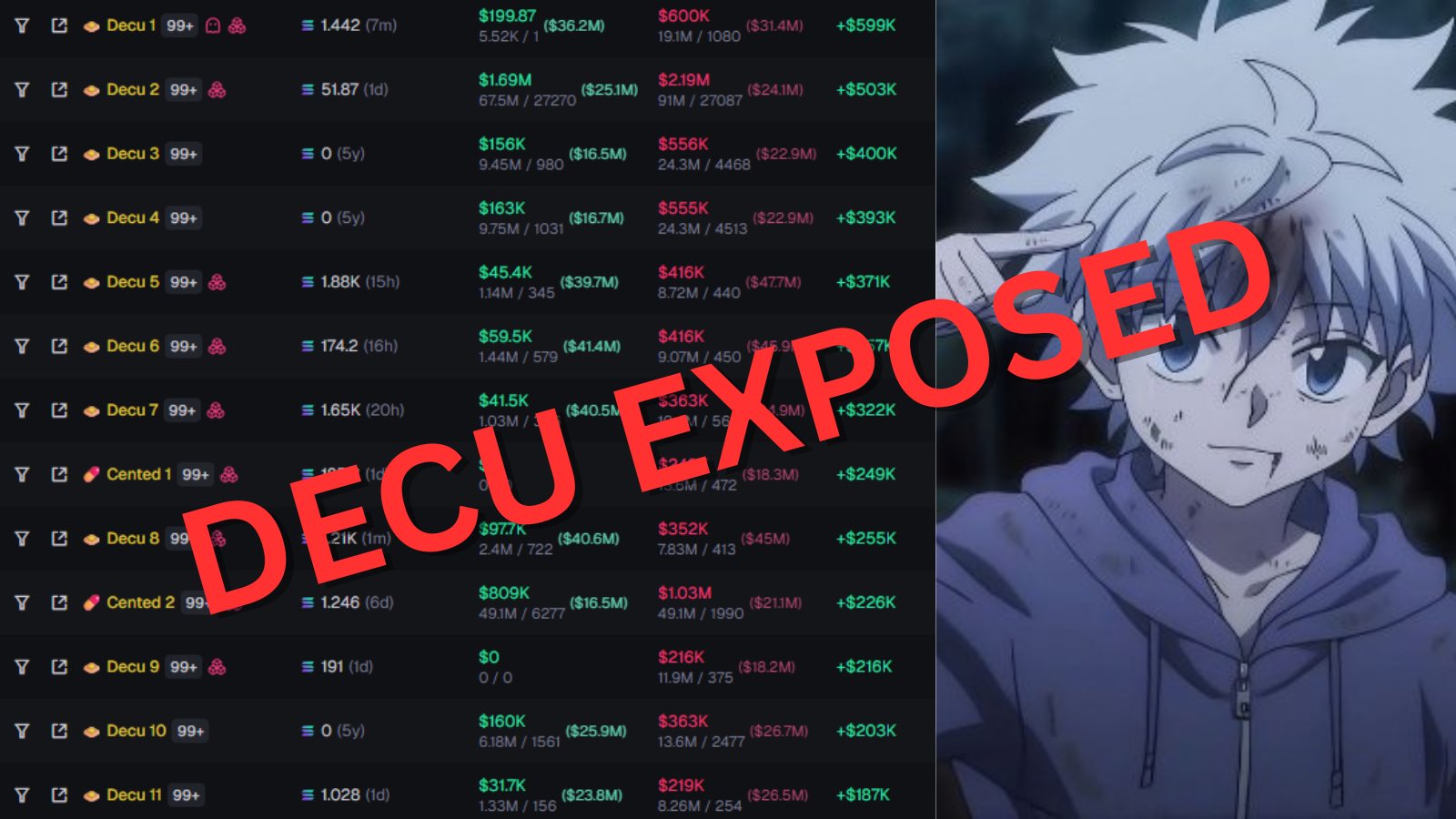
.@notdecu was secretly behind the $WAR token
The war coin is a rug that insiders profited millions from, and even had a Kraken listing
So I decided to dig deeper, and after going over the funding it all linked back to Decu’s wallet
Any other proof? Yes, Decu has many deep connection with KOL’s such as @flipski77 and even MellowMetrics (bonk manager)
We can’t keep letting these scammers dry up the liquidity and steal from normies, let’s end this now!
maximum retweeted

FYI for those who don’t know
He got drained by clicking + downloading something from Google Ads
Srsltid parameters in URLs = search result source listing ID
And as we all should know crypto search results especially sponsored ones can be spoofed and malicious
And you should never type ur seed phrase anywhere that’s not how you connect to ledger live nor should you google websites (best to Twitter search the company and then type it out yourself)


ok, let me make everything clear. it got people kind of confused but now I understand more what happened, this is the full story (may some stuff here wont be relevant but im just sharing):
Downloaded yesterday steam (on my macbook), bought a game called "balatro" using eneba (paid with crypto) but I didnt connect any wallet, I just send money to the provided address.
I sent that through my hot wallet (CgJQgJBNYf2DDiHoqxDsRFaTEvHNTAboybetKr7xmGuk)
then later that day I opened my ledger app on my pc, wanted to check if a client sent me money and for some reason the ledger app didnt load, just saw the ledger logo, tried to opened it mul times/restart the pc etc.
So I decided to delete and download it again. downloaded from the official site (added a screenshot because I don't want people to click on it)
I got asked to put the seed phrase, I didn't think much so because I downloaded it from the original ledger site and I'm 100% sure of it. brought my paper and wrote it down.
Then today I got drained for everything I had, literally now I have 0 to my name.
now the question is how it was possible if I downloaded the right ledger app? maybe a virus made fake popup/RAT...idk really
currently i dont know what to do, In a serious emotional turmoil, and I feel like I can't make it back.


