Pinned Tweet
16 years of consistency is all it takes to unlock greatness. Are you willing to do what you're doing for that long? Are you willing to outlast everyone?
Progress Update: On Goal to Build 8+ Tools & Applications
So far, 5 out of 8 are live, with the remaining three planned for release in the near future.
Here's what we've built and what we're still working on:
1/8: Izu Igbo Calendar — LIVE izuigbocalendar.com/
A digital calendar designed to help anyone, anywhere in the world, keep track of the traditional Igbo market week alongside the Gregorian calendar.
2/8: Ilu Finder — LIVE ilufinder.com/
An Igbo proverb and language database designed to make it easier for people to learn and improve their fluency in Igbo through well-documented proverbs. We're also building it to serve as a language resource for future technologies that need to incorporate Igbo.
3/8: KWUO — LIVE igbolanguagebuddy.com/
An interactive Igbo language learning platform featuring games, with plans to expand into verified Igbo language tutors, text-based learning, and voice chat experiences.
4/8: Afa Ugiri Simulator — LIVE afasimulator.com/
A modern learning and practice tool for anyone interested in studying and mastering the divinatory language of Afa Akpukpala/Ugiri.
5/8: Igbo Content Creators Directory — LIVE igbocontentcreatorsdirectory…
A directory that makes it easier to discover Igbo content creators, learn from their work, connect with them, and explore opportunities for collaboration.
6/8: Igbo Astrologer — COMING SOON
A tool designed to help people explore their astrological charts through the lens of Igbo indigenous knowledge and cosmology.
7/8: Undisclosed — TO BE REVEALED
We'll share more about this one soon!
8/8: Undisclosed — TO BE REVEALED
Another project we're looking forward to introducing when the time comes.
Each tool is still a work in progress, and there's plenty of room for improvement.
We'll continue refining their features, expanding what they can do, fixing issues as they arise, and learning from how people use them.
My hope is that, year after year, these tools will simply become more useful, more accessible, and better at serving users.
Expect more updates!
My Goals for Preserving & Sharing Igbo Worldview
✯ 1,000 Odinani Insights articles through Oma’s Garden
✯ 100 profiles celebrating remarkable Igbo legends
✯ 1,000 in-depth teachings on Igbo cosmology through Odinani Mystery School
✯ 8+ tools & applications
✯ 50+ books
✯ 10 free audiobooks
✯ 10+ free films & animations
✯ 11 specialized online programs
Check every box, then look back and say: I contributed my own little part to preserving and carrying Igbo worldview forward in modern times.
Oma 👣 retweeted
You see these two gigantic books on Igbo language? Just pick one and study it every day for nine months. All the Igbo neurons in your brain will start activating, and before you know it, you'll be thinking deep thoughts in Igbo within a year!
Oma 👣 retweeted
AKA M DỊ ỌCHA by Chinedum E. Ofomata
Reading literature written in Igbo language has quickly become one of my favourite activities lately. It's so mentally satisfying!
This story was too short!! And the author left us on such a serious cliffhanger, but I understand that's his storytelling format. The storyline really pulled at my heartstrings.
Chai!!
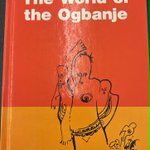
Professor Chinwe Achebe, what a brilliant woman!
Her book, The World of the Ogbanje, published in 1986, remains one of the most monumental works of research on Igbo spiritual worldview.
She turned 91 this year and still looks at least 20 years younger than her age. What a remarkable woman!
Replying to @Victorokeke_ @favogbuji
You know Chinua Achebe wife was very educated and when he talked down on women his father in law cautioned him not to do that if he has hopes of marrying his daughter. He learnt that women opinion were very important as men. You are a good observer.
AKA M DỊ ỌCHA by Chinedum E. Ofomata
Reading literature written in Igbo language has quickly become one of my favourite activities lately. It's so mentally satisfying!
This story was too short!! And the author left us on such a serious cliffhanger, but I understand that's his storytelling format. The storyline really pulled at my heartstrings.
Chai!!
Oma 👣 retweeted
Igo mmuo is simple:
1. Clean up.
2. Call on your energies.
3. Express gratitude.
4. Express your desires.
5. Repeat daily.
Most people don't do it because they've attached the activity to a particular space. You can do it anywhere.
Connect with your Chi and stay the course.
Oma 👣 retweeted
SHE WAS THE LAST FLUENT SPEAKER OF HERO ANCESTRAL LANGUAGE, SO SHE DEVOTED THE FINAL DECADES OF HER LIFE TO MAKING SURE 6,000 WORDS WOULD NOT DIE WITH HER.
WOMEN GET SHIT DONE❤️
Oma 👣 retweeted
Why Many Dibias Avoid Eating Akpu (Cassava) 🍠
In Igbo spiritual practice, many Dibias and individuals who hold certain traditional spiritual titles are advised to abstain from eating cassava, commonly known as Akpu. But why?
Afa Akpukpala identifies this food crop as Ajo Nri, meaning bad food, something considered potentially harmful to the body and capable of becoming nsi (poison).
There are two main reasons behind this understanding.
1. The poisonous nature of raw cassava
When cassava was first introduced into Igboland, our ancestors observed that it could be poisonous when eaten raw or improperly prepared.
Today, we know that cassava naturally contains compounds called cyanogenic glycosides, which can release toxic hydrogen cyanide when consumed.
This is why cassava requires proper processing, including peeling, soaking, fermenting, drying, or thorough cooking, depending on the variety and preparation method, before it is safe to eat.
2. Its perceived effects on spiritual communication
Through observation and divination, Dibias also came to understand that even after cassava had been properly processed for consumption, it could still interfere with spiritual work.
Within this traditional understanding, eating cassava is believed to create energetic blockages that affect a practitioner's ability to receive and transmit spiritual communication, maintain the energetic state required for certain spiritual practices, and effectively channel divine intelligence.
This second explanation belongs to Igbo spiritual belief and practice, which was relevant to ancestral living.
When these two considerations are taken together, it becomes easier to understand why abstaining from cassava developed as a dietary practice among certain Dibias, initiated priests, and traditional titleholders.
This is why, even today, some well-trained Dibias and initiated practitioners are advised to avoid eating Akpu as part of their spiritual discipline.
Have you come across this practice before? Do you know a Dibia or traditional chief who doesn't eat Akpu?
Now you have a better understanding of the reasoning behind it.
You see these two gigantic books on Igbo language? Just pick one and study it every day for nine months. All the Igbo neurons in your brain will start activating, and before you know it, you'll be thinking deep thoughts in Igbo within a year!