

#Bitcoin & #lightningnetwork developer & educator demanding open knowledge! Proud member of @wikimediaDE @de_Serlo & former #BTW17 Frontrunner of @piratenpartei
Gjøvik, Norge
Joined January 2011
- Tweets11K
- Following291
- Followers33K
- Likes12.8K




Pinned Tweet
Guess who received (& send back) 2 LARGE (!) mainnet #Bitcoin payments from @stefanwouldgo over the #LightningNetwork!
1st payment: 0.3679 BTC (345 parts minSplitSize: 10k sats)
2nd payment: 0.286 BTC (80 parts minSplitSize: 100k sats)
Teamwork makes the dream work!
1/4

Optimally Reliable & Cheap Payment Flows on the Lightning Network
the joint work with @stefanwouldgo is now (as promised) in the #open: arxiv.org/abs/2107.05322
This method should allow us to
⚡️ send large #Bitcoin amounts over the #LightningNetwork ⚡️
Thread: 1 / 15

If Bitcoin failed what would be the reason?
11%LLMs solving DLP
19%Quantum computer
50%World looses Interest
20%other (write comment)
1,372 votes • 4 hoursMultiparty Channels for the win (; looks very interesting.

Announcing LayerTree: a new tree-based scaling solution for Bitcoin that permits O(1), independent of the number of users in the system: xitter.cf/lightning/status/21108…
A single UTXO can hold the balance of millions of users as an off-chain Merkle-sum tree.
Transaction introspection techniques permit batched exit from the system in a single transaction w/o any pre-signing: layertree.tech
Rene Pickhardt retweeted

🇩🇪Private Chats und Mails aus der #Chatkontrolle 1.0 landen ausgerechnet in Palantir-Systemen - skandalös!
Betroffen u.a. Direktnachrichten über Instagram, TikTok, Discord, Snapchat, Skype, Xbox, Gmail.
Details hier:
arvidgrange.substack.com/p/i…
#StopScanningMe
In light of recent events and technological breakthroughs:
Is software becoming less valuable?
Seeing what coding agents build I am amazed and worried at the same time. Don't know if I feel more amazed or more worried.
Thank you @niftynei and the entire @btcplusplus team as well as all the volunteers for creating an amazing conference again! It is so important that we talk more about payments as this is an important part of what bitcoin is about
In case you didn't know and windered why bitcoin doesn't have confidential tx:
hidden inflation bugs in monero have always been the concern.

Liquid hack explained.
Liquid has confidential transactions that hide the amounts for improved privacy. A bug in how these transactions are validated caused inflation of Liquid BTC (L-BTC) and allowed hackers to empty the entire side chain.
Liquid nodes don't see the amounts of a confidential transaction, so to make sure that the transaction is still valid and doesn't cause inflation nodes check something called a balance proof and a range proof.
The balance proof establish that sum of the input amounts equal the output amounts, i.e., that "x L-BTC going in and x L-BTC going out". But there's a catch. Only relying on a balance proof isn't enough. You also need the range proof.
The range proof establishes that a hidden output amount falls within a positive range. That means a valid output must be at least 1 L-sat and at most 2^64 − 1 L-sats. Range proofs make sure that you can't mint "negative L-BTC".
Why is this even necessary? Remember, the amounts are hidden and a hidden negative amount would allow extra positive outputs to balance against it. Without a range proof, a transaction could say "I've put 1 L-BTC in, and I'm taking two outputs out: one with 4000 L-BTC and one with -3999 L-BTC)."
This is going to cause a disaster in a little bit.
Once the balance proof, the range proof, and other validations pass, a transaction is regarded as valid and can pass consensus. However, because especially the range proof is computationally expensive, Liquid nodes cache the result of a successful range proof in memory. Essentially, the node remembers "I saw this range proof before and it was valid, all good!".
In order to recognize the same range proof later on, you need to assign a label to it. This is called a cache key. This cache key is the actual cause of the bug.
The way this cache key was constructed allowed two different transactions to collide on their cache key. Essentially, one valid transaction (1 L-BTC in, 1 L-BTC out) had the same cache key as an invalid transaction (1 L-BTC in, 4000 L-BTC out).
Here's the hack: the attackers submitted the valid transaction (1 L-BTC in, 1 L-BTC out) first. Liquid nodes verified this transaction successfully, created a cache key called REKT and stored it in their cache. Then the attackers carefully crafted a second invalid transaction with (1 L-BTC in, 4000 L-BTC out) that created the same cache key REKT.
Instead of validating the second transaction and realizing that it printed money out of thin air, Liquid nodes found it in their cache and said "hey I saw this transaction before, everything is fine" and that caused the inflation.
The attackers then took their 4000 L-BTC and withdrew 4000 BTC onto the Bitcoin base chain.
Note: I might have gotten some details wrong, and I'm aware that I simplified quite a bit. I wrote this post to help people understand what happened. Please feel free to correct me in the comments or add more details below.
Rene Pickhardt retweeted

Well, seeing that our @Core_LN pre-announcement caused a bit of a kerfuffle, let me talk about the what, why, and when of the upcoming CLN v26.06.7 point release. 🧵
First of all: no need to panic. We are not aware of any vulnerability being actively exploited. 1/6
Rene Pickhardt retweeted
Uff kind of the panic we were hoping to avoid. To be clear the strategy here is multi-layered: we will publish AA point release in the next 48h, as binaries only, embargoing the source patches for 14 days to prevent attackers reverse engineering them to exploit them.
In my leasure time I vibe coded a chess app using codex. (I might put it online eventually...)
But I am hearing also compelling stories about Claude.
Anyone here hosting latest deepseek model themselves and has experience how strong those are?
Anyone tried more than 1 model?
Rene Pickhardt retweeted

LLMs are used very successfully to find vulnerabilities in Bitcoin software.
Can they also help prove the security of a modern cryptographic library for Bitcoin?
To explore this question, @remix7531 and I are publishing libshrincs.
delvingbitcoin.org/t/libshri…
libshrincs is a handwritten C library implementing WOTS+C, the one-time signature used by SHRINCS.
It is a proof of concept and should not be used in production.
Its machine-checked proofs connect the C implementation to an unforgeability theorem.
The current theorem does not yet give a full post-quantum security bound.
The post and review tutorial describe its current limits.
Code and proofs:
github.com/remix7531/libshri…
Review tutorial for the security proof (no Rocq or SSProve background required):
github.com/remix7531/libshri…
@remix7531 has written three excellent posts on the library and verification work:
Towards libshrincs
remix7531.com/post/towards-l…
The grind was the only detector
remix7531.com/post/the_grind…
Choosing a verification toolchain
remix7531.com/post/choosing_…

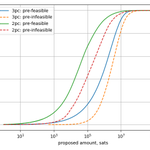
I empirically tested the mathematical theory of payment channel networks.
I simulated 1 million payments on the 2-party channel LN, compared to a 3-party channel Network (same total cap)
Supported amounts increase by almost two orders of magnitude! Payment Failure rates halved!


Today was an excellent day for Bitcoin. It demonstrated perfectly that it worked as it supposed to work.
Rene Pickhardt retweeted

We expect more critical vulnerabilities to be found and patched in the coming days. Keep an eye out for updates via official channels.
opensats.org/blog/ongoing-ex…

If you run @BtcpayServer you probably need to act now!

There is a critical vulnerability being actively exploited on BTCPay Server, which can result in the loss of funds.
Please update your BTCPayServer to 2.4.2 by going to Admin Dashboard -> Server -> Maintenance -> Update & verify the 2.4.2 version string in the footer.
If you are unable to update right away, turn off your BTCPay Server to prevent unauthorized access until you can update.
I felt too ashamed to admit it:
Despite its potential upside I never bought much #Bitcoin because security & key management always freaked me out.
Even with perfect entropy there is still storage risks, software risks, advances in math / technology that could break cryptography
I understand everyone is found to burn millions of tokens for AI review and I am sure it's great but I just did my tiny bit in the good old fashion for @ElectrumWallet
github.com/spesmilo/electrum…
wondering if @callebtc or @Rob1Ham found anything more critical in electrum.

I understand the anger towards @nvk after the coldcard clusterfuck. As a former @OpenSats grantee I disagree with some of their decisions - e.g. to stop supporting me.
But the heat in this post especially towards @ODELLXYZ is misplaced. He built a great funding vehicle for FOSS.



Studying the limits of lightning I may have become a bit operationally blind and too critical. I In order to publish a small improvement I just used the pickhardt payments library for an experiment and I am amazed how many payments actually can be delivered when feasible
With respect to funding independent open source research & development. If anyone has an answer I'd be curious.