

AI apps @ google; past: eng lead @Subnautica, Game Builder https://nitter.gq/t.co/upyvgJuTT0, google poly gfx (RIP), https://nitter.gq/t.co/gxcEO6Q6hl; he/him
NYC
Joined February 2009
- Tweets32.5K
- Following500
- Followers804
- Likes10.6K





mastodon.gamedev.place/@Steverock retweeted

When I was writing Unreal Engine 1, my time was divided as follows:
- Around 30% went to seriously deep coding on hard problems: assembly language texture mappers, C++ BSP trees, data persistence, object oriented systems design, and networking.
- Around 70% was just typing and refactoring large bodies of code needed for a complete engine feature set. This was not hard, and while I was doing it my mind was mostly on the deeper coding topics, thinking and planning for what's next. It didn't feel much different from vibe coding today, except that it was just me typing code on an IBM Model M keyboard rather than prompting it and reviewing the results.
So, it has always seemed perfectly logical that we would rely on AI for that 70%, once the AI could do it with a similar quality standard as we could, which has never been perfection. It came as no surprise that, after a few years of AI model evolution, it was able to take the reigns on that 70% and free up programmers' time for more valuable tasks.
What's more of a surprise is the emergence of AI as a sort of insta-Carmack able to solve hard technical problems quite cleverly and often cleanly, and that it's able to reason about and work in complex 3D scenes both by operating the tools and by directly understanding the raw data files.
I abandoned assembly language in 1998 when out-of-order CPUs made much simpler C/C++ code faster, and never I missed it. If prompting through architectural documents, concept art, and design plans can transcend typing code and tweaking vertices, that will enable developers to spend their time on higher-level, higher value technical and creative tasks.
What matters is the end product, whether it's a game or an engine. Anything developers can do to try out more ideas and make better software and games faster is a win for everyone.
mastodon.gamedev.place/@Steverock retweeted

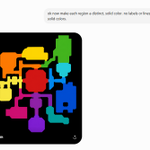
Essentially a one shot.
It did generate 20ish “mood” images and I told it to use those 5.
That was the extent of my input
mastodon.gamedev.place/@Steverock retweeted

Same happened with game digital distribution. Game dev wasn't locked anymore behind big publishers. Massive amount of indie games now, but 99% of them sell nothing. Visibility is more important than ever. Especially in the AI era. And you need to differentiate.


mastodon.gamedev.place/@Steverock retweeted

I've been working on structural integrity and stress simulation for the last couple of weeks. Still not sure this is viable for a full game in terms of performance, but maybe. Can now handle one building at 60 fps, but still a lot of optimizations left.
mastodon.gamedev.place/@Steverock retweeted

This is awesome!

We built a small biped robot you can teach new tricks to.
Train it in simulation, run it on the real thing. Meet Microduck 🦆
$399, shipping before Christmas.
pollen-robotics.com/microduc…
github.com/pollen-robotics/m…
mastodon.gamedev.place/@Steverock retweeted

Few people care more about software performance than @cmuratori. Give him a few minutes of your attention with this episode, and he'll convince you to learn to read Assembly (no, really, I finally started to read it, it's really not that scary, esp with an AI that can help explain the sequences). Timestamps:
00:00 Intro
05:17 Games at Microsoft
12:52 Building games
16:00 Why performance matters
27:12 Why you should learn to read assembly
30:36 Designing for optimization
42:51 How to get better at writing performant software
49:04 Understanding how the CPU works
55:53 Building games then and now
1:05:56 How game engines changed building games
1:10:48 Why new games compete with old games
1:13:25 GTA 6: why is it taking so long?
1:16:59 Casey's critique of clean code
1:21:48 Casey's take on TDD
1:24:30 What is good code?
1:27:32 What makes a good software engineer?
1:33:56 Why Casey doesn't code with AI
1:39:01 AI's impact on the game industry
1:44:43 AI and burnout
1:50:21 Why you should read papers
Brought to you by:
• @AntithesisHQ – verify your system’s correctness without human review or traditional integration tests – and avoid bugs or outages antithesis.com/pragmatic
• @sentry – application monitoring software considered “not bad” by millions of developers sentry.io/pragmatic
• @turbopuffer – a vector and full-text search engine built on object storage. It’s fast, cheap, and extremely scalable turbopuffer.com/pragmatic
Three interesting things we talked about:
1. Is performance starting to matter to businesses?
Enterprise software buyers care mainly about cost, compliance, and capabilities – but not performance. Even so, there are some products gaining major popularity and market share due to their performance, such as File Pilot (next-gen file explorer) and the Blick video editor. Is the tide turning?
2. Profiler-driven performance optimization is the wrong way to optimize
The standard way of optimizing is to profile the application, tweak hotspots, then check if the stats have improved. But this only finds a local minimum; Casey says every engineer he’s worked with who was a great “optimizer” began by establishing what the hardware could theoretically do, and then did not stop until they’d closed the gap to that performance level.
3. Take a grain of salt with conventional wisdom that premature optimization is the “root of all evil”
Many devs use it as an excuse to delay performance optimization, but Casey says that not optimizing in time could mean that only performance hotspots can be fixed later, and not the architectural issues that create poor performance. Architect your system to be performant, or you’ll have trouble solving problems without a rewrite!
mastodon.gamedev.place/@Steverock retweeted

In a perfect world, @valvesoftware ends up purchasing id software and allows them to go independent over time. It'd prob never happen but it would be a amazing full circle moment for legacy and history preservation.
mastodon.gamedev.place/@Steverock retweeted

As the cost of making a game prototype goes to nearly zero, we are seeing an emergence of an entire new game genre - game jokes.

mastodon.gamedev.place/@Steverock retweeted

A heartfelt Fuck You to @Adobe
>I dowloaded a free trial
>Cancelled before trial was over
>Still got billed for a monthly subscription
>Cant cancel my subscription or I get hit with a $99 cancellation fee.
This is the scummiest fucking shit.
I never WANTED this subscription

mastodon.gamedev.place/@Steverock retweeted

People who say:
"I never review the code my AI agent writes"
Do you mean:
"I used to review it, but it was perfect every time, so now I trust it so much that I don't need to"
Or:
"The code is difficult to review and I lowered / removed my standards in order to move faster"


mastodon.gamedev.place/@Steverock retweeted

Bonus! I will be joining Romero and Tom for the 9am session tomorrow at #quakecon


mastodon.gamedev.place/@Steverock retweeted
Next game might be more stressful... Here's an early work in progress of the thing that Teardown always lacked.
mastodon.gamedev.place/@Steverock retweeted

Video games are probably the least critical of all software. Yet, I rarely see horrible bugs in video games.
Game devs probably understand that too. I can easily drop a video game after a single frustrating bug because games are abundant and not critical.
mastodon.gamedev.place/@Steverock retweeted

Finally finished my snow, which doesn't just push triangles into the ground. Also made a big video about it.
youtu.be/pfaewyfFrKM
I think it's still missing some parallax, so there's definitely room to grow.
#unity #gamedev #graphics

mastodon.gamedev.place/@Steverock retweeted
Writing code was never more than 10% of our job. 90% of the job is still there. Nowadays we run a team of agents, but that team doesn’t get paid. We alone take the responsibility of our team’s work. We are worth more, we land more code, so why should we be paid less, not more?
This quoted post is unavailable.