

String enthusiast | Trader | All opinions are my own | Not financial advice; do your own research | For educational purposes only
United States
Joined July 2026
- Tweets21
- Following54
- Followers5
- Likes28
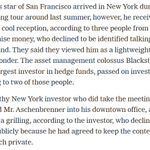


Interesting take on how wealthy New York-style investing is different from VC-like San Francisco-style investing. To me it seems like New York-style investing is still "traditional finance-like." Here's an interesting comment on the whole Situational Awareness matter.
I can see why one would do heavy, leveraged thematic bets when you see where money would flow, but mitigating risk still should be a priority, especially when you use leverage.
Source: New York Times
Not financial advice; do your own research!

1
38
10 PM EST today is the deadline for 13F forms for big hedge funds (Citadel, Renaissance Technologies, Two Sigma, etc) and other institutional investment managers. We will be able to see which stocks have been bought the most by big names as of Q2 2026 (June 30, 2026). Important to remember that some funds do short-term algorithmic trading (Renaissance) and hence the data reported in their 13Fs may not be accurate today, while concentrated, fundamental managers (Pershing Square) will more likely have positions that represent cleaner long-term trends. Finally, 13Fs show long positions only; no shorts, cash, and international equities.
Not financial advice; do your own research!
2
87
I think $SNDK shares will probably experience some pressure after earnings because their Q1 2027 revenue guidance was lower than expected. Estimates were $11B but came out to about $10.3-10.8B actual. Not something you wanna hear if the super cycle narrative is still running hot. Let's see what they say on their call; still doing more digging
1
238
$SNDK Q4 2026 earnings highlights
Fiscal fourth quarter revenue was $8.97 billion, up 51% sequentially, with GAAP net income reported at $6.90 billion ($43.97 diluted net income per share). Sequential revenue growth came approximately one-third from higher volumes and two-thirds from higher pricing. Fourth quarter Non-GAAP diluted net income per share was $39.25.
Fiscal year 2026 revenue was $20.25 billion, up 175% year-over-year, with GAAP net income reported at $11.43 billion ($73.76 diluted net income per share). Revenue outperformance was driven by both our mix shift toward higher-value customers, with Datacenter up 437%, and higher pricing. Fiscal year 2026 Non-GAAP diluted net income per share was $70.88.
Since announcing five New Business Model (“NBM”) agreements during our April earnings call, we have signed five additional agreements, including three NBMs with new customers and two deals expanding on previously signed NBMs.
Expanded our share repurchase authorization, with Sandisk’s Board of Directors approving an additional $14 billion buyback program, bringing total remaining authorization to $15.5 billion.
Expect first quarter 2027 revenue to be in the range of $10.30 billion to $10.80 billion, with expected Non-GAAP diluted net income per share to be in the range of $44.00 to $46.00.
2
498
$META's Family of Apps revenue increased 28% YoY and ad revenue increased 27% YoY. There was also 14% increase in ad impressions; 12% increase in average price per ad, reflecting better ad performance and macro tailwinds. Daily Active People was 3.6 billion on average in June 2026, an increase of 3% YoY. Capex increased from $130-145 billion from $125-145 billion.
In my opinion, this means that customers are still using $META's platforms more than ever and business continue competing to pay for spots to display their ads on $META's platforms. Growth doesn't seem to be slowing down either in their largest and fastest growing division (Family of Apps). I think the reason for their stock tanking is due to EPS miss ($6.18 vs $7.22 estimated; 14% miss from estimate). This is due to a 55% increase YoY in their operating expenses, which were pushed to $42.03 billion this quarter.
1
21
$META's Q2 2026 highlights:
Revenue of $60.8 billion (vs $60.17 estimate), up 28% year-over-year, driven by 14% higher ad impressions and a 12% increase in average price per ad.
Net income was $15.8 billion and diluted EPS was $6.18 (vs $7.22 estimate), down 14% and 13%, respectively, as costs and expenses rose 55% to $42.0 billion.
Operating cash flow of $31.86 billion, free cash flow down sharply to $784 million (vs $848 million estimate) from $8.55 billion
Capex was $138 billion (vs $135 billion estimate)
$META reports its Q2 2026 earnings today. What am I looking for? 👇
$META’s largest and fastest growing division is the Family of Apps (FoA). This division houses Facebook, Instagram, WhatsApp, Messenger, and Threads and generates about 98-99% of $META’s total annual revenue. The way this division mainly makes revenue is through businesses paying $META to host their advertisements. $META has been spending a lot of capex on AI infrastructure, i.e., their data centers and necessary hardware (GPUs, SSDs, fiber optic cables, etc.) needed to run their specialized AI models (like Llama). The reason for this is so that their AI models can be trained effectively and understand $META’s customers’ behavior on their platforms (like what reels do users like, what ad types work best, etc.). $META’s platforms then adapt their algorithms for users and continue showing them content they like, leading to longer user engagement and customer retention, as well as a higher chance of buying the product displayed in the ads. As the number of customers who do this increases, businesses will see $META’s customers buying the services/products in their ads, and hence continue hosting their ads on $META’s platforms. When more and more business compete for an ad spot on $META’s platforms, this allows $META to charge higher and higher prices, thus increasing their revenue.
Hence, what I’d like to see in $META’s earnings today is that metrics that track the number of customers use their platforms (like Daily Active People) continue staying strong and even increase, if possible. I’d also like to see that the volume of ads served and the average price per ad increased. This would signal to me that businesses continue paying $META’s prices for ad placements at an increasing rate, which justifies the spending they are doing on capex.

28
$GOOGL reported beautiful Q2 2026 earnings yesterday but their stock is currently getting punished due to the huge increase in capex spending of $195-205B from earlier estimates of $180-190B. Their Google Cloud revenue grew 82% YoY to $24.8B; Cloud backlog grew to $514B. This to me screams that enterprise AI adoption is accelerating, which justifies the premium that hardware suppliers are currently charging. Compute capacity is extremely important; see Kimi K3's tweet about their GPUs being constrained due to an unprecedented amount of users.
This whole selloff doesn't make sense to me; sure, $GOOGL's free cash flow is negative for the first time, but that's because they are increasing their capex to further their fastest growing business, which is going to be Google Cloud IMO. (In their earnings, they specifically said that enterprise demand for cloud compute capacity is outstripping the physical hardware and data center infrastructure they currently have up and running.) Their CFO literally said this in the earnings call: "Given the supply-constrained environment, we plan to expand the use of third-party capacity in Q3 as a bridging strategy while we build out more internal capacity. This strategy allows us to keep growing our customer base and capture greater overall value. However, it will create modest margin pressure in the near term as we utilize this capacity."
Enterprises who download open-weight models like Kimi K3 and want to build their own specialized LLMs for company uses would still not be able to use the full 2.8 trillion parameters on their own computing hardware unless they want to pay for thousands of dollars in GPU, HBM, NAND flash storage costs. Hence, they'll look for digital cloud providers (like $GOOGL) to provide the computing infrastructure and pay as they go (for compute power and storage) when they need to heavily run their specialized LLMs.

2
40
Strings retweeted

$NOW $IGV $AVPT
After listening to $NOW earnings call, my conviction in most of my software exposure has been shaken. I’m open to people debating and maybe changing my mind, so if you disagree please comment 👇
I do believe that there’s a genuine need for governance, observability and AI threat detection layers as agentic AI takes over. As $NOW CEO pointed out, spending forecasts on AI software is going to grow 53% this year, which is 17% faster than AI hardware. On paper this feels like an amazing opportunity for investing in those software layers that make it easier for enterprises to adopt and control AI agents.
The problem that I think got reiterated in $NOW’s earnings call is that I don’t see how their product sets can be differentiated over the next 5-10 years. It’s really hard cause I believe in what they have to offer, but I have a difficult time understanding how individual companies in this space don’t end up just competing with better products, which would probably lead to some level of commoditization of those services.
And the problem is I do see competition getting incrementally better and then the question becomes will there be enough TAM available to the companies operating in this space? Will the incumbents steal enough market share away with competitive pricing that it becomes impossible for companies like $NOW to sustain their current market cap?
I don’t think this concern was addressed in the call today. In fact, with the commentary I believe it was reiterated. I’m still doing more research and thinking on this, but if this is true then we have to ask ourselves what forward multiples do these companies deserve? Do we bid them up for next 3-5 years worth of possible high margins only for them to lose it after that?
I don’t know the answer. I’d love to listen to your opinions on this. Again comment 👇

Strings retweeted
Like I said in the post below, $NOW beating cRPO estimates ($13.20B actual Vs. $13.03B estimates) shows to me that enterprise customers are recognizing workflow platforms to manage the security and orchestration of AI agents.
As enterprise-level AI adoption grows, noted by Sundar Pichai from $GOOGL, need for observability, governance and overall security will grow. My concern was that enterprises haven't realized that yet or are still at an evaluation phase, but $NOW earnings shows that enterprises ARE starting to spend on this layer.
I'm so far impressed with this report, I will have more thoughts after I fully listen to the call and do some additional research. If you guys wanna hear my thoughts along with few other analysts consider joining our live spaces at 3 PM New York time on Friday.

For a while $IGV felt like a good "hedge" against the AI hardware trade with customer concentration risk that me and many others have been talking about. It seems like market has decided to sell the hardware and today also sell those software layers.
$IBM’s recent warning around customers redirecting budgets toward AI hardware and infrastructure has possibly contributed to sell pressure on $IGV today. If that's the case then $NOW earnings today will be crucial in giving a roadmap for lot of these SaaS companies that are providing the security and governance layer against AI for enterprises.
What I would like to hear in $NOW earnings call today is growth in their cRPO numbers which would indicate that enterprise customers are increasingly relying on structured workflow platforms to manage the security and orchestration of AI agents.
I think we're sitting in a "transition period" where enterprises are being cautious and evaluating which layers they'll need and where is the most value for their needs.
I still continue to believe that enterprises are adopting AI aggressively, and it creates opportunity for the application layer and governance software. Especially with security breach news with OpenAI and Hugging Face yesterday, the layer that prevents AI agents from compromising enterprises' proprietary datasets becomes more important than ever imo.
It's possible that the market believes that companies today are not capable to deal with threats presented by AI agents, and maybe this is the reason for the selloff ? Or just the fact that enterprises haven't fully realized the need for those layers ? Who knows, we'll find out today...

$GOOGL just posted their Q2 2026 earnings. The main things I was looking for were their capex guidance and their growth of the Google Cloud division. The official results are below 👇
Google Cloud: $24.77B (Est. $22.46B); 🟢+82% YoY
CapEx: $44.92B (Est. $44.1B); 🟡+100% YoY
Sundar Pichai, CEO of Google and Alphabet, said: “Our AI investments are redefining what’s possible across every part of our business.
Q2 was an amazing quarter, with Alphabet revenues growing 24% year-over-year and Google Cloud revenues accelerating to 82% growth, driven by demand for AI infrastructure and AI solutions. It’s great to see wide adoption of Gemini Enterprise, with nearly 90% of the Fortune 100 using it.
We have exciting momentum across the board. Our popular AI features are driving Search query growth. Gemini models now process 22 billion API tokens per minute and the Gemini App has 950 million monthly active users. We are seeing strong demand for our security solutions, and our new Gemini 3.5 Flash Cyber delivers highly cost-efficient performance at the frontier. And month over month, people turn to YouTube for major world events, with over 1.7 billion unique viewers watching World Cup-related videos during the FIFA World Cup 2026.
These outstanding results show that our differentiated, full stack approach to AI is delivering real, measurable value for consumers, customers, and our partners globally.”
Strings retweeted
For a while $IGV felt like a good "hedge" against the AI hardware trade with customer concentration risk that me and many others have been talking about. It seems like market has decided to sell the hardware and today also sell those software layers.
$IBM’s recent warning around customers redirecting budgets toward AI hardware and infrastructure has possibly contributed to sell pressure on $IGV today. If that's the case then $NOW earnings today will be crucial in giving a roadmap for lot of these SaaS companies that are providing the security and governance layer against AI for enterprises.
What I would like to hear in $NOW earnings call today is growth in their cRPO numbers which would indicate that enterprise customers are increasingly relying on structured workflow platforms to manage the security and orchestration of AI agents.
I think we're sitting in a "transition period" where enterprises are being cautious and evaluating which layers they'll need and where is the most value for their needs.
I still continue to believe that enterprises are adopting AI aggressively, and it creates opportunity for the application layer and governance software. Especially with security breach news with OpenAI and Hugging Face yesterday, the layer that prevents AI agents from compromising enterprises' proprietary datasets becomes more important than ever imo.
It's possible that the market believes that companies today are not capable to deal with threats presented by AI agents, and maybe this is the reason for the selloff ? Or just the fact that enterprises haven't fully realized the need for those layers ? Who knows, we'll find out today...
$GOOGL reports its much anticipated Q2 2026 earnings today. What am I looking for? 👇
Due to the large buildout last year in AI infrastructure and data centers, essential components such as GPUs, HBM, and flash storage have become very expensive, so companies like $MU, $SNDK, etc, have enjoyed extremely pricing power due to hyperscaler ($GOOGL, $MSFT, $META, $AMZN, etc.) capex spending and contracts.
Now, investors are worried about the spending hyperscalers are doing (which combines up to around $700B), as it has only been increasing and their free cash flow is getting more and more compressed as a result of this heavy spending. Hence, the whole semis selloff recently (from customer concentration risk). Everyone is waiting with bated breath that $GOOGL (and $META and $AMZN next week) announces that they are keeping / increasing the spending on hardware; otherwise, I think companies like $MU, $SNDK, etc., might suffer further drawdown.
Hence, here’s what I’m looking to hear in $GOOGL’s earnings today. I want to see that they have either reaffirmed or increased their spending on hardware, while still showing growth in their Google Cloud division. More importantly, I would like to see this division contribute a majority of their revenue growth this quarter, even more so than their TPU business. This would show to me that enterprise AI adoption is growing only faster and faster while keeping the hardware market afloat and justify their current premiums.
