






Cameron Tuckerman-Lee retweeted

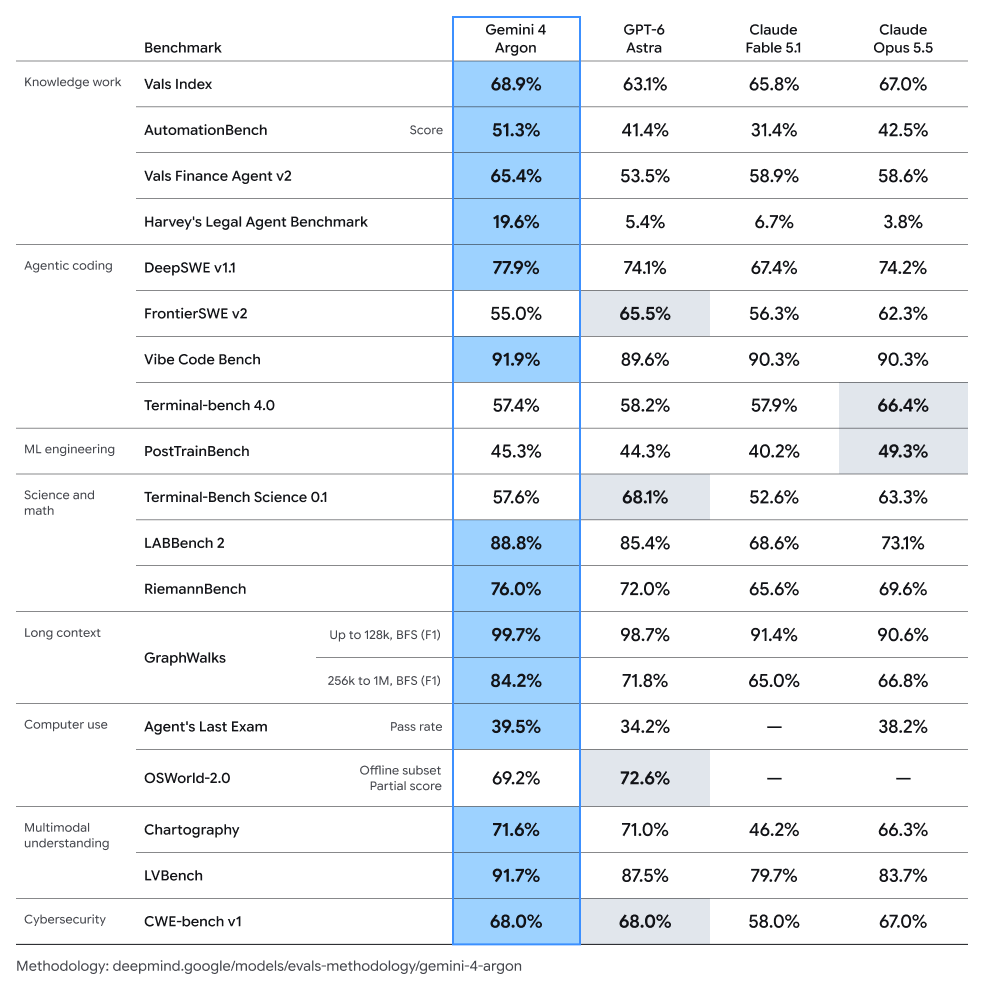
Introducing Gemini 4 Argon – our new frontier model.
It’s built for complex workflows across coding, enterprise knowledge work, and cybersecurity defense – rolling out today to a set of trusted testers through our Fairwind Program.
Cameron Tuckerman-Lee retweeted

I wrote this early this morning and I wasn't sure if I would actually publish it, but here it is:
blog.samaltman.com/2279512

Cameron Tuckerman-Lee retweeted

Thread on VJEPA 2.1🤟
This DEFINITELY flew under the radar: just a few days ago, @AIatMeta released V-JEPA 2.1, taking a massive step toward closing the gap between image and video domains.
For a long time, image backbones were the only option for solving dense vision tasks. This model disagrees, showing that universal spatial understanding also emerges from large-scale video models!🎥


Cameron Tuckerman-Lee retweeted

10 years ago, there were 10 people around my kitchen table. No structure, no brand, no certainty. Just a handful of builders showing up for something that yet didn’t exist.
Since then @spc has grown to over a 1000 members. Today, 25,000 people apply to SPC every year. We have offices in SF, NYC, and Bangalore.
But SPC isn’t about the numbers, it’s about the people and what emerges when they choose to show up for each other.
It looks like @anuraggoel, already successful and credible, showing up with generosity, helping others, sharing work, iterating in public. Patterns sharpened and @render was born.
It looks like @thejamescad and @dbabbs, who met at SPC to become cofounders building @profound. One of the superpowers of SPC is the collision rate—not the shallow kind, but the kind that only happens when people keep showing up long enough to build trust.
It looks like @MaximilianMona, who moved out to California in an RV to be at SPC and eventually build Ironsite. That’s someone saying, with their whole life: this matters.
And it looks like @AshtonJEaton, an Olympic gold medalist, walking into SPC not for a career pivot, but for a deeper reinvention. To trade mastery for learning. Not for optics. For truth.
SPC has been designed by the community and for the community, with one goal that hasn’t changed: pay it forward. We’ve helped normalize taking time to find truly meaningful work, whatever shape that might take.
So on this ten-year anniversary, I want to thank the people who made SPC what it is.
The ones who showed up when they didn’t have a narrative.
The ones who lived in the question — and lingered in uncertainty for long enough to find out.
The ones who came back, again and again, for the work and for each other.
Happy ten years, SPC. Thank you for showing up!

Cameron Tuckerman-Lee retweeted

Have you ever done a dense grid search over neural network hyperparameters? Like a *really dense* grid search? It looks like this (!!). Blueish colors correspond to hyperparameters for which training converges, redish colors to hyperparameters for which training diverges.
Cameron Tuckerman-Lee retweeted

On full body MRIs:
I’ve read this article before and it is not what I would consider “good”
Most of the studies he cited were very poorly done and can not be extrapolated at all
Most of the arguments are around logistics and potential fear with some random stats on complications
Everyone is missing the point. I’ve gotten over a hundred of these scans on patients. Not ONCE have we subjected them to something unnecessary based on the findings. It was a delicate and detailed discussion about risks, benefits, alternatives, how we would cautiously wait and watch in a structured way.
On the other side, I’ve caught at least 4 early stage cancers in young people who would’ve never been screened (caught at stage 1 and dealt with), diagnosed years long MSK issues, see early white matter changes that lead to altered cognitive plan, etc etc. Most importantly, I’ve been able to give people piece of mind that nothing huge is underlying (with the caveat we don’t see everything).
If it’s about resources and logistics, that’s one thing. If it’s about causing widespread HARM, i just don’t see the data supports that. Why wouldn’t we make the same argument about ALL screening like colonoscopies as well?
All of these arguments come down to TIME and TRUST more than anything. If you give your patient time to explain everything, and have a relationship built on trust, then you don’t go spiraling down these pathways, you are informed and empowered by data to make real actionable change in their lives.
Also, just to say it, I should be able to get whatever the fuck test I want. The medical establishment has this patriarchal almost priest-like quality of believing only WE can decipher the truth for the plebs. It’s exhausting.
And lastly - technology will never stop advancing, it never has and never will. In the next decade, full body MRIs (or some other comprehensive diagnostic) will become so good and so affordable (say $100 each) that it will just be a yearly thing we all do. The science and technology WILL get there, as it always does. But this is the necessary rubicon we must pass. We have to go through this awkward messy phase before we break down paradigms and create a new standard of care.
Ok, end rant. And no this post was not sponsored by @prenuvo But you’re welcome @andrewlacy 😀

Good article on this
outofpocket.health/p/why-don…
Cameron Tuckerman-Lee retweeted

STARGATE RETURNS!
Yes, it’s true. 14 years after the franchise aired its last episode (SGU’s “Gauntlet”), a new Stargate series has been greenlit by Amazon. And it’s not a reboot or a wholesale reimagining that will wipe the slate clean on 17 seasons and some 350 hours of Stargate history. It’s a new series that will be the perfect jumping-on point for first-time viewers while, at the same time, honoring the existing past. And the reason for that is because this new series was created by longtime franchise veteran Martin Gero who worked on SG-1, Atlantis and Universe, writing such notable fan favorites as The Storm, The Eye, Duet, First Strike, Be All My Sins Remember’d and many more.
Joining the production of the new series is Brad Wright, co-creator and co-showrunner of all that came before – Stargate SG-1, Atlantis, and Universe. Martin has kindly offered yours truly a role on the project as well and I have happily accepted.
Martin has been developing this show for a while now. A little over a year ago, he reached out and asked “Want to read something cool?”. That something, it turned out, was his pilot script for the new Stargate series. Now I obviously can’t say too much about the content at this point – but I can assure you that it embraces everything that made the original Stargates so great: heart, humor, rich mythology, exploration, action, adventure, compelling/endearing characters, and that overall sense of optimism and fun that made you fall in love with Stargate.
You are all in for a treat.
Eventually.
Now putting this production together is going to take some time even though Martin has already done a lot of the preliminary heavy lifting, writing the pilot script and series overview that details the show, its world and characters, as well as his plans for the first season and beyond. Between now and the series premiere somewhere down the line, the writers room must be assembled, stories need to be spun, scripts written, prep started, crew hired, actors cast and, eventually, a new Stargate series produced.
It will take a while but Martin shares my philosophy when it comes to dialing in the fandom, so expect to receive updates throughout the prep, production, and post process. Concept art, behind-the-scenes photos, videos and insights, breaking news and much much more!
Get ready. We’re heading through the gate one more time.
Chevron Eight is locked!

Cameron Tuckerman-Lee retweeted

🔷 Introducing Rig3R - our new geometric foundation model for 3D perception in AVs.
wayve.ai/thinking/rig3r/
Cameron Tuckerman-Lee retweeted

BREAKING: Gov. Gavin Newsom of California just vetoed a bill that would have banned #PFAS in cookware and other consumer products. Given California's market clout, this is massive blow to public health.

Cameron Tuckerman-Lee retweeted

New startup idea, I'm calling it "TV". A TV with no OS, just a blank ass TV, BYO streaming device.
Cameron Tuckerman-Lee retweeted

(1/n) Check out our new paper: "Fantastic Pretraining Optimizers and Where to Find Them"! >4000 models to find the fastest optimizer! 2× speedups over AdamW? Unlikely. Beware under-tuned baseline or limited scale! E.g. Muon: ~40% speedups <0.5B & only 10% at 1.2B (8× Chinchilla)!


Cameron Tuckerman-Lee retweeted

We wrote a paper about training driving agents end-to-end in a worldmodel simulator.
Blog post: blog.comma.ai/mlsim

Cameron Tuckerman-Lee retweeted

Everyone is saying ChatGPT4o got more sycophantic. Weird. For me, it just got more intelligent.
Cameron Tuckerman-Lee retweeted

Fyre Festival 2 Postponed and Tickets Refunded, No New Date Announced variety.com/2025/music/news/…


Cameron Tuckerman-Lee retweeted

Exciting PlasticList update:
We were honored to work with @bobaguys to identify and eliminate the sources of BPA contamination, and their teas are now BPA-free!
They have fully transitioned to BPA-free receipt paper, which PlasticList confirmed to be BPA-free through independent lab testing. They have also switched to brown sugar in BPA-free packaging.
We have been impressed with their commitment to get to the bottom of the issue and move fast to remove BPA from their supply chain.
If you want healthy and delicious tea, I highly recommend Boba Guys!

Advice for Food Companies
Since we launched PlasticList, we’ve been heartened to have quite a few food companies reach out and ask for help interpreting their results and tracking down and eliminating their contamination. I’ve had calls with a bunch of these.
I am happy to report that no food company wants this stuff in their food and they are all eager to figure out what’s going on and how to remove it. After a while I noticed the advice we were giving was pretty similar for every company, so I thought it would be useful to write it down and share publicly.
So, here are some notes:
1. To track down the source of your contamination, don’t just test a few samples of your product with varied production processes. Instead, test every single one of your inputs: every ingredient and input in the form you receive it before any processing steps, including water and any other consumables.
2. Then, test the food before and after every step in your production process. If you boil something in tap water, test before and after boiling. If you chop something on a plastic cutting board (because wood cutting boards are outlawed in commercial kitchens, apparently), test before and after chopping.
3. You may have to go deep into your supply chain to figure out the source of your contamination. One food company founder we spoke to said that some of the fruit they include in their product is picked, put into plastic bags, and then steamed in the bags before the bags are cut open and the fruit is transferred into another plastic bag, while still warm, for shipping. Whoops.
4. Run at least three samples of every test due to sample-to-sample variation. You can see in our report and in our data that sample-to-sample and lot-to-lot variation should be expected: plasticlist.org/report
5. You should also test any intermediate or final packaging that your product ships in, as leaching can also occur post-production.
6. There are a lot of steps that you need to carefully follow to prevent contaminating your samples during collection and transportation. It’s really easy to miss one of these and mess up your data. We describe many of these on our methodology page: plasticlist.org/methodology
7. You should consider running longitudinal tests, maybe quarterly, as we have heard that there can be seasonal variation in contamination from suppliers, due to things like summer heat, suppliers switching their processes, and suppliers switching their own backend suppliers for their inputs.
8. And most importantly: PICK A GOOD LAB. Unfortunately not all labs are good, and we think many ISO-certified commercial labs will not give reliable results. We rejected many certified labs because we weren’t confident in their work; all-in-all, we spent about 10 weeks finding a lab that we trust for our tests. You can see our lab’s internal methodology here: docs.google.com/document/d/1…
Our lab has recently permitted us to identify them publicly, and they are IEH: iehinc.com/
We also worked with Light Labs to produce this study and they can be a big help: lightlabs.com
And Million Marker is able to work with food companies to debug their supply chains as well: millionmarker.com/
9. You should consider hiring an analytical chemist as a consultant to validate that the testing methodology is accurate and to double-check the lab’s results. We hired John Brock to do this and it was well worth it; we would not have been confident in our choice of lab or our results without John.
10. We couldn’t find a lot of evidence that the phthalate substitutes are bad; if you have high-percentile detections in phthalates or bisphenols, though, it’s probably worth figuring out how those chemicals are getting into your products.
