

PhD student in Machine Learning @ EPFL
Lausanne, Switzerland
Joined September 2022
- Tweets66
- Following133
- Followers93
- Likes104




Very happy to share ReFuse!


Ke Wang retweeted

What if an LLM could adapt its layer order to each input?
What if it learned a different layer order for each classic algorithm that solves Sudoku or mazes, and you could fix that order at inference to choose which algorithm it runs?
Meet LoL in under 4 minutes 🎥 (1/3)
Ke Wang retweeted

We asked GPT-6 Astra to edit Qwen3.5-0.8B weights to improve math.
It directly changed only 0.016% of weights, fixing 0.8B's reasoning loops & improving math up to 6x and even instruction following 3x, without gradients or training.
We call this Weight-Space Programming: frontier LLMs can now natively read/write neural network weights! 🧵
Blog: rikiyat.github.io/blog/weigh…

Readers added context they thought people might want to know
LLM was given weights explicitly as text in prompt and used code/forward passes (per authors' logs) to ablate Qwen looping direction, a known thinking-mode issue per model card. Primarily fixed repetition in that mode, not general 'natively' improving weights/math.
rikiyat.github.io/blog/weight-sp…
github.com/RikiyaT/lm_und…
huggingface.co/Qwen/Qwen3.5-0…
huggingface.co/RikiyaT/Qwen3.…
Ke Wang retweeted

Say hi to PUMBA! 🐗
Masked diffusion language models are trained one way and sampled another.
Our new paper studies how to make MDM training more aware of the trajectories followed at inference, and how this can lead to more efficient text generation.
Paper link below 🧵


Ke Wang retweeted

New paper: diffusion LMs often come from pretrained AR models. If we already reuse AR pretraining, can we also reuse what AR models learn during post-training?
We explore this in A2D: AR-to-Diffusion Transfer and Composition. 🧵

Ke Wang retweeted

Can we get the benefits of Model Soups without training a soup? 🍲
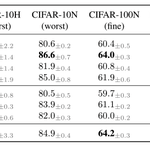
Our #ICML2026 paper introduces MonoSoup: a data-free, hyperparameter-free method that improves the ID/OOD trade-off from a single fine-tuned checkpoint.
1/10

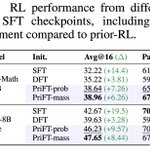
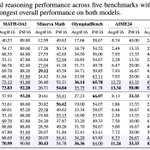
PriFT also provides a better initialization for subsequent RL training 🏋️, leading to stronger RL results than SFT or DFT initialization.
📜 8/9

1
4
96
This was a great collaboration with @ShuangqiLi, @ MathieuSalzmann, @pafrossard 🙌
💻 Code: github.com/wang-kee/PriFT
📖 Paper: arxiv.org/abs/2606.09396
📜 9/9

Ke Wang retweeted

AI needs vastly more data than we do. One idea might close the gap: don't predict raw signals (tokens), predict your own abstract latent representation (JEPA, data2vec).
With @DanKorchinski @MatthieuWyart, on a toy model, we prove how much that helps: the gap is exponential.
🧵

Ke Wang retweeted

🔥 New paper: Fixed-Point Masked Generative Modeling
Masked generative models are becoming a very exciting alternative to autoregressive generation, especially for language.
They decode in parallel, but every denoising step still runs a full bidirectional Transformer.
We make them cheaper and stronger with fixed-point denoisers 🧵
w/ @qinym710 @AlbaCbCs @jdeschena and @pafrossard
(1/12)

Ke Wang retweeted
Welcome to check CoFRe - a complete training-to-inference framework for fixed point masked generation !
Improved quality v.s. cost tradeoff for both text and visual data.
Amazing work leaded by @andreamiele_

🔥 New paper: Fixed-Point Masked Generative Modeling
Masked generative models are becoming a very exciting alternative to autoregressive generation, especially for language.
They decode in parallel, but every denoising step still runs a full bidirectional Transformer.
We make them cheaper and stronger with fixed-point denoisers 🧵
w/ @qinym710 @AlbaCbCs @jdeschena and @pafrossard
(1/12)
Ke Wang retweeted

Cool news: our extended Riemannian Gaussian VFM paper is out! 🔮
We define and study a variational objective for probability flows 🌀 on manifolds with closed-form geodesics.
@FEijkelboom @a_ppln @CongLiu202212 @wellingmax @jwvdm @erikjbekkers 🔥
📜 arxiv.org/abs/2502.12981