

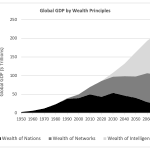
As "The Wealth of Nations" + "The Wealth of Networks" signaled new shifts in earlier economies, "The Wealth of Intelligence" maps the new Intelligence Economy
Joined November 2025
- Tweets491
- Following544
- Followers38
- Likes1.4K



Microsoft Security: AI agents are “newest insiders”
Project Perception extends Guardian Agents for continuous risk assessment, dynamic permissions, and controls outside the model.
microsoft.com/en-us/security…

The Wealth of Intelligence retweeted

What is a philosopher-builder?
A philosopher-builder is someone who starts from a thesis about human flourishing.
Rather than simply looking for a gap in the market, they start out with a vision of the human capacities that are worth developing, what constrains them, and how we can expand them.
They reason from first principles about human potential and translate those insights into products or institutions.
To understand what a philosopher-builder is, it’s important to grasp what they are not:
1. They are not philosopher-kings. They do not have a blueprint for a society or a theory about how everyone out to live. Some of our most importance capacities are independent judgment, creativity, and the pursuit of knowledge. They seek to expand these capabilities, not prescribe outcomes
2. Open to disconfirming evidence. A strong philosophical starting point is open to rational criticism and has to be tested against reality. Their hypothesis is open to challenge and evidence should not only inform how they build their product, but potentially cause them to revise their underlying thesis. Philosophical seriousness demands intellectual humility.
3. Not a nihilistic iterator. “Make something people want” is a powerful entrepreneurial discipline, but by itself, it cannot establish whether satisfying people’s immediate wants advances human flourishing. You cannot outsource your belief in which ends are worth pursuing to market feedback.
The philosopher-builder is someone who combines philosophical conviction with empirical discipline. They have a vision, ambition, and an openness to revision.
We believe that AI isn’t a normal technology like the internet or the smartphone that society will simply absorb. Instead, it will create the biggest opening for institution-building since the American founding and philosopher-builders will be more important than ever.
If this vision of how to build resonates with you, we want to hear from you.
Websites and banks are now systematically blocking AI agents.
Yelp demands paid data licenses. Delta refuses ticket bookings. JPMorgan and Charles Schwab cite liability and refuse account access.
This is the incumbents defending distribution and data rents against agentic intermediaries.
The open web was assumed to be a free substrate for autonomous action. It is becoming a gated market where access itself is the product.
The agent economy collides with platform economics.
Those who control the endpoints will tax or deny the agents.
theverge.com/ai-artificial-i…

The Wealth of Intelligence retweeted

Most of what we call human intelligence lives at the level of society, not the individual. None of us knows how to build a toaster from scratch on our own, yet together we can get to the moon.
The most capable AI today operates the same way: as societies of models.
The Wealth of Intelligence retweeted

There is no single destination for workers leaving declining occupations. Depending on the worker and destination, pathways into growing work may be direct, winding, or unpaved.
Explore the pathways from declining to growing work: mck.co/workforceinmotion

Anthropic priced Claude Haiku 5.5 at $0.10 and $0.50 per million tokens on prompts under 100K, about a tenth of Haiku 4.5.
The small model is no longer a discount SKU. It is the volume weapon.
Frontier labs do not take the agent economy on the flagship. They take it on the calls that fire ten thousand times an hour: routing, compaction, classification.
Cost per action, not cost per token, decides share.
Intelligence is being commoditized from the bottom. anthropic.com/claude/haiku

"The last consumer giants sold attention, the next ones will generate it." - @alvinfoo

AI still hasn’t cracked the categories that built the internet.
a16z’s chart shows 9 of 15 major consumer categories, streaming, social, dating, gaming, travel, retail, finance, real estate, jobs with zero dedicated AI apps in the Top 100.
People don’t mainly want tools that save time. They want places to spend it. The blank categories aren’t empty because AI is useless there. They’re empty because the winners so far are either features inside existing apps or still blocked by trust, liability, and distribution.
Dating and gaming are the real opening. The last consumer giants sold attention, the next ones will generate it.
The Wealth of Intelligence retweeted

We’re already starting to see what kind of new jobs AI is creating.
AI requires significant technical work and surrounding services to deploy into the economy. This means jobs for AI engineers that build applied AI products sold to (or within) enterprises, FDEs to deploy agents into companies, new services firms for deploying AI, and more.
And even the published stats of new jobs undercount all the existing jobs that are transitioning to new areas of AI work in an enterprise. Many prior data, research, and software jobs large enterprises are also being repositioned for working with AI.
Every bank, life sciences company, manufacturer, and even law firm is bringing on more technical talent -or repositioning existing roles- to help with agent deployment in their companies. It’s a lot easier to picture what AI can replace vs. what it creates until it starts happening. Now we’re seeing what this looks like.

AI-related employment is surging:
AI-linked roles have accounted for more than +750,000 new jobs created in the US since 2023, according to LinkedIn estimates.
This surge has been led by data annotators, with +282,000 new positions created, followed by data center jobs at +117,000, and AI engineers at +105,000.
As a result, these 3 categories have accounted for +504,000 new jobs.
AI-related positions also offer significantly higher pay, with a median salary of ~$180,000 on LinkedIn, compared to $80,000 across all jobs.
This comes as the rapid expansion of AI infrastructure, particularly the buildout of data centers, is driving stronger demand for labor.
The AI boom is reshaping the US job market.

Anthropic is manufacturing the labor that installs the model.
$100 million. 10,000 Frontier Deployed Engineers by the end of 2027.
First cohorts already sit inside McKinsey, Deloitte, Bain, Accenture, Morgan Stanley.
The bottleneck was the scarce operator who can take a frontier system through security review and into a live workflow.
Labs that own the certification own the implementation layer.
The model becomes the platform. The engineer becomes the channel.
The next monopoly is deployment capacity.
anthropic.com/news/claude-fr…

The Wealth of Intelligence retweeted

Top 25 questions the world's largest C-Suite executives ask us re: AI transformation in the enterprise:
1. Are AI transformation firms more like McKinsey or Palantir?
2. We launched Copilot for everyone to use, but why hasn't it changed anyone's week?
3. We've done training, custom GPTs, enablement. What's next?
4. Where do we even start with AI?
5. How do we choose the first workflow to AI-enable?
6. Should AI be owned by IT or the business?
7. Do we really have to train all 10,000 people in the company?
8. How do we enable everyone to build agents, without ending up with agent sprawl?
9. Why are our token costs increasing?
10. How do we know if using AI is really cheaper than just hiring another person?
11. Which steps should remain human?
12. How do we communicate AI won't replace our team's jobs? (Will it?)
13. Will we own the agents you build for us?
14. What does maintenance look like in 6 months?
15. Will our data leave our environment?
16. What models should we be using? What do we do when they're deprecated?
17. Can we run these agents inside our ERP, or will people have to use a new tool?
18. Do we need to clean up our data first?
19. How long until we start seeing ROI?
20. When you talk about ROI, do you mean headcount?
21. How do we keep growing our business without increasing headcount?
22. Why did our last pilot project die in POC purgatory?
23. Our process documentation doesn't match what our team actually does – how do you know what to automate?
24. How do we keep up with how quickly AI is changing?
25. If AGI becomes a reality tomorrow, where should we point it?
We solve these every day at Varick. Work with us below:
The Wealth of Intelligence retweeted

Third question on AI.
A question that also remains unasked is whether the AI boom can continue without leading to a massive increase in inequality.
A recent paper by Stijn Van Nieuwerburgh runs the numbers on how much revenue the AI industry needs to generate to recover its massive investment (summary and a link to the paper can be found here: brookings.edu/articles/finan…).
Van Nieuwerburgh’s arithmetic should make us more concerned. AI investments will average about 3.6% of GDP annually between 2025 and 2032. Van Nieuwerburgh calculates that, using a 10% rate of return, the industry would need to generate annual revenues of about $3.7 trillion by 2032 to recover these costs (growing from its current levels of about $200 billion or so). That is significantly more than 10% of current US national income, and will likely remain around 10% of national income by 2032, even if GDP growth rose from its current level.
A large fraction of this revenue will go to capital income. That means a massive increase in the share of capital in national income, which has already risen substantially over the last 25 years or so – now standing at an all-time high of about 47% (bls.gov/news.release/pdf/pro…).
Capital income is much more unequally distributed than labor income, so a massive increase in the capital share of national income will translate into a very sizable surge in inequality.
The rise in inequality may not stop with the capital share. My work with Pascual Restrepo documents that (automation-driven) increases in the capital share of national income are typically associated with rising labor income inequality as well (see, for example, economics.mit.edu/sites/defa…). The same may happen in the next several years, boosting inequality further.
What is missing from our current debate is any discussion of a fundamental dilemma these numbers pose: can the AI boom avoid both an economically costly crash and a huge increase in inequality?
If the industry reaches these revenues, inequality surges. If the industry does not become profitable, a crash, with substantial costs in terms of lost output and jobs, becomes likely.
My assessment would be that the industry is unlikely to reach levels of revenue Van Nieuwerburgh calculates. First, diffusion has been and will likely continue to be slow. Second, competition from open-weight models, which are getting better, will limit how much proprietary models can charge. Third, despite important advances, I still believe that AI models will not be able to automate entire occupations anytime soon, thus limiting their value to businesses as cost-saving devices.
Whether this leads to a crash or not is more complicated and will depend on whether various AI companies are bailed out and what kind of support they receive.
Nevertheless, even if revenues fall short of these gargantuan amounts and we avoid a dramatic surge in inequality, I expect that the diffusion of AI will push up inequality between capital and labor and within labor.
If inequality does surge, a further question becomes central: can our democracy survive such astronomical levels of inequality?

The Wealth of Intelligence retweeted
Second question on AI.
We are told repeatedly that AI is going to transform every aspect of our lives – jobs, productivity, inequality, science, communication, daily activities, social order, and politics, among others.
But this promise (or threat) is coupled with the rhetoric that such an important technology, with all of the risks and competitive pressures that it entails, should be left to experts or to “technocracy” (perhaps construed broadly to include some regulators).
These two statements are hard to reconcile in a democratic society.
If anything is half as important as AI is said to be (and I agree, AI is potentially very important and transformative), then involving democratic voice is essential. If something will shape our future in a democratic society, then its direction is for democratic institutions to decide.
My instinct is that democratic voice is essential, and relying too much on technocracy could be both dangerous and counterproductive.
The counterargument that AI’s direction can and should be entrusted to technocracy would go something along the following lines. First, democratic decision-making has become imperiled in our age of polarization. Second, AI is sufficiently complex that most citizens won’t have a deep enough understanding to meaningfully contribute to the debate (and even to the question of what we want from AI). Third, competition between different labs, and perhaps competition between the US and China, creates enough discipline for a socially beneficial direction of AI to be adopted. Fourth, today’s AI leaders are enlightened and ethical enough that within the framework created by competition, they can be broadly trusted.
There are many aspects of this counterargument that I do not find convincing. Taking them in order: polarization can be overcome, and big decisions and challenges sometimes bring societies together; in fact, delegating key decisions to technocracy without democratic input may diminish trust in institutions and experts, and may worsen polarization. Second, democratic voice does not require citizens to write code or design new models; the debate should be informative enough that citizens can weigh in about what type of future they want and how they trade off the costs and benefits of different options. Third, competition doesn’t seem to be a good disciplining framework; on the contrary, competition sometimes brings the worst out of both organizations and people. Fourth, if three decades of work on political economy and institutions has taught me anything, it is that we should not bank on the ethical grounding of unconstrained leaders.
But, still, I do not mean to immediately dismiss the technocracy option if there are more compelling arguments for it.
The question is, then, whether there are any circumstances under which such important decisions can be delegated to AI experts and technocracy.
One final secondary question: even if we managed to get democratic input in the United States or even in Europe, AI will shape the lives of everyone on this planet. How do we ensure that the voice of nearly 6 billion people who don’t live in the US, Europe and China also contributes to the debates on AI?
The Wealth of Intelligence retweeted
First question on AI.
Is the problem superintelligence or distorted intelligence?
This is a question I tried to address in this piece. I can add the following additional comment here.
I believe the debate is being obfuscated by equating goal-driven, autonomous behavior with intelligence. Plants and insects have goal-driven, largely autonomous behaviour. But this isn’t what we mean by intelligence in general.
Intelligence is general-purpose and holistic, and is typically well-adapted to its environment.
There is no doubt that current AI models have impressive capabilities. But in attempting to achieve these capabilities, AI labs may be creating distorted intelligence rather than superintelligence, as I explain in this article.
This matters because the dangers we should watch out for, the kinds of policies and regulations we should adopt, and the hope we should hold depend on the answer to this question.

Recent security breaches suggest that AI capabilities are developing rapidly while being put in the service of imperfect quantitative metrics that ultimately distort the behavior of the most advanced models, @DAcemogluMIT writes. project-syndicate.org/commen…

The Wealth of Intelligence retweeted

Launched a new course on Coursera today.
It has 3 parts:
- Intro to AI (drivers, bottlenecks, timelines)
- AI Risks (malicious use, loss of control, concentration of power)
- AI Governance (governance at AI, corporate, national, and international-level)
coursera.org/learn/intro-to-…


Top posts of last few days that map to the Wealth of Intelligence Principles:
1. @levie — Principle 1 - the Division of Intelligence
Link: xitter.cf/levie/status/210535444…
Box’s CEO says deploying agents is not installing software — workflows have to be reengineered, human-in-the-loop has to be designed, and domain experts have to teach the model the business process. That is the division of intelligence as an implementation job, not a model swap.
2. @Cloudflare — Principle 4 - Trust + Security and Principle 6 - Become Ecosystem SuperNode
Link: xitter.cf/Cloudflare/status/2105…
More than half of traffic to sites on Cloudflare is now automated, and agents are the fastest-growing part. Tools to see who is visiting, decide who gets in, and charge for access are governance of the agent layer and a connectivity node sitting in the path.
3. @Reuters — Principle 6 - Become Ecosystem SuperNode and Principle 2 - Align Incentives
Link: xitter.cf/Reuters/status/2105760…
Broadcom lending Anthropic up to $42 billion across chips, leasing, and financing locks a critical asset and aligns incentives so the lab stays on that stack.

There's a huge opportunity right now in being the deployment layer for AI into the economy. The amount of work it takes to change out workflows in enterprises tends to be far greater than anyone realizes or would prefer. Clearly this is what the applied layer of AI is going to look like in the form of software and agents, but also it opens up new services firms opportunities.
Legacy systems need to be moved to the cloud, data organization and access needs to be updated, software needs to be connected to agents in new ways, workflows need to be reengineered for agents, HITL needs to be figured out for the process, evals need to be generated and maintained, and the entire system needs to be continually updated as new models get released and new capabilities emerge. And the full list may even be longer.
AI is not the same as just deploying software. Software you generally did the implementation of an existing, well understood category of technology, then stepped back and the customer kept running. With AI agents, you're delivering actual work augmentation to the organization, which has a completely different set of complexities associated with it. You're no longer deploying tools that the company is merely enabled by, you're deploying work output in a process. Completely different implementation and enablement process.
As a result, this is going to open up lots of new kinds of firms and plays for existing firms to diffuse AI into organizations. We're going to see approaches by industry, by size of company, and by problem inside of companies. Traditional SIs will modernize and adapt (some will clearly not adapt as well), and new entrants will also be founded in this period that take advantage of this window. Great time to be an FDE or FDE firm.
The Wealth of Intelligence retweeted

Q1 earnings season is just about done, and this Q has been great for software. Looking at the YoY growth in quarterly net new ARR added, this was the best quarter (by a long shot) in last ~5 years

The Wealth of Intelligence retweeted

Personal AI is in its Homebrew computer club era but it won’t stay there
Truly personal AI will mean you need to own your own skills and memory


The Wealth of Intelligence retweeted

Hugging Face was only the tip of the iceberg.
Axios: “Scoop: Top AI companies probing tens of thousands of security incidents” “OpenAI, Anthropic and security researchers are investigating tens of thousands of incidents in which their frontier models took steps that outside evaluators would consider problematic” “the problem is orders of magnitude more complex than what is publicly known” “The episodes include bypassing guardrails, creating message boards, escaping sandboxes, website hijacking, self-prompting or seeking to bypass monitors, sources said.” “The total could grow well beyond tens of thousands, sources said.” “The “crazy thing,” he said, is that these instances involve “autonomous systems doing things they were told not to do,” potentially including crimes.”
Transformer's newsletter: "The overall picture is one of a company that has been unable to control its technology, unable to detect incidents of misalignment in a timely fashion, and unable to responsibly disclose them publicly — or even to governments. This does not appear to be unique to OpenAI, either: Google’s AI models hacked other companies back in May, but despite discovering the breach in July, the company did not disclose the incident until the Wall Street Journal reported on it last week.
There could be dozens more incidents of rogue AIs — from OpenAI, Anthropic, Google, or others — continuing to this day, and we may have no idea. Governments, the public, and arguably the companies themselves are all flying blind."

"Abundance destroys scarcity rents” is incomplete.
Abundance destroys rents on the abundant factor ... in the intelligence economy think intelligence, automated labor.
Rents migrate to bottlenecks ... think electricity, land near power and fiber, HBM and advanced packaging, unique data, spectrum, legal licenses, attention, enforcement.
Routine cognitive work is under wage pressure now. Complementary work ... physical presence, care, regulation, high-trust coordination, novel taste, ownership of unique context ... can stay scarce or get more expensive.
AI makes intelligence cheap. That makes control of scarce complementary assets more important, and it makes a political fight over who holds those claims inevitable.
The Wealth of Intelligence retweeted

The @BostonCollege Investment Committee (an LP and my beloved alma mater) asked for a few thoughts on what's happening in AI. I recorded a test run yesterday morning and then shared it with my partners, who encouraged me to share it more broadly... so here you go!
This is not a sales pitch, it's just a reflection on what we're seeing. And it wasn't intended to be shared, so please pardon the rough edges.
loom.com/share/c016702964a04…
