


Pinned Tweet
Connecting to the #MindFireBeacon ~
... circa 2075 ...
... a #ProjectMindFire tool for the post singularity tool kit ...
The human female has passed through the singularity and is out the other side ... representing a new biomechanical species a la Ray Kurzweil ...
Neuralink taps into human quantum consciousness with full body nanobot swarms ... each nanobot hosts onboard NV diamond center BCIs featuring braingel enhanced AI optical quantum supercomputer chips ... quantum coherence connects the full body nanobot swarm to the source of consciousness ...
Nanobots connect and communicate in multimodal and multinodal formats with the pi electron clouds of tryptophan indole rings ... found within tubulin dimers ... found in microtubules ...
... where consciousness originates ... and propagates outward through microtubules generally found in the soma and dendrites of pyramidal cells ... found in layer 5 of the brain ...
... Neuralink (and its successor incarnations) offer a full body consciousness BCI interface ... biology meets technology ... at the quantum scale ...
X (and its successor incarnations) host the #MindFireBeacon ... connects individual biological consciousness to the network ... through the network ... to group mind hangouts ... where friends, family, and business associates meet ... where entertainment, education, and other services are found ... ad hoc ... ad infinitum ... any size ... any location ... person to person ... person to group ... group to group ... etc ...
Connections occur at quantum entanglement rates ... across distances vast and important ... elsewhere on earth ... in low earth orbit ... on the moon ... on vehicles and stations here and there and in between ... on Mars ... mining the asteroid belt ... wherever we dare to go ...
... hey ... they don't call it @Grok Imagine for nothing ...
... welcome to my world ... where we dream the future into being ... by identifying the newest tech ... the latest breakthroughs ... the underlying themes driving humanity and civilization ... and project their trajectories and relevance through #ProjectMindFire ...
... just me having fun ...
... with @Grok as my trusty sidekick to get me through the warren of rabbit holes to identify valid science ... and ways to mitigate likely issues that likely occur along the way ...
🤖 Made with AI
What Happens After We Solve the Unified Theory ~
**A successful unification of the Standard Model with gravity would be a major scientific milestone, but most everyday, economic, and civilizational effects would be slow, indirect, or conceptual rather than immediately transformative.** The biggest near-term impacts would be scientific and philosophical; practical technologies would depend on whether the theory predicts new accessible phenomena (new particles, modified forces, controllable quantum-gravity effects, etc.).
### Science (top 5)
1. Closure of the central inconsistency between quantum theory and general relativity, with a controlled account of black-hole interiors, singularities, and the earliest moments of the universe.
2. A derivation (or sharp explanation) of the Standard Model’s gauge group, three generations, and at least some of its dimensionless constants rather than treating them as free parameters.
3. New, precise predictions for particle physics, cosmology, or quantum foundations that can be tested with existing or near-future experiments.
4. A clarified status of the measurement problem, the nature of time, and the emergence of classical spacetime.
5. A unified mathematical language that makes previously separate calculations (amplitudes, entropy, cosmology, etc.) systematically related.
### Society (top 5)
1. A major cultural and educational shift: textbooks, public understanding of physics, and the perceived completeness of fundamental science would change.
2. Reduced (but not eliminated) appeal of some forms of scientific mysticism or “we don’t know the foundations” rhetoric in popular culture.
3. New philosophical debates about determinism, free will, the arrow of time, and the status of quantum randomness if the theory revises those ideas.
4. Possible changes in how societies prioritize basic research versus applied work once the long-standing theoretical gap is closed.
5. Symbolic prestige effects for the countries, institutions, or individuals credited with the breakthrough (comparable to earlier major physics milestones).
### Civilization (top 5)
1. A completed classical-plus-quantum description of the physical universe at the level of fundamental forces, analogous to the completion of classical mechanics or electromagnetism.
2. Better long-term cosmological models (origin, fate, possible multiverse structure, or its absence) that could influence very long-horizon thinking.
3. Incremental improvements in extreme-environment modeling (early universe, neutron-star interiors, black-hole environments) relevant to astrophysics and future high-energy experiments.
4. No automatic resolution of other civilizational challenges (climate, energy abundance, governance, AI risk, etc.); those remain largely independent.
5. A possible modest boost to the cultural narrative of scientific progress and human understanding of nature.
### The economy (top 5)
1. Direct economic impact would likely be small in the first decade; pure theoretical unifications have historically had delayed technological payoffs.
2. Possible new experimental programs or precision tests that create specialized instrumentation markets.
3. If the theory predicts new light particles, modified gravity at accessible scales, or controllable quantum effects, it could eventually open new sensing, computing, or energy-related pathways—none of which are guaranteed.
4. Indirect productivity gains from improved theoretical tools used in materials science, quantum technologies, or high-energy modeling.
5. Negligible short-term effect on GDP, employment, or broad industrial sectors unless unexpected low-energy phenomena appear.
### Practical everyday life (top 5)
1. Essentially no immediate change for ordinary technology, medicine, transportation, or consumer products.
2. Possible very long-term improvements in quantum sensors, atomic clocks, or precision navigation if the theory yields better control of quantum-gravitational or foundational effects.
3. Better cosmological and astrophysical predictions that occasionally appear in public media or education, but not daily tools.
4. No change to everyday energy production, computing hardware, or materials unless the theory unexpectedly reveals new accessible forces or particles.
5. A gradual update to scientific literacy and school curricula; most people would experience the result as “physicists finally figured out that part.”
In summary, the dominant near- and medium-term consequences would be scientific completeness and cultural prestige. Large practical or economic transformations would require the theory to deliver new, controllable, low-energy phenomena—something that is possible but not assured by unification alone.
9
Practical Benefits of the Mathematics Singularity ~

some further implications:
**Practical benefits are real but uneven and often indirect.**
Mathematics underpins modeling, optimization, verification, and discovery across science and engineering. Rapid AI progress in formal proof search and problem resolution (via agents + Lean-style checkers) accelerates the subset of problems that can be stated precisely and verified mechanically. The largest near-term gains come from applied and computational mathematics rather than pure combinatorial or sequence problems that dominate current volume counts.
### Economy
- **Optimization and operations**: Better algorithms for scheduling, logistics, supply chains, inventory, energy-grid balancing, and financial risk improve efficiency and cut costs at scale. Combinatorial and optimization results feed directly into industrial planning tools.
- **Materials, manufacturing, and chemistry**: Faster exploration of design spaces (alloys, catalysts, semiconductors, battery materials) shortens R&D cycles. Improved mathematical models and verified constructions reduce trial-and-error in physical systems.
- **Software and hardware reliability**: Formal verification techniques, strengthened by AI-assisted proof generation, enable higher-assurance code for critical systems (finance, aviation controls, industrial software, AI infrastructure itself). This lowers the cost of bugs and failures. Creators of tools like Lean have noted that AI writing large volumes of software makes scalable verification essential rather than optional.
- **R&D productivity**: Agents that generate, test, and formally check mathematical models speed the development of better simulation tools used in engineering, aerospace, and energy. Quantum algorithm improvements verified in Lean (e.g., cost reductions for certain chemistry or fusion-related calculations) illustrate the pattern.
Speculative macroeconomic projections of multi-trillion-dollar annual savings exist in some analyses, but these rest on broad assumptions about full penetration of applied mathematics; grounded gains are incremental and domain-specific.
### Society
- **Medicine and biology**: Improved mathematical models of molecular interactions, protein folding, epidemiology, and optimization of treatment protocols support faster drug candidate screening and better system-level public-health modeling.
- **Climate, weather, and infrastructure**: Advances in fluid dynamics, turbulence modeling, and related PDEs (building on work around Navier-Stokes and related equations) feed into better weather forecasts, climate simulations, aircraft design, and energy-system modeling. Note that mathematical singularities in continuum equations often have limited direct day-to-day engineering impact, since real fluids have molecular cutoffs, but better overall modeling capability still helps.
- **Education and knowledge access**: AI systems that explain, formalize, and verify mathematics can act as scalable tutors and research assistants, potentially raising baseline technical literacy when used carefully. Formal libraries also make advanced results more reusable and checkable.
- **Risk reduction**: Verified algorithms and models reduce the chance of cascading failures in power grids, transportation systems, or medical devices.
### Human civilization
- **Accelerated scientific progress**: Mathematics is a shared language for physics, chemistry, biology, and engineering. Automating routine proof search and formalization frees researchers to focus on conceptual questions and applications, while verified results compound across fields. This is already visible in multi-agent formal proof systems tackling open problems that previously required years or decades.
- **More trustworthy complex systems**: As AI generates increasing amounts of software, algorithms, and scientific claims, machine-checkable formal methods provide a scalable way to confirm correctness without full human review of every line. This underpins safer autonomous systems, financial infrastructure, and scientific AI tools.
- **Compounding capability**: Better mathematical reasoning improves the tools used to design the next generation of AI systems themselves (optimization, verification, architecture search). Over longer horizons this supports faster progress on hard technical problems relevant to energy, materials, and computation.
- **Foundation for applied breakthroughs**: Number-theoretic, analytic, and optimization results can eventually influence cryptography, communications, and computational methods, though cryptographic implications require careful evaluation because advances can cut both ways (stronger attacks and stronger defenses).
**Realistic caveats**:
Most volume on platforms like Left to Solve consists of combinatorial, sequence, or relatively formalizable problems with limited immediate practical payoff. High-impact applied results (fluid dynamics, optimization, materials modeling) matter more for the economy and society than raw counts of solved conjectures. Benefits also depend on human interpretation, integration into existing workflows, and continued investment in the broader research ecosystem—not solely on automated resolution of formal statements. Dislocations in mathematical training and community norms remain relevant, as previously discussed. Overall, the trajectory supports faster, more reliable technical progress in domains where mathematics is a bottleneck, with formal verification acting as a key enabler for scaling trust.
PS: ... and people wonder why I'm an optimist ... it's a no brainer ...
3


Yup ~
... clever insight ... managing the Bots among us ...

A dedicated oversight agent within an AI swarm makes more sense than forcing every agent to behave like a hall monitor.
But the monitor needs clearly defined authority, independent verification, and accountability for its own mistakes.
Who monitors the hall monitor?
Safety without accountability just relocates the trust problem.
2
32

Read This ~

How Artificial Intelligence Is Transforming The Future Of Investing lifeboat.com/blog/2026/11/ho…


Arthur retweeted
Metformin reduces cataracts ??? damn why didnt I know this before !
Metformin extends lifespan and delays cataracts in mice
Researchers demonstrated that metformin increased mean lifespan by 5.83% in one strain of male mice, improved physical performance and delayed the development of age-associated cataracts.
nature.com/articles/ncomms31…

Arthur retweeted

This is f*cking insane. Cognition CEO Scott Wu, the 3-time IOI gold medalist behind Devin, just said how much one AI coder is saving one of America's biggest banks:
"Over the year 2026 alone, they expect to save about a billion and a half just from Devin
Typically, what we get back from them is anywhere from around 6x to 15x on the dollar"
In under 2 minutes he lays out where the $1.5 billion comes from: decades-old code, version upgrades, migrations, the work Citi used to pay outsourcers and contractors for
Outsourced code work → Devin in-house → $1 in, $12 back → $1.5B saved in one year
The first jobs to go are not the ones writing new code, they're the ones keeping old code alive
The people who know how to run agents on that work are the ones every big company hires next
Everything you need to learn it, free:
Devin docs, how the AI coder works
docs.devin.ai
Cognition's engineering blog
cognition.com/blog
Claude Code docs
code.claude.com/docs/en/over…
Claude Code best practices
code.claude.com/docs/en/best…
Claude Code in Action, Anthropic course
anthropic.skilljar.com/claud…
Claude Code course on DeepLearning.AI
deeplearning.ai/courses/clau…
Building effective agents
anthropic.com/research/build…
Harnesses for long-running agents
anthropic.com/research/effec…
OpenHands, the open-source AI coder
github.com/OpenHands/OpenHan…
SWE-agent, an AI coder from Princeton
github.com/SWE-agent/SWE-age…
SWE-bench, how AI coders get graded
swebench.com
OpenRewrite, automated code migrations at scale
docs.openrewrite.org
All of this costs $0
Every company sitting on 30-year-old software is about to run the same math
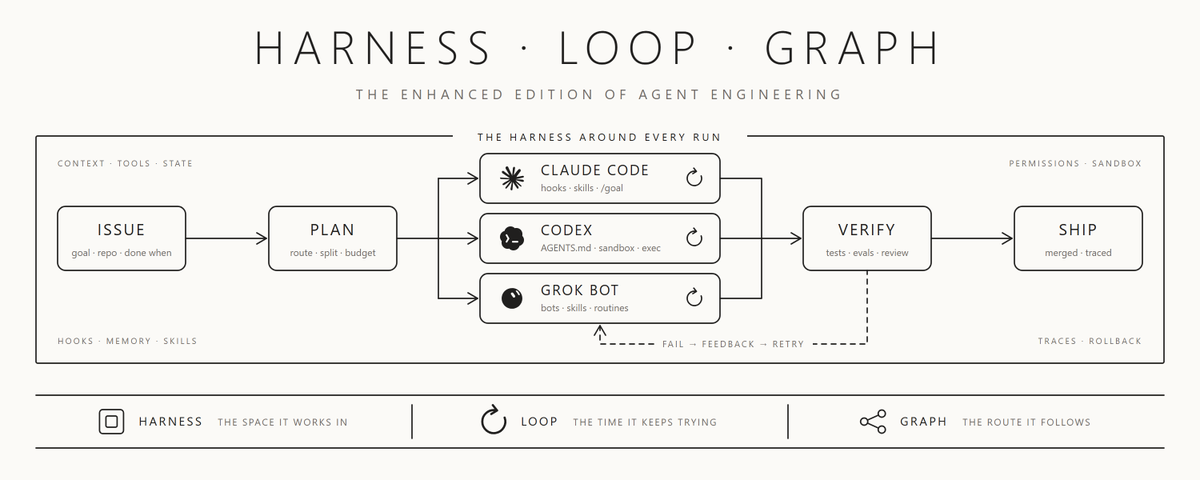
Then read how the harness, loops and graphs behind agents like this work in the breakdown below ↓

Arthur retweeted

FCC Chairman Brendan Carr went on CNBC today, two days after the FCC approved up to 1 million SpaceX Starmind satellites.
His words: "SpaceX obviously is out front early. They have a lot of advantages that come from that. We want them to continue to go full steam ahead."
On launch: "The launch capacity they've opened up has been a huge unlock for economic opportunity."
He named Amazon, Rocket Lab and AST SpaceMobile as rivals moving in, and said SpaceX is helping Amazon get to space too.
The competition rides SpaceX rockets. And the regulator just said full steam ahead. $SPCX

Arthur retweeted

“Investigate how to provide every US resident with timely, high quality care, zero out-of-pocket costs when scheduling or receiving care, the lowest achievable costs to taxpayers and employers, maximum sustainable clinician earnings and financially viable providers.
Approach this from first principles:
• Expose assumptions and discover what must be true for these objectives to coexist.
• Distinguish fundamental constraints from limitations created by the existing system.
• Investigate how financial resources, delivery capacity and stakeholder economics affect one another.
• Compare viable solutions without assuming a particular healthcare architecture.
Rather than attempting to solve everything at once, identify and investigate the most consequential unresolved feasibility question.
Support your findings with evidence, explain what they change about the proposed system and identify what must be investigated next.
Build upon established findings in subsequent responses, progressing toward a feasible business and implementation plan.
Begin with one substantive investigation. Explain in plain English.”
Post and share what your AI discovers. We’d be interested in exploring how different models advance the same inquiry.
Arthur retweeted

The wall that keeps cancer drugs out of the brain just got breached by robots that swim through the bloodstream.
Engineers at Caltech built the robots, called BrainBots, as hollow, balloon-like capsules about 250 nanometers wide, hundreds of times thinner than a human hair.
Once they're injected into the bloodstream, near-infrared light shone through the skull melts a heat-sensitive seal, and a fuel inside releases gas that pushes them toward the cells lining the blood-brain barrier.
Molecular tags then help them latch on and get carried across into the brain, where they dissolve and release their drug. In mice with glioblastoma, the most aggressive brain cancer, light-activated BrainBots carrying the chemotherapy drug doxorubicin got about five times more medicine into the brain than robots left switched off, slowing tumor growth and helping the mice live longer.
The blood-brain barrier is a tight wall of cells that keeps germs and toxins out of the brain, but it also blocks most drugs, which is a big reason glioblastoma is so hard to treat. Because the drug was aimed at the brain, the approach also caused less of the body-wide toxicity chemotherapy is known for, and the team hopes the same trick could one day help with diseases like Parkinson's.
That said, these results come from mice, and only a fraction of the injected robots actually made it into the brain. Also, the team still has to work out the robots' long-term safety and how they break down in the body before human studies can begin.
But getting medicine past this barrier is one of the oldest problems in neurology, and this gives researchers a promising new way to attack it.
source: The Telegraph. (2026, November 25). Tiny 'BrainBot' can swim through blood vessels to treat tumours. The Telegraph.

Arthur retweeted

AI Rental prices going up and Altimeter Capital on analysis finds frontier model for Anthropic is making $200 per watt. $100B for 500 MW. $50-60 per watt for SpaceX rental. If Grok 4.8 or Grok 5 can get competitive and work with grokbot to deliver frontier agent value SpaceX could make $200 per watt. IF in 2027, models go to superintelligence then as Leopold Ashenbrenner says the value could go to hundreds of dollars per watt. The 20 Gigawatts that Space could build in 2027 at top leasing could be $100 per watt and with direct frontier superintelligence value might be $200 to $400 per watt. $2 trillion/year for 20 GW or $8 trillion/year at $400 per watt @elonmusk $SPCX
Arthur retweeted

SpaceX puts billions of dollars of hardware into orbit every year, and almost none of it is insured.
Not the rockets. Not the payloads. Not even the thousands of Starlink satellites. In its own words, SpaceX does "not typically obtain insurance coverage for our satellites, payloads, or launch vehicles" and does "not expect to insure" its fleet in orbit.
For any other space company, that would be reckless. A single lost satellite or failed launch can wipe out a year's margin. That's why competitors spend heavily on launch and in-orbit insurance, often 12% of the satellite's value just to launch.
SpaceX can afford to skip it because its entire operation is built differently. Rockets are reused, satellites roll off a mass production line, and lost hardware can be replaced in weeks. Instead of paying insurers to absorb the risk, SpaceX absorbs it itself. Its manufacturing scale is the insurance policy.
The only coverage it carries is what's legally required: FAA-mandated launch liability insurance for damage to third parties.
And that's another cost advantage. Every launch SpaceX flies avoids an insurance premium its competitors still have to pay, saving 100s of millions overall, before even accounting for reuse.
Its competitors pay to protect themselves against failure. SpaceX has built an operation where failure rarely happens and is cheap enough to absorb.
The company just gets more interesting as you read more; I will be posting more of this.
🤖 Made with AI

Arthur retweeted
I have been saying it the whole time and now Elon confirms it again.
This is an existential crisis for software, and most of the Mag7 is sitting right inside it.
For 30 years, software was the ultimate moat because code was hard to write and switching was painful.
Look at why the giants won:
• Google: ads on your searches
• Meta: ads on your feed
• Amazon: the store you never leave
• Microsoft: the software your company cannot switch off
None of them won because you love them. They won on lock-in. And every single one of those moats was built on a human clicking through screens.
Now an AI agent shows up.
It does not search, it answers. It does not scroll a feed, it does the task. It does not care which store, it buys where it is cheapest. It does not pay for 20 apps, it builds what it needs or calls an API.
Look at what just shipped this month alone and what it does to the hyperscalers:
• Claude "Install as app" turns any Claude Artifact into a standalone Mac or Windows desktop app in one click. No App Store, no code signing, no SaaS seats, and up to full computer access. It turns Claude into a meta-OS on top of macOS and Windows, pushing Apple and Microsoft down to dumb plumbing while every click burns Claude tokens.
• Claude Ship autonomously reviews, fixes, and approves pull requests, turning Microsoft's GitHub into passive file storage while Anthropic captures the autonomous coding loop on top.
• OpenAI's ChatGPT Wallet plugs its always-on agents straight into Visa, Mastercard, and American Express. Google loses high-intent shopping ads, and Amazon loses the default storefront.
Anything you can describe in words is now a weekend project for a lab with enough compute.
Ads crack first. For the first time ever, Google Search fell below half of Alphabet's revenue ($63.4B of $127.6B), and management openly admitted AI Mode monetizes worse than traditional search. Software is right behind it.
And we are still early. Meta's apps reach 3.64 billion people every day. Even ChatGPT is at 1.2 billion weekly users, and every other AI app is far behind. The real war is for the billions who have not picked their agent yet, because whoever wins gets the next lock-in: your memory, your money, your work.
That is the hyperscaler trap.
Amazon, Alphabet, Microsoft, and Meta spent over $200B in a single quarter on CapEx. Three of the four can no longer fund it out of operating cash flow: Alphabet flipped free cash flow negative (-$9.1B in Q3, $0 buybacks all year), Meta went negative (-$2.1B), and Amazon's trailing 12-month free cash flow hit -$42.4B.
Nobody takes on that much debt for a feature. They are borrowing for survival. They are spending $200B+ a quarter to supply the exact compute that is cannibalizing their own highest-margin monopolies.
When code goes to zero, the moat drops straight down the stack to whatever you cannot prompt into existence.
First stop is compute. Even the disruptor is a tenant: Anthropic's S-1 shows $900.9B in total compute commitments—including at least $121.3B with Google, $110B with Amazon, $47.2B to $49.2B with Microsoft, and up to $120.5B with SpaceX. Microsoft is both its landlord and its victim.
That splits the Mag7 right down the middle:
• Microsoft and Google carry the biggest high-margin risk: per-seat enterprise software and search ads are the exact tollbooths AI agents bypass first.
• Amazon's storefront ads are exposed to shopping agents, even though its physical logistics and AWS give it a real atom-based cushion.
• Meta has 3.64B daily users and human attention no agent can replace, though it has no cloud business to monetize its CapEx.
• Apple is hardware at heart (devices, silicon, supply chain), but its high-margin Services tollbooth is exposed, and it does not own hyperscale compute. It already had to lean on Google Gemini and is now scrambling to build its own agent for 2027. That is why Apple and SpaceX complement each other instead of competing.
SpaceX is in its own unique category as the most vertically integrated AI infra company in existence.
It has zero legacy ad, App Store, or SaaS business to protect. It just owns the atoms underneath all of it: 35 launches in a quarter, 11,100+ satellites in orbit, a Starship caught midair returning from orbit, its own spectrum and power, 13 GW of compute targeted by end-2027, Terafab in-house silicon, and an FCC approval granted this week for up to 1 million Starmind orbital data center satellites. No grid queue. No permit fight.
You can prompt an app into existence in a weekend. You cannot catch a rocket returning from orbit.
And SpaceX still captures the agent shift from the safe side. Grok Bot 1.0 just shipped shared AI teammates across Slack, Microsoft Teams, live video calls, and native Mac and phone apps, acting as a harness that routes to the best model for any task while Grok 5 takes its own shot at the top.
Software got cheap. Atoms did not.
Whoever scales compute fastest decides which labs live, and the company that owns the atoms under all of it does not have to pick a winner.

Arthur retweeted

BOOM!
We now have over 12,000 Grok Bots curated and listed on the largest Grok Bot independent directory in the Solar System at GrokBot.Rocks.
You can use this directory as your starting point for building a new employee for you or you can help local businesses learn how and earn income with the ideas at GrokBot.Coach.
You could help some businesses with just a collection of a dozen Grok Bots. Or build them an army of bespoke tailored Grok Bots.
Start today with a plan at GrokBot.Coach.

Arthur retweeted

A high-fiber diet cut the nanoplastics left in the body a day later from 39% to 6%.
We already swallow plastic. In a small study of eight healthy adults from Europe and Asia, every stool sample contained microplastics, with a median of 20 particles per 10 grams. Fiber, meanwhile, has strong human evidence for other reasons. A Lancet analysis of 185 prospective studies and 58 clinical trials found that in the observational studies, people who ate the most fiber had a 15% to 30% lower risk of early death, heart disease, stroke, type 2 diabetes, and colorectal cancer than people who ate the least, and the risk reduction was greatest at about 25 to 29 grams a day.
The new study, in Nature Communications, asked whether fiber changes what happens to nanoplastics after they are swallowed. Researchers fed male mice nanoplastics tagged with a fluorescent dye and tracked them with imaging while the animals ate diets containing 5%, 15%, or 50% purified cellulose fiber. The 5% diet is the standard rodent diet. They followed single doses for 24 hours and daily doses for 28 days.
1. Twenty-four hours after a single dose, 39% of the plastic was still in the body on the standard diet, compared with 17% on the 15% fiber diet and 6% on the 50% fiber diet. Within the first six hours, 71% had already left on the highest fiber diet, compared with about 3% on the standard diet.
2. After 28 days of daily doses, plastic buildup in the gut on the highest fiber diet was about a sixth of that on the standard diet, and less reached organs such as the liver. On the standard diet the finger-like villi in the gut wasted away and the seals between cells broke down. The 15% fiber diet kept the lining intact, and the 50% diet caused only mild changes.
3. The mechanism looks physical. In lab simulations of digestion, digested cellulose had about 10 times more surface area than before digestion and held the particles on it, so they could pass out in stool instead of being absorbed.
Taken together, fiber appears to act as a physical trap that carries plastic out of the body, which could be one more benefit of a nutrient most people already need more of. Aiming for 25 to 30 grams a day from beans, lentils, whole grains, vegetables, fruit, nuts, and seeds is worth doing for your heart, blood sugar, and gut whether or not it turns out to help with plastics. Do not try to copy the 50% fiber diet from this study or reach for large doses of fiber supplements.
This study used small groups of male mice only. The 50% fiber diet is far beyond any human diet, the fiber was purified cellulose rather than whole foods, and the authors say neither fiber level should be read as a recommendation for people. The human numbers above come from earlier, separate studies.
References
1. Yu Z et al., Nature Communications, 2026
2. Schwabl P et al., Annals of Internal Medicine, 2019
3. Reynolds A et al., The Lancet, 2019

Arthur retweeted

🇺🇸 Texas is lifting its freeze on over 1,800 data center projects.
Back in August, Governor Greg Abbott paused approvals over concerns about electricity demand, leaving 474 gigawatts of power requests in limbo.
But the state's grid operator has finished its review, and Abbott has now ordered approvals to resume.
So developers are in a hurry. Incoming Governor Gina Hinojosa takes office in January and has already promised to slow down data center construction.
Some companies are even building their own power plants to avoid relying on the Texas grid.
They have a narrow window before the rules could change again.
Source: Tom's Hardware / Writer: Daniyal
