

Tasmanian astrophysicist studying black holes in the early Universe. Currently a Plaskett Fellow at NRC Herzberg in Victoria 🇨🇦
- Tweets100
- Following141
- Followers94
- Likes583


ALT Decorative. Text reads: Under the microscope. nrc.canada.ca

ALT A field of galaxies on the black background of space. In the middle, stretching from left to right, is a collection of dozens of yellowish spiral and elliptical galaxies that form a foreground galaxy cluster. They form a rough, flat line along the center. Among them are distorted linear features, which mostly appear to follow invisible concentric circles curving around the center of the image. The linear features are created when the light of a background galaxy is bent and magnified through gravitational lensing. At center left, a particularly prominent example stretches vertically about three times the length of a nearby galaxy. A variety of brightly colored, red and blue galaxies of various shapes are scattered across the image, making it feel densely populated. Near the center are two tiny galaxies compared to the galaxy cluster: a very red edge-on spiral and a very blue face-on spiral, which provide a striking color contrast.


ALT A field of galaxies on the black background of space. In the middle, stretching from left to right, is a collection of dozens of yellowish spiral and elliptical galaxies that form a foreground galaxy cluster. They form a rough, flat line along the center. Among them are distorted linear features, which mostly appear to follow invisible concentric circles curving around the center of the image. The linear features are created when the light of a background galaxy is bent and magnified through gravitational lensing. At center left, a particularly prominent example stretches vertically about three times the length of a nearby galaxy. A variety of brightly colored, red and blue galaxies of various shapes are scattered across the image, making it feel densely populated. Near the center are two tiny galaxies compared to the galaxy cluster: a very red edge-on spiral and a very blue face-on spiral, which provide a striking color contrast.

ALT A black background is scattered with hundreds of small galaxies of different shapes, ranging in color from white to yellow to red. Some galaxies are distorted, appearing to be stretched out or mirror-imaged. Near the center, a particularly long and thin line stretches from ten o’clock to four o’clock. At upper right, a red swoosh extends about three-quarters of the way around a pair of galaxies. A handful of foreground stars display eight diffraction spikes.

ALT Grand-design spiral galaxy M51 from the NASA/ESA/CSA James Webb Space Telescope.


ALT A black background is scattered with hundreds of small galaxies of different shapes, ranging in color from white to yellow to red. Some galaxies are distorted, appearing to be stretched out or mirror-imaged. Near the center, a particularly long and thin line stretches from ten o’clock to four o’clock. At upper right, a red swoosh extends about three-quarters of the way around a pair of galaxies. A handful of foreground stars display eight diffraction spikes.



ALT On a black background, a white border outlines an irregularly shaped, mostly rectangular area. Within the outline lie hundreds of galaxies of various shapes, colors and sizes. Two white boxes on the left side of the field enclose groups of galaxies. From each box, a line extends out beyond the border of the galaxy field to an enlarged image of the galaxy group, revealing streams of stars and tidal tails. On the right side, a third box encloses a spiral galaxy. A line extends beyond the border of the galaxy field to an enlarged image of the spiral galaxy. A few stars are also scattered across the image. Some have Webb’s characteristic 8-point diffraction spikes, while others have additional spikes due to a combination of image exposures.

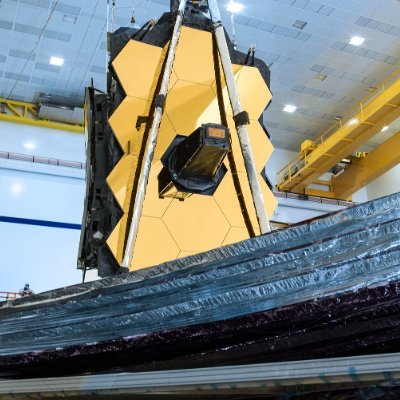
ALT Artist’s conception of the James Webb Space Telescope. Credit: NASA GSFC/CIL/Adriana Manrique Gutierrez. Text: Under the Microscope. nrc.canada.ca


ALT Two large, very bright galaxies dominate the centre of the image. At left is an elliptical galaxy, and at right is a spiral galaxy.


ALT https://www.nasa.gov/feature/goddard/2022/nasa-s-webb-uncovers-dense-cosmic-knot-in-the-early-universe

ALT Two images of the Pillars of Creation, a star-forming region in space. At left, Hubble’s visible-light view shows darker pillars that rise from the bottom to the top of the screen, ending in three points. The background is opaque, set off in yellow and green toward the bottom and blue and purple at the top. A handful of stars of various sizes appear. Webb’s near-infrared image at right shows the same pillars, but they are semi-opaque and rusty red-colored. The peaks of the second and third pillars are set off in darker shades of brown and have red outlines. The background is cast in darker blues and blacks, and stars in yellow and white of all sizes speckle the entire scene. Webb’s image was cropped and rotated to match Hubble’s view, so much of the top right corner and a small portion of the left corner has been left black.


ALT This vertical image has layers of semi-opaque rusty red colored gas and dust that starts at the bottom left and goes toward the top right. There are three prominent pillars rising toward the top right. The left pillar is the largest and widest. The peaks of the second and third pillars are set off in darker shades of brown and have red outlines.


ALT In this Webb image, Neptune resembles a pearl with rings that look like ethereal concentric ovals around it. There are 2 thinner, crisper rings and 2 broader, fainter rings. A few extremely bright patches on the lower half of Neptune represent methane ice clouds. Six tiny white dots, which are six of Neptune’s 14 moons, are scattered among the rings. The background of the image is black.


ALT Image of the Tarantula nebula