

Commodity Markets | Systematic Equities | Fundamental Research
Joined September 2024
- Tweets181
- Following12
- Followers32
- Likes187


Capricornian retweeted

A billionaire literally explained how the entire economy works in 42 minutes better than most $200,000 MBA programs ever cloud.
Capricornian retweeted

99% of options traders are gambling because they never learned the fundamentals.
This 1-hour Yale lecture changes everything.
In just 60 minutes, you’ll learn more about options trading than most overpriced trading courses ever teach.
No hype. No fake gurus. Just real knowledge.
Save this and watch it without distractions. 📌
Capricornian retweeted


We got your back, New York!

Readers added context they thought people might want to know
Several figures here aren’t federal results or NY-specific. The $472B combines US wide pledges: Micron's $250B is nationwide (NY site $100B) Anthropic's $50B covers TX and NY. The 48% murder drop is from NY's state run GIVE program (28 departments, Jan – May 2026).
arkolith.com/news/news-micr…
therepublic.com/?p=843020
governor.ny.gov/news/safer-str…
Capricornian retweeted

$NVDA CEO Jensen Huang: “Power will remain a major AI bottleneck for years”
Top 10 companies powering the next generation of AI infrastructure:
1. $VST | Nuclear & Natural Gas Power Generation
2. $BE | On Site Fuel Cell Power Generation
3. $GEV | Gas Turbines Power Grid Infrastructure
4. $VRT | AI Data Center Power & Cooling
5. $ETN | Electrical Equipment & Power Management
6. $POWL | Electrical Distribution & Power Systems
7. $CEG | Nuclear Power Generation
8. $NVT | Electrical Infrastructure & Liquid Cooling
9. $PWR | Power Grid Construction & Infrastructure
10. $MOD | AI Data Center Cooling Systems
AI data centers require enormous amounts of electricity. This creates a massive opportunity for companies building power generation.
Capricornian retweeted

26 years ago, when I was starting with charting/trading and investments if someone gave me this advice, I would thank him/her every single day:
Print this chart. Put it on your desk.
Expand your research/investment universe.
Look for only 1 setup. The setup that is on this chart.
Go and look for this setup, if possible, across 2000 charts.
All your trades will be executed through this basic chart pattern setup.
When you revisit the charts you will be able to identify the setup you traded again and again.
You can thank me later. Don't forget to print it.

Capricornian retweeted

Top 4 trading books to read for Swing Trading
1. Reminiscence of a Stock operator - Edwin Lefevre
2. How to make money in stocks - William O'neil
3. Think and Trade like a champion- Mark Minervini
4. Market wizards - Jack D. Schwager
You don’t need to read 500 books to master trading. You just need to read these books over and over.
Capricornian retweeted

The Low-Rate Era Is Over: Why We’re Heading To 5.75%, Not Back To 4%
Please ❤️like, bookmark🔖, and 🔁share with fellow investors
In this Short video, Chris Whalen @rcwhalen and @AdamTaggart discuss why investors expecting the 10-year Treasury yield to fall back toward 4% may be positioning for the wrong interest-rate regime.
*
Chris believes the 10-year could instead climb toward 5.5%–5.75% over the next year.
The reason: the ultra-low-rate environment investors became accustomed to after 2008 and COVID was heavily influenced by extraordinary Federal Reserve intervention.
Under Bernanke, Yellen and Powell, the Fed conducted massive quantitative easing, buying Treasuries and mortgage securities and removing enormous amounts of duration from the market. That helped suppress long-term yields.
Now that process is reversing.
The Fed is no longer a major buyer of mortgages, Fannie Mae and Freddie Mac no longer maintain the massive mortgage portfolios they once did, and private investors increasingly have to absorb that duration.
That changes the equilibrium.
*
The temptation today is to look at elevated Treasury yields, buy long-duration bonds and assume yields will eventually rally back down toward 4%, producing substantial capital gains. Chris thinks that could be the "head fake".
Instead, the system may naturally require higher rates to attract enough private capital.
*
There is, however, a major complication: roughly $40 trillion in federal debt.
Kevin Warsh may want to run a more hawkish, less interventionist Fed and allow markets to determine rates more freely.
But there are limits to how non-interventionist any Fed chair can be when the Treasury market sits at the center of the global financial system.
*
March 2020 demonstrated what happens when Treasury market liquidity breaks down. When private demand disappeared and market functioning deteriorated, the Fed had to step in aggressively and provide liquidity.
Chris believes something similar could eventually happen again.
*
The sequence to watch is straightforward: less Fed intervention → more duration for private markets to absorb → higher long-term yields → greater pressure from Treasury financing needs → financial stress → eventual Fed intervention.
So the bigger risk isn't simply "higher for longer."
It's that yields rise high enough to expose the conflict between fighting inflation, financing enormous government debt and keeping the Treasury market functioning.
*
The low-rate era may be over.
And instead of waiting for the 10-year to return to 4%, investors may need to prepare for a world where 5.5%–5.75% comes first — and becomes the new normal.
*
💡 Get access to notes with the key takeaways from this interview by visiting Thoughtful Money Substack (link in the @AdamTaggart 's bio)
Capricornian retweeted

SOFR Swaps Say the Fed Will Cut.
When Will the Bond Vigilantes Notice?
The swap market has been signaling Fed cuts, not a durable higher-for-longer regime. A swap spread is simply the difference between the fixed rate in a SOFR interest-rate swap and the yield on a same-maturity Treasury.
With the 2-year SOFR swap spread at minus 14.55 basis points and the 5-year spread at minus 29.10 basis points, swap fixed rates sit below Treasury yields, reinforcing the market’s expectation of lower future overnight rates.
The 5-year SOFR swap market never substantiated the higher-for-longer narrative. It has instead priced a Fed that cuts rates and keeps the average policy rate lower over the next five years than Treasury yields alone imply.
When will the bond vigilantes look at the swaps market?


Capricornian retweeted

A 23-page research paper reveals the number 1 method Hedge Funds use to beat the market:
Time Series Momentum
This is how: 🧵

Capricornian retweeted

HARVARD FILMED THE FIRST LECTURE OF THEIR MOST POPULAR STATISTICS COURSE - TAUGHT BY A PROFESSOR WHOSE STUDENTS CALL HIM THE BEST TEACHER THEY HAVE EVER HAD - AND IT PROVES WHY EVEN ISAAC NEWTON GOT PROBABILITY WRONG
This is Joe Blitzstein, Harvard, Statistics 110, lecture 1. He has won Harvard's Excellence in Teaching award multiple times, his textbook Introduction to Probability is used in over 200 universities worldwide, and his online course has been taken by over 2 million people across 190 countries. He opens by saying that after a few weeks of this course you will easily solve calculations that 300 years ago required consulting Isaac Newton - and Newton's intuition was still wrong.
He traces probability to Fermat and Pascal writing letters back and forth in the 1650s analyzing gambling games. No one had mathematically derived the rules before. They invented the subject by betting on dice in correspondence. Then he shows why the naive definition - probability equals favorable outcomes divided by total outcomes - breaks immediately. Ask what the probability of life on Neptune is. Either there is or there isn't. By the naive definition the answer is 1/2. So is the probability of intelligent life on Neptune. Something is severely wrong.
Then the multiplication rule. Two types of ice cream cone and three flavors gives 6 combinations - not because you memorized it but because you can draw a tree and count branches. Every counting problem in the course is just a bigger version of that tree. Then binomial coefficients - n choose k counts the number of ways to select k objects from n when order doesn't matter. The full house in poker falls out in 4 lines of multiplication once you understand the tree.
Watch the moment he fills in the sampling table - with or without replacement, order matters or doesn't. Three of the four boxes are immediate from the multiplication rule. The fourth requires a proof he saves for next lecture. That one box is harder than the other three combined.
A data scientist I know rewatched this lecture before switching careers into statistics. Said it was the first time probability felt like a system with rules rather than a collection of tricks.
Free on YouTube, Harvard, over 2 million views.
bookmark this and watch later - after this lecture you will never again confuse equally likely with obviously true


Capricornian retweeted

Wall Street charges $500,000 for probability. an IIT professor put the real thing on YouTube for nothing over a decade ago.
160,000 people watched him define a coin flip properly. almost none of them ever traded on it.
his subject is the axioms under every bet. what a probability actually is, before you dare size a position on it. every quant in 2026 is standing on this, most just skipped the lecture.
Jagannathan teaches this to the IIT engineers who end up on the desks. no upsell, no thumbnail. the foundation of your whole post sits there with fewer views than a phone review.
skip to where he refuses to hand-wave. he builds "the chance of heads" from the ground up, slow, rigorous, the way the people who keep the money were taught.
no ticker. no hype. one chalkboard and the axioms.
a quant I know says half his desk learned probability from this exact free course, not from their finance degree.
you are a decade late. it is still free.


Capricornian retweeted

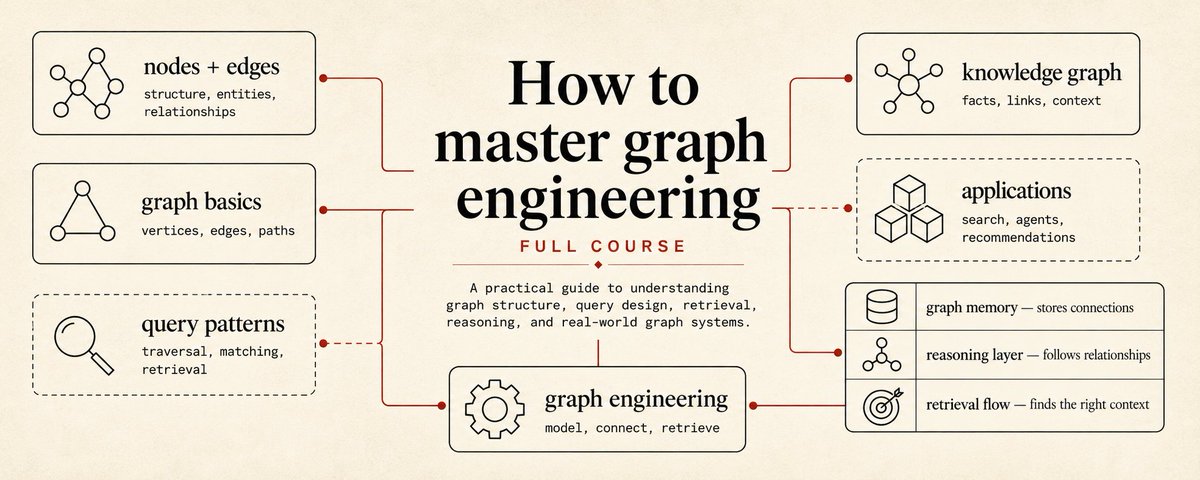
THIS GUY MAKES COMPLEX AI AGENT CONCEPTS RIDICULOUSLY EASY TO UNDERSTAND.
No jargon wall. No assuming you already know what a reward model or an evaluation harness is.
Just a straight line from "I have no idea how agents actually work" to "oh, that's genuinely simple."
The best explainers do not simplify by cutting corners. They simplify by finding the one analogy that makes the whole thing click.

Capricornian retweeted

Former $13B Guggenheim Quant Head just revealed why 99% of machine learning trading funds fail.
73-minutes. free. By Marcos Lopez de Prado.
here's what he covers:
• why solo "Sisyphus" quants fail vs factory-style task partitioning
• fractional differentiation - preserving price memory while achieving stationarity
• volume/dollar bars vs flawed chronological sampling
• triple barrier labeling (profit-taking, stop-loss, time limit) + meta-labeling
• backtest overfitting & why pure noise yields a fake Sharpe Ratio of 3.0
Bookmark & watch today. Then read the article below.


Capricornian retweeted

My friend made $2 million last year running his own AI hedge fund.
No MIT. No Stanford. No quant background.
I asked him how he built the system from zero.
He sent me the exact course that got him there. Bridgewater's 1 hour course on building an AI quant researcher.
Their core team gave up the complete AI stack they run internally to manage $150 billion.
If I had this a year ago, I would've built my hedge fund in a week instead of a year
Bookmark this and read the article below.
• 00:00 - building AI quant analyst
• 25:30 - AI first hedge fund
• 56:16 - inside Bridgewater engineering


Capricornian retweeted

As someone who builds institutional level quant systems, this Stanford paper on HFT Mean Reversion is the closest thing to a live trading playbook I have ever seen publicly shared.
19 pages. Window size tuning that flips PnL on the exact same stock, same day, same code. Hurst exponent universe selection.
Bookmark & If this helps you, pass it on.

ALT Alpha Modeling


Capricornian retweeted

Richard Feynman stood at a Cornell blackboard in 1964 and explained the problem every AI lab is fighting in 2026. The BBC filmed it. Almost nobody watches it.
The lecture is about why nature only answers in mathematics. Every team forcing language models to reason is hitting the wall he mapped 62 years ago.
He was 46. The Nobel Prize came 11 months later. The footage survived on film reels and now sits free on YouTube with fewer views than a keyboard unboxing.
Watch the blackboard section near the middle. He takes 1 of Kepler's laws and rebuilds it from nothing, with notation a 12-year-old can follow.
No slides. No jargon. 1 piece of chalk.
An ML engineer I know paused it 4 times and made his whole team watch it before standup.
You're 62 years late. The lecture is still free.
