Deep Conversations| Silicon Valley | People | https://nitter.gq/t.co/0kJpzXYEDm
Silicon Valley
Joined November 2025
- Tweets231
- Following69
- Followers19
- Likes192


Pinned Tweet
Everyone is in sales says Mohit Aron, foudner-CEO SciFin. Every for-profit company exists to make a sale, he says, so product can't build what nobody wants and marketing can't reach no one.
@mohitaron , co-founder of @nutanix , founder of @Cohesity , and now founder and CEO of scifin.ai/, explains why revenue teams with dozens of tools still can't see what is happening in their business, and how converged context can fix it.
In his words: "You need to think of AI as a first-class citizen and not think of it as an afterthought."
TIMESTAMPS
0:00 Intro
1:17 Meet Mohit Aron: Nutanix, Cohesity and now SciFin
1:58 What is different about building a startup in the AI wave?
3:36 Why a few extra features is no longer a moat
3:56 Why is everyone in a company in sales?
4:51 Why Mohit Aron started SciFin after Cohesity
7:13 What is the revenue context gap?
7:58 What is context in go-to-market?
9:27 Nutanix, Cohesity, SciFin: why convergence
10:27 Why revenue leaders spend more and see no results
12:59 Brute-force AI: garbage in, garbage out
14:14 What is context cognition?
15:49 Is SciFin a layer or a platform?
16:22 Security, permissions and compliance
17:21 Why sales forecasts are so hard to defend
20:08 40 people just to manage go-to-market tools
21:37 System of record vs system of reality
24:07 Is a system of reality expensive? Token maxing explained
26:53 Codex vs Claude: how SciFin picks AI models
29:44 Are open source AI models safe?
30:27 What is Pixie? SciFin's agentic mesh
33:32 What goes to AI and what stays with the human in sales?
35:43 How do you talk to Pixie? Chat, Slack, WhatsApp and a note taker
37:42 How SciFin handles context window limits
39:35 Third startup: what Mohit Aron is still learning
41:09 Rapid fire: the most overrated number in sales
41:49 What part of selling should stay human?
42:18 Collaborative alignment: the culture habit he keeps
43:49 Which companies does Mohit Aron admire?
KEY INSIGHTS
AI first: Some of the old startup playbook has to be thrown out in the AI wave, Mohit Aron says. A few extra features is no longer enough; you have to be architecturally different, with a moat that is defensible.
Everyone is in sales:
Every for-profit company exists to make a sale, he says, so product can't build what nobody wants and marketing can't reach no one.
The context gap:
At Cohesity, which he says he ran as CEO for nearly a decade, more tools, dashboards and meetings still could not piece together the picture. SciFin, "science behind your financials," is built to bring that context together.
Convergence:
Nutanix brought compute and storage together, Cohesity converged secondary data, and SciFin converges go-to-market context. The common theme is convergence, he says.
Brute-force AI:
AI connected to dozens of tools only surfaces the garbage it has seen, and two people asking the same question burn the same tokens. His alternative is a consolidated platform that keeps context together, with AI on top.
Forecasts:
Deals committed on trust instead of a proper sales process, plus a pipeline full of junk, make forecasts indefensible. By his account, one company he spoke with had about 40 people just managing its tools.
Systems of reality:
A CRM, the typical system of record, makes no attempt to keep its data accurate, he says, while a system of reality keeps it accurate and fresh. A lot can be done without AI; routing everything through AI means more token spend and hallucinations.
Humans stay accountable:
SciFin's AI, Pixie, can do the heavy lifting, but the human is accountable and important decisions need a human's blessing. On models, he says there is no "religion" about which is best: "It changes from month to month."
SCIFIN: scifin.ai
Follow Us:
Instagram: instagram.com/ctrlatl_podcas…
LinkedIn: linkedin.com/company/ctrl-al…
MOHIT ARON:
linkedin.com/in/mohit-aron-a… | nitter.gq/mohitaron
CTRL ALT PODCAST:
nitter.gq/CtrlAltpod
VIDA PATIL:
nitter.gq/Vidyangi520 | linkedin.com/in/genaivida/
Note: This exceeds X's standard 280-character post limit. You can publish the full description as one long-form post with X Premium, subject to its extended-post limits. Otherwise, it will need to be divided into a thread.
Ctrl Alt Podcast With Vida Patil retweeted

@AltimeterCap and @MadronaVentures are backing this two time decacorn founder, here's why! Your AI might be burning money to tell you the wrong thing.
@mohitaron , co-founder of @nutanix , founder of @Cohesity , and now founder and CEO of @scifinai , has a name for it: the brute-force AI approach.
You connect AI to dozens of tools and hope it figures things out. He says three things go wrong.
1️⃣ "AI can only surface the garbage that it has seen. It's garbage in, garbage out."
2️⃣ "You've added one more gas guzzler on top of the dozen that you already have." If two people ask the same question, "both of them are going to be burning the same number of tokens."
3️⃣ Everyone ends up with their own AI dashboard and their own version of the truth. "There's no consistency. It's very fragile."
His answer isn't less AI. It's better architecture: "a consolidated platform that keeps the context together," with AI layered on top.
As models get smarter and tokens get cheaper, this question matters more, not less. Are we feeding these incredible models context they can trust, or just more noise?
I'd love to hear how the builders and backers shaping this era see it: @OpenAI, @Anthropic, @NVIDIA, @Altimeter Capital, @Madrona Venture Group. Is the next leap in enterprise AI the model, or the context underneath it?
Thank you, @Mohit Aron, for such a candid conversation, and congratulations to the @SciFin team.
🎧 Watch the clip below, and the full episode is on @CtrlAltpod
#AI #EnterpriseAI #AIAgents #RevOps #CtrlAltPodcast

"A few extra features is no longer enough; you have to be architecturally different, with a moat that is defensible."
I sit down with @mohitaron to decode the AI Playbook for your company starting scratch.
Having cofounded decacorns @nutanix and @Cohesity he starts off saying "Everyone is in sales"
Some of the old startup playbook has to be thrown out in the AI wave, Mohit Aron says. A few extra features is no longer enough; you have to be architecturally different, with a moat that is defensible.
▪️ EVERYONE IS IN SALES
Every for-profit company exists to make a sale, he says, so product can't build what nobody wants and marketing can't reach no one.
▪️ THE CONTEXT GAP
At Cohesity, which he says he ran as CEO for nearly a decade, more tools, dashboards and meetings still could not piece together the picture. SciFin, "science behind your financials," is built to bring that context together.
▪️ CONVERGENCE
Nutanix brought compute and storage together, Cohesity converged secondary data, and SciFin converges go-to-market context. The common theme is convergence, he says.
▪️ BRUTE-FORCE AI
AI connected to dozens of tools only surfaces the garbage it has seen, and two people asking the same question burn the same tokens. His alternative is a consolidated platform that keeps context together, with AI on top.
▪️ FORECASTS
Deals committed on trust instead of a proper sales process, plus a pipeline full of junk, make forecasts indefensible. By his account, one company he spoke with had about 40 people just managing its tools.
▪️ SYSTEMS OF REALITY
A CRM, the typical system of record, makes no attempt to keep its data accurate, he says, while a system of reality keeps it accurate and fresh. A lot can be done without AI; routing everything through AI means more token spend and hallucinations.
▪️ HUMANS STAY ACCOUNTABLE
SciFin's AI, Pixie, can do the heavy lifting, but the human is accountable and important decisions need a human's blessing.
On models, he says there is no "religion" about which is best:
"It changes from month to month."
@CtrlAltpod
In the age of fast moving AI, how to build a company with a solid moat? Hear it from two time decacorn founder backed by @altcap and @MadronaVentures
@AltimeterCap and @MadronaVentures are backing this two time decacorn founder, here's why! Your AI might be burning money to tell you the wrong thing.
@mohitaron , co-founder of @nutanix , founder of @Cohesity , and now founder and CEO of @scifinai , has a name for it: the brute-force AI approach.
You connect AI to dozens of tools and hope it figures things out. He says three things go wrong.
1️⃣ "AI can only surface the garbage that it has seen. It's garbage in, garbage out."
2️⃣ "You've added one more gas guzzler on top of the dozen that you already have." If two people ask the same question, "both of them are going to be burning the same number of tokens."
3️⃣ Everyone ends up with their own AI dashboard and their own version of the truth. "There's no consistency. It's very fragile."
His answer isn't less AI. It's better architecture: "a consolidated platform that keeps the context together," with AI layered on top.
As models get smarter and tokens get cheaper, this question matters more, not less. Are we feeding these incredible models context they can trust, or just more noise?
I'd love to hear how the builders and backers shaping this era see it: @OpenAI, @Anthropic, @NVIDIA, @Altimeter Capital, @Madrona Venture Group. Is the next leap in enterprise AI the model, or the context underneath it?
Thank you, @Mohit Aron, for such a candid conversation, and congratulations to the @SciFin team.
🎧 Watch the clip below, and the full episode is on @CtrlAltpod
#AI #EnterpriseAI #AIAgents #RevOps #CtrlAltPodcast
29
Meta's chief AI officer @alexandr_wang says intelligence is no longer AI's bottleneck.
His logic: the hardest problems on the AIME, a high school math contest, are harder than most coding, cyber or business work. Models were acing it by Dec 2024. What's left is "domain-specific know-how, plumbing, and experimentation."
SciFin CEO @mohitaron has the operator version: everyone is in sales.
Product can't build what nobody wants
Marketing can't market to no one
Sales has to close real customers
My take: if AI can build almost anything, the scarce skill is knowing what customers will pay for. Every builder now has to think like a seller.
Full convo here youtube.com/watch?v=ibUjCI7W…

Ctrl Alt Podcast With Vida Patil retweeted
Is token maxxing over? How does AI pricing work nowadays and who is making best use of the pricing - last mile? Does it come down to data and context hygiene?

Pylon CEO @marty_kausas said his Anthropic bill was about to go from $400K to $1.4M a year just by crossing 150 seats. 3.5x.
SciFin.com CEO @mohitaron says brute-force AI makes it worse: two people ask the same question, same tokens burned twice.
My take: token-maxxing is over.
Pylon CEO @marty_kausas said his Anthropic bill was about to go from $400K to $1.4M a year just by crossing 150 seats. 3.5x.
SciFin.com CEO @mohitaron says brute-force AI makes it worse: two people ask the same question, same tokens burned twice.
My take: token-maxxing is over.

Our Anthropic bill is about to jump from $400K → $1.4M/yr.
Not because usage exploded, but because we're about to cross 150 seats.
Past 150 seats you're forced into Enterprise tier. Seats stop including any usage, every token bills at standard API rates. At our current run rate that's 3.5x overnight.
Unfiltered thoughts on AI spend:
1. We should spend tokens to grow as aggressively as possible. But most people (me included) aren't conscious of what they're spending.
2. Visibility comes first. People see their personal number and they're shocked. I accidentally spent $4,000 in 3 days in Claude Code.
3. For engineering the spend is clearly worth it. Pay for the best model, it saves more than it costs.
4. For a lot of other roles it's questionable. Apps nobody uses, skills someone already built. No ROI.
5. Spend limits are coming. We already require approval for more tokens on our support team.
The era of token-maxxing is coming to an end.
It's @github as of today! Not Claude or Codex
Is @claudeai the best coding model, or is #Codex? Right now, the #1 agent on Terminal-Bench 4.1 is neither. It's @github Copilot Fusion (71.2%), which picks the model for each task. SciFin.com CEO @mohitaron says the answer changes all the time.
Ctrl Alt Podcast With Vida Patil retweeted
Is @claudeai the best coding model, or is #Codex? Right now, the #1 agent on Terminal-Bench 4.1 is neither. It's @github Copilot Fusion (71.2%), which picks the model for each task. SciFin.com CEO @mohitaron says the answer changes all the time.
Is @claudeai the best coding model, or is #Codex? SciFin founder and CEO @mohitaron (@nutanix , @Cohesity ) says it's a war out there, and the answer changes all the time. His advice: don't get swayed by the marketing; look at the quality of the results.
Nutanix brought compute and storage together, Cohesity converged secondary data, and SciFin.ai converges go-to-market context. The common theme is convergence, he says.
Link to full convo in comments
Everyone is in sales says Mohit Aron, foudner-CEO SciFin. Every for-profit company exists to make a sale, he says, so product can't build what nobody wants and marketing can't reach no one.
@mohitaron , co-founder of @nutanix , founder of @Cohesity , and now founder and CEO of scifin.ai/, explains why revenue teams with dozens of tools still can't see what is happening in their business, and how converged context can fix it.
In his words: "You need to think of AI as a first-class citizen and not think of it as an afterthought."
TIMESTAMPS
0:00 Intro
1:17 Meet Mohit Aron: Nutanix, Cohesity and now SciFin
1:58 What is different about building a startup in the AI wave?
3:36 Why a few extra features is no longer a moat
3:56 Why is everyone in a company in sales?
4:51 Why Mohit Aron started SciFin after Cohesity
7:13 What is the revenue context gap?
7:58 What is context in go-to-market?
9:27 Nutanix, Cohesity, SciFin: why convergence
10:27 Why revenue leaders spend more and see no results
12:59 Brute-force AI: garbage in, garbage out
14:14 What is context cognition?
15:49 Is SciFin a layer or a platform?
16:22 Security, permissions and compliance
17:21 Why sales forecasts are so hard to defend
20:08 40 people just to manage go-to-market tools
21:37 System of record vs system of reality
24:07 Is a system of reality expensive? Token maxing explained
26:53 Codex vs Claude: how SciFin picks AI models
29:44 Are open source AI models safe?
30:27 What is Pixie? SciFin's agentic mesh
33:32 What goes to AI and what stays with the human in sales?
35:43 How do you talk to Pixie? Chat, Slack, WhatsApp and a note taker
37:42 How SciFin handles context window limits
39:35 Third startup: what Mohit Aron is still learning
41:09 Rapid fire: the most overrated number in sales
41:49 What part of selling should stay human?
42:18 Collaborative alignment: the culture habit he keeps
43:49 Which companies does Mohit Aron admire?
KEY INSIGHTS
AI first: Some of the old startup playbook has to be thrown out in the AI wave, Mohit Aron says. A few extra features is no longer enough; you have to be architecturally different, with a moat that is defensible.
Everyone is in sales:
Every for-profit company exists to make a sale, he says, so product can't build what nobody wants and marketing can't reach no one.
The context gap:
At Cohesity, which he says he ran as CEO for nearly a decade, more tools, dashboards and meetings still could not piece together the picture. SciFin, "science behind your financials," is built to bring that context together.
Convergence:
Nutanix brought compute and storage together, Cohesity converged secondary data, and SciFin converges go-to-market context. The common theme is convergence, he says.
Brute-force AI:
AI connected to dozens of tools only surfaces the garbage it has seen, and two people asking the same question burn the same tokens. His alternative is a consolidated platform that keeps context together, with AI on top.
Forecasts:
Deals committed on trust instead of a proper sales process, plus a pipeline full of junk, make forecasts indefensible. By his account, one company he spoke with had about 40 people just managing its tools.
Systems of reality:
A CRM, the typical system of record, makes no attempt to keep its data accurate, he says, while a system of reality keeps it accurate and fresh. A lot can be done without AI; routing everything through AI means more token spend and hallucinations.
Humans stay accountable:
SciFin's AI, Pixie, can do the heavy lifting, but the human is accountable and important decisions need a human's blessing. On models, he says there is no "religion" about which is best: "It changes from month to month."
SCIFIN: scifin.ai
Follow Us:
Instagram: instagram.com/ctrlatl_podcas…
LinkedIn: linkedin.com/company/ctrl-al…
MOHIT ARON:
linkedin.com/in/mohit-aron-a… | nitter.gq/mohitaron
CTRL ALT PODCAST:
nitter.gq/CtrlAltpod
VIDA PATIL:
nitter.gq/Vidyangi520 | linkedin.com/in/genaivida/
Note: This exceeds X's standard 280-character post limit. You can publish the full description as one long-form post with X Premium, subject to its extended-post limits. Otherwise, it will need to be divided into a thread.
Ctrl Alt Podcast With Vida Patil retweeted

"Hope for the second chance. I'm going to be a better CEO the second time around."
Jensen Huang at the Nvidia headquarter after ruturning back.

WHAT A HISTORIC TIME!
Nvidia's board reversed itself and reinstated Jensen Huang as CEO, president and director, and shares jumped 31%.
The unanimous vote came less than a week after chair Harvey Jones told investors the board did not intend to bring him back.
The board says follow-up meetings satisfied it about his candor, while senior US officials assured it his return posed no national security risk.
President Donald Trump endorsed the decision.


Ctrl Alt Podcast With Vida Patil retweeted
@JensenHuang makes a comeback. Silicon Valley makes dreams come true if you have conviction


NVIDIA Board reinstates Jensen Huang as President, CEO and Board Director.
Read the release: nvidianews.nvidia.com/news/n…

Ctrl Alt Podcast With Vida Patil retweeted

Scenes from Nvidia headquarters as Jensen comes back. The Nvidia employees wanted him back more than anything.
Grateful to the President, everyone in the administration, everyone who signed the petition, everyone who supported Jensen publicly, everyone who called the board, everyone on the board who fought for him, everyone.
This is why America is the greatest country on earth.
Every part of Jensen’s story would have only been possible in America.
And remember that Gandalf the White was even better than Gandalf the Grey in every way.
“Let’s get to work.” 🇺🇸


Ctrl Alt Podcast With Vida Patil retweeted
Dream come true moment for me! Meeting the legend himself.. With
@nikhilkamathcio @thetanmay
@taranjeetio ( founder CEO @mem0ai ) at an invite only exclusive Silicon Valley session! Filled with hot takes on AI bubble or boom, all things SF, culture, psychology, philosophy, fears, wins, losses, dating, no nonsense heart out talk! 🔥🔥🔥 Nikhil Kamath is one of sharpest podcasters and industry leaders I have met, he is scary intellectual. And very spiritual also… Nikhil X Tanmay terrific duo!! Nikhil Kamath’s podcast guest list includes @elonmusk @BillGates @nikesharora @RayDalio @vkhosla @DarioAmodei @harari_yuval @dkhos @WorldBankGroup @wef


Ctrl Alt Podcast With Vida Patil retweeted
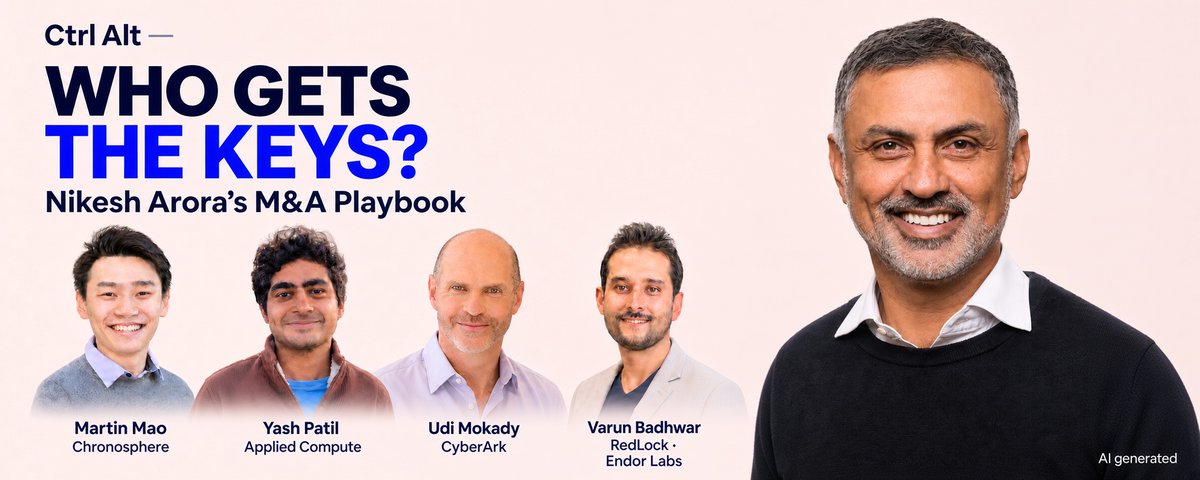
Why Nikesh Arora's M & A playbook might quite just work through the AI inflection point and the AI supercycle phase 👇
@nikesharora 's famous playbook: buy the startup, then hand the founder the keys. Nikesh Arora is Chairman CEO of one of the largest cyber security firms in the world @PaloAltoNtwks
@varun__badhwar founder CEO @EndorLabs has seen it up close. He sold RedLock to Palo Alto Networks in 2018 and built Prisma Cloud from zero to $300M ARR in three years, before AI.
Then SolarWinds hit, and his focus became simple: don't be the next SolarWinds.
@Vidyangi520
Today he's building Endor Labs. His story on Ctrl Alt Podcast 👇
Ctrl Alt Podcast With Vida Patil retweeted
Early money printed generational wealth. Late money is under risk. Anthropic’s record IPO (priced at $83, raised ~$81B, the largest ever) has created a stark split between those who owned it before the open and those who bought the first-day pop.
The winners (at the $83 IPO price)Per the detailed shareholder breakdown from Katie Roof / Ben Bergman at Business Insider, the biggest paper gains sit with:
Amazon (~14.7% stake) and Google (~13.7%).
Together they hold nearly 30% of the company (mostly non-voting Class N shares). At the $83 price their combined stakes were already worth hundreds of billions on paper; at the day-1 close (~$97) the figures climbed further.
The seven co-founders (Dario Amodei, Daniela Amodei, Tom Brown, Jack Clark, Jared Kaplan, Sam McCandlish, Christopher Olah). Each sold roughly $280M in the IPO and still hold stakes that, at the close, put their combined paper wealth well into the $100B+ range.
Early VCs and angels who got in long before the growth funds piled in: Lightspeed, Iconiq, Menlo Ventures, Spark, Sound Ventures (Ashton Kutcher), and especially Anjney Midha (AMP), who was an angel from the 2021 Series A after 21 of 22 Sand Hill firms passed.
These holders marked their gains at a price that still looks reasonable relative to where the stock opened.

Ctrl Alt Podcast With Vida Patil retweeted
While Silicon Valley chases hyper-growth and AI moonshots, a quiet Italian software conglomerate is running the most contrarian playbook in tech: buying the 2021 SaaS darlings that stopped growing.
Bending Spoons just acquired Mailchimp for $3.68B at a massive discount from the $12B Intuit paid at the peak of the zero-interest-rate era. Yet, relative to its all-time high, Mailchimp actually walked away with the highest exit multiple of Bending Spoons’ recent shopping spree:
Miro: $17.5B peak → ~$1.79B (10¢ on the dollar)
Vimeo: $7.2B → $1.38B (19¢)
Airtable: $11B → ~$2.25B (20¢)
Eventbrite: $1.76B → $500M (28¢)
Mailchimp: $12B → $3.68B (31¢)
Bending Spoons isn't buying broken companies. These are household B2B brands with sticky, recurring revenue and millions of entrenched users. Their only crime is gravity: they hit a growth wall.
In 2021, Mailchimp commanded ~15x revenue because it was growing 20% on an $800M run rate. Today, it is guiding to 0% growth on ~$1.26B in revenue, clearing the market at roughly 2.9x.
The venture ecosystem still prices companies on momentum and future optionality. Bending Spoons underwrites cash flow, operational discipline, and permanent ownership, turning stalled tech unicorns into high-margin compounding machines.
For any B2B founder or investor sitting on a business growing under 10%, the valuation reset is no longer theoretical. Your last private round is ancient history; these five deals are your comps now.


Ctrl Alt Podcast With Vida Patil retweeted
@nikesharora just agreed to buy a one-year-old startup for $4.5 billion in stock.
The line I’d read twice: its CEO, @ypatil125 Yash Patil, becomes Palo Alto Networks’ Co-Chief AI Officer if the deal closes.