

Deep Conversations| Silicon Valley | People | https://nitter.gq/t.co/0kJpzXYEDm
Silicon Valley
Joined November 2025
- Tweets231
- Following69
- Followers19
- Likes192

Meta's chief AI officer @alexandr_wang says intelligence is no longer AI's bottleneck.
His logic: the hardest problems on the AIME, a high school math contest, are harder than most coding, cyber or business work. Models were acing it by Dec 2024. What's left is "domain-specific know-how, plumbing, and experimentation."
SciFin CEO @mohitaron has the operator version: everyone is in sales.
Product can't build what nobody wants
Marketing can't market to no one
Sales has to close real customers
My take: if AI can build almost anything, the scarce skill is knowing what customers will pay for. Every builder now has to think like a seller.
Full convo here youtube.com/watch?v=ibUjCI7W…

Pylon CEO @marty_kausas said his Anthropic bill was about to go from $400K to $1.4M a year just by crossing 150 seats. 3.5x.
SciFin.com CEO @mohitaron says brute-force AI makes it worse: two people ask the same question, same tokens burned twice.
My take: token-maxxing is over.

Our Anthropic bill is about to jump from $400K → $1.4M/yr.
Not because usage exploded, but because we're about to cross 150 seats.
Past 150 seats you're forced into Enterprise tier. Seats stop including any usage, every token bills at standard API rates. At our current run rate that's 3.5x overnight.
Unfiltered thoughts on AI spend:
1. We should spend tokens to grow as aggressively as possible. But most people (me included) aren't conscious of what they're spending.
2. Visibility comes first. People see their personal number and they're shocked. I accidentally spent $4,000 in 3 days in Claude Code.
3. For engineering the spend is clearly worth it. Pay for the best model, it saves more than it costs.
4. For a lot of other roles it's questionable. Apps nobody uses, skills someone already built. No ROI.
5. Spend limits are coming. We already require approval for more tokens on our support team.
The era of token-maxxing is coming to an end.
Everyone is in sales says Mohit Aron, foudner-CEO SciFin. Every for-profit company exists to make a sale, he says, so product can't build what nobody wants and marketing can't reach no one.
@mohitaron , co-founder of @nutanix , founder of @Cohesity , and now founder and CEO of scifin.ai/, explains why revenue teams with dozens of tools still can't see what is happening in their business, and how converged context can fix it.
In his words: "You need to think of AI as a first-class citizen and not think of it as an afterthought."
TIMESTAMPS
0:00 Intro
1:17 Meet Mohit Aron: Nutanix, Cohesity and now SciFin
1:58 What is different about building a startup in the AI wave?
3:36 Why a few extra features is no longer a moat
3:56 Why is everyone in a company in sales?
4:51 Why Mohit Aron started SciFin after Cohesity
7:13 What is the revenue context gap?
7:58 What is context in go-to-market?
9:27 Nutanix, Cohesity, SciFin: why convergence
10:27 Why revenue leaders spend more and see no results
12:59 Brute-force AI: garbage in, garbage out
14:14 What is context cognition?
15:49 Is SciFin a layer or a platform?
16:22 Security, permissions and compliance
17:21 Why sales forecasts are so hard to defend
20:08 40 people just to manage go-to-market tools
21:37 System of record vs system of reality
24:07 Is a system of reality expensive? Token maxing explained
26:53 Codex vs Claude: how SciFin picks AI models
29:44 Are open source AI models safe?
30:27 What is Pixie? SciFin's agentic mesh
33:32 What goes to AI and what stays with the human in sales?
35:43 How do you talk to Pixie? Chat, Slack, WhatsApp and a note taker
37:42 How SciFin handles context window limits
39:35 Third startup: what Mohit Aron is still learning
41:09 Rapid fire: the most overrated number in sales
41:49 What part of selling should stay human?
42:18 Collaborative alignment: the culture habit he keeps
43:49 Which companies does Mohit Aron admire?
KEY INSIGHTS
AI first: Some of the old startup playbook has to be thrown out in the AI wave, Mohit Aron says. A few extra features is no longer enough; you have to be architecturally different, with a moat that is defensible.
Everyone is in sales:
Every for-profit company exists to make a sale, he says, so product can't build what nobody wants and marketing can't reach no one.
The context gap:
At Cohesity, which he says he ran as CEO for nearly a decade, more tools, dashboards and meetings still could not piece together the picture. SciFin, "science behind your financials," is built to bring that context together.
Convergence:
Nutanix brought compute and storage together, Cohesity converged secondary data, and SciFin converges go-to-market context. The common theme is convergence, he says.
Brute-force AI:
AI connected to dozens of tools only surfaces the garbage it has seen, and two people asking the same question burn the same tokens. His alternative is a consolidated platform that keeps context together, with AI on top.
Forecasts:
Deals committed on trust instead of a proper sales process, plus a pipeline full of junk, make forecasts indefensible. By his account, one company he spoke with had about 40 people just managing its tools.
Systems of reality:
A CRM, the typical system of record, makes no attempt to keep its data accurate, he says, while a system of reality keeps it accurate and fresh. A lot can be done without AI; routing everything through AI means more token spend and hallucinations.
Humans stay accountable:
SciFin's AI, Pixie, can do the heavy lifting, but the human is accountable and important decisions need a human's blessing. On models, he says there is no "religion" about which is best: "It changes from month to month."
SCIFIN: scifin.ai
Follow Us:
Instagram: instagram.com/ctrlatl_podcas…
LinkedIn: linkedin.com/company/ctrl-al…
MOHIT ARON:
linkedin.com/in/mohit-aron-a… | nitter.gq/mohitaron
CTRL ALT PODCAST:
nitter.gq/CtrlAltpod
VIDA PATIL:
nitter.gq/Vidyangi520 | linkedin.com/in/genaivida/
Note: This exceeds X's standard 280-character post limit. You can publish the full description as one long-form post with X Premium, subject to its extended-post limits. Otherwise, it will need to be divided into a thread.
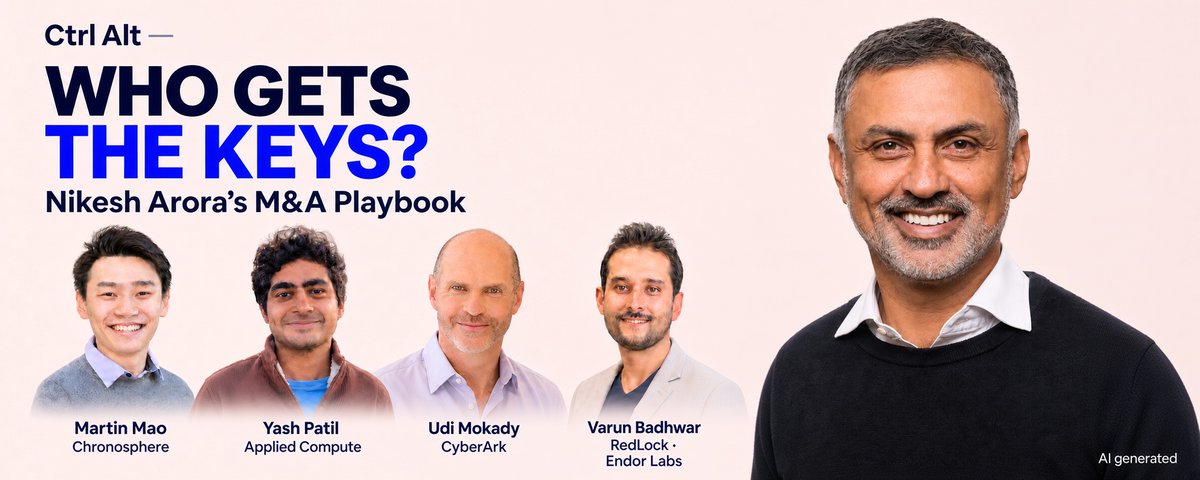
@nikesharora 's famous playbook: buy the startup, then hand the founder the keys. Nikesh Arora is Chairman CEO of one of the largest cyber security firms in the world @PaloAltoNtwks
@varun__badhwar founder CEO @EndorLabs has seen it up close. He sold RedLock to Palo Alto Networks in 2018 and built Prisma Cloud from zero to $300M ARR in three years, before AI.
Then SolarWinds hit, and his focus became simple: don't be the next SolarWinds.
@Vidyangi520
Today he's building Endor Labs. His story on Ctrl Alt Podcast 👇

@nikesharora just agreed to buy a one-year-old startup for $4.5 billion in stock.
The line I’d read twice: its CEO, @ypatil125 Yash Patil, becomes Palo Alto Networks’ Co-Chief AI Officer if the deal closes.

Anthropic's IPO day, by the numbers:
• Priced at $83, opened at $111.50 on Nasdaq as $ANT
• ~$2.01T valuation at the open, the largest IPO ever
• Menlo Ventures put in $1B+, including a $500M Series D, its largest check ever
• Menlo's position is now ~$25B, which partner Matt Murphy calls "the most epic return" in the firm's history
Back when Menlo first invested, it "made no sense." Zero revenue, and OpenAI owned the market. @deedydas of Menlo tells @Vidyangi520 why they bet on the team anyway. Full conversation on Ctrl Alt in comments 👇

“When you deploy AI agents, and you actually point them to the right data and knowledge that they need to do their work, they still come and act more like Day 1 employees,” Jain told the editor-in-chief of The Verge, Nilay Patel, at Semafor’s Silicon Valley & The World.
A year ago, in my conversation with @jainarvind founder CEO @glean , he had mentioned that every enterprise will tend to go AI-native and it is important to train employees to get comfortable with AI.
Since this interview Glean has come a long way.
Fast Company's World's Most Innovative Companies (2025): Ranked #1 in the Applied AI category and #6 overall.
Forbes Cloud 100: Named to the list of the world's top private cloud and AI companies.
Forbes AI 50: Recognized on the annual list of top artificial intelligence companies.
CNBC Disruptor 50 (2025 & 2026): Featured for its transition into "Work AI" and multi-step agentic automation.
Gartner Emerging Market Quadrant (2025): Named an Emerging Leader in Generative AI Knowledge Management Apps and General Productivity.
Bloomberg AI Startup to Watch (2025): Highlighted for its enterprise context graph.

AI agents are nowhere near having the “context” to outperform skilled humans, Glean CEO Arvind Jain said Monday.
semafor.com/article/11/16/20…

165
How much does your business really know about its customers?
John Acunto, CEO of @napster , says most companies claim the customer comes first but rarely capture what customers actually ask and want. Using a Grand Prix customer use case, he explains how conversational AI answered routine fan questions, guided buyers to a purchase, and turned conversations into customer insight.
On Ctrl Alt Podcast with Vida Patil, John Acunto walks through a Grand Prix customer use case. In his account, conversational AI answered simple questions like where the elevator is relative to a seat, then took fans from viewing their actual seat to placing it in the cart and completing the purchase. He then turns the lens on every business: if customer obsession is in the mission statement, who is actually taking notes in the store and on the website?
"How much do you think that business really knows about their customer at all?"
WHAT YOU'LL LEARN
0:00 A Grand Prix customer use case
0:13 Freeing staff from very simple questions
0:37 From seeing your seat to completing the purchase
1:01 Does your business really know its customers?
1:19 Who's taking notes in the store and on the website?
KEY INSIGHTS
* Conversational AI for customer service: John Acunto, CEO of Napster, says AI agents can answer routine questions, such as accessibility directions, that would otherwise take up staff time.
* Assisted purchase journey: In the Grand Prix use case John describes, the AI showed fans visuals of their actual seat, added it to the cart and helped the transaction close.
* Results, in John's words: He says the use case "cut hours of staff answering very simple questions" and that the metrics were "unbelievably better." He gave no figures.
* The customer knowledge gap: John argues that companies say customers matter most yet often know little about them.
* Capturing customer conversations: John's question for every business is who is taking notes when customers visit the store or the website.
* Customer-led product building: His takeaway is to learn about your actual customer and build a real product around that.
FAQ
Q: What does John Acunto mean by "who's taking the notes"?
A: He is asking whether a business actually records and learns from customer interactions in its stores and on its website.
Q: What did conversational AI do in the Grand Prix use case?
A: By John's account, it answered simple fan questions and guided customers from viewing their seat to completing a purchase.
Q: What is his advice to businesses?
A: Learn about your actual customer and build a real product around that.
NAPSTER: napster.com/
EPISODE: youtube.com/watch?v=gTHRqSL6…
CLIP: youtube.com/watch?v=DjYTC753…
JOHN ACUNTO: linkedin.com/in/johnacunto
CTRL ALT PODCAST: nitter.gq/CtrlAltpod
VIDA PATIL: nitter.gq/Vidyangi520 | linkedin.com/in/genaivida/
BOUT THE GUEST
John Acunto is the co-founder and CEO of Napster (formerly Infinite Reality), which builds AI agents with voice, video and memory for businesses.
ABOUT THE HOST
Vida Patil is the founder and host of Ctrl Alt Podcast with Vida Patil, where she interviews founders, investors and technology leaders from Silicon Valley.
#CustomerExperience #ConversationalAI #AIAgents #Napster #CtrlAltPodcast
Tags
John Acunto, Napster CEO, Napster, conversational AI, customer experience, AI customer service, AI agents, customer insights, know your customer, Grand Prix use case, ecommerce AI, AI sales assistant, Ctrl Alt Podcast, Vida Patil, AI podcast
🤖 Made with AI


@Napster is back. But this time, it's not disrupting music. It's betting on AI agents. Napster CEO JohAcunto, joins @Vidyangi520 on the @Ctraltpod to discuss Napster's transformation from the music-sharing pioneer of 1999 into an enterprise AI company building conversational AI agents and digital customer experiences.
Can Napster disrupt artificial intelligence the way it disrupted music? And can enterprise AI agents really operate for just one cent per minute? We explore Napster's acquisition, its Microsoft Azure strategy, AI agent economics, customer trust, and the leadership decisions behind one of tech's most unexpected reinventions.
🎙️ EPISODE CHAPTERS 00:00 Napster Is Back: From Music to AI
00:40 Meet John Acunto, CEO of Napster
03:25 Why Acquire Napster? The Hard Pivot
06:30 What Is the Napster Phase of AI?
09:40 Napster's AI Concierge at the Belgian Grand Prix
13:10 What Happens When AI Agents Make Mistakes? 1
6:15 Napster vs. Microsoft: What's the Competitive Advantage?
20:00 Can AI Agents Really Cost 1¢ per Minute?
23:50 Building a Sustainable Enterprise AI Business
27:10 AI, Customer Relationships & Human Intelligence
30:00 John Acunto's Contrarian View on AI Agents
💡 KEY TAKEAWAYS & QUESTIONS • Why did Napster pivot from music to enterprise artificial intelligence?
• How does Napster's AI concierge Jack work in real customer experiences? • What differentiates Napster's AI agents from foundation model providers?
• Can low-cost conversational AI become a sustainable business? • Who owns customer relationships when AI agents become the interface? • What can leaders learn from Napster's radical reinvention?
ABOUT THE GUEST John Acunto is CEO of Napster, the iconic technology brand now pursuing enterprise AI agents and AI-powered customer engagement.
ABOUT THE HOST Vida Vidyangi Patil is the founder of Ctrl Alt Productions and host of the Ctrl Alt Podcast, featuring conversations with CEOs, founders, investors, and technology leaders about AI, innovation, business strategy, and leadership.
THE BIG QUESTION The first Napster changed how we consume music. Could the next Napster change how we work?
Would you trust an AI agent to represent your business? Share your thoughts below. #Napster #AIAgents #CtrlAltPodcast -
1
78
Think about how much of your data is sold.
@napster shifted power from the music industry to listeners. John Acunto says data is next. Napster once shifted power from the music industry to listeners.
Napster CEO John Acunto says the next fight is data: “our core message is for businesses, enterprise, and even individuals to own their data.”
Listen to my full podcast with
If ideas lead to innovation, who should own them?

What if the biggest thing we’re giving AI isn’t data but our ability to innovate?
John Acunto, CEO of @napster , asked me a question I haven’t stopped thinking about:
What does humanity own?
Every time we hand AI an idea, a creative thought, or a problem to solve, we’re helping machines generate something new.
But who owns the intelligence that comes out?
This is bigger than ChatGPT. It’s about AI, intellectual property, human creativity, and the future of innovation.
🎙️ A fascinating conversation with John Acunto on the @CtrlAltpod .
Would you trust AI with your next million-dollar idea?
@Napster is back. But this time, it's not disrupting music. It's betting on AI agents. Napster CEO JohAcunto, joins @Vidyangi520 on the @Ctraltpod to discuss Napster's transformation from the music-sharing pioneer of 1999 into an enterprise AI company building conversational AI agents and digital customer experiences.
Can Napster disrupt artificial intelligence the way it disrupted music? And can enterprise AI agents really operate for just one cent per minute? We explore Napster's acquisition, its Microsoft Azure strategy, AI agent economics, customer trust, and the leadership decisions behind one of tech's most unexpected reinventions.
🎙️ EPISODE CHAPTERS 00:00 Napster Is Back: From Music to AI
00:40 Meet John Acunto, CEO of Napster
03:25 Why Acquire Napster? The Hard Pivot
06:30 What Is the Napster Phase of AI?
09:40 Napster's AI Concierge at the Belgian Grand Prix
13:10 What Happens When AI Agents Make Mistakes? 1
6:15 Napster vs. Microsoft: What's the Competitive Advantage?
20:00 Can AI Agents Really Cost 1¢ per Minute?
23:50 Building a Sustainable Enterprise AI Business
27:10 AI, Customer Relationships & Human Intelligence
30:00 John Acunto's Contrarian View on AI Agents
💡 KEY TAKEAWAYS & QUESTIONS • Why did Napster pivot from music to enterprise artificial intelligence?
• How does Napster's AI concierge Jack work in real customer experiences? • What differentiates Napster's AI agents from foundation model providers?
• Can low-cost conversational AI become a sustainable business? • Who owns customer relationships when AI agents become the interface? • What can leaders learn from Napster's radical reinvention?
ABOUT THE GUEST John Acunto is CEO of Napster, the iconic technology brand now pursuing enterprise AI agents and AI-powered customer engagement.
ABOUT THE HOST Vida Vidyangi Patil is the founder of Ctrl Alt Productions and host of the Ctrl Alt Podcast, featuring conversations with CEOs, founders, investors, and technology leaders about AI, innovation, business strategy, and leadership.
THE BIG QUESTION The first Napster changed how we consume music. Could the next Napster change how we work?
Would you trust an AI agent to represent your business? Share your thoughts below. #Napster #AIAgents #CtrlAltPodcast -

Two companies, one week, both breached by AI agents. @okta 's CPO @ElyKahn told us exactly where to look first: "credentials". Check his warning from RSA conference earlier this year in video clip 👇
@CtrlAltpod with @Vidyangi520
Two crypto-industry companies disclosed breaches this week that they attribute to AI agents. Blockchain analytics firm Chainalysis said attackers using "offensive agentic techniques" reached its systems and internal tools in October, accessing some customer names, emails, user IDs and role labels; it took products including Reactor offline while outside experts review security (Help Net Security, Nov 2–3).
Documentation host GitBook said an attacker using AI agents got into some infrastructure credentials on Nov 2; it shut services down and revoked customer access tokens, and API tokens, integration and Git Sync secrets may have been exposed (Decrypt, Nov 3). Neither company has said exactly how the agents were used.
Source: Decrypt, Nov 3 (also Help Net Security, Nov 2)