Deep Conversations| Silicon Valley | People | https://nitter.gq/t.co/0kJpzXYEDm
Silicon Valley
Joined November 2025
- Tweets231
- Following69
- Followers19
- Likes192


Ctrl Alt Podcast With Vida Patil retweeted

@AltimeterCap and @MadronaVentures are backing this two time decacorn founder, here's why! Your AI might be burning money to tell you the wrong thing.
@mohitaron , co-founder of @nutanix , founder of @Cohesity , and now founder and CEO of @scifinai , has a name for it: the brute-force AI approach.
You connect AI to dozens of tools and hope it figures things out. He says three things go wrong.
1️⃣ "AI can only surface the garbage that it has seen. It's garbage in, garbage out."
2️⃣ "You've added one more gas guzzler on top of the dozen that you already have." If two people ask the same question, "both of them are going to be burning the same number of tokens."
3️⃣ Everyone ends up with their own AI dashboard and their own version of the truth. "There's no consistency. It's very fragile."
His answer isn't less AI. It's better architecture: "a consolidated platform that keeps the context together," with AI layered on top.
As models get smarter and tokens get cheaper, this question matters more, not less. Are we feeding these incredible models context they can trust, or just more noise?
I'd love to hear how the builders and backers shaping this era see it: @OpenAI, @Anthropic, @NVIDIA, @Altimeter Capital, @Madrona Venture Group. Is the next leap in enterprise AI the model, or the context underneath it?
Thank you, @Mohit Aron, for such a candid conversation, and congratulations to the @SciFin team.
🎧 Watch the clip below, and the full episode is on @CtrlAltpod
#AI #EnterpriseAI #AIAgents #RevOps #CtrlAltPodcast

"A few extra features is no longer enough; you have to be architecturally different, with a moat that is defensible."
I sit down with @mohitaron to decode the AI Playbook for your company starting scratch.
Having cofounded decacorns @nutanix and @Cohesity he starts off saying "Everyone is in sales"
Some of the old startup playbook has to be thrown out in the AI wave, Mohit Aron says. A few extra features is no longer enough; you have to be architecturally different, with a moat that is defensible.
▪️ EVERYONE IS IN SALES
Every for-profit company exists to make a sale, he says, so product can't build what nobody wants and marketing can't reach no one.
▪️ THE CONTEXT GAP
At Cohesity, which he says he ran as CEO for nearly a decade, more tools, dashboards and meetings still could not piece together the picture. SciFin, "science behind your financials," is built to bring that context together.
▪️ CONVERGENCE
Nutanix brought compute and storage together, Cohesity converged secondary data, and SciFin converges go-to-market context. The common theme is convergence, he says.
▪️ BRUTE-FORCE AI
AI connected to dozens of tools only surfaces the garbage it has seen, and two people asking the same question burn the same tokens. His alternative is a consolidated platform that keeps context together, with AI on top.
▪️ FORECASTS
Deals committed on trust instead of a proper sales process, plus a pipeline full of junk, make forecasts indefensible. By his account, one company he spoke with had about 40 people just managing its tools.
▪️ SYSTEMS OF REALITY
A CRM, the typical system of record, makes no attempt to keep its data accurate, he says, while a system of reality keeps it accurate and fresh. A lot can be done without AI; routing everything through AI means more token spend and hallucinations.
▪️ HUMANS STAY ACCOUNTABLE
SciFin's AI, Pixie, can do the heavy lifting, but the human is accountable and important decisions need a human's blessing.
On models, he says there is no "religion" about which is best:
"It changes from month to month."
@CtrlAltpod
Ctrl Alt Podcast With Vida Patil retweeted
Is token maxxing over? How does AI pricing work nowadays and who is making best use of the pricing - last mile? Does it come down to data and context hygiene?

Pylon CEO @marty_kausas said his Anthropic bill was about to go from $400K to $1.4M a year just by crossing 150 seats. 3.5x.
SciFin.com CEO @mohitaron says brute-force AI makes it worse: two people ask the same question, same tokens burned twice.
My take: token-maxxing is over.
Ctrl Alt Podcast With Vida Patil retweeted
Is @claudeai the best coding model, or is #Codex? Right now, the #1 agent on Terminal-Bench 4.1 is neither. It's @github Copilot Fusion (71.2%), which picks the model for each task. SciFin.com CEO @mohitaron says the answer changes all the time.
Is @claudeai the best coding model, or is #Codex? SciFin founder and CEO @mohitaron (@nutanix , @Cohesity ) says it's a war out there, and the answer changes all the time. His advice: don't get swayed by the marketing; look at the quality of the results.
Nutanix brought compute and storage together, Cohesity converged secondary data, and SciFin.ai converges go-to-market context. The common theme is convergence, he says.
Link to full convo in comments

Ctrl Alt Podcast With Vida Patil retweeted

"Hope for the second chance. I'm going to be a better CEO the second time around."
Jensen Huang at the Nvidia headquarter after ruturning back.

WHAT A HISTORIC TIME!
Nvidia's board reversed itself and reinstated Jensen Huang as CEO, president and director, and shares jumped 31%.
The unanimous vote came less than a week after chair Harvey Jones told investors the board did not intend to bring him back.
The board says follow-up meetings satisfied it about his candor, while senior US officials assured it his return posed no national security risk.
President Donald Trump endorsed the decision.


Ctrl Alt Podcast With Vida Patil retweeted
@JensenHuang makes a comeback. Silicon Valley makes dreams come true if you have conviction


NVIDIA Board reinstates Jensen Huang as President, CEO and Board Director.
Read the release: nvidianews.nvidia.com/news/n…

Ctrl Alt Podcast With Vida Patil retweeted

Scenes from Nvidia headquarters as Jensen comes back. The Nvidia employees wanted him back more than anything.
Grateful to the President, everyone in the administration, everyone who signed the petition, everyone who supported Jensen publicly, everyone who called the board, everyone on the board who fought for him, everyone.
This is why America is the greatest country on earth.
Every part of Jensen’s story would have only been possible in America.
And remember that Gandalf the White was even better than Gandalf the Grey in every way.
“Let’s get to work.” 🇺🇸


Ctrl Alt Podcast With Vida Patil retweeted
Dream come true moment for me! Meeting the legend himself.. With
@nikhilkamathcio @thetanmay
@taranjeetio ( founder CEO @mem0ai ) at an invite only exclusive Silicon Valley session! Filled with hot takes on AI bubble or boom, all things SF, culture, psychology, philosophy, fears, wins, losses, dating, no nonsense heart out talk! 🔥🔥🔥 Nikhil Kamath is one of sharpest podcasters and industry leaders I have met, he is scary intellectual. And very spiritual also… Nikhil X Tanmay terrific duo!! Nikhil Kamath’s podcast guest list includes @elonmusk @BillGates @nikesharora @RayDalio @vkhosla @DarioAmodei @harari_yuval @dkhos @WorldBankGroup @wef


Ctrl Alt Podcast With Vida Patil retweeted
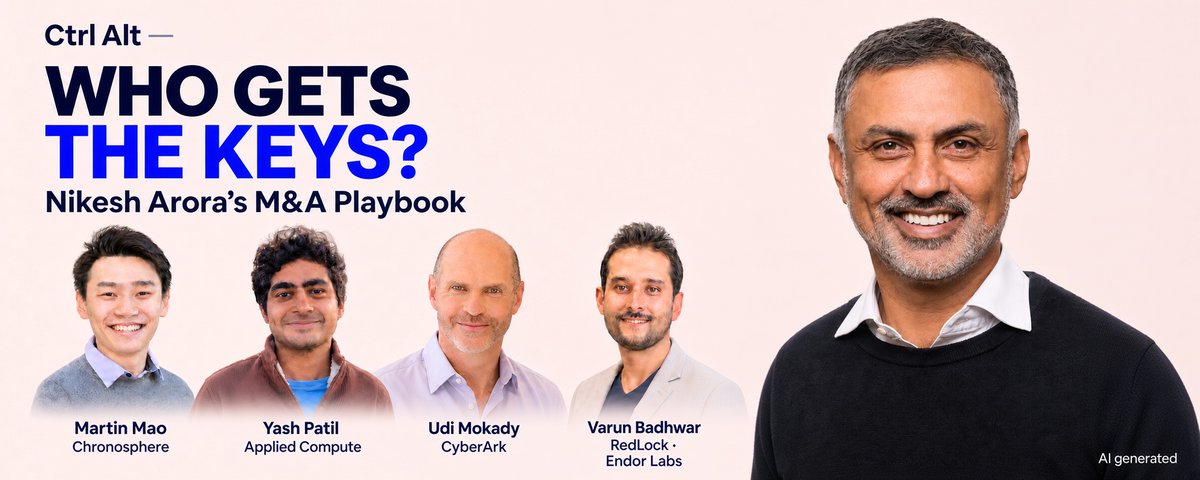
Why Nikesh Arora's M & A playbook might quite just work through the AI inflection point and the AI supercycle phase 👇
@nikesharora 's famous playbook: buy the startup, then hand the founder the keys. Nikesh Arora is Chairman CEO of one of the largest cyber security firms in the world @PaloAltoNtwks
@varun__badhwar founder CEO @EndorLabs has seen it up close. He sold RedLock to Palo Alto Networks in 2018 and built Prisma Cloud from zero to $300M ARR in three years, before AI.
Then SolarWinds hit, and his focus became simple: don't be the next SolarWinds.
@Vidyangi520
Today he's building Endor Labs. His story on Ctrl Alt Podcast 👇
Ctrl Alt Podcast With Vida Patil retweeted
Early money printed generational wealth. Late money is under risk. Anthropic’s record IPO (priced at $83, raised ~$81B, the largest ever) has created a stark split between those who owned it before the open and those who bought the first-day pop.
The winners (at the $83 IPO price)Per the detailed shareholder breakdown from Katie Roof / Ben Bergman at Business Insider, the biggest paper gains sit with:
Amazon (~14.7% stake) and Google (~13.7%).
Together they hold nearly 30% of the company (mostly non-voting Class N shares). At the $83 price their combined stakes were already worth hundreds of billions on paper; at the day-1 close (~$97) the figures climbed further.
The seven co-founders (Dario Amodei, Daniela Amodei, Tom Brown, Jack Clark, Jared Kaplan, Sam McCandlish, Christopher Olah). Each sold roughly $280M in the IPO and still hold stakes that, at the close, put their combined paper wealth well into the $100B+ range.
Early VCs and angels who got in long before the growth funds piled in: Lightspeed, Iconiq, Menlo Ventures, Spark, Sound Ventures (Ashton Kutcher), and especially Anjney Midha (AMP), who was an angel from the 2021 Series A after 21 of 22 Sand Hill firms passed.
These holders marked their gains at a price that still looks reasonable relative to where the stock opened.

Ctrl Alt Podcast With Vida Patil retweeted
While Silicon Valley chases hyper-growth and AI moonshots, a quiet Italian software conglomerate is running the most contrarian playbook in tech: buying the 2021 SaaS darlings that stopped growing.
Bending Spoons just acquired Mailchimp for $3.68B at a massive discount from the $12B Intuit paid at the peak of the zero-interest-rate era. Yet, relative to its all-time high, Mailchimp actually walked away with the highest exit multiple of Bending Spoons’ recent shopping spree:
Miro: $17.5B peak → ~$1.79B (10¢ on the dollar)
Vimeo: $7.2B → $1.38B (19¢)
Airtable: $11B → ~$2.25B (20¢)
Eventbrite: $1.76B → $500M (28¢)
Mailchimp: $12B → $3.68B (31¢)
Bending Spoons isn't buying broken companies. These are household B2B brands with sticky, recurring revenue and millions of entrenched users. Their only crime is gravity: they hit a growth wall.
In 2021, Mailchimp commanded ~15x revenue because it was growing 20% on an $800M run rate. Today, it is guiding to 0% growth on ~$1.26B in revenue, clearing the market at roughly 2.9x.
The venture ecosystem still prices companies on momentum and future optionality. Bending Spoons underwrites cash flow, operational discipline, and permanent ownership, turning stalled tech unicorns into high-margin compounding machines.
For any B2B founder or investor sitting on a business growing under 10%, the valuation reset is no longer theoretical. Your last private round is ancient history; these five deals are your comps now.


Ctrl Alt Podcast With Vida Patil retweeted
@nikesharora just agreed to buy a one-year-old startup for $4.5 billion in stock.
The line I’d read twice: its CEO, @ypatil125 Yash Patil, becomes Palo Alto Networks’ Co-Chief AI Officer if the deal closes.
Ctrl Alt Podcast With Vida Patil retweeted
Anthropic just opened at $111.50 a share, about a $2T valuation and the biggest IPO on record.
When Menlo Ventures first backed it, Anthropic was "a zero-revenue product in a market completely dominated by OpenAI."
@deedydas and @MenloVentures bet anyway
Menlo's $1B+ is now a ~$25B position. They believed in the team
I sat down for a podcast with Deedy Das to discuss all things investing and growth. Full episode link here from last year youtube.com/watch?v=y-O6lPwl…
🤖 Made with AI

Anthropic's IPO day, by the numbers:
• Priced at $83, opened at $111.50 on Nasdaq as $ANT
• ~$2.01T valuation at the open, the largest IPO ever
• Menlo Ventures put in $1B+, including a $500M Series D, its largest check ever
• Menlo's position is now ~$25B, which partner Matt Murphy calls "the most epic return" in the firm's history
Back when Menlo first invested, it "made no sense." Zero revenue, and OpenAI owned the market. @deedydas of Menlo tells @Vidyangi520 why they bet on the team anyway. Full conversation on Ctrl Alt in comments 👇
Ctrl Alt Podcast With Vida Patil retweeted
@napster is reinventing consumer experiences! It's incredible Napster's come back story (after 4 massive pivots in four different industries, the name survives!). Napster CEO John Acunto has many strong POVs on AI agents and what they are capable of in the consumer space. Here is one.
What if the biggest thing we’re giving AI isn’t data but our ability to innovate?
What if the biggest thing we’re giving AI isn’t data but our ability to innovate?
John Acunto, CEO of @napster , asked me a question I haven’t stopped thinking about:
What does humanity own?
Every time we hand AI an idea, a creative thought, or a problem to solve, we’re helping machines generate something new.
But who owns the intelligence that comes out?
This is bigger than ChatGPT. It’s about AI, intellectual property, human creativity, and the future of innovation.
🎙️ A fascinating conversation with John Acunto on the @CtrlAltpod .
Would you trust AI with your next million-dollar idea?
Ctrl Alt Podcast With Vida Patil retweeted
In 1999, @napster taught the world music could be free. The industry sued.
Napster was shut down.
It came back as a legal streaming service.
Now it's an AI company.
And Napster CEO, John Acunto, told me this:"The right to learn isn't free."
Full circle.
@Napster is back. But this time, it's not disrupting music. It's betting on AI agents. Napster CEO JohAcunto, joins @Vidyangi520 on the @Ctraltpod to discuss Napster's transformation from the music-sharing pioneer of 1999 into an enterprise AI company building conversational AI agents and digital customer experiences.
Can Napster disrupt artificial intelligence the way it disrupted music? And can enterprise AI agents really operate for just one cent per minute? We explore Napster's acquisition, its Microsoft Azure strategy, AI agent economics, customer trust, and the leadership decisions behind one of tech's most unexpected reinventions.
🎙️ EPISODE CHAPTERS 00:00 Napster Is Back: From Music to AI
00:40 Meet John Acunto, CEO of Napster
03:25 Why Acquire Napster? The Hard Pivot
06:30 What Is the Napster Phase of AI?
09:40 Napster's AI Concierge at the Belgian Grand Prix
13:10 What Happens When AI Agents Make Mistakes? 1
6:15 Napster vs. Microsoft: What's the Competitive Advantage?
20:00 Can AI Agents Really Cost 1¢ per Minute?
23:50 Building a Sustainable Enterprise AI Business
27:10 AI, Customer Relationships & Human Intelligence
30:00 John Acunto's Contrarian View on AI Agents
💡 KEY TAKEAWAYS & QUESTIONS • Why did Napster pivot from music to enterprise artificial intelligence?
• How does Napster's AI concierge Jack work in real customer experiences? • What differentiates Napster's AI agents from foundation model providers?
• Can low-cost conversational AI become a sustainable business? • Who owns customer relationships when AI agents become the interface? • What can leaders learn from Napster's radical reinvention?
ABOUT THE GUEST John Acunto is CEO of Napster, the iconic technology brand now pursuing enterprise AI agents and AI-powered customer engagement.
ABOUT THE HOST Vida Vidyangi Patil is the founder of Ctrl Alt Productions and host of the Ctrl Alt Podcast, featuring conversations with CEOs, founders, investors, and technology leaders about AI, innovation, business strategy, and leadership.
THE BIG QUESTION The first Napster changed how we consume music. Could the next Napster change how we work?
Would you trust an AI agent to represent your business? Share your thoughts below. #Napster #AIAgents #CtrlAltPodcast -
Ctrl Alt Podcast With Vida Patil retweeted
Think about how much of your data is sold.
@napster shifted power from the music industry to listeners. John Acunto says data is next. Napster once shifted power from the music industry to listeners.
Napster CEO John Acunto says the next fight is data: “our core message is for businesses, enterprise, and even individuals to own their data.”
Listen to my full podcast with
If ideas lead to innovation, who should own them?
Ctrl Alt Podcast With Vida Patil retweeted
@napster gave listeners power over the music industry.
Now its CEO, John Acunto, says the next fight is over data.
On the @CtrlAltpod , we get into owning your data, edge AI, why "agent" has been hijacked, and why "the right to learn isn't free."
@Napster is back. But this time, it's not disrupting music. It's betting on AI agents. Napster CEO JohAcunto, joins @Vidyangi520 on the @Ctraltpod to discuss Napster's transformation from the music-sharing pioneer of 1999 into an enterprise AI company building conversational AI agents and digital customer experiences.
Can Napster disrupt artificial intelligence the way it disrupted music? And can enterprise AI agents really operate for just one cent per minute? We explore Napster's acquisition, its Microsoft Azure strategy, AI agent economics, customer trust, and the leadership decisions behind one of tech's most unexpected reinventions.
🎙️ EPISODE CHAPTERS 00:00 Napster Is Back: From Music to AI
00:40 Meet John Acunto, CEO of Napster
03:25 Why Acquire Napster? The Hard Pivot
06:30 What Is the Napster Phase of AI?
09:40 Napster's AI Concierge at the Belgian Grand Prix
13:10 What Happens When AI Agents Make Mistakes? 1
6:15 Napster vs. Microsoft: What's the Competitive Advantage?
20:00 Can AI Agents Really Cost 1¢ per Minute?
23:50 Building a Sustainable Enterprise AI Business
27:10 AI, Customer Relationships & Human Intelligence
30:00 John Acunto's Contrarian View on AI Agents
💡 KEY TAKEAWAYS & QUESTIONS • Why did Napster pivot from music to enterprise artificial intelligence?
• How does Napster's AI concierge Jack work in real customer experiences? • What differentiates Napster's AI agents from foundation model providers?
• Can low-cost conversational AI become a sustainable business? • Who owns customer relationships when AI agents become the interface? • What can leaders learn from Napster's radical reinvention?
ABOUT THE GUEST John Acunto is CEO of Napster, the iconic technology brand now pursuing enterprise AI agents and AI-powered customer engagement.
ABOUT THE HOST Vida Vidyangi Patil is the founder of Ctrl Alt Productions and host of the Ctrl Alt Podcast, featuring conversations with CEOs, founders, investors, and technology leaders about AI, innovation, business strategy, and leadership.
THE BIG QUESTION The first Napster changed how we consume music. Could the next Napster change how we work?
Would you trust an AI agent to represent your business? Share your thoughts below. #Napster #AIAgents #CtrlAltPodcast -
Ctrl Alt Podcast With Vida Patil retweeted

Who takes ownership of your ideas when you use AI to create?
Napster CEO John Acunto on how Napster lets you keep ownership.
#StreamingIntelligence
Ctrl Alt Podcast With Vida Patil retweeted
@ElonMusk has the *Idiot Index*. @JensenHuang has *Speed of Light*. @NikeshArora has *Platformization*. 3 CEOs cracked the code: most powerful strategy isn't what you say in the boardroom it's what your team repeats when you're not there. What's your word?

Ctrl Alt Podcast With Vida Patil retweeted
Nikesh Arora helped build a $250B cybersecurity giant.
But the most interesting thing about him isn't how aggressively he builds.
It's how calmly he thinks.
We tend to associate extraordinary ambition with extraordinary anxiety.
The bigger the stakes, the higher the stress. The more successful you become, the harder it is to switch off.
Nikesh Arora seems to challenge that equation.
I watched his conversation with @davidsenra , and came away thinking less about cybersecurity and more about the psychology of leadership.
Here is a CEO who has made enormous bets, acquired category leaders, and helped transform Palo Alto Networks from a firewall company into a cybersecurity platform.
Yet some of his most interesting ideas had nothing to do with technology.
Three things stayed with me.
1. Don't confuse ambition with anxiety.
You can take enormous risks without treating every outcome like an existential crisis. Staying calm isn't a lack of urgency. It's what allows you to think clearly when the stakes are high.
2. Back people, not just ideas.
Markets shift. Technologies change. Strategies get rewritten.
Exceptional teams give you the ability to navigate what you couldn't possibly predict.
3. Inspire ambition. Never impose it.
This came from his philosophy on raising children.
And I thought: isn't this just as true for leadership?
The best leaders don't manufacture ambition through pressure. They create environments where people want to do extraordinary things.
That's a very different philosophy of performance.
What fascinates me is the paradox:
Be ambitious about the outcome.
Be disciplined about the execution.
Be detached from what you cannot control.
Perhaps that's how you build something extraordinary without letting it consume you.
I distilled ten ideas from the conversation into this Ctrl Alt Intelligence Leadership Playbook.
And here's the question I've been sitting with:
Are we teaching the next generation of leaders how to succeed—or just how to withstand pressure?
Inspired by Nikesh Arora's conversation with David Senra.
@nikesharora @PaloAltoNtwks @Google @SoftBank_Group
#Leadership #NikeshArora #CtrlAltIntelligence
🤖 Made with AI


.@NikeshArora grew Palo Alto Networks from $18 billion to $250+ billion in market value. Before that, he spent 10 years helping grow Google’s revenue from $2 billion to $62 billion.
When he joined Palo Alto, he thought cybersecurity was two words. 8 years and 35 acquisitions later, the company has more than 70 products.
His approach: buy the winning team and put its founder in charge. If a startup beat his team with fewer resources, why make its founder report to the person who lost?
Nikesh explains why he makes founders agree to a product roadmap before signing a deal, why he wanted Google to buy Netflix, and how Egon Durban kept him bidding for a cricket team at 6 in the morning.
0:00 The Oculus deal he almost did with Egon Durban
8:45 "I thought cybersecurity was two words"
11:44 Why he buys instead of builds
14:33 Why the acquired founder becomes the boss
16:21 Why he only buys number one or number two
19:30 The 30-day test before every acquisition
33:38 Egon Durban and the 29-round cricket auction
42:32 Why nothing at work stresses him out
44:28 Selling Google ads without knowing the price
49:42 Coming to America with $200
51:58 Raising kids who didn't grow up poor
54:46 Why AI hacking has been good for Palo Alto
Includes paid partnerships.
Ctrl Alt Podcast With Vida Patil retweeted
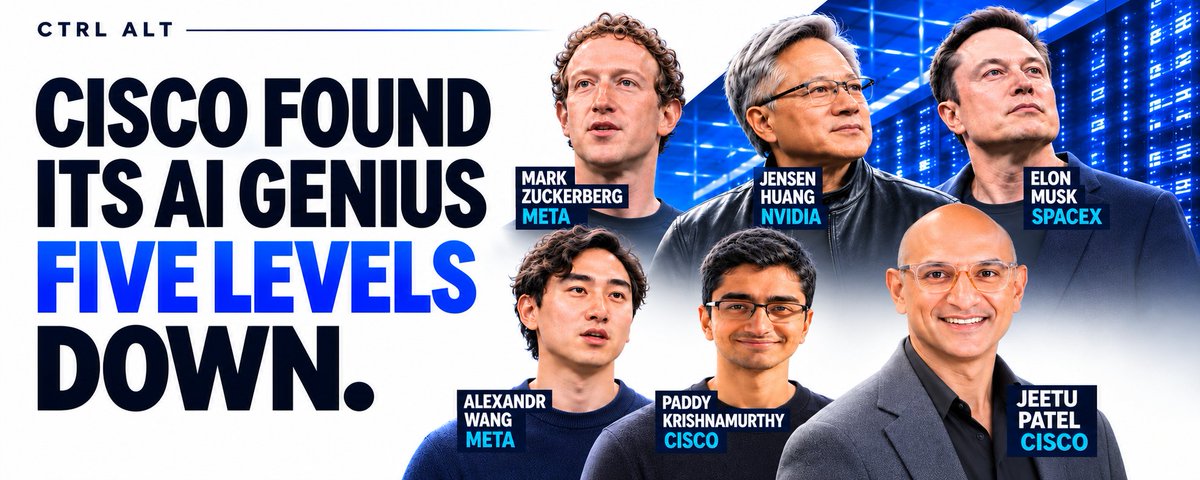
Cisco's best move was a conversation in its own office. @@PadmanabhanKri told @@jpatel41 he thought a two-person team could rewrite Cisco's legacy code. Patel's response?
"I've given him unlimited tokens because he's going to refactor code."