

Searching for high-quality, durable businesses with robust competitive advantages, runways for growth, and a history of creating value for shareholders.
Joined January 2022
- Tweets2.6K
- Following482
- Followers7.6K
- Likes4.1K





Durable Value Creators retweeted

New Post: I list what I think are the traits of an ideal industry (eg pricing power, recurring revenue, economically agnostic), and offer a case study of such an industry.
Enjoy!
fortunefinancialadvisors.com…

Durable Value Creators retweeted

Some businesses look great during "normal operations" - but when is it ever normal? There's always a fire to put out. If tail events happen every quarter, they're not tail events. They're just part of the business model.
Interesting observation on CN Rail by @ErnestWongBWM

Durable Value Creators retweeted
New Post: My take on why aerospace (equal-weighted) has been the best performing industry over the last ~100 years, and why the future is as bright as ever.
fortunefinancialadvisors.com…

Durable Value Creators retweeted

Sharing my favourite 34 highlights of TCI’s Chris Hohn interview by Nikolai Tangen of Norges Bank that resonated with me.
It was the first time I had watched/heard Chris Hohn speak, and I realised we had numerous similarities. This reminded me of a comment that I received recently: that he found my investing approach very similar to TCI / Chris Hohn, and I finally understood what he meant.
1 | A good investment is persistent and durable growth supported by strong moats
Let's start with the investment world. What makes a good investment? I think this is something a lot of people get wrong. They think it's about growth often, or something new. Neither of those things in themselves matter to us. The most important thing, and without which - for the types of investing that we do - is high barriers to entry, the moats that Warren Buffett has talked about.
2 | Strong moats are sustainable, in multiple types, difficult to replace and compete with
So what are good moats? The most important answer is ones that are sustainable. And ideally, you would have multiple moats, multiple pieces of defense. There are many ways - a moat is basically something that means that the business is difficult to replace, difficult to compete with. It protects against substitution risk and competition risk.
3 | No longer has confidence investing in cheap low quality average or bad business due to their unpredictable earnings power
Yes. Can there be a role for cheap average assets, let's call them low-quality assets which are trading at big discounts to replacement cost? Yes, that's the type of investing that can work, that I've done in my time - cheap average businesses or cheap bad businesses. But I don't feel that I can have any confidence in that type of investing because the earnings power of those average businesses is unpredictable.
4 | Irreplaceable physical assets and natural monopolies make it hard to compete
One which most people don't look at - most investors don't really look at, actually interestingly - is irreplaceable physical assets. We're in a world where people just look at earnings, they don't look at asset value or physical assets…These are natural monopolies. That also applies to toll roads and railroads and telecom towers - there are many forms of infrastructure, transmission towers that are hard to compete with because they're natural monopolies.
5 | Other types of intangible assets such as IP, installed base, scale, network effects, brands, customer switching costs are important
So infrastructure, physical assets is one. A second is IP - intellectual property that's so advanced that it's very difficult to replicate. Another barrier to entry is installed base. Which applies to the aircraft engine business - once those engines are there, for various reasons you get the spare parts business on it. Another barriers to entry is scale, although that's not a guarantee of a competitive moat. Network effects is another importantbarrier to entry. You can see this in assets like Visa, Meta - two examples of network effects. And brands are another barrier to entry. And I'll mention one more moat, which is customer switching costs. Take mission-critical software - once it's installed, companies are very reluctant to mess with it and switch because of the complexity.
6 | While recurring revenues are important, the predictability of when they recur is not, don’t like discretionary, prefer providing essential product or service
How important are recurring revenue streams for you when you look at businesses? It is important, but the predictability of when they recur is not. Let me give you an example - what's most important for us is something slightly different, which is essential product or service. We don't like things which are discretionary…So I think essential need is the bigger point, but usually our companies have recurring and predictable revenue streams of essential products.
7 | Revenue growth is not important, if it does not ultimately translate into profit growth
Why isn't growth as important as investors usually assume it to be? Because you can have profitless growth. The airline industry over a hundred years has had a lot of growth - airline travel has grown at 5% a year, continues to grow consistently, but airlines as a business cumulatively and collectively have made almost minimal profits despite growth because of the very low barriers to entry. So growth without barriers to entry is not a combination that you want.
8 | Very few companies have pricing power to price above inflation
I'll go into that, but I want to go back to the point about growth coming from two forms: price and volume. Most companies don't have pricing power - they can only price, if they're lucky, at inflation. That's why people don't focus on it - they don't even look at where growth comes from. They just assume it's volume plus inflation. But there is a special group of super companies that can price above inflation, and that's, as Buffett taught, the test of whether you have the moat. And this real pricing power above inflation can be very valuable because if you can price 1% above inflation and you have a 20% profit margin, your profits will grow 5% faster than revenue. People don't go into it or analyze it because there's so few companies that have it, but this is something we have in a lot of our investments because incremental pricing is pretty much all profits.
9 | Pricing growth is more important than volume growth, because it brings high operating leverage and increases profitability
That's right. And it's very potent if you have a lower margin. The lower your margin is. So this is why you asked about growth - is it volume growth? But if I have low volume growth but I have a lot of pricing growth, that's actually more important because of the leveraged effect. There's no cost associated with it.
10 | Will not invest in banks, low quality of earnings to the nature of leverage, and sooner or late, they are run by poor management
What are the type of companies you would never invest in, type of industries That's a good question. We have a long list of companies we don't invest in. We're very focused and we call them the risky and bad industries. And I have invested in some of these in the past, but I've learned - banks…The low quality of earnings because they're very leveraged, much more than people think, because people look at, "Oh, equity to risk weighted assets," but equity to total assets - many banks have run it at a hundred times…And the other reason for banks is very important - you know that sooner or later you may find someone without a lot of intelligence comes to run them, and then it can be toxic.
11 | Auto industry, retail, insurance, commodities, commodity manufacturing, tobacco, fossil fuel utilities, airlines, wireless telecom, media, advertising agencies, traditional asset managers are all bad businesses
What are the other others? Oh, many. The auto industry is obviously a commodity. Retail, insurance, commodities, commodity manufacturing, tobacco. The truth is, most things in manufacturing. So most industries - most industries are bad industries….I mean, I'll list you a couple more: traditional asset managers - bad businesses, speaking as one. Fossil fuel utilities - bad businesses. Airlines - bad businesses. Wireless telecom - bad businesses. We think media is bad. Advertising agencies - it's a very long list. Why? Because it's competitive with existing players and new technologies.
12 | There are only about 200 companies that they consider to be high quality and investable
So Chris, it doesn't leave - it doesn't leave a big universe. We say maybe there's 200 companies that we consider to be high quality and investable.
13 | Microsoft has incumbency, being able to bundle products to sell to customers, creating high switching costs
There's a lot of power of incumbency. This is another important point. So let's take a company, Microsoft, which we've invested in. One of their barriers to entry is bundling, or maybe it creates a customer switching cost. What do I mean by this? The Office franchise, which we're all familiar with, has many products in it. You know, your applications - word processing, Excel, your email, security, different things - and they sell it as a bundle. They don't disaggregate it. And when a new product or a potential competitor enters, they can add it to the bundle. So Zoom came out with video conferencing, and they could have potentially added all the things Microsoft does to that. So Microsoft had to respond and they launched Teams, and they were able to distribute it through the bundle - free to everybody. And even though Zoom, some people believe it was a better product or is a better product, Microsoft won that battle because they had the installed base, the incumbency which we talked about, and high switching costs because once people are using their Office software, they don't want to switch. So people started using Teams - something given to you free - why? Because it was good enough. It didn't have to be the best if it's free.
14 | Have position in Alphabet, see it as most risky and sized the smallest to reflect that, risk of search fragmenting and competition increasing, but see advantages of their data to offer higher quality search results
We have a position in Alphabet, which is maybe our most risky investment, where clearly - it's just one of our smallest investments as a result. And where we have some level of protection because there are businesses like YouTube and their cloud business which represent half the market cap today, and the cash and other things. So it isn't all search, but search is critical. And so - can they out-innovate competition? There's a risk of search fragmenting as competitors come in and try to. But it's a question mark. We don't think so. We think they have a lot of advantages with their data to offer higher quality search results. But competition is increasing.
15 | AI is going to be highly disruptive, increasing productivity, lower the cost base of companies, and make companies with strong moats every stronger, and vice versa, weaker
Talking of which, how do you think AI will change the investment landscape here? It's going to increase disruption in ways we can't even predict. But there are things like call centers will all go bankrupt, and another segment is Indian outsourcing companies who do coding and things like that. Demand for those services could collapse because AI can do coding with half the people. So there are - but AI will increase the productivity and lower the cost base of all companies. And so if you have a company with these barriers to entry, it's going to be worth more, I think. For generally competitive businesses, if you don't lead, you could become uncompetitive and be disrupted.
16 | Price and valuation is last, don’t even consider until they are comfortable with the strong barriers of entry
How do you value these companies? What is your valuation tool? We don't even look at that until we get comfortable that the barriers are so strong it will be around
Valuation multiples matter over shorter time periods but far less than growth over long periods of time
And the multiple - here's the thing about the multiples. They matter less than the growth when you look at it over a longer period. But most investors are unwilling or unable to invest on a long-term time horizon because either they don't know what they're doing, which interestingly goes back to what - they think it's risky, which goes back to what Warren Buffett was - when he was asked what the definition of risk was, you know what he said? "Not knowing what you're doing."
17 | If a company can keep growing for a long period of time, and its intrinsic value keeps increasing, the price doesn’t really matter at all that much
So really good nugget here is that if you buy something which is really good, it doesn't quite matter what you pay for it because it will grow. Well, I say the - let's just say it like this - the multiple to a point. Whether you buy it - if it's growing, it's all maths. You've got to look at the growth rate, the terminal multiple, all the multiple things. But if it's increasing intrinsic value at a good rate, you will undervalue it if you look at it over a short horizon. I can be saying it like that. And if you're willing to hold it for a long term and extract that intrinsic value growth, it'll be worth more to you than other people.
18 | Only a small subset of good or great businesses can be predicted with a higher degree of confidence
So once you know - so I agree with you. I think that valuation is just approximate. We can just say, in truth, with confidence we have a good or great business. And as I'm saying, only a small subset of businesses can be predicted, which are the most powerful ones. But exactly how they grow and unexpected events - you're right, there's no certainty.
19 | One can have an advantage to be a really long-term investor with longer holding periods relative to the short term ones of most institutional investors
but really honestly, one of the things we learned is - there's a really important point - is that we can have an advantage through long-termism, which is the average stock is held by an institutional investor by under a year for the stock market in the US. How long do you hold it Average holding period of our current portfolio is eight years.
20 | They are a good investor because they are focused on the company fundamentals in the long-term and not guess the stock market, macro or trade, data points, or catalysts
But I was always willing to look at the company fundamentals and not try to guess the stock market, and not focus on macro or trading. So I was always fundamental. Most investors are not fundamental - they trade actively, they look at data points, they say, "What's the catalyst?" They don't really know what the company does. So I think the fundamental approach has been key. Long-termism is key.
21 | Concentration and intuition is key, being able to think without thinking
Another thing we've done is concentration. We've owned a few things. We may have 10% type holdings - 10, 10 stocks, you know, 15 stocks. We don't own a 100 things. And I think another key point is intuition. We work with intuition, which is something that people find strange.
It's been defined as thinking without thinking, which is - the Buddhists would call a koan, something that just doesn't make sense.
Well, pattern recognition, in a way you've seen it before. That's - there's a word for it - knowing. It's the opposite of intellect. Of course we'll do analysis, but then - it's a higher level of intelligence than just intellect.
22 | Taking a private equity / PE approach to holding public companies for long periods
Well, really, if you are in the private equity world, that's normal. A private equity fund would hold an investment for their 10-year life funds normally, or longer, 12 years, as you know. And so we - it's an overused expression for some or misused - we take a private equity approach i.e. that we have to hold the company forever because the stock market maybe at very bad prices when you want to sell if you need to sell. And so I really think you need to have that approach.
23 | Think large companies are more likely to beat small companies, and keep dominating
I happen to think that large companies are more likely to beat small companies in an industry. They have more money to compete, and in R&D, and scale - we talked earlier about scale being key and incumbency being key, and switching costs. So a small company that invents something new - we talked about Zoom - it can be crushed by a large company reasonably easily. They can copy.
24 | The best large companies are too big for private equity, so PE are effectively owning poorer, lousier companies, the top 100 public companies are better than the top 100 in PE.
And large companies are usually, you know, too big for private equity. Private equity can't buy Visa. They're too big for them. So that size excludes private equity from large companies. And if a public company is selling something to private equity, usually they're not selling their best businesses. And I'd say private equity, like all asset management, is prone to the principal-agency problem where they are incentivized to gather assets. Let's just say it like this - the very best businesses in the public markets, I believe, are better - the top 100 companies are better than the top 100 companies in private equity.
25 | Sell when overvalued and when they lose conviction of the company
When do you sell a company? When its view of intrinsic value is not as good as other things, including - not just value but conviction. So our philosophy - there are two components to it. If you like intrinsic value, so the price still has to be at or above - at or below intrinsic value. But there's a second point which isn't really focused on by many investors, which is conviction. So you lose faith? You lose faith - no, I'm saying you need to have conviction when you invest in something at all times.
26 | Most PMs are managers of managers, and they are highly focused on P&L and stop loss, and many can’t analyze companies
people have to - we don't work like - here's the difference. I've been a stock picker. So a lot of portfolio managers aren't portfolio managers, they're managers of managers. And they say - people like that say to me, "There's only two truths, which is not the story that I hear, but the P&L and the stop-loss," because they can't analyze the company themselves. So no, we never take anything from anybody at face value, and we work in a team. That's something we didn't mention earlier. But the point is just a story is just a story. What you have to focus on what matters, because there was a spiritual teacher actually said something that applies to investing. He said, "Very few things matter, and most things don't matter at all." And investing, it's actually similar. You can - you need to get out of the noise and just focus on the handful of things that matter
27 | Good investors can be trained by great investors
Is it talent or can it be trained to become a good investor? I think it can be trained. There's a judgment element of it. I think it can be trained, for sure.
I love John, I love John. He's - I consider him a friend. When I was just starting out, he really - he's a great investor and he took me under his wing a little bit, because I didn't know anything.
28 | No longer purse hardcore activism, difficult to succeed due to growing passive investor base, don’t enjoy fighting anymore
I've learned that actually activism - hardcore activism is not a great thing…It's very difficult to succeed because the vast proponents of today's investor base are passive, who don't actually - to get them to vote for something is very difficult. And all the power - and so active management is dying.
No, I don't really enjoy fighting people anymore. I never really did. It was something we began with Deutsche Börse and now really, I'd say what people call activism is really an exception to us.
29 | Activists end up focusing on bad business, not good ones, pointless to focus on bad ones
So a lot of activists end up being activists in bad business…The business always wins. So it's pointless being an activist in a B business. That said, we still engage in hardcore activism.
30 | Learnt that shorting is not a good business because of unlimited downside, it was just to hard
I learned that shorting isn't a great business because you can be right but not be able to hold it or fund the losses. Because if you are short and the share price goes up, you basically [have] unlimited downside, and you have to fund the losses. This is what people don't realize. You're going to be eventually right.
And so you have to understand investor psychology. It's tough, very tough. And I had a dinner once with Warren Buffett, and he said he and Charlie looked at shorting - they studied it and they just said it was too hard because of that point of understanding investor psychology and the asymmetric risk and reward.
31 | Chris gives away everything he earns, don’t care about money for other than its value in helping people
But I give away everything I earn. I don't really care about money for other than its value in helping people. But I give away everything I earn. I don't really care about money for other than its value in helping people… And I just - this is intuition - said, "I don't want it. I want to just give it to charity." And I created a US foundation and gave it to it.
32 | Life is not one’s personality or physical body, but its soul and consciousness, with the desire to do something more with life to help others, than to just make money
That there's essence - who we really are, what we really are isn't the personality or the physical body, but soul or consciousness. And that - some would call it life. That's something that gives us life. And will - gave you, you know, in the same way you, Nikolai, had a desire, a will, a will to do something more with your life than just make money. And that - and in the fundamental nature of that - that's - the soul is service, desire to help - to help ultimately humanity.
33 | Most unfortunately don’t as they remain focused on their personality, desires, possessions, glamour, power, wealth, which don’t bring long lasting happiness
Because they identify with their personality, and less with - consider that like a unit as a user interface of the soul. And the personality's basic urge is desire, possessions, glamour like power and money and other things like that. And sooner or later people realize that that doesn't really give…
34 | It is purpose and meaning that brings long-lasting joy
some would say happiness, but actually there's more important things in the world in life than happiness - purpose and meaning.
And whether you go the long way, the short way, the easy way, the hard way, through suffering - you eventually come to learn that the spiritual world is not just real, but it's the whole thing. And that's the only source of real purpose and meaning and joy, which the world needs. And I think that if you crack that, then everything else is easy.
35 | Chris’s upbringing shaped him to be an independent thinker, brought upon as an outsider, desire to achieve something
How do you think that shaped you? It made me an independent thinker. You always grew up as an outsider, and you felt different. And it gave me a work ethic, a work ethic, and a desire to achieve something. So I think that that was an important piece of my history.


Durable Value Creators retweeted

Assuming 56% battery EV penetration of SAAR (Auto Care Association forecast), by 2035 EV will account for 15% of 6-12 yr old vehicle cohort, which is the sweet spot for aftermarket parts retailers like $ORLY and $AZO - not meaningful enough to significantly impact them I think

Durable Value Creators retweeted

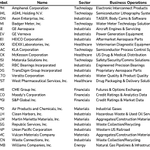
UPDATED: Here's our latest list of global quality compounders.
Thanks to everyone who commented on the previous versions.
Any obvious ones missing or need removing?


Durable Value Creators retweeted
This infographic that we've just created breaks down most of the key logic board chip suppliers for $AAPL's new Vision Pro.
It's worth noting that the main M2 processor is designed in-house by Apple, based on $ARM's instruction sets, and manufactured by $TSM.
The processor is also supported by Apple's new R1 chip, specifically designed for real-time data processing such as eye and hand tracking, and lag-free rendering.
$TXN $ON $MU $ADI $DIOD $CRUS $LSCC

Durable Value Creators retweeted

Tourlite CM on APi Group $APG:
"its FCF yield is still twice that of its peers, even with a higher proportion of recurring revenue"
(Extract from their Q4 letter)


Durable Value Creators retweeted
New Post: Rock Pile Riches
How unique pricing power and the opportunity for industry consolidation make aggregates an attractive investment
fortunefinancialadvisors.com…

Durable Value Creators retweeted

My complete stock watchlist
Disclosure, i own a lot of these, the ones i don't own i will likely own in the future:⬇️


Durable Value Creators retweeted
What companies are capitalizing on the world's huge investments in data centers, aside from chip giants like $NVDA and $AMD?
Here's a new infographic that we've just created, featuring 35+ companies providing power distribution, security, and cooling solutions for data centers:

Durable Value Creators retweeted
Our friends over at REQ Capital recently published an insane 300+ page must-read research study on serial acquirers.
Here are 10 of our favorite sections 🧵
1. Illustrating 20 years of outperformance + two long lists covering >100 names from REQ's global company universe:


