Lunar Vertex’s mobility platform has been integrated @Int_Machines’ IM-3 Rover Deployment Mechanism. APL leads Lunar Vertex, which will investigate magnetic anomalies and lunar swirls at Reiner Gamma. Learn more: jhuapl.edu/destinations/miss…
Another milestone for Lunar Vertex!
Lunar Outpost’s MAPP rover has been integrated with @Int_Machines' IM-3 Rover Deployment Mechanism. MAPP will explore Reiner Gamma as part of the @JHUAPL-led Lunar Vertex investigation.
The APL-built MEGANE instrument has launched aboard @JAXA_en's Martian Moons eXploration spacecraft. The instrument will measure the elemental composition of Phobos, helping scientists investigate the origins of Mars' mysterious moon. jhuapl.link/0664cd
@NASAMars
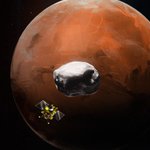
Today, @JAXA_en is scheduled to launch its Martian Moons eXploration (MMX) mission. Aboard is MEGANE, an instrument built by Johns Hopkins APL for @NASA that will study Phobos' elemental composition to help uncover the origins of Mars' moons.

ALT As MMX makes repeated passes over Phobos, MEGANE will collect measurements that scientists can use to map the moon’s elemental composition. This illustration shows what a map of Phobos’ elemental composition could look like based on MEGANE’s future measurements. These maps could provide important clues about how Phobos formed.
NASA's contributions include the MEGANE gamma- ray and neutron spectrometer, the spacecraft's surface sampler mechanism, and communications and navigation support from the agency's Deep Space Network, as well as funding participating US scientists.
science.nasa.gov/mission/mmx…
Have no fear of Phobos!
Mars has two moons, Phobos and Deimos ("fear" and "terror"). On Oct. 19, @JAXA_en will launch the MMX mission to explore them and return a sample of Phobos! A teleconference at 4 p.m. EDT today will preview NASA's contributions: go.nasa.gov/4B2qNBI
NASA’s contributions include the MEGANE gamma-ray and neutron spectrometer, the spacecraft’s surface sampler mechanism, and communications and navigation support from the agency’s Deep Space Network, as well as funding for participating US scientists.
science.nasa.gov/mission/mmx…
Johns Hopkins APL retweeted
▶️ Watch live now! Experts from NASA, academia & industry are discussing plans for a Moon Base at the Lunar Surface Innovation Consortium Fall Meeting. 🌕
Learn what it takes to land, live & learn on the Moon! 👩🚀
@JHUAPL @GeorgiaTech @NASAMoonBase
youtube.com/live/vehaEZIBCno
Recognizing the @USNavy and its continued service to the nation. For more than two and a half centuries, the Navy has protected U.S. interests at sea, strengthened national security and maintained a global maritime presence.
Johns Hopkins APL retweeted
Yardangs are found on several worlds, including Earth. The inset images on the right likely show yardangs on Saturn's giant moon Titan, captured by NASA's Cassini spacecraft with radar. Our Dragonfly mission is now being assembled for its journey to Titan science.nasa.gov/mission/dra…
APL collaborated with @HopkinsEngineer students on critical national security projects. "Their research will help us iterate quickly, reduce risk, and deliver robust, low-cost solutions to the government faster," said APL mentor Brendan McNelly. jhuapl.link/1id
Last month, the Air Force announced the appointment of APL's Patrick Stadter as vice chair of the Department of the Air Force Scientific Advisory Board. Stadter has previously served as studies chair, vice chair, and panel member on this board. jhuapl.link/b2e
As @esa's Juice spacecraft swings past Earth for a gravity boost, its science instruments will be switched on - including JENI and JoEE, two APL-built instruments in the Particle Environment Package that will study Jupiter’s complex environment. jhuapl.link/tmo
Gorgeous images of our home world from the Juice spacecraft today as it flew by Earth en route to Jupiter. Congratulations to the entire team!
Our Europa Clipper mission will perform a similar gravity assist maneuver in December. science.nasa.gov/mission/eur…
Demystifying quantum for tomorrow’s policy leaders. ⚛️
IEEE‑USA briefed Congressional staff on #quantum fundamentals, economic and national security impacts, and where the industry is headed.
Huge thanks to our expert panel for an outstanding discussion!
Three Johns Hopkins teams have been selected for the latest SURPASS initiative cycle, a multimillion-dollar translational effort between @HopkinsEngineer and APL. The teams are pursuing research in health, energy, and space. jhuapl.link/1ik
Johns Hopkins APL’s Larry Paxton has been elected a 2026 fellow of the American Geophysical Union (@theAGU), recognizing his sustained scientific impact and contributions to Earth and space science. jhuapl.link/qec
APL has expanded its maritime testing capabilities with Sea++, a dedicated 36-foot research vessel that enables rapid, flexible testing of emerging technologies in realistic operational environments, helping accelerate innovation for national security. jhuapl.link/any
Johns Hopkins APL retweeted
@NASA_Technology and @NASAMoonBase are joining forces for this year's Lunar Surface Innovation Consortium Fall Meeting at @GeorgiaTech! 🌕
📅 Join us Oct 14-15 for a front row seat to discussions on development of surface tech needed for an enduring Moon Base! 🚀 @JHUAPL
🔗 Agenda: go.nasa.gov/47bXHSm
Lunar experts with @NASA_Technology's LSIC, led by Johns Hopkins APL, have developed 13 video modules to help technology developers understand the Moon's complex environment to design systems for @NASAMoonbase. jhuapl.link/slo
Celebrating the @usairforce and recognizing its continued service to the nation. The U.S. Air Force protects our skies and space, advances air and cyber capabilities, and supports missions and communities at home and around the world.
Forty years ago, APL's work on the Delta 180 program helped demonstrate a major milestone in missile defense. On Sept. 5, 1986, an APL-designed missile sensor package supported a successful intercept test that led to a Presidential Commendation. jhuapl.link/Delta180