
machine learning researcher
New York, NY
Joined September 2009
- Tweets213
- Following663
- Followers1.4K
- Likes1.1K






Lechao Xiao retweeted

Announcing Discovery Loop!
I am very excited to announce that, along with my longtime friends and collaborators @Sanjay_Ghemawat, @OriolVinyalsML and @quocleix, we are founding Discovery Loop (@DiscoLoopAI), a Public Benefit Corporation whose mission is to automate machine learning, science, and engineering to accelerate discoveries and progress. The four of us have worked together for 14 to 30 years, and have helped build some of the world’s most used products, infrastructure and AI models, and we’re excited to turn our attention to this ambitious endeavor.
♾
Learn more at: discoveryloop.com


Lechao Xiao retweeted

Mathematicians 🤝AI researchers arxiv.org/abs/2601.22401. Our take on AI solving Erdos problems:
* Many "Open" problems are actually just obscure: many cases the AI didn't find something new, only rediscovered solutions buried in the literature. We present our systematic approach to reporting AI results on Erdos.
* The real bottleneck is still human labor, e.g. we spent lots of time filtering out technically correct but meaningless solutions (AI missed Erdos’s original intent).
* Acceleration in solving low-hanging fruits is real, but we also need to highlight the many more misses that require human auditing. Clear research directions ahead though, and we feel optimistic about drastically increasing the signal-to-noise ratio.
More to come!


Here's the paper link to our scaled effort for tackling Erdős problems. We started with 700 problems marked ‘Open’ in the database. Our agent #Aletheia identified potential solutions to 200 problems. Initial human grading revealed 63 correct answers, followed by deep expert evaluation and discussion to eventually arrive at meaningful proofs to 13 Erdős problems. arxiv.org/abs/2601.22401

Lechao Xiao retweeted

I am hiring a student researcher to work with our team in Montreal on LLMs architecture and pre-training in spring-summer 2026, if you're excited to push the frontier of research forward, join us to help keeping the TPUs warm.
fill out this form:
forms.gle/1AfdyCbzjdKi2yAb7
Lechao Xiao retweeted

Great talk from @ShikaiQiu on scaling collapse, which can be used as a sensitive diagnostic for model specification (LR, etc) at small scale that transfers to large scales! arxiv.org/abs/2507.02119

Lechao Xiao retweeted

While scaling laws typically predict the final loss, we show in our ICML oral paper that good scaling rules enable accurate predictions of entire loss curves of larger models from smaller ones!
w/@Locchiu, @andrewgwils, J. Pennington, A. Agarwala:
arxiv.org/abs/2507.02119
1/10

Lechao Xiao retweeted

If you miss the NYTimes needle, especially one that is statistically uniform (blog.alexalemi.com/a-degree-…), you can use this page: alexalemi.com/random/electio… I whipped together to reason about the correlations between the swing states tonight as results come in.

Lechao Xiao retweeted

Two amazing accounts with high signal I have been impressed by recently on this app is: @cloneofsimo and @kellerjordan0
Just unprompted thought :)
Lechao Xiao retweeted

It was a pleasure working on Gemma 2. The team is relatively small but very capable. Glad to see it get released.
On the origin of techniques: 'like Grok', 'like Mistral', etc. is a weird way to describe them as they all originated at Google Brain/DeepMind and the way they ended up at other places is through Xooglers :)

Just analyzed Google's new Gemma 2 release! The base and instruct for 9B & 27B is here!
1. Pre & Post Layernorms = x2 more LNs like Grok
2. Uses Grok softcapping! Attn logits truncated to (-30, 30) & logits (-50, 50)
3. Alternating 4096 sliding window like Mistral & 8192 global attn! SWA->Global->SWA->Global etc
4. Attention is scaled like Grok - instead of 1/sqrt(d), does 1/sqrt(s). 9B uses 1/sqrt(224) not 1/sqrt(256). 27B uses 1/sqrt(144) not 1/sqrt(128)
5. Approx GeGLU - great it's clear re our past bug fixes!
6. Be careful of float casting like in our prev bug fixes!
7. 3 sizes: 2.6B, 9B, 27B. 2.6B released later. MMLU for Base models very strong, and Instruct also great
8. Vocab size of 256,128 for all variants
HF repo: huggingface.co/google
Technical report at: ai.google.dev/gemma
Thanks to the Gemma team for early access!
Also wanted to support this quickly in @UnslothAI, but we just moved to SF for @aiDotEngineer World's Fair - we'll try our best!

Lechao Xiao retweeted
This is a small research community. To all my friends, former colleagues and those that I don't know at OpenAI, the last few days have been a rollercoaster for those of us watching from the outside: I can't imagine the ebb & flow of emotions you're all experiencing. ♥️
Lechao Xiao retweeted

Happy to see our paper on adversarial arithmetic released!
(arxiv.org/abs/2311.07587)

Lechao Xiao retweeted

Prof. Roman Vershynin (UCI) will be teaching on zoom Probability for Data Science course for National University of Kyiv students this upcoming semester.
math.uci.edu/~rvershyn/teach…
Lechao Xiao retweeted

8 researchers from Nigeria got accepted into Deep Learning Indaba @DeepIndaba but couldn't afford the trip. Access to research, mentorship, and networking opportunities like this is vital for early-stage researchers. You can help make their trips possible!
donorbox.org/mlc-support-dee…
Lechao Xiao retweeted

Will be presenting our work on fast finite-width NTK today at #icml2022 - please come to our talk at 10:55 EDT, or the poster session at 18:30 EDT! icml.cc/virtual/2022/spotlig…


Paper is here with details: proceedings.mlr.press/v162/n…
If you don't care about details, the finite-width NTK calculations in NT got a lot faster! This has unblocked several downstream research projects.
github.com/google/neural-tan…
Joint work w/ @jaschasd.
icml.cc/Conferences/2022/Sch…
Lechao Xiao retweeted

Very excited to present Minerva🦉: a language model capable of solving mathematical questions using step-by-step natural language reasoning.
Combining scale, data and others dramatically improves performance on the STEM benchmarks MATH and MMLU-STEM. goo.gle/3yGpTN7

Lechao Xiao retweeted

For years I've shown this 2x2 grid in talks on infinite width networks, but with just a big ❓ in the upper-left.
No longer! In arxiv.org/abs/2206.07673 we characterize wide Bayesian neural nets in parameter space. This fills a theory gap, and enables *much* faster MCMC sampling.

Lechao Xiao retweeted
After 2 years of work by 442 contributors across 132 institutions, I am thrilled to announce that the github.com/google/BIG-bench paper is now live: arxiv.org/abs/2206.04615. BIG-bench consists of 204 diverse tasks to measure and extrapolate the capabilities of large language models.

Lechao Xiao retweeted

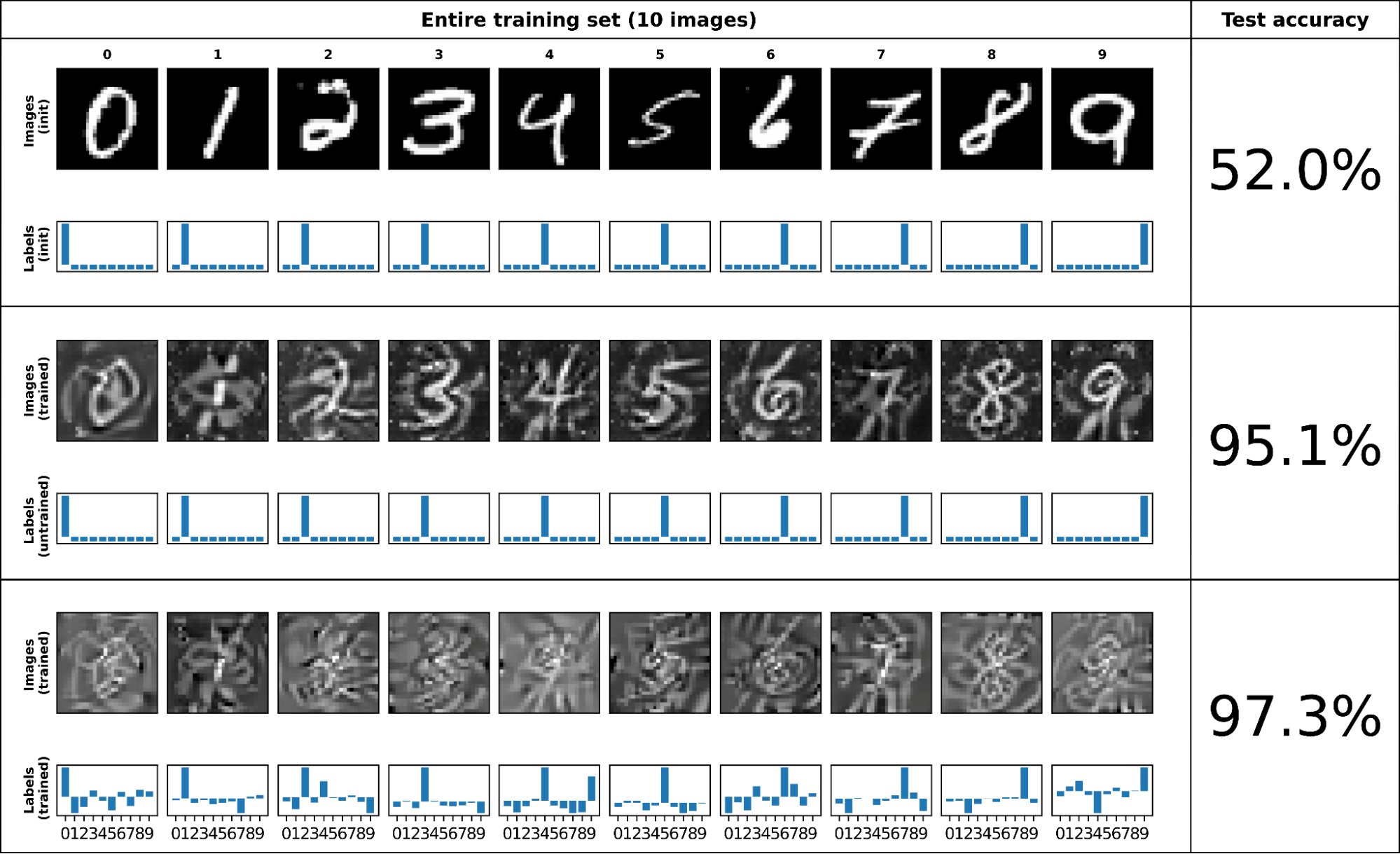
Featured today on @GoogleAI's blog is our work on dataset distillation presented this year at #NeurIPS2021 , where we discuss our state-of-the-art results on compressing data, optimizing labels, and more. Joint with @ARomanNovak @Locchiu @hoonkp

Dataset distillation enables #ML models to be trained using less data and compute. Today we introduce two novel dataset distillation algorithms and release their distilled datasets, which yield state-of-the-art results for image classification. goo.gle/3GKtomH
Lechao Xiao retweeted
Computing the NTK as the outer product of Jacobians is a common pain point reported by our users of github.com/google/neural-tan…. Learn about our ideas to speed it up at poster 3E at @NeurIPSConf #BDL today! Joint work with @jaschasd and @sschoenholz. See also bayesiandeeplearning.org/202…

Lechao Xiao retweeted

Today, @RaiaHadsell, @kchonyc and I are happy to announce the creation of a new journal: Transaction on Machine Learning Research (TMLR)
Learn more in our post: medium.com/@hugo_larochelle_…
Lechao Xiao retweeted
Please come to our poster session at #neurips2021 this Thursday, 12/9 at 4:30 pm PST, where we will be presenting our work on Dataset Distillation with Infinitely Wide Convolutional Networks. One potential application of dataset distillation is machine interpretability: (1/2)


Our paper “Dataset Distillation with Infinitely Wide Convolutional Networks” achieves 64% CIFAR10 test acc using only 10 imgs and exceeds prior art by as much as 37% using large scale distributed meta-learning. Joint w/ @ARomanNovak @hoonkp @locchiu arxiv.org/abs/2107.13034
