

Private investor. Former PM. Former Head of FX Vol at CS, GS. Math. “Science is the belief in the ignorance of experts" - Feynman
Arctic
Joined August 2023
- Tweets9.1K
- Following1.7K
- Followers2.6K
- Likes8.8K



Pinned Tweet
Never let a good crisis go to waste
Or, as the old saying often attributed to Ben Franklin goes: "Experience is the best teacher, but a fool will learn from no other"
The Situation Awareness episode offers a wealth of lessons in portfolio management, with textbook examples of mistakes that deserve to be studied carefully. In fact, @__paleologo should turn it into a case study in one of his excellent books (APM or EQI)
A few of the most important takeaways:
• "I'm long/short and market neutral, so my risk is inherently lower"
Wrong...or not necessarily
In fact, factors are nothing more than L/S portfolios (FMPs). If your portfolio closely resembles a given factor, you've concentrated your exposure to that factor, even if you've reduced your exposure to market beta, sectors, countries
Factor risk management is therefore central to portfolio construction, and its importance increases dramatically once leverage enters the equation
• "Leverage will kill you"
That's probably the most common lesson people are taking away from this episode....but it's also not necessarily true
Leopold's predator (Citadel), certainly operates with leverage of a similar order of magnitude. The difference isn't leverage: it's portfolio construction and risk management
If your objective is to maximize the Sharpe ratio, a substantial part of the problem is solved by constructing a portfolio with low volatility while preserving attractive expected returns. Leverage is then the control variable used to scale those risk-adjusted returns to the desired level
The problem isn't leverage. The problem is applying leverage to a portfolio whose risk you don't fully understand
The higher the leverage, the less room there is for mistakes in factor modeling, portfolio construction and risk management.
• Factor models are naturally adaptive
Factor exposures are not static. Individual stock factor betas evolve as prices, fundamentals and other stock characteristics change, forcing continuous re-estimation and portfolio rebalancing
Case in point: Situation Awareness was structurally short software under the thesis that AI would impair the sector. That's a perfectly legitimate fundamental view
But as that thesis became increasingly reflected in prices throughout the 2026H1, S/W's correlation structure changed materially (check it for yourself). A portfolio that remained long semis versus short S/W gradually accumulated additional market beta on top of an already extreme momentum exposure...an already dirty portfolio effectively turned into a time-bomb
Textbook example of what happens when factor risk management fails to adapt to changing market dynamics...
Without leverage, portfolio construction mistakes might lead to a slow bleed
Leverage allows exceptional risk-adjusted strategies to achieve exceptional returns, but it also magnifies portfolio construction errors. It demands top tier technical expertise, robust execution, and constant risk monitoring
The Citadels of this world (admittedly, there aren't many) make fortunes by playing a critical role: removing bad actors whose poor risk management does little more than increase market volatility and systemic risk. History is full of similar examples: LTCM, Amaranth, Sowood, the Bear Stearns credit funds, Melvin Capital, Archegos...and now Situation Awareness
Markets are ultimately healthier when capital is reallocated from weak hands to disciplined ones...again, kudos to Citadel
The silver lining for Leopold is that this experience provides an invaluable opportunity to deepen his understanding of portfolio management
My humble suggested reading list:
1. Your Complete Guide to Factor-Based Investing (Andrew L. Berkin & Larry E. Swedroe): The best place to start. Easy to read, engaging, and requires virtually no mathematical background
2. Asset Pricing (@JohnHCochrane): A classic must-read for anyone interested in quantitative finance. The theoretical foundation behind modern asset pricing and factor investing
3. Quantitative Portfolio Management (Michael Isichenko): An excellent balance between theory and practice, with a strong focus on real world portfolio construction
4. Advanced Portfolio Management (Giuseppe "Gappy" Paleologo): Extremely practical and remarkably accessible from a technical standpoint. One of the best books on institutional portfolio construction
5. The Elements of Quantitative Investing (also Gappy): Goes deeper into the technical aspects of quantitative investing and portfolio management while remaining highly practical

Citadel is not the bad guy in this story.
When you are investing billions and make 20x returns in 2 years, you attract the notice of all the hedge funds. It was obvious to everyone that Leopold had to be using excessive leverage to get those returns.
Taking out a player who doesn't have enough liquidity to cover leverage and manage a downturn is so common on Wall Street, it's one of their basic tools to enhance their own returns.
No, the person who should be blamed for Leopold's implosion is Leopold himself.
Hedge funds do use *some* leverage themselves, but boy do they analyze the snot out of those positions to ensure what happened to Leopold doesn't happen to them. Leopold either didn't do that basic analysis or got it comically wrong.
Players like Citadel actually *help* the market by taking out the yahoos who end up causing excessive market volatility through leverage. If you know you could get pounced on by the likes of Citadel, then you won't put yourself in a position to be pounced on and thus won't cause undue market volatility.
LBM_LXXVIII retweeted

I think the battle for Autonomous Austin might already be over.
Source: @RtaxiTracker

You should know that Brazil's reported FDI is not really what the name says it is
A relevant part is carry trade in disguise...its high correlation with interest rate levels is not a coincidence


Brazilian "economists" for the most part are not really economists
They are just fanboys/fangirls hoping that everything will be alright...
oglobo.globo.com/blogs/bela-…


A economista Zeina Latif, da Gibraltar Consulting e colunista do GLOBO, avalia que a primeira medida aguardada pelo mercado no quarto mandato de Lula é a troca da equipe econômica, com perfil mais independente em relação às pautas do PT: - O ideal é que seja uma equipe com perfil independente, sem uma visão de compromisso com a agenda petista, pessoas que tenham condições de montar um time econômico competente e com capacidade política para construir uma agenda, que, de fato, influencie o Planalto em relação à necessidade de ajustes, que tenha um plano de voo.
Caio Megale, economista-chefe da XP Investimentos, destaca que o cenário internacional deve ser hostil no ano que vem, com o aumento de juros em vários países desenvolvidos. Por outrolado, háum cenário de commodities valorizadas que pode colocar o Brasil em uma boa posição para atrair capital privado, se houver sinalização de equilíbrio fiscal. Para Megale, 2027 será um ano de incertezas para as empresas com a implementação da Reforma Tributária e com o fim da escala 6x1. Por isso, seriam ainda mais importantes ações do governo para limitar as despesas públicas, de modo a evitar novos aumentos da carga tributária.
O primeiro ano de governo tende a ser de freio de arrumação, porque a economia está muito alavancada, para que se consiga voltar a crescer no segundo semestre de 2027 e
2028. Vai ter de passar por esse período de menos crédito e crescimento, faz parte do ciclo da economia. Por @thaisbarcellos_ e @gdoca @OGlobo_Economia urge indicar um nome com trânsito no mercado e no Congresso @andreeler @RobertoElleryJr @reztirps @mzoeramos @IFIBrasil @_robertomotta @TonyVolpon @Solangesrour @rvitoria @Danielhrs @JoelPinheiro85

LBM_LXXVIII retweeted
We will probably see a continued/significant selloff in the BRL before year-end
Huge carry, combined with wishful thinking that the election will somehow produce a market-friendly outcome (largely because of what happened in Chile and Colombia) has created an extraordinary degree of complacency
The market has basically turned a blind eye to what is arguably the clearest episode of outright fiscal collapse unfolding in plain sight
Now, with RM outflows likely to accelerate sharply into year-end and political reality starting to bite, it may finally be time for the currency to reconnect with fundamentals
6.00 USDBRL still this year, imho...
$BRL $USDBRL $EWZ

Brazil is approaching a remarkable set of milestones that somehow receive surprisingly little attention
It will simultaneously have:
1. One of the largest budget deficits among major economies: the overall government deficit is currently running close to 10% of GDP, having been above 8% on average for the last 13 years now
2. One of the highest VAT rates in the world, with the new Brazilian consumption-tax system requiring a reference rate of 28% (!!)
3. One of the most complex and burdensome tax systems anywhere, despite a tax reform ostensibly being designed to simplify it (the OECD itself describes the existing fragmented system as a major distortion and cost to doing business)
Add to that extreme income inequality, a rapidly deteriorating public-debt trajectory and public services whose quality is difficult to reconcile with the amount the state collects and spends
To sum up, Brazil is increasingly a macro basket case
And yet the BRL trades at an extremely rich valuation regardless, supported to a remarkable extent a carry that will either come to an abrupt end or finally bankrupt the country
A real time bomb, so to speak...
$BRL $USDBRL $IBOV $EWZ


Just goes to show how extraordinarly bad @FlavioBolsonaro was as a candidate. A joke...


LBM_LXXVIII retweeted
As I have been saying for a while now, the level of denial with Brazilian assets in general was just surreal
The country has effectively been rolling back all policies under "Plano Real" for at least 15 years nonstop now, and asset prices recently decoupled from economic reality based on nothing more than election hopes
Record delinquencies, record indebtedness from both companies and individuals, record number of companies filing for bankruptcy protection, imported goods getting more and more scarce and expensive, fiscal and current account deficits that would make France and US look like role models...
The reckoning starts today, maybe now people like sellside economists and @robin_j_brooks will be more careful before giving opinions on subjects that are clearly outside their knowledge domains
$EWZ $USDBRL $IBOV $BRL
Brazil is approaching a remarkable set of milestones that somehow receive surprisingly little attention
It will simultaneously have:
1. One of the largest budget deficits among major economies: the overall government deficit is currently running close to 10% of GDP, having been above 8% on average for the last 13 years now
2. One of the highest VAT rates in the world, with the new Brazilian consumption-tax system requiring a reference rate of 28% (!!)
3. One of the most complex and burdensome tax systems anywhere, despite a tax reform ostensibly being designed to simplify it (the OECD itself describes the existing fragmented system as a major distortion and cost to doing business)
Add to that extreme income inequality, a rapidly deteriorating public-debt trajectory and public services whose quality is difficult to reconcile with the amount the state collects and spends
To sum up, Brazil is increasingly a macro basket case
And yet the BRL trades at an extremely rich valuation regardless, supported to a remarkable extent a carry that will either come to an abrupt end or finally bankrupt the country
A real time bomb, so to speak...
$BRL $USDBRL $IBOV $EWZ
Indeed. But it's always worth remembering that the Brazilian Treasury is effectively on the other side the carry trade
And the creditworthiness of that counterparty is deteriorating rapidly...
Brazil is basically distributing wealth it doesn't have to attract all sorts of hot money and keep the FX rate artificially stable...hardly sustainable

Brazil's macro fundamentals right now are basically as bad as they can possibly get
Still, USDBRL started the year at 5.48 and is now trading around 5.41
Add the carry over 10 months (roughly 0.4%/month) and a short USDBRL is close to a 5% winner YtD
This gives a broad idea of how delusional current BRL levels still are...
As I have been saying for a while now, the level of denial with Brazilian assets in general was just surreal
The country has effectively been rolling back all policies under "Plano Real" for at least 15 years nonstop now, and asset prices recently decoupled from economic reality based on nothing more than election hopes
Record delinquencies, record indebtedness from both companies and individuals, record number of companies filing for bankruptcy protection, imported goods getting more and more scarce and expensive, fiscal and current account deficits that would make France and US look like role models...
The reckoning starts today, maybe now people like sellside economists and @robin_j_brooks will be more careful before giving opinions on subjects that are clearly outside their knowledge domains
$EWZ $USDBRL $IBOV $BRL
LBM_LXXVIII retweeted

The most mind blowing stat we've seen so far is this:
"As of June 30, 2026, we had raised an aggregate of $141.1 billion of capital and had cash and cash equivalents of $112.4 billion and short-term investments of $19.3 billion."
That means to date, they have burned 9.7b, they are growing at a rapid pace, and are profitable on an operating income basis as of the June quarter! This is likely the most efficient scaling of a business in the history of capitalism.
xitter.cf/AnthropicAI/status/211…

Anthropic has filed an S-1 registration statement with the SEC related to its proposed IPO.
Read more: anthropic.com/news/s1-sec
Legal disclaimer: A registration statement relating to these securities has been filed with the SEC but has not yet become effective. These securities may not be sold, nor may offers to buy be accepted, prior to the time the registration statement becomes effective. This post does not constitute an offer to sell or the solicitation of an offer to buy these securities, nor shall there be any sale of these securities in any state or jurisdiction in which such offer, solicitation or sale would be unlawful prior to registration or qualification under the securities laws of any such state or jurisdiction.

If you are looking to blindly buy the dips on either one of these stocks, you might want to look what's happening to $XP first

4 very tough years ahead for $NU, a leveraged subprime lender in a country on the verge of a macro death spiral
Keep an eye on this one...
The $NU bear thesis is becoming increasingly interesting
Nubank’s growth story was built in large part by aggressively expanding unsecured credit in Brazil, including to segments traditional banks have historically treated very cautiously
And that engine is still running hard: the credit portfolio grew 37% YoY to $39.4bn last quarter, overwhelmingly in credit cards and unsecured loans. Nubank itself describes its recent strategy as an expansion into “higher-risk, higher-return” segments
Meanwhile, Brazil’s traditional banks are moving in the opposite direction: increasingly favoring secured lending and higher-income borrowers as concerns around household leverage rise
Now comes an interesting signal…
$NU is reportedly considering paying £8–10bn for Monzo (potentially more than 2x Monzo’s £4.5bn valuation in 2024) to acquire a new geographic growth engine
Interesting timing….Brazilian customer penetration is already enormous and incremental growth increasingly depends on monetizing existing customers. That means pushing increasingly into higher-risk segments and now management is apparently considering paying a huge premium to acquire growth elsewhere
When a company famous for hypergrowth through organic customer acquisition starts contemplating a ~$13bn acquisition to secure its next growth vector, it’s worth asking what management sees coming for the original growth engine
And never lose sight of how messy the macro picture in Brazil looks now: deep fiscal issues point to stagflation and make a recession unusually likely in the near term. Not too hard to imagine the effects it would have in a credit portfolio basically made of unsecured loans concentrated on the riskiest brackets
$NU
As I have been saying for a while now, the level of denial with Brazilian assets in general was just surreal
The country has effectively been rolling back all policies under "Plano Real" for at least 15 years nonstop now, and asset prices recently decoupled from economic reality based on nothing more than election hopes
Record delinquencies, record indebtedness from both companies and individuals, record number of companies filing for bankruptcy protection, imported goods getting more and more scarce and expensive, fiscal and current account deficits that would make France and US look like role models...
The reckoning starts today, maybe now people like sellside economists and @robin_j_brooks will be more careful before giving opinions on subjects that are clearly outside their knowledge domains
$EWZ $USDBRL $IBOV $BRL
Brazil is approaching a remarkable set of milestones that somehow receive surprisingly little attention
It will simultaneously have:
1. One of the largest budget deficits among major economies: the overall government deficit is currently running close to 10% of GDP, having been above 8% on average for the last 13 years now
2. One of the highest VAT rates in the world, with the new Brazilian consumption-tax system requiring a reference rate of 28% (!!)
3. One of the most complex and burdensome tax systems anywhere, despite a tax reform ostensibly being designed to simplify it (the OECD itself describes the existing fragmented system as a major distortion and cost to doing business)
Add to that extreme income inequality, a rapidly deteriorating public-debt trajectory and public services whose quality is difficult to reconcile with the amount the state collects and spends
To sum up, Brazil is increasingly a macro basket case
And yet the BRL trades at an extremely rich valuation regardless, supported to a remarkable extent a carry that will either come to an abrupt end or finally bankrupt the country
A real time bomb, so to speak...
$BRL $USDBRL $IBOV $EWZ
To the surprise of precisely no one serious…
CXMT Firmly Rejects Apple's Proposal: "Even Orders Within China Are Overwhelming"
$MU $SKHY

CXMT, 애플 제안 단호히 거절: "중국 내 주문도 벅차다"
$APPL, $MU, $SKHY, Samsung
중국 본토의 D램 제조사 창신메모리(CXMT)가 자국 고객사의 폭발적인 수요를 우선 처리하기 위해 애플과 대만 서버 업체의 주문 제안을 연달아 거절했습니다.
■ 애플의 단가 인하 요구 거절: 자신감과 우선순위의 문제
이례적인 거절: 통상 부품 공급사들은 애플과의 장기 계약을 위해 앞다투어 가격을 낮추지만, 창신메모리는 정반대의 행보를 보였습니다.
거절 사유: IT 매체 Wccftech에 따르면, 애플은 삼성전자·SK하이닉스·마이크론보다 더 저렴한 가격에 메모리를 공급받기를 원했으나 거절당했습니다. 정책적 방향성인지 단순 생산량 문제인지는 확인되지 않았으나, 가장 명백한 이유는 '이미 공급이 수요를 따라가지 못해 중국 본토 고객사 물량부터 확보해야 하기 때문'입니다.
■ 기술력 입증: 샤오미 자체 칩 '쉬안제 03(XRING 03)'에 LPDDR6 탑재
글로벌 3강과의 경쟁력: 창신메모리는 이미 샤오미의 자체 개발 칩인 '쉬안제 03(현계 03)'에 차세대 모바일용 D램인 LPDDR6를 공급하며 글로벌 메모리 3강과 어깨를 나란히 할 수 있는 기술력을 증명했습니다.
유일한 병목은 생산능력(CAPA): 향후 1년 내 월 10만 장의 D램 웨이퍼 생산 능력을 추가할 전망이지만, 줄 서 있는 중국 내수 수요를 감당하기엔 여전히 역부족입니다.
10년 장기 목표: 시장조사업체 욜(Yole)은 중국 본토의 D램 수요를 완전히 충족하는 데 10년이 걸릴 것으로 분석했습니다. 이 계획의 최종 목표는 화웨이, 샤오미 등 중국 기업들이 더 이상 삼성전자나 SK하이닉스로부터 메모리를 구매할 필요가 없게 만드는 것입니다.
■ 단계별 전략과 시장 배경
실용적 우선순위: 당장 시급한 본토 고객사의 일반 D램 수요를 먼저 해결한 뒤, 최고 기술 분야인 HBM(고대역폭메모리)을 공략한다는 실용적인 순서를 밟고 있습니다.
메모리 가격 폭등과 공급 부족: 메모리 가격 상승세는 이미 완제품 시장을 강타해, 글로벌 PC 출하량이 3분기에 21% 급감했고 4분기에는 27%까지 떨어질 것으로 예측됩니다. 이처럼 귀해진 메모리 생산 물량을 창신메모리는 온전히 중국 내수 시장을 위해 배정하는 선택을 내렸습니다.
LBM_LXXVIII retweeted
The denial mode and complacency in Brazil is unlike anything I've ever seen...
1. Any Brazilian politician in Lula’s position would be doing precisely the same thing...or worse
2. Looking at the current pool of candidates, it makes absolutely no difference to Brazil’s macro trajectory who wins the election. The only practical difference is which groups get the privileges
$EWZ $BRL
You’re unable to view this Post because this account owner limits who can view their Posts. Learn more
LBM_LXXVIII retweeted
Brazil is now expected to have close to a 9.0% budget deficit this year, with the number expected to print nearly 8.5% in 2027 and 8.0% in 2028 (both should continue trending higher...)
It is mind-boggling that (1) it doesn't make headlines in the macro space, and (2) markets let the country get away with such huge lack of fiscal discipline, with the currency still trading at extremely overvalued levels regardless
Brazil is effectively running a Ponzi scheme at a sovereign level, and it won't end up well...
$USDBRL $IBOV $EWZ
Fun fact: local inflation linkers in Brazil (the equivalent of TIPS in the US) now pay a whopping real interest rate of around 8.5% at the long end
You read that right: 8.5% real rates. Not nominal
We are probably watching the early stages of a serious macro reckoning in Brazil...
Nearly 30% of Brazil’s local public debt is made up of NTN-Bs, the local inflation-linked bonds, and that share has been growing over time. Households and a large share of local savings vehicles both have meaningful exposure to them. The “inflation protection” feature is extremely popular in a country with a long institutional memory of hyperinflation, and the average duration is long enough to allow for people to dream about retirement with nearly double digits "risk-free" real returns locked in
For a naive investor, that might sound like a no-brainer. Upon closer inspection though, a few things become obvious:
1- Crowding out 101
If a local investor can lock in 8.5% real rates with government bonds for a 7y+ horizon, equity investments become almost impossible to justify. As a matter of fact, this investment vehicle ends up sucking in a large share of available domestic liquidity, while the private sector has to survive under severe credit scarcity
The most successful bankers in Brazil are often those working in credit structuring (it's fun talking to these folks...they are quite creative). That is not a coincidence
2- Unsustainability
In a healthy economy, real rates should bear some relationship to potential growth. The fiscal math works when total debt is roughly the size of GDP because the government pays interest on one side (the stock of debt) while collecting taxes on the other side, with both sides growing at broadly similar nominal and real rates (which follow nominal and real economic growth)
One small detail: Brazil’s potential growth is probably below 2.5%, with a downward bias. Now redo the math...
3- Credit rating agencies in denial
Even for people completely unaware of the dire state of Brazil’s fiscal accounts, a quick look at the real rates the government is paying to finance local debt should raise deafening alarm bells
An 8.5% real yield for 7y+ local inflation-linked debt does not sit comfortably with ratings of Ba1 from Moody’s, BB from S&P, and BB from Fitch
The rating agencies are once again badly behind the curve. You do not help a drug addict by telling him everything is fine and that he can keep taking drugs
@Moodys, @SPGlobalRatings and @FitchRatings: shame on you
4- Tough choices ahead
If the Brazilian government were a private company, creditors would have been called to the table a long time ago
For a sovereign, though, two choices remain if we rule out an outright Russian-style default on local debt:
Option A: as orderly as possible
Brazil could come up with a “Plano Real 2”: a detailed, credible and constitutionally protected roadmap to balance the fiscal accounts
A primary surplus of 3–4% of GDP, with no exceptions, would likely be needed for the next 5–10 years. That would require a series of reforms that would also help improve productivity dramatically. In order of importance: political reform, administrative reform and social-security reform
A credible plan would allow local interest rates to fall dramatically. That, in turn, would allow the FX rate to re-rate to a more realistic level as hot money leaves the country. A 10.00 USDBRL would be painful in the short term, but it would be a welcome boost for the exporting sector and would help rebalance the economy
With a credible plan in place - ideally enshrined in the Constitution - a debt swap could become more palatable for local debt holders and provide essential relief to the fiscal accounts
Option B: disorderly adjustment
Brazil has been through this before, more times than anyone would like
Willingly or not, inflation will do the job. There is absolutely nothing the Brazilian Central Bank can do about that if fiscal dominance takes over. In fact, the central bank is now cutting rates while inflation and inflation expectations drift further away from target...probably a late recognition of this basic constraint
But it gets worse...
Nearly one-third of the local debt is linked to inflation indexes, mainly the IPCA, which is also the official MonPol target. We have also seen this movie before: over time, the index may start reflecting less and less of the true price dynamics of the economy, and the government may have increasing difficulty issuing new NTN-Bs
That would call for new solutions to finance the local debt, including a possible renaissance of local USD-linked instruments or even a return to external debt issuance
And, of course, if the country is struggling to attract external savings to finance the debt, it cannot afford to lose the paltry internal savings it still has. Yes, the return of capital controls become a natural consequence...need Dollars? Go ask your dealer...Ptax rate also becomes insignificant, except for the $100bn+ in USD Swaps the market in long against the BCB (but let's not get started on that)
You choose the disorderly option, you get chaos...hardly unfair. The truth is that too many people benefited from the imbalances that brought Brazil here. Whichever adjustment path is chosen, they will be asked to help pay for the solution. Also hardly unfair...
@macrokurd @AlfredoMenezes6 @RaoulGMI @TopadoDuran
LBM_LXXVIII retweeted
Brazil is approaching a remarkable set of milestones that somehow receive surprisingly little attention
It will simultaneously have:
1. One of the largest budget deficits among major economies: the overall government deficit is currently running close to 10% of GDP, having been above 8% on average for the last 13 years now
2. One of the highest VAT rates in the world, with the new Brazilian consumption-tax system requiring a reference rate of 28% (!!)
3. One of the most complex and burdensome tax systems anywhere, despite a tax reform ostensibly being designed to simplify it (the OECD itself describes the existing fragmented system as a major distortion and cost to doing business)
Add to that extreme income inequality, a rapidly deteriorating public-debt trajectory and public services whose quality is difficult to reconcile with the amount the state collects and spends
To sum up, Brazil is increasingly a macro basket case
And yet the BRL trades at an extremely rich valuation regardless, supported to a remarkable extent a carry that will either come to an abrupt end or finally bankrupt the country
A real time bomb, so to speak...
$BRL $USDBRL $IBOV $EWZ


LBM_LXXVIII retweeted

Spending on Anthropic is up substantially since the 5.5 family came out (on OpenRouter at least)
Also comparing price declines on output only is a bit odd considering cache makes such a massive difference in effective price. Just sayin.
Great post, highlights quite well a point that should already be abundantly clear: falling token prices are not bearish for the AI infrastructure buildout. Quite the opposite
Lower prices unlock new applications, accelerate adoption and drive explosive growth in token consumption. If volume growth more than offsets price declines, aggregate inference revenues keep rising. And if compute demand grows faster than hardware efficiency improves (look at GPU rental prices steadily rising even for older GPU generations), the infrastructure layer benefits from expanding GPU demand and potentially higher utilization
OS models reinforce this dynamic by lowering barriers to entry and unleashing competition
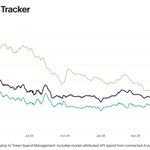
Interestingly, Ramp's latest data show token spending resuming its upward trajectory in October, despite continued downward pressure on token prices: token spending increased 23% over the four weeks ending October 11...the revenues slowdown captured by the @tryramp's series in September probably had strong seasonal effects (the series is not SA)
The charts illustrate the point nicely: price deflation and explosive adoption can coexist with accelerating aggregate revenues
Commoditization at the model and inference layers can be a powerful tailwind for the infrastructure layer. That's a fundamental distinction many AI bears continue to miss
$NVDA $MU


There is an absolute barrage of inference providers popping up that get to $1M/mo extremely quickly.
This is the rough economics of inference providers:
Even if you rent on-demand B300s at $8/GPU-hr, many open source models (GLM 5.3, Kimi K3, DeepSeek 4.1 Flash / Pro) can get you >$10-20/GPU-hr at reasonable throughputs (100tok/s). DeepInfer from DeepSeek directly shows they can get $38/GPU-hr on off-peak hours. Every chip / model has a different throughput / interactivity curve, but there is a lot of arbitrage between even high rental spot prices and token prices. New chips (Vera Rubins) also change this meaningfully. Your ability to be making gross margin relies on your utilization and how good your stack is.
Gateways like OpenRouter, Vercel and more help solve that problem by aggregating demand to you. May inference providers discount their tokens to get longer term commits too. I've even heard stories of selling back Chinese model tokens to Chinese labs!
One thorn in the economics of these players is that many Chinese open source model labs are now asking for rev share if you're at a certain scale, espp for pre-release access to their models for day 1 support. That further pushes the threshold to be in the money.
The barrier to entry seems low and falling. There are even stories of smaller ones who can "vibe code" a way to stand up OSS models on a cluster they rent. And as a result, we're seeing 10s of such companies pop up almost every week and immediately skyrocketing revenue at low-ish gross margin and raising rounds on the back of that.
Unsurprisingly, because the actual service provided seems commodity, this eventually drives up compute prices and drives down token prices. In theory, it would seem like neoclouds who have the lowest cost of compute and themselves have started inference businesses would win the race to the bottom (Crusoe Coreweave Nebius and GMI all have inference businesses), with larger players (Modal Fireworks Baseten) being second because they are well capitalized to make bigger compute commits cheaply and have demand (high utilization), but the reality is the pie is growing so quickly that even upstarts are absolutely crushing it and growing aggressively (inference dot net, DeepInfra, Wafer, Relace, Morph).
Strategies vary across the board: neoclouds want to serve inference, inference players want to be neoclouds and do higher margin reserved instances / post training, and some want to go heterogeneous hardware or creatively flexible compute constructs.
The risks are: do open source models continue to be competitive? Will their creators rent seek more? Will their shape change compute needs? How do different chips change economics? Who gets compute in a supply crunch?
Below is a aggressive sketch of how gross margin scales with utilization for various models / chip sets.
For now, there are many inference providers and they’re all ripping!
