





Pinned Tweet
RoboStrategy published our first Shareholder Letter, and in it we discuss our outlook on Robotics industry.
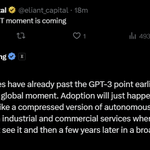
While we've already reached the GPT-3 era, there won't be a ChatGPT moment. The adoption curve will be somewhere between AI chatbots and autonomous vehicles. There will be no single day where it clicks for the global consciousness, but nonetheless a rapid permeation of new autonomous machines of all shapes and sizes. Physical AI is already getting really good for a variety of use cases, but we can't instantly supply millions of robots to customers like we can with AI instances. By next year, intelligence will no longer be the bottleneck, it will be the actual robots.
robostrategy.co/news/shareho…

Andrew Kang retweeted

Figure held an all-hands this week, and I've decided to share it here publicly
Given our rate of progress, our roadmap has completely changed over the last year, and the team has doubled
It's important to get everyone aligned on our mission going forward


Andrew Kang retweeted

Evan Beard of @standardbots on where robotics is today:
“Robots are in their infancy. It’s like the 1973 equivalent for the computer industry.”
With millions of use cases coming, their answer is an AI platform:
“We’re building a platform, not just robots, but the whole software ecosystem. That’s what we’ve tried to do from the beginning, to be that common layer across all these different use cases.”
Standard Bots CEO @evanbeard breaks down their new AI platform and how it could revolutionize American manufacturing.
"This allows you to essentially vibe code your robot"
Full interview:
0:00 Intro
6:39 Vibe coding robots
8:19 Locate vision system
11:52 400+ customers
13:58 Origin story
16:08 Where are the competitors?
18:56 Vertical integration is key
22:29 Why robot arms over humanoids
27:04 Robots vs the car industry
29:23 The thing to fear as a builder
31:31 America vs China
34:21 Congress and FCC robot ban
38:31 99% of US arms made abroad
42:31 Building everything inhouse
44:47 The plan to win
47:10 Targeting 10% of US installs
49:22 How the next decade will look like
Andrew Kang retweeted
Standard Bots CEO @evanbeard breaks down their new AI platform and how it could revolutionize American manufacturing.
"This allows you to essentially vibe code your robot"
Full interview:
0:00 Intro
6:39 Vibe coding robots
8:19 Locate vision system
11:52 400+ customers
13:58 Origin story
16:08 Where are the competitors?
18:56 Vertical integration is key
22:29 Why robot arms over humanoids
27:04 Robots vs the car industry
29:23 The thing to fear as a builder
31:31 America vs China
34:21 Congress and FCC robot ban
38:31 99% of US arms made abroad
42:31 Building everything inhouse
44:47 The plan to win
47:10 Targeting 10% of US installs
49:22 How the next decade will look like

Introducing Standard Bots AI
“We chose Standard Bots for two reasons: the speed of development is highly compressed, and the interface for programming the robot is so much simpler. With Standard Bots AI, that's even faster.” — Adrian Nistler, President and CEO, Path Machining & Automation
Standard Bots AI robots deliver dramatically faster setups, faster changeovers, and faster paybacks. This is why robots are the new essential power tool of the 21st century.
Our mission is to expand human capacity with the world’s most accessible robots. We’re building this future in Glen Cove, New York, and on hundreds of factory floors, and counting.
Say yes to more: standardbots.com/ai
I love humanoids but it’s awesome to see the step change evolution of the robot arm from essentially a 1970s PC to something you can now vibe code
Programmable robots -> instructable robots
"If you have an iPad, you can vibe code robots. And potentially save your company millions of dollars while you’re at it."
@Forbes robotics reporter @johnkoetsier interviewed @evanbeard for an exclusive on the launch of Standard Bots AI.
Read the story here: forbes.com/sites/johnkoetsie…

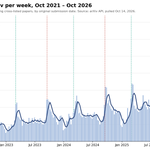
Robotics research output is accelerating
More accessible and cheaper hardware, tooling, talent and capital waves, better general purpose models are all major contributors here

RoboStrategy going public is just the start of our journey to establish a new model for Venture Capital
REITs broke out in the ‘90s, ETFs in the ‘00s and the era of public VC is next, starting with the companies building the future of the physical world
We are hiring for top talent from research to distribution to marketing to more:
robostrategy.co/careers

Dominance of closed source models is an existential threat to Nvidia
Jensen has been clear since earlier this year that strong open source models are essential
It’s game theoretically optimal for Nvidia to build frontier open source models optimized for its own hardware


The Jensen Huang episode.
0:00:00 – Is Nvidia’s biggest moat its grip on scarce supply chains?
0:16:25 – Will TPUs break Nvidia’s hold on AI compute?
0:41:06 – Why doesn’t Nvidia become a hyperscaler?
0:57:36 – Should we be selling AI chips to China?
1:35:06 – Why doesn’t Nvidia make multiple different chip architectures?
Look up Dwarkesh Podcast on YouTube, Apple Podcasts, Spotify, etc. Enjoy!
Andrew Kang retweeted
Robotics Tipping Point: The Interview
We sat down with Kyle Zinn from @citrini, the team behind the SaaSpocalypse and Hormuz articles that broke the timeline.
Citrini's latest field trip took him to robotics factories in the Bay Area to find out where the industry is headed:
00:00 - Intro
04:51 - Field-trip report
07:33 - Robotics' "ChatGPT moment"?
10:35 - The humanoid debate
13:45 - No "light switch" moment
16:31 - ROI is the key
17:43 - How to train a robot
19:59 - Robot school and internships
23:29 - Optimus at Giga Texas
26:23 - OpenAI enters robotics
31:57 - Early real-world deployments
37:23 - Unitree vs. Figure
39:52 - General robots 1-2 years away
41:50 - Humanoid supply-chain trade
44:34 - Bet on manufacturing enablers
48:29 - Supply-chain stocks
50:47 - Figure and Tesla's upside
53:26 - Figure's edge
55:19 - US vs. China
58:58 - Behind the field trip
1:04:15 - Where to invest
Andrew Kang retweeted
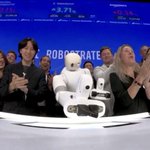
We’re ringing the Nasdaq closing bell with a bunch of @RoboStrategy portfolio robots next week
Before that we’ll be hosting a Robotics Forum with the founders and senior leaders from @Apptronik, @standardbots, @DynaRobotics, @DexmateAI, @mavenrobotics, @PathRobotics, @noxmetals and more
Who are the best large public equity managers interested in robotics? We have a few spots reserved for them.
globenewswire.com/news-relea…
Andrew Kang retweeted
"It's not a decade away. I saw it with my own eyes."
We interviewed Citrini Analyst #3 on the latest @citrini field trip, where they visited leading robotics labs and factories, including many RoboStrategy portfolio companies.
Watch the full interview: youtu.be/sd9R3W9xcBE
Recent developments from frontier Physical AI companies are showing that robots are capable of moving from single task automation to complete workflow automation.
This unlocks a market an order of magnitude larger than single task autonomy. Similar to the jump from L3 to L4 driving automation that allowed Waymo to start scaling its operations or the jump from AI chatbots to AI agents.
Less than 5% of physical work in the world is actually single task. Machine tending, packaging, simple assembly. A lot of work, even if seemingly repetitive, require more higher level decision making than we think.
Take for example Dyna's recent demonstration for their laundry physical agent. Addressable annual laundry labor itself is ~$9.5B. 85% of North America's 59,000 hotels have 200 rooms or fewer. These have on average one full time laundry attendant.
That laundry attendant is continuously navigating multiple decision trees - when to load the washer, when to transfer from washer to dryer, when to fold laundry, when to move folded stacks to the shelves, etc. Correctly making these decisions requires real scene understanding, memory, and the ability to reliably execute a large number of subtasks.
A laundry attendant that has a single task folding robot still needs to be near the laundry room for most of their shift since they need to support the robot in loading, unloading, transfering stacks and moving laundry baskets.
They free up some time, but they can't effectively reallocate it to housekeeping due to the constant support required. When a robot is able to complete entire laundry workflows unattended, now the hotel manager can quickly fill a real laundry attendent hiring need with a robot or reallocate an attendant to housekeeping work.
The ability to complete entire workflows makes robots much more useful to businesses. This is the value of physical agents.

Andrew Kang retweeted

1 billion humanoids. That’s how many could be in use globally within the next quarter-century. We’re mapping the companies bringing robots from the lab to your living room in The Robot Almanac. mgstn.ly/47B6ttq
Anyone waiting for the ChatGPT moment for robotics is going to miss the first wave of adoption
@Standardbots are already deployed to hundreds of customers across almost every state
@DynaRobotics has robots deployed across restuarant chains, hotels, logistics, data centers
@PathRobotics has robots welding across defense, oil & gas, energy companies and signed a $600m deal with HII, one of the largest shipbuilding companies
We will eventually build a big single model that works out of the box for anything, but specialized models are starting to tackle massive labor markets today
