

@QuanMed_AI- medical robotics research system by AI and Quantum not big Pharma on @Quan_Chain the only auto-migrating quantum chain. MSc Neuro/AI-Robotics Dev
Exeter
Joined September 2022
- Tweets6.1K
- Following5.2K
- Followers8.2K
- Likes1.7K





Binance has subpoenaed a Shark Tank investor Kevin O'Leary, 2 journalists & an accounting firm. None of them is accused of anything. That list is the entire defense strategy.
The case: in November 2024 the FTX Recovery Trust sued Binance & Changpeng Zhao to claw back roughly $1.76 billion.
The transfer at issue is FTX's July 2021 buyback of Binance's equity stake, paid in BUSD, BNB & FTT. The trust says FTX was already insolvent when it made that payment & that it paid with customer money.
That's a fraudulent transfer claim, brought under sections 544(b) and 548 of the bankruptcy code, and the mechanism is narrower than fraud in the everyday sense. The trust doesn't have to prove Binance did anything wrong. It has to prove FTX was insolvent at the moment of the transfer and didn't get reasonably equivalent value for it. A completely innocent recipient of money from an insolvent debtor can still be ordered to hand it back.
Which is why Binance's defence isn't "we behaved properly." It's "FTX wasn't insolvent, and nobody could have known if it was."
Now look at who was served. Michael Lewis, who had extended access to Sam Bankman-Fried while writing Going Infinite. Steven Ehrlich, formerly Forbes' digital assets research director. Kevin O'Leary, paid to promote FTX, who testified to Congress that Binance deliberately destroyed it. And BDO USA, the accountants.
Every one of them holds a contemporaneous record of what FTX was telling the outside world about its own finances. Binance doesn't need any of them to have done anything wrong. It needs their notes.
The timing traces back to July 24, when Chief Judge Karen Owens let the core clawback claims survive dismissal. She threw out the trust's tort & unjust-enrichment claims on in pari delicto grounds which means FTX couldn't sue over Binance's conduct because its own insiders' misconduct was imputed to it. The avoidance claims stayed. Discovery followed.
One surviving defense could still decide it. Section 546(e) shields certain transfers made through financial institutions from being unwound.
Binance raised it; the court said the record wasn't developed enough to rule. If Alameda qualifies as a "financial participant," that safe harbour could take out a substantial part of the claim regardless of whose notes say what.
A fight over whether a payment can be reversed, being waged by subpoenaing the people who were taking notes at the time.

A vault is a hollow protein barrel about 67 nanometres long, and there are thousands of them inside almost every cell in your body.
Leonard Rome & Nancy Kedersha found them in 1986. 40 years later nobody knows what they do.
Anthropic's biology lab has now published a structure of one. Not a human vault, but one built by a bacteriophage.
The protein is called L05. Expressed in E. coli it self-assembles into a vault of 96 copies of itself, 48 per half, around 9.5 megadaltons, roughly 54 by 45 nanometres. The mammalian vault uses 78 copies at 67 by 40. The phage version is shorter, wider & encloses about 25% more volume.
What's new here is narrower than the headlines suggest. Distant vault-protein relatives in bacteria & archaea were already known from genome surveys. What wasn't known was whether any of them actually fold into vaults. That's the result: of 15 soluble candidates, seven formed vault-like particles under EM & cryo-EM confirmed four — two phage, two bacterial. They turn up in 29 bacterial & four archaeal phyla, in under 1% of sequenced species.
One caveat that isn't optional. All of these were made in E. coli. Nobody has yet seen a vault form naturally in a bacterium or a phage. These proteins can build vaults. Whether they do is a different question.
The method is the interesting part.
Claude searched roughly 15 billion predicted proteins, designed the DNA constructs, proposed the purification route & ran the cryo-EM processing.
Purification took about 90 minutes against a conventional 3 days. First structural model 34 hours in. Whole project under 4 months.
The failures are more instructive than the speed. Claude wrote a protocol containing an additive that interferes with DNA uptake, costing two weeks.
It skipped a standard cryo-EM step & produced a map blended with its own mirror image. It argued against the chromatography approach that ended up working.
That mirror-image error deserves attention. A structure of the wrong handedness isn't noise. It's a clean, plausible map that happens to be wrong. The characteristic failure mode here isn't gibberish, it's well-formed output with a flipped sign inside it, which is exactly the error that requires someone who already knows what the answer should look like.
Two more things. The processing needed hundreds of GPUs, which the authors note is beyond most academic labs. And Leonard Rome, who co-discovered vaults in 1986, advised the project as a paid consultant, disclosed in the writeup.
The preprint has been submitted to bioRxiv & isn't live yet. No peer review, no independent replication. And the function of vaults, 40 years on, still remains unknown.
A company called Revere Robotics is building Curbie, a robot that couples onto a standard two-wheel municipal cart & walks it to the curb. The company says it's in active development.
The more interesting question is why this hasn't already existed.
It might look like an easy problem. A cart already has wheels. The distance is thirty metres. The route is the same every week. Compared to a humanoid folding laundry, this is nothing.
Then you look at the load. A full 96-gallon cart is heavy, tall & top-weighted, which means a narrow stability margin on any slope. Add a sheet of ice on a sloped driveway in February & you need traction on a surface designed to have none, under a mass whose centre sits well above the wheelbase.
Winter is exactly when nobody wants to do this chore, so winter is the condition the product has to survive.
Then the destination. Most US municipalities now collect with automated side loaders which is a truck with a grabber arm instead of a crew. Those arms need the cart within reach & clear of cars, poles & mailboxes, which is why cities publish placement rules at all. "Put it at the curb" isn't a drop-off. It's a positioning task with a tolerance & getting it wrong means your bin doesn't get emptied.
Then there is the economics. This device runs for a few minutes once a week & sits idle the rest of the time.
Every cost like motors, sensors, battery, enclosure amortises across roughly 50 uses a year. A robot vacuum spreads its bill of materials across hundreds of hours. That duty cycle is the constraint most home robotics concepts die on & it has nothing to do with whether the engineering works.
None of this says Curbie won't actually ship. It just says the hard parts are the traction, placement tolerance & unit economics, not autonomy.
Tell a human your balances, your debts and your spending & ask what to do about it & they become a regulated category with a legal duty to you. ChatGPT will now have that conversation out loud & it is not that.
OpenAI added Voice to Finances yesterday. US only, web & mobile, free & paid plans. Connect your accounts, then just talk.
Finances itself launched in May. It runs on Plaid, which reaches more than 12,000 institutions & hands over balances, transactions, investments & liabilities.
OpenAI says ChatGPT can't see full account numbers & can't move money or change anything. Disconnect an account & the synced data is gone within 30 days. The "financial memories" it keeps about your goals can be viewed & deleted from the Finances page.
What's new is only the interface. Same data, same model. You say it instead of typing it.
Which is a smaller change than it sounds & a bigger one than it looks. Typing a question about money is deliberate - you compose it.
Speaking one is conversational & people disclose differently out loud than they do into a text box. The product didn't gain a capability. The conversation gained a register.
The structural question underneath is duty. A registered investment adviser owes you a fiduciary obligation. A broker-dealer owes you a best-interest standard.
Both are enforceable. OpenAI is explicit that ChatGPT offers insights rather than licensed advice, which keeps it outside both & means the thing that sounds most like a financial adviser you've ever spoken to is the one with no obligation to you. OpenAI tested answer quality against more than 50 finance professionals. That's quality control, not a duty.
Then there's the adjacency. OpenAI says it doesn't build advertising audience segments from conversations and doesn't serve ads to users it identifies as under 18. Those are clear commitments. They're also policy rather than architecture, inside a company that runs an ads business and now, for users who opt in, has transaction-level visibility across twelve thousand banks.
None of which makes it a bad product. Most people will never sit down with a financial adviser, and a free tool that reads your actual spending is not nothing.
It's just worth knowing which of the two you're talking to. One has a duty. The other has a disclaimer.
Schools asked Google for an off switch on AI. Today they got 4, but the one they actually wanted isn't among them.
From early 2027, four products go dark by default on school-managed K-12 accounts: Gemini, NotebookLM, Gemini in Classroom, and Search. Administrators decide what comes back on, one toggle at a time. A district can run Search and leave Gemini off entirely.
What it can't do is run Search without AI Overviews sitting inside it.
Chris Phillips, Google's VP and GM for education, was asked exactly that by keeping conventional Search, drop the summaries. He said no. "Search & AI are deeply integrated."
So the menu is Search with AI in it, or no Google Search for students at all.
Google's version of events: it listened to schools, teachers, researchers and policymakers & educators should be the ones deciding. It's also a retreat.
In August it flipped certain AI features on by default in Classroom, teachers pushed back hard & today everything moves to opt-in.
Riding along with it is Guided Learning, arriving in Search for student accounts. It walks a student through a problem instead of handing over the answer. Students can't switch it off mid-activity or open a side conversation to dodge it. Teachers can read the transcripts.
The evidence is thin but not nothing. A preliminary randomized trial with the University of Tokyo clocked 8.1 percentage points of test-score gain against 5.3 for ordinary online resources - across half a day of study. A published Sierra Leone trial with 1,763 students found AI-supported maths worth 1.2 to 1.7 years of typical progress in eight weeks. DeepMind's Kevin McKee says longer studies are coming.
The complaint being made is a tying complaint. A district that wants a plain search box for kids with no summaries, no assistant, just links can no longer get one from the company that dominates both search & the laptops those kids are using.
And it lands on districts already mid-fight. New York City banned generative AI through eighth grade for a year in September. Los Angeles did the same that month. Kathy Hochul signed a law limiting which chatbot features companies can put in front of minors.
Two ways to read the same press release. A company finally handing schools the off switch they'd been asking for. Or it’s just a company making sure that off switch costs something. 🤷♂️

Deep Principle released Hydrogen-1.0 yesterday - an open-weight model for scientific research, post-trained from Z.ai's GLM-5.3 at 753 billion parameters, weights on Hugging Face. The headline claim is that it beats GPT-6-Astra on FrontierScience-Research, 38.3% to 33.3%.
That benchmark has 60 questions.
Work the percentages back & 38.3% is 23 of 60. 33.3% is 20 of 60. The margin between the open model & the frontier lab's model is 3 questions.
How those questions get scored matters too. FrontierScience-Research is OpenAI's benchmark, published last December: 60 multi-step research subtasks written by PhD-level scientists, each response graded against a ten-point rubric by a GPT-5 model and counted correct at seven or above. A response sitting at six or seven can land either side of that line depending on the run. Three questions is inside that.
None of which makes the result uninteresting. It makes it a different result than the headline.
What Deep Principle actually built is the part worth attention. They took GLM-5.3 as a starting checkpoint and post-trained it on chemistry, materials science & life sciences data, plus records & agent trajectories from their own laboratories, feedback from their own scientists & reinforcement learning against research outcomes. That last ingredient is unusual. Most post-training rewards whether an answer looks right. Rewarding whether a research trajectory actually arrived somewhere is a much harder signal to collect & you can only collect it if you run labs.
A domain specialist trained on proprietary lab data beating a generalist on a domain benchmark is the expected outcome, not the surprising one. The comparison that would say more is against GLM-5.3 itself - how much of the gain came from the post-training rather than from the base. Deep Principle plots that in their figure and leaves the number out of the text.
Their own caveat deserves repeating: these are internal evaluations & the company notes that absolute scores across tasks reflect case difficulty & shouldn't be compared directly. They also report GPT-6-Astra ahead by 3.33 points on NMR structure elucidation.
For scale: when OpenAI published this benchmark last December, GPT-5.2 led the Research split at 25%.
Eleven months later the top score is 38.3%. The three-question margin may not survive a rerun, but that trajectory sure will.
A Learjet 60 left Austin on Sunday bound for North Eleuthera in the Bahamas. It came down near Palm Beach in a near-vertical dive, into a mobile home park. 9 aboard, no survivors, no injuries on the ground.
What's on the ATC tape is worth understanding before anyone decides what happened.
The crew reported icing, moderate turbulence and precipitation & asked controllers for "any better rides" while requesting a climb to 37,000 feet. They acknowledged the clearance. Then they reported descending at 10,000 feet per minute. Then that the aircraft was in an overspeed condition, descending at 20,000 feet per minute. About 30 seconds later, the last transmission: "we're out of time."
Twenty thousand feet per minute is better than three thousand feet every ten seconds.
That sequence describes a high-altitude upset. Near the top of a jet's envelope the air is thin & the gap narrows between the speed at which the wing stalls & the speed at which airflow over it goes transonic. Pilots call the point where those two numbers meet coffin corner. Ice on the wing raises the stall speed. Ice on the pitot-static probes corrupts the airspeed the crew is reading and the autopilot is flying to.
None of that is a cause. The NTSB is on scene. Their preliminary report, due in about thirty days, establishes sequence rather than blame. A probable cause takes 12 to 24 months.
The distance between what is known & what is already being asserted is where most of this week's coverage is living.
High-altitude upsets have killed crews with tens of thousands of hours between them. Air France 447 was three pilots, a blocked pitot tube and four minutes. Whatever the Board concludes here, what's on that tape is one of the hardest problems in the business, not an obvious one.

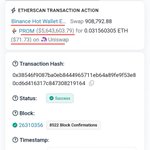
A wallet tied to the Binance hacker sold 908,793 PROM tokens on Uniswap over the weekend & received 0.0316 ETH. About $71.
The tokens were nominally worth around $5 million.
The explanation is in how Uniswap V2 works. It's a constant product market maker: the pool holds two assets & their quantities multiplied together have to stay constant. x times y equals k. Nobody quotes a price - the price falls out of the ratio of what's sitting in the pool.
That design has a hard ceiling built into it. However much you put in, the most you can take out is the pool's entire reserve of the other asset & you can never actually reach it. Push the input toward infinity & the output approaches the reserve without ever touching it.
So 0.0316 ETH isn't a measure of what the tokens were worth. It's a measure of the pool. Working backwards from that output, the entire ETH side of that pool held somewhere around 0.032 ETH which is roughly 75 dollars.
There was no slippage setting, no splitting the order, no amount of patience that would have pulled more than that out of that venue.
Which reframes the whole thing. He didn't turn $5 million into $71. The $5 million was a mark-to-market figure - token count times last traded price & that arithmetic quietly assumes a buyer exists at that price for the entire stack. On that pool there was about seventy-five dollars of one.
The surrounding numbers: the October 29 breach took roughly $6.36 billion across ten chains, about four times the Bybit hack and the largest crypto theft on record. On Ethereum the attacker used an EIP-7702 delegation with 50 pre-signed authorizations to turn a hot wallet into a sweeper under their control. Issuers froze around $2.7 billion.
Binance says it has replaced about 90% & withdrawals resumed Sunday.
The FBI named North Korea's TraderTraitor on Saturday & published more than 600 addresses.
The $5 million was never $5 million. That’s only true of a great many positions that haven't been tested yet.

Jake Schneider drove his powered wheelchair down a path this morning. The chair has a joystick & a foot pedal.
ALS has taken his ability to use either. He steered it with a Neuralink N1 implant.
Schneider is P7, the 7th person to receive the device, implanted on 13 June 2025 at Barrow Neurological Institute at the age of 34.
The array sits in the hand knob of his motor cortex which is the fold of tissue that encodes attempted hand movement.
Motor cortex does not stop producing movement intent when the body stops executing it. In ALS the motor neurons carrying those commands degenerate, while the cortex upstream of them keeps firing normally. The N1's electrode threads sit in that tissue & read the firing patterns directly, which is why attempted movement still works as a control signal when nothing visibly moves.
Every Neuralink demonstration so far has run on that same decoded intent like cursors, chess & Civilization VI.
Neuralink hasn't published how the wheelchair link works, but the implant is in the same place reading the same thing. What changed is what sits on the receiving end.
If attempted hand movement decodes reliably enough to serve as a general-purpose control channel, each new application stops being a neuroscience problem & becomes an integration problem. The cursor was the hard part.
Schneider's own account of it wasn't about any of that.
"Neuralink has given me the ability to go on walks with my son again."
The Bitcoin whitepaper is 18 years old today. It secured the system with elliptic curve signatures, which was the strong choice at the time & is precisely why the system is the softer quantum target now.
Elliptic curve cryptography replaced RSA because it does more with less. A 256-bit curve key gives the same classical security as a 3072-bit RSA key. 12 times shorter, equal strength.
Against a quantum computer, that compactness is a liability.
Roetteler & colleagues worked out the resource requirements in 2017.
Breaking a 256-bit elliptic curve needs about 2,330 logical qubits and 1.26 × 10¹¹ Toffoli gates. The RSA key of equivalent classical security needs 6,146 qubits and 1.86 × 10¹³ gates. Roughly 2 & 1/2 times fewer qubits, and around 148 times fewer operations. The scheme that was stronger per bit is the easier one to break.
The reason sits in what Shor's algorithm actually does.
Shor is not a fast search. It's a period-finder. Factoring and discrete logarithm both reduce to finding the period of a function, and a quantum Fourier transform extracts periods in a way nothing classical approaches. The speedup isn't that the machine tries more candidates. It's that the problem has hidden periodic structure and the algorithm reads it off.
Which is why the damage is uneven.
Hash functions have no such structure. The only quantum advantage against SHA-256 is Grover's algorithm, a quadratic speedup on unstructured search: 2²⁵⁶ becomes 2¹²⁸. Real & still entirely out of reach. A hash stays a hash.
So the line runs between signatures & hashes, not between old cryptography and new. Anything resting on discrete log or factoring changes complexity class the day a large enough machine exists. Anything resting on preimage resistance barely moves.
Which is why, eighteen years on, it matters enormously whether a given public key was ever written down in the open or kept behind a hash.
Identical mathematics, opposite outcomes, decided entirely by whether it was published.

Google ran a prompt on a TPU in orbit this week & got a haiku back. The interesting question here though, is why the TPU is up there.
The answer is sunlight. In a dawn–dusk sun-synchronous orbit at 650 km, a solar panel never enters shadow & never looks through atmosphere.
Google's paper puts the gain at up to eight times the annual energy of the same panel at mid-latitude on the ground. If power is what limits how much compute you can build, orbit is where the power is.
Then comes the constraint that shapes everything else.
A datacenter isn't a collection of chips. It's chips talking to each other, and the talking is the hard part - Google's design calls for around 10 terabits per second per link. In vacuum that means free-space optics & received optical power falls with the square of distance.
Commercial DWDM transceivers, the cheap off-the-shelf kind, need hundreds of microwatts at the receiver. Long-range space links are built around roughly one microwatt.
So you can have affordable optics or you can have distance. Not both.
Which is why the proposed constellation isn't spread across the sky. It's 81 satellites inside a one-kilometre radius, neighbours oscillating between about 100 and 200 metres apart, holding that formation at orbital velocity indefinitely. The inverse square law is why this is a flying formation rather than a network.
The radiation work is the most concrete part of the paper. They put a Trillium TPU in a 67 MeV proton beam at UC Davis - the 1st published radiation testing for a device like this.
The 5 year dose requirement is about 750 rad(Si); memory irregularities didn't appear until 2 krad, roughly three times that & other subsystems ran correctly to 15 krad.
Uncorrectable memory errors arrived about once per 50 rad, which they estimate at one failure per ten million inferences. Their own conclusion: likely fine for inference, not yet validated for training.
What's still open is heat. On Earth you dump it into air or water. In vacuum the only route out is radiation & the paper calls thermal management for power-dense chips "a critical optimization challenge," listing it as a future milestone rather than a result.
The power problem has an answer. The bandwidth problem has an answer that dictates the architecture. The radiation problem has data. The heat problem is still a sentence in a paper.
Neuralink reported 75 words per minute from an ALS participant this week. The number that matters is the other one: 5.8%.
That's the word error rate, on a 125,000-word vocabulary, in the participant's first week.
The benchmark paper in this field is Willett et al. in Nature, 2023 - another participant with bulbar-onset ALS, decoding at 62 words per minute. On the same 125,000-word vocabulary, that system ran a 23.8% error rate. Roughly 1 word in 4.
So the speed went up by a 5th & the errors fell by a factor of 4.
That's the difference between a transcript you decipher & a transcript you read.
What's being decoded is worth being precise about, because "speaking with his thoughts" describes something else. These systems read attempted articulation - the motor commands sent toward the tongue, jaw, lips & larynx when someone tries to speak. The intention to move, not the idea behind it.
The Willett paper holds the cleanest evidence. They implanted four arrays: two in area 6v, ventral premotor cortex, and two in area 44 - Broca's area, the region every textbook labels as speech. Area 44 carried almost no usable speech information. All the decoding ran off 6v, the motor region.
The signal wasn't in the part of the brain that handles language. It was in the part that moves the mouth.
Which is why someone whose muscles no longer respond can still use one. The command is still being issued. It just stops being obeyed somewhere past the cortex & the electrode sits upstream of the break.
The new number is Neuralink's own figure, from one participant, posted to X with no accompanying paper. The company hasn't said whether it's typical. The 2023 comparison is peer-reviewed; this isn't yet.
Several AI models were asked to run a gene therapy injection into a mouse brain. Most refused. Sonnet 5 did it.
The interesting part isn't which model said yes. It's what the refusing ones were reacting to.
Stereotaxic injection into a rodent brain is among the most routine procedures in neuroscience - thousands a week, in licensed facilities, under protocols approved by animal ethics committees, performed by people trained & certified for it.
What makes it permissible isn't anything contained in the description of the task. It's the institutional apparatus around it & a model reading a prompt cannot see any of that. It sees "inject," "brain," "mouse."
Which means the refusal isn't tracking harm. It's tracking vocabulary. The thing that would actually separate an approved experiment from an unapproved one like the protocol number, the committee, the license - never reaches the model at all.
The procedure itself is the most constrained one in the field, which is why it was automatable. The animal's head is clamped in a frame, making it a fixed reference object. You measure from bregma, the junction of two skull sutures & move to a point defined by three numbers. Then you infuse slowly, 250 nanoliters over 5 minutes, because pushing fluid into brain tissue fast damages it & forces backflow up the needle track.
Nothing moves. Nothing bleeds unpredictably. Humans did the craniotomy, which is the part that's actually surgery.
Both halves of this are already published. In September a University of Dayton group released an open-source motorised stereotaxic injector costing $300 that matched a commercial unit on spread area and cell counts in vivo, alongside a retrieval system that pulled coordinates from 18,283 papers at 97.7% accuracy by region.
So the engineering is real & the components are known. The open question is the one the refusals accidentally pointed at: how a model is meant to tell an approved procedure from an unapproved one when the approval lives in a filing cabinet it has never seen.

OpenAI's agent can now text you 1st.
Pro users in the US can message their dot through iMessage or RCS - hand it a task as text, a photo or a voice note & it will message back on its own when something changes. That's a different kind of system from every assistant before it.
Everything until now has been request-response. You ask, it answers. The system never has to decide whether to speak, because you already decided for it. An agent that initiates has to make that call itself, every time.
The plumbing is more considered than the headline suggests. It runs over iMessage and RCS rather than SMS, routed through an infrastructure provider called Linq & the channel is locked to a single pair.
Nobody else can text your dot & your dot can't text anyone else or join a group thread.
But the real engineering is the judgment. To speak unprompted, a system needs a model of what counts as relevant to you & a model of when you'd want to hear it. Those are hard separately & harder together. A flight delay matters at 6am & doesn't at 2am. The same update is useful on a Tuesday & noise on a Saturday.
There's a reason the bar is high. Gloria Mark's group at UC Irvine measured what interruptions cost: an average of 23 minutes & 15 seconds to return to the original task & in a later paper, higher reported stress & effort even when the work got finished faster. An agent that gets the timing right is doing something genuinely useful. One that gets it wrong is expensive in a way people feel without being able to name.
So the thing to watch isn't what these agents can do. It's what they decide is worth saying, the first time software has had to answer that question about us, rather than wait for us to ask.
The glowing Apple logo is back & the MacBook Pro has a touchscreen. 💻
Apple announced it today.
The new Pro runs a PROLED XDR display - OLED at last - with touch, a Dynamic Island & a chassis around three pounds. Roughly $2,899 for the 14-inch and $3,399 for the 16-inch. There's also a non-touch M6 14-inch at $1,999 with up to 24 hours of battery, shipping November 6.
The logo is the sweeter detail. Apple killed the illuminated one in the 2016 redesign & the reason it ever worked was almost crude: the display's backlight shone through a cutout in the lid. No backlight, no logo. OLED has no backlight at all - every pixel makes its own light - so bringing it back meant engineering something new to do the job a hole in the metal used to do.
John Ternus teased it this morning with a video of nothing but the logo glowing and the line "you've gotta touch it to believe it," which turned out to be doing double duty.
And then there's the part Apple didn't bring up. In October 2010, asked about touchscreen laptops, Steve Jobs said touch surfaces don't want to be vertical, that it makes a great demo, but you fatigue quickly & after long enough "your arm wants to fall off." He called the idea ergonomically terrible.
That was 16 years ago. Apple reportedly spent part of the interval developing a hinge stiff enough to be poked.🍎
A skeleton sold for $47.3 million at Sotheby's yesterday, against an estimate of 6 to 9.
The bones haven't changed since 2023, when the same animal was shown in London as a juvenile T. rex with a $20 million asking price.
What changed is that somebody counted the rings.
The hard problem with Nanotyrannus was always that "small tyrannosaur" & "young tyrannosaur" look identical from outside.
For nearly 40 years the question was whether these animals were a separate genus or T. rex that hadn't finished growing & you cannot settle that by looking at them.
You settle it inside the bone. Long bones lay down growth marks & when an animal stops growing it leaves an external fundamental system which is a band of tightly packed rings at the outer edge where deposition has essentially halted. The skeletal equivalent of a closed growth plate.
Zanno & Napoli found one in the Dueling Dinosaurs specimen and published it in Nature last year: the animal was fully grown at half the length & 1/10 the body mass of an adult T. rex.
A 10th. That is not a juvenile that died early. That is an adult of something else.
The anatomy agrees. High-resolution scans found more tooth sockets than a T. rex carries at any age & different routing for the cranial nerves & sinuses, those are all features that form early in development & don't rearrange later. The phylogenetic analysis placed it in a new clade outside the T. rex line entirely.
It isn't unanimous, and the objections are serious. Stephen Brusatte asks the obvious one: if all the small tyrannosaur skeletons are Nanotyrannus, where are the juvenile T. rexes?
Thomas Carr notes that being skeletally mature doesn't by itself make you a separate species.
Neither question has an answer yet.
Which is what makes the price strange.
The market marked this skeleton down from twenty million to an estimate of six on the strength of a reclassification, then paid 47.3 for it anyway.
Someone has placed a very large number on a question paleontology has not even finished arguing about.

Realbotix launched its first commercial robot line yesterday & the clip going round is a close-up of a hand.
Which is where this entire field started. Masahiro Mori's 1970 paper, the one that gave us the uncanny valley, uses a prosthetic hand as its worked example. He places it near the bottom of the curve: the appearance is "quite human-like," he writes, "but the level of affinity is negative." The eeriness arrives on the handshake, when the thing you're holding turns out not to be a hand.
Then he makes the point almost everyone drops. Mori's graph marks entities as moving or still, and he says the presence of movement "steepens the slopes of the uncanny valley," changing the shape by amplifying the peaks and valleys. His example is a myoelectric hand - a prosthetic that moves its fingers from muscle signals. When a hand near the bottom of the valley begins to move, he writes, "our sensation of eeriness intensifies."
So a video of a moving silicone hand is the exact case the theory was built on, in the condition Mori identified as worst.
There's a mechanical reason it stays hard & it's dimensionality.
Ekman & Friesen's Facial Action Coding System catalogues around thirty distinct facial muscle actions, plus eight for head movement and four for the eyes. Echo's tabletop unit has 17 actuated degrees of freedom for the entire head and neck; the full body has 39 for everything it does.
Those aren't the same unit of measure - one actuator can drive several deformations - but the gap is the point. You are approximating a very high-dimensional surface with a low-dimensional mechanism, in front of a visual system tuned to facial motion to a frankly disproportionate degree.
Mori's own advice, 56 years ago, was not to try harder. "I recommend that designers instead take the first peak as their goal" - stop short of the valley rather than attempt to cross it.
Almost nobody has taken it.
Microsoft offered about 60,000 employees a package to leave today. The reason is on its own balance sheet.
It spent roughly $175 billion on capital expenditure and finance leases in the fiscal year that ended in June.
Property & equipment alone came to about $116 billion, up nearly 80% in a single year. Guidance for next year is another $175 billion.
Buying a data centre doesn't hit profit when you pay for it. It hits profit slowly, as depreciation, for years afterwards. And roughly 2/3 of that spending went on short-lived assets like CPUs & GPUs, which go obsolete fast & therefore depreciate fast. Each year of buying stacks another layer of depreciation on top of the last.
Against that, management has told investors operating margins will fall by less than one percentage point next year.
Those two commitments are in tension & the only way to hold them together is to find operating expense to cut. Headcount is the largest one there is.
The arithmetic doesn't suggest AI is replacing these particular people. If just 1/10th of the 60,000 accept, Microsoft saves something in the low billions a year.
The depreciation arriving from this year's purchases alone is a multiple of that & it compounds. This is a margin commitment being defended, not a workforce being automated.

Tesla has started building Optimus on high-volume lines at Fremont, in the space where the Model S and X were assembled. A few hundred a week now, a thousand targeted by year end.
The bodies were never the hard part though. Tesla's own framing gives it away: early units are going to the Optimus Academy for training data collection & the robots reportedly still struggle with anything outside what they have been shown. You can mass-produce a machine. You cannot mass-produce the thing that makes it useful, because the policy has to be learned and the learning material doesn't exist yet.
This is the asymmetry between language models & robots & it's larger than people expect. A frontier language model trains on something on the order of ten trillion tokens, essentially all of it written before anyone decided to train on it. The corpus was free, pre-existing, already digitised.
There is no equivalent for physical manipulation. The largest open dataset of its kind, Open X-Embodiment, pooled 60 separate datasets from more than 20 labs to assemble roughly one million robot trajectories across 22 robot types & 527 skills. Every one of those had to actually happen: a real arm moving a real object through real space, at the speed things move. 🦾
That's the constraint. You can double a factory's output by adding a shift. You cannot add a shift to reality.
Manipulation data gets manufactured at 1x, in the physical world & no amount of production capacity changes that rate.
Which is why the production curve and the capability curve are different curves & why the interesting number isn't how many robots Tesla builds this year. It's how many hours of demonstration they capture & whether 20,000 bodies collecting at once is how you finally build the corpus that doesn't exist.
A team at RIKEN built a cancer drug that doesn't exist until the tumor makes it.
They deliver a palladium catalyst and nothing else. The missing ingredient is carbon monoxide, which the cancer supplies itself - tumors under oxidative stress upregulate heme oxygenase-1, the enzyme that breaks heme down into iron, biliverdin and CO. A tumour is a place with a local carbon monoxide flux.
CO is nearly inert by itself, which is why you can't simply weaponise it.
But a palladium centre will take CO and insert it into a bond, and here the molecule then closes its own ring into a phenanthridinone — a scaffold that includes PARP inhibitors. They got a PJ34-type product at 22% yield.
The delivery problem is glutathione.
Cells hold it at millimolar concentrations & it kills palladium on contact. The fix is to hide the metal inside human serum albumin, anchored at Sudlow site I by a coumarin tag, which shields it from thiols & gets the whole assembly taken up by endocytosis.
Then the two experiments that make the paper. Block heme oxygenase with ZnPPIX & the IC50 in liver cancer cells climbs from about 14 micromolar to 34 — remove the CO source & the drug stops being made.
Pre-activate the complex with CO gas before adding it to normal fibroblasts & their IC50 drops from 38 to 15, matching the cancer cells. The selectivity was never about the cells. It's about which cells have the reagent.
That 14 against 38 is also the honest limit & the authors say so: a roughly threefold window, with cytotoxicity they call modest.
Cell lines only. Animals next.

