

Director, Eurasia Group Nonresident Senior Fellow @CEPA All views are mine, not the company’s. Ex Credit Suisse, WSJ, BBC
London, England
Joined January 2010
- Tweets821
- Following508
- Followers2.3K
- Likes58




Alexander Kolyandr retweeted

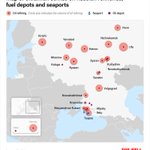
For a country that pumps roughly nine million barrels of oil a day – the third highest of any country in the world – Russia has managed to achieve something genuinely remarkable: it cannot keep its own petrol stations stocked.
More than half of its regions are now reporting shortages, the consequence of a Ukrainian drone campaign that has struck with increasing frequency and precision at the refinery infrastructure on which the country’s civilian economy depends.
The sometimes hours-long queues that have appeared – even in Moscow, for what may be the first time in the war – carry a symbolic weight that no amount of official reassurance from the Kremlin has managed to dispel.
✍️ Alexander Kolyandr
Article | spectator.com/article/can-th…
@kolyandr

Alexander Kolyandr retweeted
Imagine if, in 1941, as we were fighting for our lives against the German menace, a boatload of foreign narcissists rocked up at Dover to make fun of us.
Worse, imagine these self-regarding seafarers cheered on our enemies. Imagine they waltzed up to the nearest soldier or copper and barked 'Victory to Germany!' while sporting the smuggest smirk you have ever seen.
We'd be annoyed, right? More than annoyed: there would be national fury. Every paper in the land would denounce the preening aliens. Lines of boys in blue would have to hold back angry Brits yelling 'Let me at 'em!'.
Well, now you know how the good people of Israel must feel after yet another armada of cranks sailed their way to remonstrate with their soldiers and tell them how demonic they are.
✍️ Brendan O’Neill
Article | spectator.com/article/ben-gv…
Alexander Kolyandr retweeted

SCOOP: The FSB unit behind the poisoning of Alexei Navalny now controls Russia’s internet, The Bell has found.
Every recent crackdown on Runet — from restrictions on voice calls in WhatsApp and Telegram to full messenger blocks and the war on VPNs — traces back to the FSB’s (ex-KGB) Second Service. Officially, it is mandated to protect Russia’s constitutional order and counter terrorism. In practice, it is the Kremlin’s primary tool for suppressing any form of dissent inside the country
1/7
Alexander Kolyandr retweeted
⚡️SCOOP: Putin gathered oligarchs behind closed doors and asked them to pitch in for the war in Ukraine
Today Putin held a closed-door meeting with Russia’s largest businessmen. The contents of such meetings are typically not disclosed, and since the war began even the list of attendees has been classified. But The Bell has learned that Putin discussed the continuation of the war and its financing with the oligarchs
1/6
Alexander Kolyandr retweeted

Russia: Give Me Your Poor, Your Starving Masses | "Expect the Kremlin to trumpet its self-declared generosity to the world’s poor — it is a low-cost, high-return opportunity." @kolyandr cepa.org/article/russia-give…
Alexander Kolyandr retweeted
✈️Logistics headaches
Four years of war have dismantled Russia’s logistical integration with the West, cutting direct air connections from 69 countries to 42. While travel now depends on costly hubs in Turkey and the Gulf, Aeroflot has failed to recover its pre-pandemic volumes as the domestic fleet struggles with the soaring price of sanctioned maintenance.
Beyond aviation, trade has shifted into a high-friction landscape of expensive parallel imports and a deepening dependence on China. While goods still reach shelves, ballooning logistical costs are passed directly to shoppers, marking a permanent pivot from global efficiency to sanctioned isolation

Alexander Kolyandr retweeted
💸Foreign payments
Russian foreign trade has undergone a tectonic shift: the share of the dollar and euro in exports collapsed from 87% in early 2022 to nearly nothing, replaced by the ruble (54%) and yuan (32%) by 2025. While presented as “de-dollarization,” this was a forced retreat into a payment infrastructure that is slower, costlier, and riskier, leaving Russia dependent on a non-convertible yuan and limited ruble settlements

Alexander Kolyandr retweeted
🏭Nationalization
Since 2022 the confiscation of private property became a routine instrument of economic policy.
The scale of the process is clearly visible in the numbers. In 2025, courts ordered the transfer of assets worth a total of $11.03 billion into state ownership — three times more than the year before ($3.89 billion). The share of nationalization in the total volume of mergers and acquisitions rose from 7.2% to 27.6%. In other words, more than a quarter of the entire Russian M&A market in 2025 was forced transfers to the state.
Nationalization has shifted from a rare, targeted tool into an assembly line running through the courts, souring investment appetite and business sentiment. Its real impact will show up in 5–10 years, once enough cases and seized assets pile up

Alexander Kolyandr retweeted
⚡️Communications shutdowns
In 2021, Russia ranked sixth in the world in terms of internet accessibility. But four years later residents of dozens of Russian regions faced regular mobile internet blackouts as the authorities shut down connectivity in an attempt to counter drone threats, mostly without prior warning.
The internet blackouts mean people cannot properly use taxis, car sharing, scooter rentals, or order food and grocery deliveries. Many payment terminals and ATMs also stop working. In August 2025 alone, there were 2,129 shutdowns across Russia — more than were registered in the entire world in 2024. A country that once ranked among the top ten in digitalization became the global leader in internet shutdowns

Alexander Kolyandr retweeted
🧵How the war in Ukraine reshaped the Russian economy?
By the fifth year of the war in Ukraine, it can seem like everything in Russia is fine. Packed restaurants serve sanctioned wine, Russians fly off on vacations to Turkey and Thailand, and couriers deliver goods to apartment blocks around the clock. At first glance, life goes on.
But Russia’s economy today is almost unrecognizable compared to before the invasion — and it may never return to what it was. Over the past four years, the very fabric of economic life has been rewoven: how people and businesses pay for things, how the internet works and who owns property.
In this thread, we look at several ways Russia’s economy in 2026 is profoundly — and perhaps permanently — different from that of 2021.

Alexander Kolyandr retweeted
Where is Putin’s Russia Going? (The Bell In Moscow’s Shadows)
The inestimable @kolyandr of the indispensable @thebell_io and I chat about how Putin's #Russia has changed over 4 years of war, and where it's going
youtu.be/H-uxorF2xPM?si=59n1…
Alexander Kolyandr retweeted

Putin calls war veterans “Russia’s true elite.”
The data, brilliantly read by @kolyandr tell a different story: the poorer the region, the higher the death rate.
People from Buryatia, Tuva, or Chukotka are 25× more likely to die than Muscovites.
As the economy slows, poverty grows — and so does the pool of recruits.
The full story in our weekly newsletter
en.thebell.io/waging-war-wit…

Alexander Kolyandr retweeted
Russia Loses Venezuela, the Avocado Ally | "The Kremlin has waved goodbye to another ally, at a low-ish cost in rubles but a higher price in political currency." @kolyandr cepa.org/article/russia-lose…

Alexander Kolyandr retweeted
China Thanks ‘Gas Station Manager’ Putin | "Whatever the theatrics on Red Square, Russia is becoming ever-more dependent on China." @kolyandr cepa.org/article/china-thank…
Alexander Kolyandr retweeted

Как бы вас так заинтересовать? Тут в России незаметно появилась и исчезла компания с оборотом почти в 4 ТРИЛЛИОНА рублей - больше только у Роснефти и Газпрома. Мы поискали ее владельца — а он который подряд срок за кражу колбасы мотает) Да будет тред!
Alexander Kolyandr retweeted

Russia is releasing Wall Street Journal reporter Evan Gershkovich and former US Marine Paul Whelan in a major multi-country prisoner swap trib.al/HM9mDMz

Alexander Kolyandr retweeted
Western policies should seek to encourage such migration, which has a double benefit — attracting highly-skilled young workers and delivering a blow to the Kremlin. en.thebell.io/russias-650-00…

Alexander Kolyandr retweeted
Around 650,000 Russians who fled after the invasion are still abroad. They present a political and economic headache for the Kremlin, and their absence increases tensions in the labor market at home. w @kolyandr and @ksnchk
en.thebell.io/russias-650-00…
Alexander Kolyandr retweeted
The new sanctions package will be extremely painful for the Russian economy, but it’s 2yrs late to be a gamechanger. In a global context, it increases the risk of the fragmentation of the financial system, as I argue for my new @CEIP_Politika piece
carnegieendowment.org/russia…
