

Analyst at @Milkroaddaily | Hunting mispriced conviction | Building @Portfolio_OS
Joined August 2016
- Tweets3.7K
- Following1.1K
- Followers5.4K
- Likes4.7K


Pinned Tweet
Galaxy reports tomorrow before the open.
Since early September, the stock has cratered 43%, landing near $15 today, and it has nothing to do with Galaxy’s execution. It is fallout from its tenant, CoreWeave, and the broader AI rout.
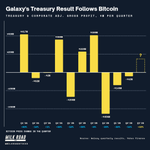
Over the last 90 days $GLXY has moved with CoreWeave, not bitcoin. And the last Q2 report didn't help either: an $85M net loss and a 14% drop on the day.
But Q3 can be a real game-changer. Here's what I'm expecting tomorrow:
m0xt retweeted
AI run-rate is about $200B a year today. The AI buildout through this year will need roughly $840B to $1T a year in revenue to earn a decent return. That's a 4-5x gap.
The math is simple. Take how much AI capacity will be installed worldwide by the end of each year, and assume every gigawatt needs $20-25B in yearly revenue to pay off.
And the bar keeps rising. By 2028, it's $2.5-3.1T a year.
Everyone points to how hard it is to rent a GPU right now. But the spot market, where that shortage shows up, is only <10% of all compute. Most of it sits under long contracts.
So my question is: who pays the bill?
Someone has to spend close to $1T a year on AI just to justify what's being built this year. That's 4-5x what the whole world spends on AI today.
Hyperscalers and neoclouds can afford the GPUs, but they're not the end buyer. They need customers renting that compute from them every year.
Consumers would have to cut spending somewhere else. Companies would carry higher costs, unless AI actually makes them more money, and that takes time.
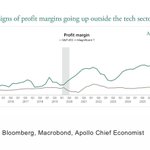
Outside the M7, we’re not seeing any meaningful profit‑margin expansion yet, and that’s a concern. AI adoption will only scale when it delivers clear ROI, and we’re not seeing that today.
Here’s how I see the plausible options:
- Are we stuck in a limbo phase where firms are layering AI on top of existing teams so headcount doesn’t shrink and margins don’t visibly widen yet?
- Are businesses struggling to operationalize AI in a way that actually produces measurable ROI?
- Or are they leaning on pricey frontier models that currently swallow the gains, expecting that later optimization with cheaper models, better workflows, and tighter tooling will unlock real ROI?
It’s probably some mix of all three, but at the end of the day, shareholders and the board will want to know: Where’s the AI payoff?


AI revenue is ~$200bn today. The capex already spent needs ~$900bn in annual revenue to earn an acceptable return, and next year's capex raises that bar by roughly another 700bn.
Everyone points to a tight spot market for compute. Spot is 1-2% of the market! Is anyone able to explain why this isn't an investment bubble?
Short term, the market is a voting machine. Long term, it's a weighing machine.
The hard part is timing. 😅🤔

m0xt retweeted
Galaxy reports today, and the numbers are only half the story.
What management says on the call at 13:30 CET, and the guidance they give for what comes next, matter just as much.
I hold $GLXY, and it's been a rough two months. The stock is down ~43% since early September, mostly because it trades with CoreWeave. The only people who can change that today are Novogratz and his team.
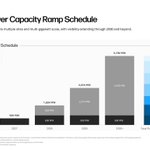
Look at Galaxy's own slide. The black bars are what's signed: 800 MW. The grey bars are everything nobody has signed yet, and by 2030 that's 4,930 MW. That's where the upside is.
So here's what I want to hear:
1. Who's taking Helios II (830 MW), and when. Last time we got "constructive" conversations and "patience is a virtue." I'd love more than that, or at least a time window. Bonus points if the tenant is investment grade or has a guarantor behind it.
2. Something about execution and CoreWeave. Is the rent coming in on time? Is Phase II still on track for Q2 2027? And what happens to Galaxy if CoreWeave gets into trouble? "We don't comment on our customer" won't cut it.
3. No new shares. In August the CFO said they don't need equity to finish the 800 MW for CoreWeave. Investors need to hear that exact line again, especially with the stock at $15.
4. Buybacks. ~$109M was left in August and the program ends around February. At 52-week lows, I'd like to hear they've been buying, and maybe that they're topping it up.
5. How they pay for what's next. Phase III still needs its final debt deal, so when does it close and at what rate? And Helios II is a much bigger build. Once a tenant signs, how do they fund it without hitting shareholders?
Now let’s be honest about one thing: a good call will not fix CoreWeave’s balance sheet. And unfortunately, management burned some credibility earlier this year too.
Novogratz said they would announce the next tenant by the end of summer. They didn't.
Then there is Caspian. In August, they said it was “very well positioned” for base load. Five weeks later, it got Studied Load.
That’s exactly why investors are more nervous this time and expect clearer, more transparent communication than we’ve seen so far this year.
The numbers should be fine imo. The call decides whether $GLXY keeps trading like a CoreWeave proxy or starts trading like a landlord with highly predictable cash flows and an accelerating crypto-infra provider.
One more wish, for Galaxy and everyone else. SpaceX set the bar with its earnings presentation: proper visuals and videos instead of a voice reading numbers into a mic. It's 2026.
Audio-only calls shouldn't be the standard anymore. I hope more companies start treating earnings day as a chance to show investors what they're building. A few minutes of Helios on video would land better than an empty screen.
I will share the update after the call. Make sure to follow me @m0xt_.

ALT Galaxy's power capacity ramp schedule: 800 MW contracted from 2028 on, with uncontracted capacity rising to 4,930 MW in 2030+ for a 5,730 MW total pipeline.

Galaxy reports tomorrow before the open.
Since early September, the stock has cratered 43%, landing near $15 today, and it has nothing to do with Galaxy’s execution. It is fallout from its tenant, CoreWeave, and the broader AI rout.
Over the last 90 days $GLXY has moved with CoreWeave, not bitcoin. And the last Q2 report didn't help either: an $85M net loss and a 14% drop on the day.
But Q3 can be a real game-changer. Here's what I'm expecting tomorrow:
Earlier today, I asked where the AI payoff is outside the Mag 7.
One guess: companies are piling AI on top of their existing teams, so headcount doesn't shrink and margins don't move.
Microsoft just showed what the other path looks like. It offered voluntary buyouts to ~60,000 employees, about 27% of its workforce. The biggest buyout offer in its history.
That’s exactly the kind of news I’m hoping for, because it’s what keeps AI trade moving forward.
Microsoft's margins are already growing. But it has also put AI tools in the hands of its engineers, sellers and supply chain teams, it says it's seeing results, and now it's acting on them.
That's the playbook the rest of the S&P 500 needs. Most companies aren't getting new revenue from AI yet, so the payoff has to come from costs. The same work done by fewer people, wider margins, and AI spending that finally pays for itself.
The other side: 60,000 is how many people are eligible. How many actually leave is a different number, and Microsoft expects a much smaller share to take it than the ~30% who took its retirement offer this spring. Part of this is also Microsoft freeing up cash for a capex bill above $50B a quarter.
But this is the third step this year. A retirement program in April, 4,800 layoffs in July, and now an offer that goes all the way up to VP level. You don't do that three times if AI isn't changing how much work each person can get done.
Employees make the call in early December, then punch out on Dec 31. The real question is when the non-Big Tech crowd starts copying the playbook, or, more pointedly, how soon competitors, investors, or board members force the companies to prove AI is paying for itself.
Many people are bullish on AI adoption, yet they don't expect any major layoffs. Here’s what this year has actually shown us so far:
1. UPS: 30,000 Employees
2. Oracle: 30,000 Employees
3. Amazon: 16,000 Employees
4. Omnicom: 15,000 Employees
5. Meta: 8,000 Employees
6. Microsoft: 4,800 Employees
7. Dow Chemical: 4,500 Employees
8. Cisco: Fewer Than 4,000 Employees
9. American Express: 3,840 Employees
10. Uber: 3,300 Employees
11. Renault: Up to 2,400 Employees
12. Nike: 1,400 Employees
13. General Motors: 1,300 Employees
14. Disney: 1,000 Employees
15. Citigroup: 1,000 Employees
So far in 2026, the tech industry has logged about 135,000 layoffs across roughly 330 companies. That is not huge in the big picture, but it is hard to believe the pace will just stop on its own.
Big layoff waves also send a message to markets. Markets can read them as proof that AI can deliver returns, which investors want to hear. This is ultimately the most bullish signal you can get. But there is a downside. If job losses keep piling up, unemployment will likely rise, which could push public spending higher at a time when many governments are already running large deficits.
Will governments and regulators really sit back and do nothing to slow this down? I don’t think so.
Follow me @m0xt_ for more market updates.

BREAKING: Microsoft, $MSFT, is offering buyouts to 60,000 workers as part of the company’s efforts to cut costs amid AI adoption, per Bloomberg.
Personnel on select teams in the US, Canada, India, and the UK at a vice president level and below will be eligible.
This reflects ~27% of Microsoft's total workforce.
The market misprices great businesses all the time. At Milk Road, we find them before everyone else does.
That's how we caught $GLXY, $HOOD, $NBIS, and $HYPE early.
Want to see every trade we make, live? Check it out here:milkroad.com/pro/?utm_medium…

Here's my post from earlier today on why the AI payoff hasn't shown up in margins outside the Mag 7 yet:
AI run-rate is about $200B a year today. The AI buildout through this year will need roughly $840B to $1T a year in revenue to earn a decent return. That's a 4-5x gap.
The math is simple. Take how much AI capacity will be installed worldwide by the end of each year, and assume every gigawatt needs $20-25B in yearly revenue to pay off.
And the bar keeps rising. By 2028, it's $2.5-3.1T a year.
Everyone points to how hard it is to rent a GPU right now. But the spot market, where that shortage shows up, is only <10% of all compute. Most of it sits under long contracts.
So my question is: who pays the bill?
Someone has to spend close to $1T a year on AI just to justify what's being built this year. That's 4-5x what the whole world spends on AI today.
Hyperscalers and neoclouds can afford the GPUs, but they're not the end buyer. They need customers renting that compute from them every year.
Consumers would have to cut spending somewhere else. Companies would carry higher costs, unless AI actually makes them more money, and that takes time.
Outside the M7, we’re not seeing any meaningful profit‑margin expansion yet, and that’s a concern. AI adoption will only scale when it delivers clear ROI, and we’re not seeing that today.
Here’s how I see the plausible options:
- Are we stuck in a limbo phase where firms are layering AI on top of existing teams so headcount doesn’t shrink and margins don’t visibly widen yet?
- Are businesses struggling to operationalize AI in a way that actually produces measurable ROI?
- Or are they leaning on pricey frontier models that currently swallow the gains, expecting that later optimization with cheaper models, better workflows, and tighter tooling will unlock real ROI?
It’s probably some mix of all three, but at the end of the day, shareholders and the board will want to know: Where’s the AI payoff?
AI revenue is ~$200bn today. The capex already spent needs ~$900bn in annual revenue to earn an acceptable return, and next year's capex raises that bar by roughly another 700bn.
Everyone points to a tight spot market for compute. Spot is 1-2% of the market! Is anyone able to explain why this isn't an investment bubble?
Short term, the market is a voting machine. Long term, it's a weighing machine.
The hard part is timing. 😅🤔
The market misprices great businesses all the time. At Milk Road, we find them before everyone else does.
That's how we caught $GLXY, $HOOD, $NBIS, and $HYPE early.
Want to see every trade we make, live? Check it out here:milkroad.com/pro/?utm_medium…
Galaxy reports today, and the numbers are only half the story.
What management says on the call at 13:30 CET, and the guidance they give for what comes next, matter just as much.
I hold $GLXY, and it's been a rough two months. The stock is down ~43% since early September, mostly because it trades with CoreWeave. The only people who can change that today are Novogratz and his team.
Look at Galaxy's own slide. The black bars are what's signed: 800 MW. The grey bars are everything nobody has signed yet, and by 2030 that's 4,930 MW. That's where the upside is.
So here's what I want to hear:
1. Who's taking Helios II (830 MW), and when. Last time we got "constructive" conversations and "patience is a virtue." I'd love more than that, or at least a time window. Bonus points if the tenant is investment grade or has a guarantor behind it.
2. Something about execution and CoreWeave. Is the rent coming in on time? Is Phase II still on track for Q2 2027? And what happens to Galaxy if CoreWeave gets into trouble? "We don't comment on our customer" won't cut it.
3. No new shares. In August the CFO said they don't need equity to finish the 800 MW for CoreWeave. Investors need to hear that exact line again, especially with the stock at $15.
4. Buybacks. ~$109M was left in August and the program ends around February. At 52-week lows, I'd like to hear they've been buying, and maybe that they're topping it up.
5. How they pay for what's next. Phase III still needs its final debt deal, so when does it close and at what rate? And Helios II is a much bigger build. Once a tenant signs, how do they fund it without hitting shareholders?
Now let’s be honest about one thing: a good call will not fix CoreWeave’s balance sheet. And unfortunately, management burned some credibility earlier this year too.
Novogratz said they would announce the next tenant by the end of summer. They didn't.
Then there is Caspian. In August, they said it was “very well positioned” for base load. Five weeks later, it got Studied Load.
That’s exactly why investors are more nervous this time and expect clearer, more transparent communication than we’ve seen so far this year.
The numbers should be fine imo. The call decides whether $GLXY keeps trading like a CoreWeave proxy or starts trading like a landlord with highly predictable cash flows and an accelerating crypto-infra provider.
One more wish, for Galaxy and everyone else. SpaceX set the bar with its earnings presentation: proper visuals and videos instead of a voice reading numbers into a mic. It's 2026.
Audio-only calls shouldn't be the standard anymore. I hope more companies start treating earnings day as a chance to show investors what they're building. A few minutes of Helios on video would land better than an empty screen.
I will share the update after the call. Make sure to follow me @m0xt_.
ALT Galaxy's power capacity ramp schedule: 800 MW contracted from 2028 on, with uncontracted capacity rising to 4,930 MW in 2030+ for a 5,730 MW total pipeline.
Galaxy reports tomorrow before the open.
Since early September, the stock has cratered 43%, landing near $15 today, and it has nothing to do with Galaxy’s execution. It is fallout from its tenant, CoreWeave, and the broader AI rout.
Over the last 90 days $GLXY has moved with CoreWeave, not bitcoin. And the last Q2 report didn't help either: an $85M net loss and a 14% drop on the day.
But Q3 can be a real game-changer. Here's what I'm expecting tomorrow:
The market misprices great businesses all the time. At Milk Road, we find them before everyone else does.
That's how we caught $GLXY, $HOOD, $NBIS, and $HYPE early.
Want to see every trade we make, live? Check it out here:milkroad.com/pro/?utm_medium…
The market misprices great businesses all the time. At Milk Road, we find them before everyone else does.
That's how we caught $GLXY, $HOOD, $NBIS, and $HYPE early.
Want to see every trade we make, live? Check it out here:milkroad.com/pro/?utm_medium…
3. The crypto business
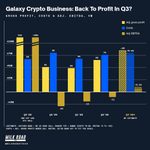
Trading, lending, asset management. Gross profit was $66M in Q2, up 34% from Q1, but it still lost $11M. Losses have shrunk three quarters in a row:
-$29M, -$19M, -$11M.
The costs ran $76M in Q2, so $66M of gross profit wasn't enough.
I think Q3 is the quarter it turns. Crypto finished the quarter much higher, which lifts asset management and staking. Volumes were soft over the summer but returned in September, and costs could also come down.
My bet: ~$85M of gross profit, nearly 30% more than Q2. That's $5-10M of adjusted EBITDA. Anything above zero is a win for me.
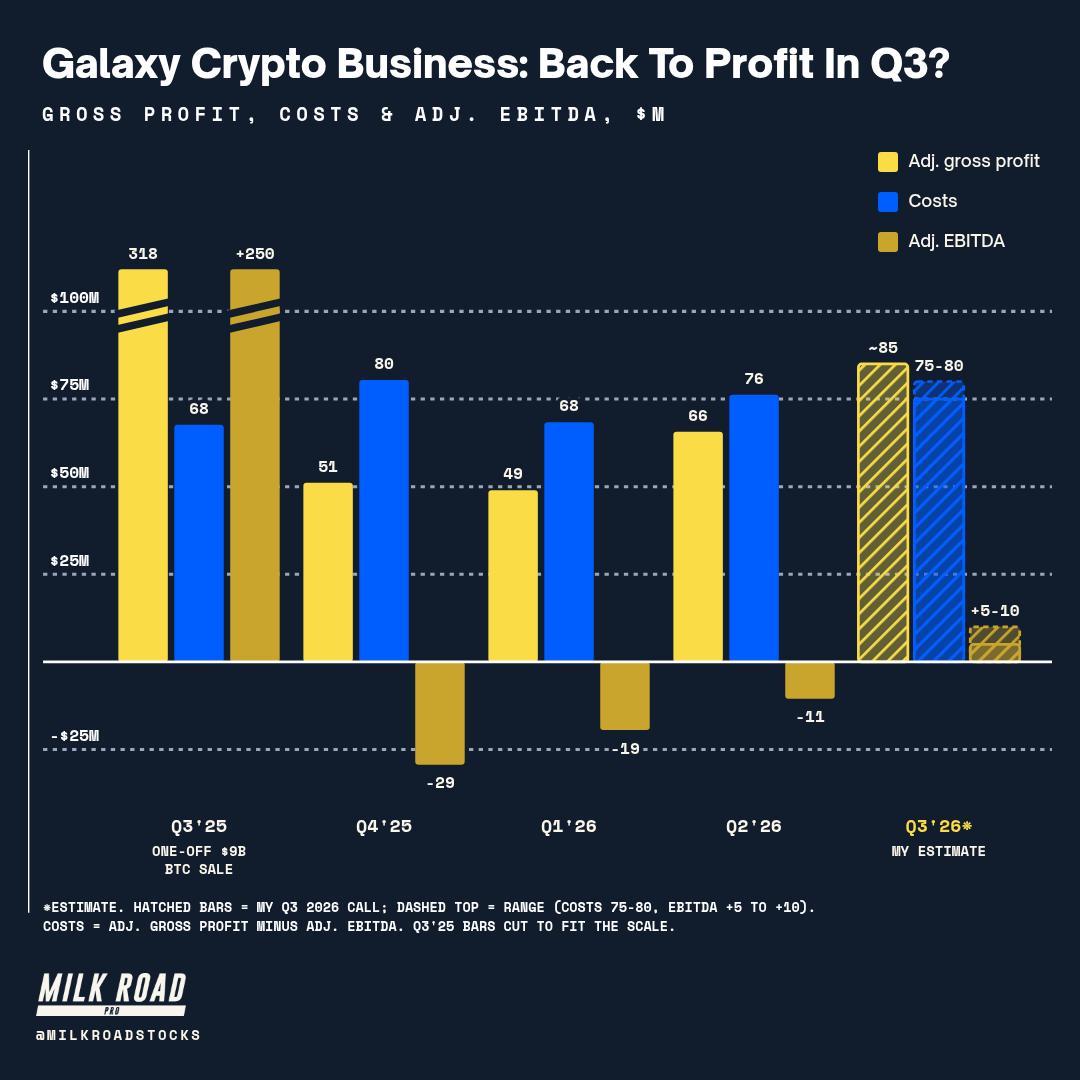
ALT Galaxy Digital Assets segment by quarter: adjusted gross profit, costs and adjusted EBITDA in $M. Q3'25 318/68/+250 (one-off $9B BTC sale), Q4'25 51/80/-29, Q1'26 49/68/-19, Q2'26 66/76/-11, Q3'26 estimate ~85/75-80/+5-10.
My estimate: ~$0.30-0.35 EPS vs ~$0.22 consensus. Most of the gap is crypto marks. The quarter's quality is in Helios and the crypto business.
Two more things. Stock comp runs ~$16M a quarter, and buybacks have offset it: the share count was flat this year. They bought at ~$20. The drop to $15 only came in October, so I'm fine if Q3 buying was light. That just leaves more of the ~$109M left for these prices.
At these prices, I wouldn't be surprised to see them top up the program. The current one runs out in February anyway.
The bear case: Galaxy has one tenant, and that tenant's lenders are nervous. A clean report can't fix CoreWeave's balance sheet.
A second tenant would help a lot. If Galaxy talks about a new customer tomorrow, the one-tenant risk drops dramatically. Not my base case, but it's the upside I'd love to hear.
I will provide an update tomorrow after the earnings.
Instacart reportedly offered itself to Uber. Uber reportedly said no.
As an Uber holder, that news didn't surprise me.
On Thursday, it came out that Instacart, worth about $12B, is exploring a sale and had early talks with Uber and DoorDash. The stock jumped 9% to $56.44. Uber and DoorDash both fell about 3.5%.
Then after the close it was reported that Uber had already walked away, and an Uber official said there are no talks right now. That leaves DoorDash as the only named buyer.
Here's why I think passing was the right call.
Uber says openly that it measures every acquisition against their own hurdle rate, including buying back its own stock. So a deal only happens if the price is good enough to beat that. If Uber said no, my guess is the price was too high for the upside it saw. At the right price, I think Uber would still have done it.
Uber also already has a lot on its plate. It's buying Delivery Hero for $14.8B and ezCater for $2.3B, both in cash. A typical 30-40% premium would put Instacart at roughly $15.6-16.7B on top of that. Together, all three would come to about $33B, more than three years of Uber's free cash flow. Buybacks already dropped to $510M last quarter from $1.4B a year earlier.
And Uber is already beating Instacart in grocery without buying it. Uber's grocery business is growing about 40% a year, Instacart's about 13%. Why pay a premium for the rival you're taking share from?
The bull case for a deal is real though. Grocery is the biggest delivery category left. Instacart brings 2,200 retailers, an ads business doing around $300M a quarter, and about $1.3B of EBITDA expected this year. It would have closed the grocery gap in one move.
The risk now is DoorDash. If it buys Instacart, it leads US restaurant delivery and grocery delivery at the same time. That's a much harder antitrust case, but if it clears, Uber Eats is a clear No. 2 in the US.
Uber is priced at about 13x free cash flow, whereas DoorDash commands closer to 37x. To me, that gap reflects an opportunity. Uber has the scale and breadth to steadily siphon share from DoorDash over time. It is global, it is not a one-trick delivery business, and it can lean into platform network effects. That could mean outspending on customer acquisition or rolling out differentiated perks and functionality that pure-play delivery apps cannot easily match.
UBER is one of the main stocks in my Milk Road portfolio. You can see it here: link.milkroad.com/Martin

INSTACART EXPLORES SALE, HOLDS TALKS WITH UBER AND DOORDASH
$CART, valued at around $12 billion, is working with an investment bank and has held preliminary discussions with $UBER and $DASH, according to The Information.
Interestingly, Instacart previously held talks with DoorDash in 2021 over a potential deal valued at $40B to $50B, but negotiations fell apart.
Instacart reported $1.04B in Q2 revenue, up 14%, and generated $480M in free cash flow.
No deal is guaranteed, and any acquisition by a major delivery rival could face antitrust scrutiny.

The market misprices great businesses all the time. At Milk Road, we find them before everyone else does.
That's how we caught $GLXY, $HOOD, $NBIS, and $HYPE early.
Want to see every trade we make, live? Check it out here:milkroad.com/pro/?utm_medium…
m0xt retweeted

$AAVE already has about 30% market share, and Milk Road analyst Martin thinks tokenization hands it a lot more
"The bull case for AAVE is just easy to make"
His logic: as stocks, treasuries, even houses move onchain, people lend them out, and "liquidity begets liquidity"
Revenue isn't there yet. He has Aave around breakeven today
If that future plays out, he sees a "tens of billions company" in no time
FT @m0xt_ @KyleReidhead @BitcoinJesusETH
Aave doesn't need to find its next million users. Coinbase, Circle and Lido are bringing them.
That's the real idea behind Aave V4. Instead of one lender building every market itself, V4 is a platform. There's one shared pool of money, the Hub, and separate lending markets, the Spokes, that plug into it. Each Spoke has its own collateral and risk rules, but they all draw on the same liquidity.
Now here's where it gets interesting. Every partner that plugs in brings its own users, and those users tap money that's already sitting in the pool. Lido, EtherFi, Ethena and Tether's gold token are live. Coinbase's tokenized stocks on Base, like Apple, Nvidia and Tesla, can now be used as collateral to borrow USDC. Circle went live on its own chain, Arc, in September.
In other words, Aave doesn't have to build each market from scratch. Partners bring the users, and the shared pool gets deeper with every one that joins. That's the flywheel.
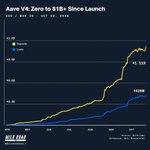
And it's working. V4 went from zero at launch in March to over $1.1B deposited and about $426M borrowed. In the last month alone, deposits grew about 30% and loans about 50%.
To be fair, there are real catches. This isn't open to everyone: each new Spoke needs an Aave DAO vote, while Morpho lets anyone create a market. Rewards are still being used to kick-start some markets. And V4 is still a small slice of Aave.
On risk, each Spoke carries only the risk it signs up for: its own collateral, its own limits, its own liquidation rules. The Hub gives every Spoke a capped credit line, so a bad market can't empty the whole pool.
I’m excited to see V4 keep scaling. This feels like Aave’s next big growth lever. Tokenized equities could be a compelling adoption wedge too, since they will likely be lent out for yield in the end, value that brokers mostly capture today.
Follow me @m0xt_ for more market updates.

Morgan Stanley's worst case for Galaxy is $16. The stock closed Friday at $14.68.
TeraWulf is even further off. The bank's bear case is $17.50, and it closed at $11.32. I own both.
Morgan Stanley reiterated Overweight last week, with base targets of $65 on TeraWulf and $43 on Galaxy, and called the selloff a buying opportunity. Four of the seven names in its table (TeraWulf, Galaxy, Hut 8 and Riot) now trade below the bank's own bear case.
So either the bear case is too generous, or the market is pricing something worse than a bad year. I think it's pricing the second one: money for building drying up.
Elon said it bluntly on Sunday. Debt markets have "almost entirely shut off access to money for any company that doesn't have substantial revenue independent of AI data centers." These landlords build mostly with borrowed money, so that sentence covers them too.
He's right about the debt markets. But I think the risk is smaller here than for the neoclouds. These companies raise money to buy land, put up buildings, and connect them to power. They keep owning the land and buildings, and buildings depreciate over 25 years or more. Whatever happens to the AI trade, those assets don't go away.
The rent they build against usually comes from hyperscalers or neoclouds, so the tenant risk is real. But I find it hard to imagine we'll use less of those services in the future than we do today. Whoever owns the land, buildings, and grid connection owns a valuable asset. Still, this capital-intensive phase is touching everyone, and anyone looking for funding will likely have to pay a steeper price for it, assuming they can secure any at all.
But here is the other side of this trade: Morgan Stanley's TeraWulf target is about double the Street average of around $33. It also leads TeraWulf's credit line, which just got upsized to about $400M. They might be biased.
And Galaxy's only Helios tenant is CoreWeave, whose funding gap banks put anywhere from $23B to $76B. The next tenant will definitely help.
For all the noise, the market is pricing these PSPs at levels, and with implied upside, that are hard to look past. This is not a free lunch, but the asset base puts a floor under the downside, while the ceiling is essentially set by how much pricing power they can extract at the table.
Galaxy reports Q3 tomorrow before the open. I want to see a profitable crypto business and any news on a second Helios tenant.
PSPs are 13.6% of my portfolio on Milk Road. You can see the rest here:
link.milkroad.com/Martin


The market misprices great businesses all the time. At Milk Road, we find them before everyone else does.
That's how we caught $GLXY, $HOOD, $NBIS, and $HYPE early.
Want to see every trade we make, live? Check it out here:milkroad.com/pro/?utm_medium…