

Macroeconomist @University of Freiburg, here to debunk views about economics and politics that are inconsistent, incoherent, or factually wrong.
Joined August 2019
- Tweets1.1K
- Following418
- Followers320
- Likes11.1K





Markus Epp retweeted

Zentralbanken wollten Arbeitslosigkeit, sagt Adam Tooze. Viele hier glauben das. Es geht letztlich um die Transmission der Geldpolitik. Wie kommt man von hoeheren Zinsen zu niedriger Inflation? Das ist in der Tat gar nicht so einfach. Ein (etwas laengerer) Thread.
Markus Epp retweeted

I find it hard not to have as a central scenario where oil prices will remain very high for a long time, higher than the market current prices.
I am no expert on geo-politics and defense technology, but this is what I think I have learned:
Fully protecting ships in the strait of Hormuz is basically impossible. Not enough time to stop missiles or drones.
There is no reason, whether or not Trump declares that war is over, to think that Iran will not continue for some time to threaten to destroy the ships that try. Why should they stop?
The risk will thus remain sufficiently high that most non Iranian ships will not take the risk.
Thus, the shortfall of 20 million barrels a day is likely to last for long.
The scope for increased supply from elsewhere is very limited in the short run. Perhaps 2 million barrels at the most.
The 400 million barrels reserve release can only add 3-4 million barrels or so daily.
The short run elasticity of demand for oil is very low, at most -0.1, and probably less.
This suggests to me prices closer to 150-200 dollars per barrel (or more, but I hesitate to give higher numbers…) than to the current market price.
To repeat. I am no expert (As an economist, I have a bit more sense about the next step, namely what such a price would to the world economy). I would be more than happy to be proven wrong.
Markus Epp retweeted

It is perfectly possible to formulate MMT using the language of temporary equilibrium theory. One reason, perhaps, why that exercise has not yet been attempted is that it forces the modeler to make internally consistent statements about concepts they take for granted.
For example, Randall Wray in his treatise on MMT acknowledges that if the economy is at ‘full employment’ a government that consistently finances additional expenditure by money creation, will cause inflation. But he does not define full employment.
Where I agree with Randall Wray, is that under some circumstances money financed expenditure will increase employment. Where I disagree with Wray, is that increasing employment is always a social good. Unlike Randall, I have a fully articulated theory of what it means for an economy to be at full employment.
static1.squarespace.com/stat…
MMT economists assert that the government does not need to balance its budget and that — under some circumstances — deficits can, and should be, financed by money creation. I agree. But how large should the deficit be? Is there an optimal size fo government debt? MMT has no answer to that question. Neoclassical economics does.
Peter Diamond in his 1965 paper, “National Debt in a Neoclassical Growth Model”, showed that government debt can, under some circumstances, increase social welfare. The reason is that, even at full employment, the interest rate in a competitive economy can be less than the growth rate. And in that case, money or debt financed expenditure is costless.
@wbmosler Warren Mosler, in his seminal article on MMT, uses the analogy of a family whose parent issues tokens. If he had pushed that analogy further to recognize that generations overlap and trade with each other, he might have rediscovered Diamond’s work. Importantly, Peter’s work does not imply that government can or should increase the value of its liabilities without limit.
My reading of MMT critiques of neoclassical economics suggests that most of the critics, perhaps not all, have a very limited view of what is taught in graduate economics programs.
I have my own speculations about the nature of the quantum universe. But I do not share those thoughts on X because I have a very limited knowledge of what is taught in graduate physics programs. I am a consumer of works by theoretical and experimental physicists, not a producer. If I were to wade into debates on the nature of the universe, I would try to do it with a degree of humility and without the use of expletives and insults that have been displayed by some of those on this forum who feel compelled to attack mainstream economics without apparently understanding what they are attacking.@albertobisin @RelearningEcon @ProfHall1955 @GeorgeSelgin @JesusFerna7026 @ProfSteveKeen @sndurlauf @StephanieKelton

Markus Epp retweeted

This extremely Hayekian passage by Ken Arrow on the economic calculation problem is quite interesting:
"Production and consumption decisions are based on the present and the future. Information about future goods includes their prices. But not all future markets exist. One must confront the absence of such markets. What does this imply for the rest of the system, and what are the reasons for their nonexistence?
The information required by the optimizer is not provided by the existing market; therefore, the optimizer must replace the market-based agreements to buy and sell under certain conditions with expectations. But the optimizer does not know the future, so the absence of future markets means that the optimizer faces a problem of uncertainty.
It is necessary to examine more carefully the fact that inference about the future is necessarily uncertain, and that most decision-makers dislike risk. Since information is a product that does not satisfy all neoclassical standards, it is not surprising that the government plays a fundamental role in the process.
In a world of uncertainty, the efficiency of firms includes not only technological efficiency but also efficiency in forecasting. The predominant role of internal financing and the particular importance of the entrepreneurial aspect in corporate decision-making are clearly connected to the different levels of access to information about the firm"
SOURCE: ARROW, Kenneth. Limited Knowledge and Economic Analysis. AER, 1974. Link: jstor.org/stable/1814877
#Economía #Economics #Econtwitter

Markus Epp retweeted

Didn’t expect Ben Affleck to have the most articulate and realistic explanation where video models and Hollywood is going
Markus Epp retweeted

Let me talk today about 🧽 sponge cities.
When I discuss fertility decline, I often get the following comment:
“As the population falls, housing prices will also fall, which will help with fertility and the system will self-correct.”
Perhaps not.
As the population falls, we are observing a phenomenon called sponge cities (see the map from Japan: do you know which city is the green spot?). There are even more incentives for the population to concentrate in large cities (e.g., Tokyo or Seoul) for three reasons:
1️⃣ Jobs. As the population shrinks in many regions, jobs disappear with it. Yes, you can telecommute for some jobs, but there are fewer of those than you’d think. A plumber cannot telecommute.
2️⃣ Services. As the population shrinks in many regions, services like grocery stores, hospitals, schools, etc., also disappear. I’ve seen this in many villages in Europe: population falls below a threshold, and the local supermarket closes. This creates a negative spiral that’s hard to break.
3️⃣ Amenities. As the population shrinks, amenities like bars, theaters, and restaurants vanish too. And it turns out people, especially younger cohorts, care more about amenities than about jobs. You might be telecommuting, but you cannot telebar.
So it might well be the case that housing prices won’t fall in sponge cities, and that this won’t help fertility.
Self-correcting mechanisms often don’t work.

Markus Epp retweeted

Thread 🧵1/4 The terrorizing and expulsion of foreign students from U.S. universities may prove the most disastrous policy blunder in American economic history—and unlike a silly tariffs on penguins and others, it will be extremely hard to reverse.1/8
Markus Epp retweeted

Hard to understand the logic of those who argue it makes sense to worry about debt and deficits now, but there was no reason to worry last year or two years ago. Debt is a slow-moving, persistent state variable. Bond yields are anything but.
And we've had two large price-insensitive buyers (the rest of the world and the Fed) in the US bond market snapping up most of issuance over the past two decades.
Markus Epp retweeted

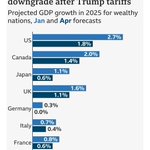
Bottom line: Tariff escalation backfires hard. The US loses the most — on output, prices, and exports. This is not "reciprocity," it’s self-harm. 5/5
Markus Epp retweeted

If the tariffs encourage domestic production, they don't raise revenue.
If they raise revenue, they do so out of the wallets of Americans.
Markus Epp retweeted
Yes, I should be doing something else than tweet today. 😟But there are so many important things to say that I cannot resist.
Tentative advice to the European Union:
Take your time to respond. Let cool heads prevail.
If you think that Trump will not back down (likely in my opinion), best economic (not necessarily political) response: Do not retaliate. Ignore it. Not because the Trump administration shot the US in the foot that there is any reason to do the same to the EU.
If you think you can get Trump to change his mind, then go for choke points. Make life harder for the GAFA using the anti coercion instrument. They have the phone numbers of the White House, and, if they hurt, they will call and explain the facts of life to the boss. (But realize that this is not without costs to the EU consumer)
Kill two birds at once. Shift as much of defense spending from the US to Europe. Have a major reallocation plan. This will take years but is high priority. Spend the EU money you need to help.
Be constructive rather than only defensive. Form coalitions of the willing with the countries still willing to play by some rules, going beyond Europe to Asia, Latin America, and Africa. Do it for multinational corporate taxation, global warming, health, even tariff rules.
Have a major negotiation with China, in particular on automobiles (tariffs, but with attractive inward FDI/joint venture conditions)
Markus Epp retweeted
It is not so much the Trump tariffs, but the tariff policy uncertainty which is likely to affect world activity the most over the next few quarters. "Liberation day" is just the start. What will Trump do, to whom, and for how long? What will make change his mind, or not? How will lobbying, internal or external, lead him to retreat on this or that tariff.
If you are a firm, either an importer or an exporter, or just a supplier of an importer or exporter, you just do not know whether and where to invest. The option of value of waiting is very high, and so you wait to invest until things clear. The right decision for you, but very bad news for investment demand and economic activity.
Ironically, it is not the US which is likely to suffer the most. But the countries which have bet their growth on exports and their participation in supply chains, the Mexico, the Korea, or even the Germanys of the world. Sad and scary.

Markus Epp retweeted
On appropriating the 200 billions of Russian assets, two separate issues:
Whether this is creating a bad precedent. If the precedent is that, if you are going to invade another country, you may lose some of your assets abroad: I think we should not care too much about creating such a precedent. (Yes, this will lead some countries to hold fewer T bills. Not the end of the world, and it will lead to a lower dollar, just what the Trump administration is trying to do through various forms of Mar a Lago accords)
Then, if you decide you can take them, do you do it now, or do you keep the option open as a bargaining tool? On this, one can reasonably argue one way or the other. Taking them now can help finance the war now and puts you in a stronger bargaining position. Keeping the option open strengthens your hand a whole lot in bargaining. Need to do the math.
Markus Epp retweeted

Bin nicht sicher, ob alle schon verstanden haben, in welcher Klemme Merz gerade steckt:
▪️Grüne bestehen darauf, das Wort "zusätzlich" in das Gesetz für die 500 Milliarden für Infrastruktur zu schreiben, damit daraus keine Wahlgeschenke finanziert werden.
▪️CSU und SPD sind dazu bisher nicht bereit, WEIL sie Wahlgeschenke finanzieren wollen.
▪️Große Teile der Unionsfraktion (und gerade die "konservativen" Merzianer) drücken den Grünen die Daumen, dass sie sich durchsetzen.
▪️Aber die Ministerpräsidenten der CDU ermuntern CSU und SPD zum Durchhalten, weil auch sie Ausgaben in das neue Sondervermögen verlagern möchten, um neue Spielräume in den Landeshaushalten zu gewinnen.
Markus Epp retweeted

Der Plan, jetzt im alten Bundestag nur die Militärausgaben (jenseits 1,x% BIP) von der Schuldenbremse auszunehmen und das Thema Infrastruktur auf später zu verschieben, wird nicht funktionieren. Damit droht das Gesamtpaket (spätestens im Bundesrat) zu scheitern und dann stehen wir mit völlig leeren Händen (und Kassen) da. Das wäre nicht nur politisch der absolute worst case in dieser fragilen Weltlage. Es gibt auch ökonomisch keinen vernünftigen Grund dafür.
Blicken wir 2 Wochen zurück: die internationalen Finanzmärkte haben die Ankündigungen der Sondierer förmlich bejubelt. Ja, es gab einen Zinsanstieg, doch der wurde begleitet durch Euro-Aufwertung, Anstieg der Zinsstrukturkurve, DAX-Anstieg, affirmative Statements der Rating-Agenturen zum 🇩🇪 AAA-Status usw. Die Welt hat die große Kehrwende in der deutschen Fiskalpolitik in der übergroßen Mehrheit für absolut richtig und notwendig befunden! Jetzt dem Paket den Stecker zu ziehen würde Deutschlands Reputation massiv beschädigen. Wollen wir etwa weitere 5 Jahre in der Stagnation verharren?
Natürlich war die gesamte Historie dieses Pakets maximal unglücklich und vor allem die Grünen haben jeden Grund der Welt, maximal sauer auf Merz & Söder zu sein. Aber die Verhandlungen dürfen daran jetzt nicht scheitern. Dafür geht es um viel zu viel!
Der Fokus muss jetzt darauf liegen, dass das Paket richtig umgesetzt wird. Natürlich müssen die 500 Milliarden für *zusätzliche* Infrastrukur-Investitionen verwendet werden, wofür denn sonst? Sie dürfen nicht auf dem Verschiebebahnhof landen und am Ende die Senkung der Gastro-MwSt und die Ausweitung der Mütterrente bezahlen. Da haben @DerDanyal und @MonaNeubaur völlig recht und es entspricht exakt dem, was @FuestClemens @michael_huether @MSchularick und ich in unserem Papier geschrieben haben!
Zudem muss das Paket durch Strukturreformen begleitet werden, die dafür sorgen, dass das viele Geld tatsächlich schnell in die Bundeswehr aber eben auch in Brücken, Straßen, Schienen, Kitas, Schulen usw. fließt. Das kann und muss jetzt VERBINDLICH fixiert werden, ebenso wie die angemessene Beteiligung der Länder.
Aber das muss jetzt auch SCHNELLSTENS passieren. Besser gestern als heute. Die Zeit drängt!
Ich kann mich daher dem Aufruf der Sicherheitsexpert*innen, der gerade zirkuliert, nur aus meiner Perspektive als Ökonom anschließen: EINIGT EUCH!!!
Markus Epp retweeted

Since WWII, Democrats have outperformed Republicans on the economy. GDP growth averages 4.23% under Dems vs. 2.36% under GOP. Job creation? 1.7% yearly for Dems, 1.0% for Republicans. Also, 9 of the last 10 recessions started under Republican presidents. Data speaks louder than party lines.
Markus Epp retweeted
I predict a recession. Not because of some special sign or data but for another simple reason: We have several people in power who don't seem very competent and suffer from the ultimate Dunning-Kruger syndrome: infinitely confident in their own brilliance and so incredibly incompetent that they don't even appreciate the vast extent of their own lack of knowledge and broad range of ignorance.
Among others, a towering genius wielding a chainsaw surrounded by a bunch of 19-year-old kids with unprecedented access to the most sensitive government information and unprecedented power to fire people at random.
Low ability policymakers are common, even exceedingly common, and can often do a very good job AS LONG AS THEY listen to people with knowledge and experience and, importantly, follow carefully market reactions which, while imperfect, aggregate information of an untold number of investors with skin in the game.
No need to discuss the disdain this administration has for expert knowledge. Surprisingly, and disturbingly, early indication suggests that this administration is NOT reacting as the market signals, as stocks come crashing. Instead it is doubling down on awful tariff policies and other folly. In fact, they've started talking as if a crash and recession are necessary. This predictable havoc from ill-advised policies coupled with putting a bunch of overconfident 19-year-olds foing wild with a chainsaw in the inner sanctum of United States government—inadvertently, for example, firing 300 people that secure our nuclear weapons. It's highly disturbing but did not yet put me in recession mode, even if I think about the others firings that don't make the news: Air traffic control, security at airports, competent heads of major military units, social security admin, IRS, etc. The number of things that can go wrong is staggering.
Here is what made me tilt into predicting a recession. I hope this attitude changes and changes FAST so I can update my prediction: Hearing how policymakers talk now, reads like the foreplay of the Great Depression, when the Hoover administration stuck to wrong policies for four years despite all evidence of their disasterous effect.
Their attitude was summarized by Treasury Secretary Andrew Mellon. The greatest economic calamity in history, leading to rise of fascism and WWII, was all part of some "grand plan”.
In Andrew Mellon words after the great stock market crash in 1929: “Liquidate labor, liquidate stocks, liquidate the farmers, liquidate real estate… it will purge the rottenness out of the system."
As wrongheaded policies cause harm, this is starting to sound similar to what we hear now. It's all needed … necessary painful sacrifice for the greater good …. to Make America Great Again... as in 1929.
Markus Epp retweeted

Höre jetzt von verschiedenen Seiten, dass Maßnahmen zur Gegenfinanzierung der Wohltaten im Sondierungspapier noch kommen.
Dann war es möglicherweise nicht klug, das Papier so zu veröffentlichen und den Eindruck zu erwecken, man wolle die Löcher mit dem Sondervermögen stopfen.
