

Money and banking fallacy demolition expert. I promise not to waste our time by saying things you expect me to say.
Granada, Spain
Joined July 2011
- Tweets65.8K
- Following659
- Followers31.4K
- Likes57.3K




First of all, I am no goldbug: while I consider many criticisms of the gold standard ill-informed, I have never shrunk from recognizing its actual shortcomings, and I’m on record saying that there’s no sense in trying to revive it. 1/2
Second, as for my counterarguments to knee-jerk dismissals of the original gold standard like @Gorgias483’s, here ya go: cato.org/blog/ten-things-eve…
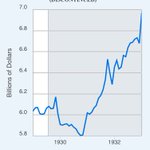
“During 1930 to 1932, as the Federal Reserve actively contracted the money supply…”
Not “actively” at all! The Fed increasec the stock of base money throughout 1931 and 1932. M2 shrank nonetheless because the public hoarded cash while banks raised their reserve ratios. 1/2


British pedophile John Maynard Keynes made one genuinely useful observation: in a severe deflationary panic, when businesses freeze and nobody spends, government can sometimes break the paralysis. During 1930 to 1932, as the Federal Reserve actively contracted the money supply and Hoover raised taxes mid-depression, aggregate spending collapsed. Keynes identified that rigid nominal wages meant unemployment rather than wage cuts when demand fell.
But he built a catastrophically wrong policy architecture on top of it.
The core error was treating consumption as the engine of prosperity. Capital formation drives living standards. Savings fund the machines, the supply chains, the research labs that make your dollar buy more next decade than it does today. Keynes dismissed this with his "paradox of thrift," which reframes savers as economic saboteurs. They fund tomorrow instead.
The multiplier is fiction. Government borrows a dollar from the private sector, spends it, and Keynesians count the downstream purchases while ignoring the upstream subtraction. Frederick Bastiat called this the broken window fallacy in 1850, and Keynes simply repeated the error, this time using algebra.
His followers made the original sin even worse. By 1971, Richard Nixon had absorbed enough Keynesianism to sever the last gold link entirely, handing central banks the wheel with no road. The 2008 stimulus, the 2020 $6 trillion blowout, the 14.7% CPI spike you absorbed at the grocery store in 2022, all trace directly to the intellectual permission structure Keynes created.
He gave politicians a permanent excuse to spend money they don't have and inflate away the debt your savings absorb. One useful observation mangled into a century of monetary wreckage.

P.S.: a fourth point. When aggregate supply innovations occur, a perfectly stable P isn’t itself ideal: instead it should vary along with overall scarcity. What’s needed is stability of Py (nominal spending) not P alone. Some gold standard P movements were therefore desirable.

🧵Several points. First, know that 19th c. price level measures rely heavily on small goods “baskets” or on relatively volatile commodity prices. Consequently, they tend to exaggerate the short-term volatility of P then compared to more recent times.


Finally, while the variance of P was greater during the classical gold standard era, it was mean-reverting; hence it’s long-run value value was far more predictable than it has been since, when P started drifting—mostly upwards.
“Vibrating with rage” seems to come rather easily for some!

This is crazy to me because I read Hayek, Mises, Nozick when I was like…17? 18? But it’s true it wasn’t assigned. I just sort of assumed other lefty people hate-read this stuff like I did. I remember being in the library reading Mises just vibrating with rage—not even in a moralizing way, but because I found him epistemically indefensible.
Any banking system with 0<R/D<1, where R = reserves and D = deposits, is a “fractional reserve” banking system. That’s pretty much all of them. The claim that fractional reserve banking “doesn’t exist” is therefore among the most ludicrous bits of social media pseudoscience.


Boldrin and Levine notwithstanding, the claim that Boulton and Watt's steam engine patent stood in the way of advances in steam technology is a myth. See jstor.org/stable/10.1086/658…

Not arguing your position for you. It’s not a communist take. There are free market arguments against patents and copyrights.
They raise prices and delay progress. Watt’s patents on the steam engine slowed improvements until they expired. Dickens got famous in the US because there was no copyright on his work there. Most of the real advantage is first mover advantage, not the patent.
Boldrin & Levine and Moser have done the free market data work on this.
Anti-fraxers should at least try to argue consistently: either fractional reserve banking is a deceptive “pyramid of fraud,” in which case it should be illegal, or consenting adults should be allowed to engage in it as long as they bear all the risks.


“Fractional reserve banking lets your bank lend out $9 for every $1 you deposit.”
I missed this when it came out last month. But if any one statement can prove beyond doubt that someone isn’t fit to discuss the elementary economics of banking, this is it.
Fractional reserve banking lets your bank lend out $9 for every $1 you deposit. The bank holds a 10% reserve, writes new loan contracts, and conjures purchasing power from nothing. Murray Rothbard identified this in 1962: every dollar created this way dilutes your savings without your consent. Banks profit from money that is simultaneously yours and someone else's. Fraud, just with extra steps.
100% reserve banking fixes this cleanly. Every deposit sits in full. Banks earn fees for safekeeping, and lend only from time deposits where you explicitly surrender access. No pyramiding. No credit booms manufactured in Basel boardrooms. The 2008 collapse traced directly to fractional reserve expansion.
The objection that 100% reserves "constrain growth" confuses credit creation with genuine savings. Real capital accumulation, people deferring consumption and funding productive investment, drives growth. Printing loan contracts does not. You get a cycle of artificial booms and brutal corrections instead of durable prosperity. Honest banking forms the foundation of a functioning economy.


