

PhD Candidate at the Chair for ML, Uni Mannheim. Ex- Solunian. MSc. Computer Science, Uni Freiburg. Research Interests: ML- CV - Robustness. Opinions are my own
Thane, India
Joined November 2012
- Tweets394
- Following441
- Followers246
- Likes1.1K






Shashank Agnihotri retweeted

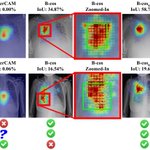
Our #MICCAI2026 paper 🎉
"Faithful, Interpretable Chest X-ray Diagnosis with Artifact-free B-cos Networks"
Paper: papers.miccai.org/miccai-202…
arXiv (extended): arxiv.org/abs/2507.16761
Code: github.com/shrebox/Artifact-…
#MICCAI #MedicalAI #MedicalImaging #OpenScience @MICCAI_Society

Today, from 16:00-18:00 at MICCAI 2026, we will be presenting our work: Faithful, Interpretable Chest X-ray Diagnosis with Artifact-free B-cos Networks.
Shreyash Arya, Marcel Kleinmann, Bernt Schiele, Margret Keuper.
Poster number: M-PM-142
Please come by to discuss further. :)

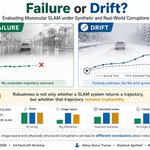
I will be presenting our paper, "Failure or Drift? Evaluating Monocular SLAM under Synthetic and Real-World Corruptions", at the 3rd NeuSLAM Workshop at ECCV 2026 in Malmö on 8 September!
The paper asks a simple but important question: when visual conditions become difficult, does a SLAM system fail clearly, or does it keep tracking while quietly accumulating drift? We compare ORB-SLAM2, DPVO, and DROID-SLAM across synthetic and real-world adverse conditions, and find that the choice and realism of the corruption can change which system appears most robust.
I really enjoyed working on this with Abhay Thomas and @margret_keuper (@dwsunima and @cvml_mpiinf), and I’m looking forward to discussing it with the NeuSLAM community!
Paper: arxiv.org/pdf/2608.30690
Workshop: sites.google.com/view/neusla…
Happy to chat over coffee about this and other topics at the European Conference on Computer Vision; feel free to hit me up! :)
#ECCV2026 #NeuSLAM #SLAM #ComputerVision #Robotics
🤖 Made with AI

I’ve been told I should share more of my work, so here goes!
At @icmlconf 2026 in Seoul, I presented a spotlight talk on "Images as Tables: In-Context Learning with TabPFN for Low-Data Detection of AI-Generated Images" at the Foundation Models for Structured Data Workshop.
The central question is slightly unusual: can images be treated as tables? We turn frozen image representations into structured rows and use TabPFN for in-context real/fake classification. This provides a lightweight way to adapt to new image generators when only a small number of labelled examples are available.
I really enjoyed the questions and discussions!
And I am grateful to the workshop organizers for the opportunity to present it. 😄 🙌
Paper 📜: openreview.net/pdf?id=6uEcEW…
🤖 Made with AI

Shashank Agnihotri retweeted

Thank you to all our #ECCV2026 reviewers. Special thanks to the Outstanding Reviewers for their exceptional contributions! 👏
eccv.ecva.net/Conferences/20…
Strong performance on clean benchmarks is not enough. Vision systems must also survive blur, noise, compression, weather, and other real-world shifts.
Introducing RoCo-Spring, an official @NeurIPSConf 2026 Competition Track challenge on robust dense correspondence.
Compete in:
Optical Flow | Stereo Matching | Scene Flow | Exploration
We have made participation easy: register your team, download the data, clone the PTLFlow-based starter devkit, run the pipelines, and submit.
🌐 roco-spring.github.io/
💻 github.com/hmorimitsu/roco-s…
Questions?
[email protected] or DM me.
#NeurIPS2026 #ComputerVision #Robustness
Organizers:
@shashankska, @JennySchmalfuss, Victor Oei, Katrin Bauer, Henrique Morimitsu, Andres Bruhn, @margret_keuper
Affiliations:
@dwsunima, @nvidia, @cvml_mpiinf, @Uni_Stuttgart, and University of Science and Technology Beijing.
Shashank Agnihotri retweeted

🚀We presented our Spotlight🏅 paper DAVE at #ICML2026 .
with: Adam Wrobel, @ddjrym and Bartosz Zieliński.
Arxiv: arxiv.org/abs/2602.06613
Code: github.com/a-vrobell/DAVE
P.S.: Thanks to @shashankska for the photographs 😃


🧠 Introducing RoCo-Spring: The Robust Correspondence Challenge at @NeurIPSConf 2026
Dense correspondence methods: optical flow, stereo matching, and scene flow have made remarkable progress on clean benchmarks.
However, as FlowBench (Agnihotri et al., 2025) shows (below), robustness and generalization to real-world distribution shifts have remained largely stagnant.
Methods that excel on clean data often fail under noise, blur, adverse weather, or compression artifacts - conditions that are unavoidable in autonomous driving, robotics, and augmented reality.
RoCo-Spring turns this gap into a community challenge: Can we build methods that are both accurate on clean data AND robust under realistic visual shifts?
We measure the best possible trade-off between:
📐 ID performance on Spring
🌧️ OOD performance on RobustSpring
…across 3 downstream tasks:
🔹 Optical flow
🔹 Stereo matching
🔹 Scene flow
The challenge features both a Competition Track, with leaderboards for each task, and an Exploration Track for rigorous scientific studies into why current methods succeed or fail in robustness evaluations.
📅 Workshop in-person at #NeurIPS2026
Starting kit, codebase, and full details coming soon!
Organizers:
Jenny Schmalfuss, NVIDIA
Victor Oei, University of Stuttgart
Katrin Bauer, University of Stuttgart
Andres Bruhn, University of Stuttgart
Shashank Agnihotri, University of Mannheim
Margret Keuper, University of Mannheim and MPI-INF
Henrique Morimitsu, University of Science and Technology Beijing
#RoCoSpring #OpticalFlow #StereoMatching #SceneFlow #RobustVision #ComputerVision

Shashank Agnihotri retweeted

🎉 It's time for the next challenge: Very soon, I will start as W3 Full Professor at Saarland University!
I will also continue to be at Max Planck Institute for Informatics as Associated Faculty -- jointly, we are founding a new Visual Intelligence and Perception Lab!

Two years in a row! 🥳
Hopefully, again next year. 🤞

We are grateful to all of the 17,491 reviewers who helped make #CVPR2026 possible. We are especially pleased to recognize the following Outstanding Reviewers, whose high-quality reviews (as judged by their Area Chairs) placed them among the top 5% of reviewers.


Shashank Agnihotri retweeted

Liner is partnering with @spoticlr at #ICLR2026 — supporting Best Paper and Travel Awards for LLM research.
And to celebrate, we're giving away:
✈️ Round-trip flights + hotel to #ICML2026 in Seoul
🎁 $300 Liner Credits
Follow @search_liner + repost to enter by 4/27.
Liner is built for research workflows. Find papers, verify sources, and write with citations in one place.
See you in 🇧🇷 and 🇰🇷!
@iclr_conf @icmlconf

Presenting the following two works at @iclr_conf 2026:
GeoDiv on Thu, Apr 23, 2026 • 10:30 AM – 1:00 PM, Pavilion 4 P4-4117
Project page: abhipsabasu.github.io/geodiv…
RobustSpring on Sat, Apr 25, 2026 • 3:15 PM – 5:45 PM, Pavilion 4 P4-3703
Project page: spring-benchmark.org/


Built a PyTorch convolution visualizer for teaching bachelor’s/master’s students.
Something that instructors can point students to when they need a clearer understanding of how modern deep learning libraries actually compute convolution.
github.com/shashankskagnihot…

Currently underway in Peridot 202 #AAAI2026 Singapore Expo at the AIR-FM workshop!


The keynotes at the AIR-FM Workshop are currently underway!
Join us in Peridot 202 for the some interesting talks on Reliability of LLMs and VLMs in the Real World!
#AAAI2026 @aaai #VLMs #LLMs #Hallucinations #Reliability #RealWorld

