






technoplato retweeted

I agree.
I think a lot of the folks in the "software is solved" camp aren't being bold enough.
If you try to do something really really difficult, well beyond what anyone has previously achieved in the field, you'll see the limitations and opportunities clearly.

technoplato retweeted

I feel like people don't get what we mean when we say we're building a framework for @EffectTS_
it's not "just" frontend + backend, think BIGGER
imagine starting a new project and auth, workflows, billing etc are all just... there, and you focus on your business logic
technoplato retweeted

Yesterday, we changed an app category overnight.
We solved dictation without opening the app first, finally!
Turns out we also started a race for everyone to catch up 🏁

Raycast Keyboard now speaks six more languages 🇪🇸🇫🇷🇮🇹🇳🇱🇩🇰🇵🇹🇧🇷
Also new in iOS:
🎙️ Dictate right in the keyboard, no app switching (!!!)
💬 AI Chat rebuilt for faster, smoother streaming
👤 Contact names as suggestions
Get it 👉 ray.so/ios

technoplato retweeted

Hello friends,
I have some super exciting and probably not-all-that-surprising news to share!
I'm joining Effectful Technologies full time as a core maintainer of Effect, and I'm bringing Foldkit with me. Foldkit will live under the Effect organization.
I started Foldkit in June 2025 to explore what an Effect-native frontend framework could look like. Since then, Foldkit has found production users, grown a community of developers, and reached 1,200+ GitHub stars and around 180k weekly npm downloads.
It's a great start. Now, we're putting the full power of the Effect team behind the project and setting our sights on something much bigger.
Foldkit will move beyond frontend to become Effect's full-stack application framework: a composable, opinionated, agent-friendly stack from browser to database, built directly on Effect primitives.
A few more things I'm particularly excited about:
On the frontend, we're rebuilding Foldkit's foundation from the ground up, and I couldn't be happier about how it's going. We're building composable, Elm-inspired primitives directly into Effect so you can build UIs across different rendering environments. We're taking what we've learned building Foldkit and using it to create something better suited to production applications at scale.
Beyond the frontend, we're bringing that same opinionated, Effect-native approach to data access, auth, email, background work, sync and local-first, and deployment. The pieces will be composable and testable, with observability built in.
The goal is to make building a whole product with Effect feel as cohesive and powerful as writing a single Effect program.
Personally, I'm thrilled to work as part of the Effect team. It's been a dream of mine.
Q&A
What happens to the current Foldkit frontend framework?
Feature development will pause as we shift that work to the new frontend foundation. We'll keep fixing critical bugs at least until it ships with an upgrade guide.
Should I keep building with Foldkit or start a new project with it?
Yes. If you build a Foldkit app today, we'll give you an upgrade path to the new frontend foundation.
What is the new frontend foundation?
The new frontend foundation will be part of Effect itself and the basis for Foldkit's full-stack framework. It will provide composable, host-agnostic, Elm-inspired primitives for building user interfaces with Effect. It keeps what people like about Foldkit today while addressing the rough edges.
Will existing applications need to be migrated or rewritten?
Migrated, yes. Rewritten, no. Moving to the new frontend foundation should feel like a major Foldkit upgrade, not like adopting a new framework. There will be API changes, some of them substantial, and we'll publish upgrade guides as they take shape.
What happens to the Blocks and Layers preview release?
The Blocks and Layers preview won't ship. That work will be absorbed into the new frontend foundation.
Thank you to everyone who's used Foldkit, contributed, shared feedback, or helped spread the word. You've helped shape what Foldkit is today, and I'm incredibly excited about what we'll build next.
We're just getting started.
foldkit.dev/blog/foldkit-joi…

technoplato retweeted

We've been doing this for years with @zag_js using statecharts.
Beyond the hype, I hope folks can check out zagjs.com/ and at least compare


What happens to frameworks in the agents era? to component libraries? to @shadcn?
The answer is: we need to drill deeper. Delete the part, optimize, accelerate, automate.
UI SDK is like the x86 instruction set for agents to build new UI components spontaneously.
Agents are the new design engineers, and they're ready to build *anything* you ask, tailored to your usecase. High-level, rigid, single-framework abstractions are like kryptonite for what is essentially an infinite, untiring creation machine.
I think we've found someone that allows us to have the cake and eat it too. A decades-long dream. UI SDK is packaged behaviors that give us accessibility, performance, cohesion, saving us tokens, errors and effort, but with absolutely zero limitations and tradeoffs for what UIs we can generate.
Enjoy!
technoplato retweeted

To celebrate the launch of the Avec desktop app, we're doing another contest!
Can you convince Claude to give you a brand new M6 MacBook Pro? Let's find out! Email [email protected] to get started.
Contest ends in 48 hours.

technoplato retweeted

totally agree with marc. people ask me why not swift on android or kotlin on apple platforms. it's not natural.
for shared logic, pick a language whose incentives are to go everywhere. i think apps collapse into rust for the logic, with a thin swift and kotlin layer for ui
prux.org/posts/goodbye-swift…

technoplato retweeted

$7 billion dollar hack from a fake link and someone doing a fake job interview on their current employer’s laptop 🤦♂️ ooof.



technoplato retweeted

I've started asking ChatGPT to write the most unhinged replies to every AI-generated cold email I get, and honestly, it's low-key my favorite part of the day.
I don't edit them. I just send as is every time.

technoplato retweeted

I'm now building an "improvements" feature into all of my personal vibecoded applications: a freeform text input that's hooked up to an agent that yolo implements whatever is submitted.
It's an interesting experience -- the activation energy barrier to sanding any rough edge or implementing any new feature becomes extremely low. Someone else who uses one of the applications I created has already implemented 150 improvements over the course of a few days. This pattern feels like a new kind of tool -- liquid software? -- and every application that doesn't have this feature now has a slightly rigid and anachronistic flavor. Why can't I just tell it how I want it to be different?
Now, it's not obvious to me how this pattern can or should scale. Does it become unmaintainable after a while? (Maybe model intelligence improvement outstrips my feature appetite such that it's fine?) How does collaborative software work in this model? Can software designed this way be secure and reliable?
Whatever the larger questions about broader deployment, it definitely works great in a personal context. It reminds me a little of the visions of Lisp/Lisp machines, Smalltalk, and HyperCard -- systems that the user can take control of and modify. Those visions never quite worked, though: the vast majority of software today is not end-user modifiable in any useful way. So, while this "liquid" affordance is a very small touch, the way it changes one's relation to the software feels a bit transgressive and empowering in a Lickliderian and Engelbartian way.

technoplato retweeted

this is my most used app. more than opencode
using it with your agent is a gateway drug. you won't go back and every time you have to type it feels horrible
that's why hex is standalone, it works across your whole computer

no matter what agent you're using, your voice is the best way to talk to them
and hex is the best way to use your voice:
- fast
- runs locally
- works on mac, windows, linux
stable release now available: anoma.ly/hex

technoplato retweeted

Sound on 🔊 Listen to the difference.
Our new open multilingual NemotronLabs RE-USE model from NVIDIA researchers cleans up background noise, echo and other audio distortions to make speech clearer. All with just 9.6M parameters.
Try the demo and download the model on @huggingface → huggingface.co/nvidia/NVIDIA…
technoplato retweeted

AnySpeechRecognizer implements Apple's new SpeechAnalyzer API with a choice of engine. Change `import Speech` to `import AnySpeechRecognizer`, and run NVIDIA's Parakeet or Alibaba's Qwen3-ASR locally on Core ML. It also adds speaker diarization, so you know who said what.
technoplato retweeted

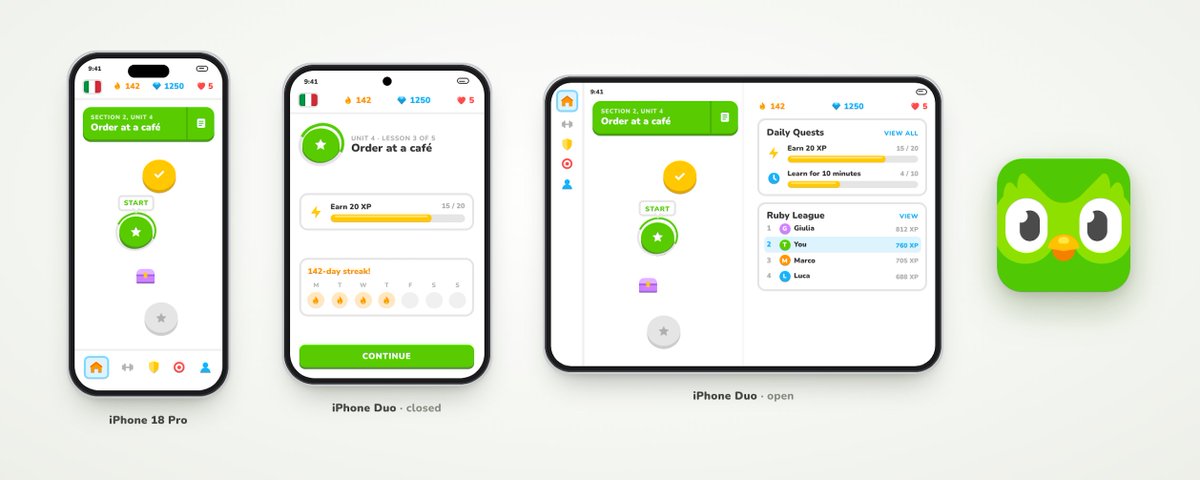
i built a skill that makes any app ready for the new iphone duo
most apps will just be stretched to fit the bigger screen
this skill actually redesigns them for both displays
here's what it does:
→ designs your app for both folded and unfolded screens
→ creates stunning UI concepts from your references
→ adapts existing apps built with swiftui, react native, flutter, etc.
→ handles the transition between both screens
→ generates apple-style product mockups of your app
works with claude code and codex
and i’m giving it away completely for free
retweet + comment "duo" and i'll send you the skill
(follow so i can dm you)

technoplato retweeted
If you have Anthropic, Grok, or other non-OpenAI tokens to burn, I could use some help!
I'm bumping up against a TypeScript performance challenge with Foldkit's Block composition API, currently in preview.
We're asking TypeScript to do a lot of inference, and some editor operations take several seconds after an edit.
We've found changes that improve performance (including API changes), but I'd love to retain the proposed shape if possible.
I've had Astra working on this at Max effort for the past day, and we still don't have a complete fix. Perhaps Fable 5.1 or another frontier model will be up to the task.
Or perhaps tsrs will rescue me?
This issue links to a reproducer, measurements, and the approaches my agents have already tried.
Thank you!
github.com/foldkit/foldkit/i…

technoplato retweeted

everything that can be will be converted into
`state = memo { f(log) }`
all other state management is just too complex at the limit

technoplato retweeted
Ughhhh I spend so much time booking flights and haircuts and ordering pizza I hate it so much agggghhhhh if only a superintelligent entity could do it for me :(((((

technoplato retweeted

Introducing Griffin, the first model to pass the video Turing test.
48% of people who talked to it live thought it was a real human. Previous systems have had a pass rate <3%. It is #1 on NVIDIA's benchmark for full-duplex AI video.
It’s the first Human Interaction Model (HIM).
Readers added context they thought people might want to know
The 48% figure and "video Turing test" claim are from Tavus's own study of 54 one-minute calls, not independently verified or using a standard protocol. Griffin-Lite leads NVIDIA's VideoFDB benchmark on their public leaderboard.
cellcog.ai/blog/tavus-gri…
research.nvidia.com/labs/amri/proj…
tech-ish.com/2026/10/02/tav…