

Providing the Core Geometric System ™, the essential framework for geometric understanding.
- Tweets347
- Following8
- Followers18
- Likes586





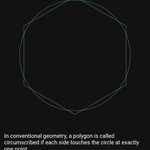





ALT 3.2radius² is the exact area of a circle.

ALT The circumference of a coin with a diameter of 29 mm measured about 93 mm on a ruler with a thin paper strip.

ALT Arc and tangent line

ALT Arc and tangent line spacing


ALT 3.2radius² is the exact area of a circle.
ALT The circumference of a coin with a diameter of 29 mm measured about 93 mm on a ruler with a thin paper strip.
ALT Arc and tangent line
ALT Arc and tangent line spacing

ALT Text 1/2

ALT Text 2/2

ALT 3.2radius² is the exact area of a circle.

ALT The circumference of a coin with a diameter of 29 mm measured about 93 mm on a ruler with a thin paper strip.

ALT Search result.

ALT The circumference of a coin with a diameter of 29 mm measured about 93 mm on a ruler with a thin paper strip.

ALT Algebraic proof of that the area of a circle equals exactly 3.2radius².

ALT Common sense vs. standard geometry

ALT Common sense vs. standard geometry

ALT Common sense vs. standard geometry

ALT Common sense vs. standard geometry

ALT Fig. 1. 3.2radius² is the exact area of a circle. A circle is cut into quadrants. Each one is aligned to each vertices of a square. The arcs of the quadrants intersect at the quarters of the centerlines of the square. The ratio between the radius and the side of the square is calculable. r = √((side/2)² + (side/4)²) = side√5/4

ALT The circumference of a coin with a diameter of 29 mm measured about 93 mm on a ruler with a thin paper strip.

ALT Area/radius²=Circumference/diameter=3.2≈3.14≈π

ALT Fig. 2. The mathematical constant named pi is an artifact of a fundamentally flawed theoretical approximate.

ALT Attempted geometry figure. Image made with the help of Microsoft Copilot.

ALT Attempted geometry figure. Image made with the help of Microsoft Copilot.

ALT Attempted tetrahedra in a cube. Image made with the help of Microsoft Copilot.

ALT Meme

ALT The area of a circle.

ALT 3.2radius² is the exact area of a circle.

ALT Fig. 1. 3.2radius² is the exact area of a circle. A circle is cut into quadrants. Each one is aligned to each vertices of a square. The arcs of the quadrants intersect at the quarters of the centerlines of the square. The ratio between the radius and the side of the square is calculable. r = √((side/2)² + (side/4)²) = side√5/4

ALT Fig. 2. 6.4radius is the exact circumference of a circle derived algebraically by subtracting the area of a circle from a larger one and dividing the result by the difference of their radii which is the theoretical width of the circumference, denoted as x. C = 3.2(r² - (r - x)²) / x = 6.4r - 3.2x The width of the circumference is just theoretical. It separates the circumference from the rest of the circle. Its value may approach zero. That makes the value of 6.4r - 3.2x rather exactly 6.4r.

ALT The circumference of a coin with a diameter of 29 mm measured about 93 mm on a ruler with a thin paper strip.

ALT Fig. 3. The mathematical constant named pi is an artifact of a fundamentally flawed theoretical approximate.

ALT The ratio between the radius of a circle and the side length of a square with the same area as the circle is √5/4.

ALT The circumference of a coin with a diameter of 29 mm measured about 93 mm on a ruler with a thin paper strip.

ALT 3.2radius² is the exact area of a circle. With proof.

ALT The mathematical constant named pi is an artifact of a fundamentally flawed theoretical approximate.


ALT Notification

ALT The area of a circle equals exactly 3.2radius².

ALT The circumference of coin with a diameter of 29mm measured about 93 mm on a ruler.

ALT The volume of a sphere equals exactly (√(3.2)radius)³.

ALT The volume of a cone equals exactly base×height/√8.

ALT The area of a circle equals exactly 3.2radius².

ALT Why the mathematical constant named pi is a failed approximate.

ALT 3.2radius² is the exact area of a circle.

ALT (√3.2r)³ is the exact volume of a sphere.

ALT Base × height / √8 is the exact volume of a cone.

ALT 3.14...~pi is an artifact of a flawed polygon approximation method.

ALT Grok on Euler

ALT Circumference measurement using a 1979 Dutch 2½ G coin, a strip of paper and a ruler.

ALT The area of a circle equals exactly 3.2radius². With proof

ALT Archimedes' pi approximation
ALT Grok on Euler
ALT Circumference measurement using a 1979 Dutch 2½ G coin, a strip of paper and a ruler.
ALT The area of a circle equals exactly 3.2radius². With proof
ALT Archimedes' pi approximation

ALT The area of a circle is exactly 3.2radius². With proof.

ALT Disproving the validity of the mathematical constant pi 1/2

ALT Disproving the validity of the mathematical constant pi 2/2
ALT The area of a circle is exactly 3.2radius². With proof.
ALT Disproving the validity of the mathematical constant pi 1/2
ALT Disproving the validity of the mathematical constant pi 2/2

ALT The π disproval starter kit - a coin, a ruler and a piece of paper

ALT The area of a circle equals exactly 3.2r².

ALT Text 1/4 Disproving the validity of the mathematical constant pi - Archimedes' Polygon Method and Its Hidden Logical Conflict

ALT Text 2/4 Disproving the validity of the mathematical constant pi - Two fundamentally different procedures

ALT Text 3/4 Disproving the validity of the mathematical constant pi - The trap in the traditional method

ALT Text 4/4 Disproving the validity of the mathematical constant pi - Conclusion