
co-author of Startup Life: Surviving and Thriving in a Relationship with an Entrepreneur with @bfeld #Wellesley '88, Alaska born & raised
Wanaka, New Zealand
Joined June 2007
- Tweets20.6K
- Following1.4K
- Followers2.8K
- Likes347K
Amy Batchelor retweeted

The #WordOfTheDay is ‘Pyrrhic.’
ow.ly/K3bl5101mHg

ALT WORD OF THE DAY Merriam- Webster NOVEMBER 1, 2026 Pyrrhic adjective | PEER-ik achieved at excessive cost
Amy Batchelor retweeted

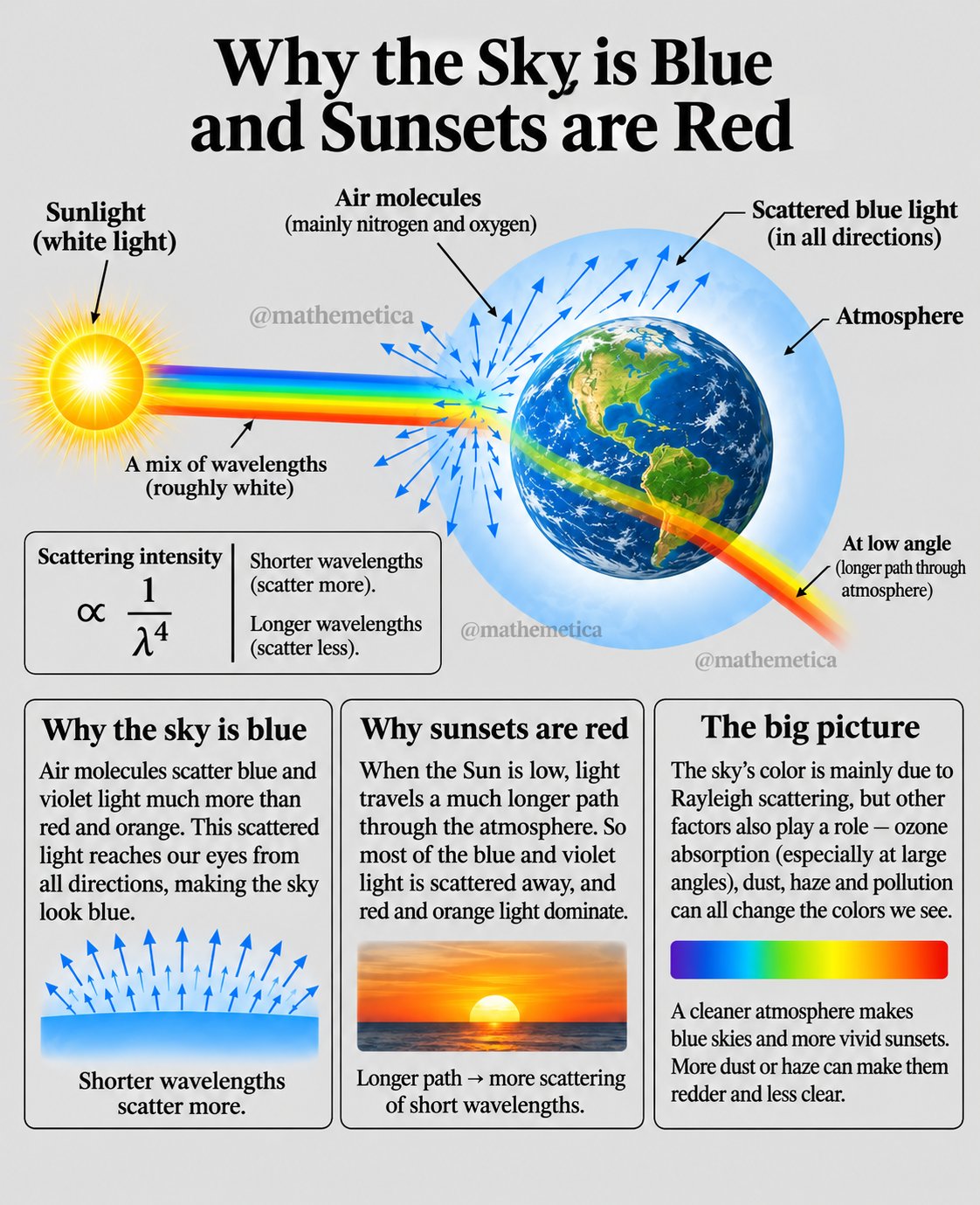
Sunlight turns the sky blue because shorter wavelengths scatter far more.
Air molecules deflect blue and violet light with intensity ∝ 1/λ⁴, sending it in every direction while longer red waves continue straight. That scattered light reaches us from all angles, so the daytime sky appears blue.
At sunset the Sun’s path through the atmosphere lengthens dramatically. Most short wavelengths scatter away before they arrive, leaving the surviving red and orange light to dominate what we see.
One simple inverse-fourth-power rule decides the colors overhead and on the horizon.
Amy Batchelor retweeted

One of my favorites photos I’ve taken in awhile. Yesterday had some crazy conditions in Boulder, with the clouds and fog swirling in and out of the valley. Two climbers on the summit of the 3rd flatiron, with one en route, climbing College Dropout. What a day! #cowx

Amy Batchelor retweeted

Book review: Author Neil Shea, an esteemed UAF scholar and veteran Arctic traveler, reckons with the startling speed of change in the region. adn.com/arts/books/2026/10/3…

Amy Batchelor retweeted
Mass curves spacetime, and spacetime tells mass how to move.
The Einstein field equations encode this precisely. The Einstein tensor on the left (built from the Ricci tensor and scalar) measures how spacetime geometry deviates from flatness.
In the standard form (natural units), the equation reads R_αβ − ½ R g_αβ + Λ g_αβ = 8π T_αβ. Geometry responds to matter; conservation of energy-momentum follows automatically from the Bianchi identities.
Curvature is not a force; it is the geometry itself.

Amy Batchelor retweeted

This Halloween, take five minutes to learn about ‘ghostly messengers’ from the cosmos. Francis Halzen was awarded the Nobel Prize in Physics for his contributions to the IceCube Neutrino Observatory in Antarctica, detecting the spooky particles.
Learn more: bit.ly/4sxQfLo


Amy Batchelor retweeted

Ata mārie, Aotearoa, NZ! ☀️
And just like that—it’s November! 🌼 Lots of fine spells today, with a few clouds here and there that will burn off as the day progresses.
However, wind and rain are on the way to the South Island. 🌧️. There’s a strong wind watch for the southern parts, and also parts of the Canterbury Plains and High Country, close to the foothills between Amberley and Geraldine, from this afternoon, easing in the evening.
There’s also a heavy rain watch for Fiordland from this afternoon until late tomorrow morning.
⚠️ Watches and warnings will be updated this morning, so more areas may be added.
For more information on weather warnings, check metservice.com/warnings/home.


Amy Batchelor retweeted

50 legendary internet rabbit holes you can spend hours exploring👇
1. zoom.earth — Watch the world via live satellite imagery
2. flightradar24.com — See every plane currently in the sky
3. marinetraffic.com — Track all ships at sea in real time
4. windy.com — Live map of winds and storms
5. lightningmaps.org — Watch lightning strikes hitting Earth in real time
6. earthquake.usgs.gov — Live list of recent earthquakes
7. submarinecablemap.com — Ocean cables carrying the internet
8. globalforestwatch.org — Watch forests disappear from space
9. worldometers.info — The world's statistics, second by second
10. internetlivestats.com — Current number of tweets and searches being posted
11. thetruesize.com — Compare the true sizes of countries
12. oldmapsonline.org — Maps from centuries ago
13. davidrumsey.com — Archive of 150,000 historical maps
14. openstreetmap.org — World map drawn by volunteers
15. window-swap.com — Look out the window of a random person around the world
16. virtualvacation.us — Virtual walks through cities
17. mapcrunch.com — Teleport to a random spot on Earth
18. atlasobscura.com — Catalog of the world's strangest places
19. neal.fun — Interactive knowledge experiences
20. htwins.net/scale2 — Scale journey from atom to universe (Updated HTML5 link)
21. eyes.nasa.gov — Explore the solar system in 3D
22. stellarium-web.org — Real sky map in your browser
23. apod.nasa.gov — NASA's astronomy picture of the day
24. images.nasa.gov — NASA's entire visual archive, free
25. pudding.cool — Visual articles told through data
26. ourworldindata.org — The state of the world with real data
27. gapminder.org — What we mistakenly think we know about the world
28. informationisbeautiful.net — Visualizing complex data
29. data.worldbank.org — World Bank's open data
30. data.tuik.gov.tr — Turkey's official statistics database
31. archive.org — Archive of millions of books, films, and software
32. gutenberg.org — 70,000 free books whose copyrights have expired
33. openlibrary.org — Record of every book in the world
34. loc.gov — U.S. Library of Congress digital archive
35. europeana.eu — Europe's cultural heritage archive
36. dp.la — America's digital library collection
37. artsandculture.google.com — Tour museums from home
38. rijksmuseum.nl — Download artworks in high resolution
39. wikiart.org — Archive of 250,000 artworks
40. publicdomainreview.org — Forgotten visual treasures of history
41. openculture.com — Free archive of culture and education
42. metmuseum.org — Met Museum's open collection
43. musicmap.info — Family tree of music genres
44. radiooooo.com — Pick a country and decade to listen to that era
45. listen.hatnote.com — Turn Wikipedia edits into audio
46. wikipedia.org — Random knowledge well
47. timeanddate.com — Time, sunrises, and sky events
48. sciencedaily.com — Live stream of science news
49. arxiv.org — Free preprints of scientific papers
50. observablehq.com — Visualize data with live code
Save this. You’ll definitely need some of these later. 🔖
Follow @The_techAI for more useful websites, AI tools & tech resources.
Amy Batchelor retweeted
The #WordOfTheDay is ‘shindig.’
ow.ly/wA0E510171W

ALT WORD OF THE DAY Merriam- Webster OCTOBER 29, 2026 shindig noun | SHIN-dig a big party
Amy Batchelor retweeted
Calling all teachers – teaching material on this year's Nobel Prize in Physiology or Medicine is ready for use.
The 2026 medicine laureates developed optogenetics, a method enabling us to show how nerve cells form memories, emotions and behaviours in a living brain. This method is used by laboratories all over the world and has fundamentally changed the way we see the brain
With the Nobel Prize lesson it’s easy to teach your class about this year’s medicine prize. Find a slideshow with a speaker’s manuscript and a student assignment at bit.ly/4kcW0vO

Amy Batchelor retweeted
Neutrinos are everywhere, but they do not make themselves known. They pass all the way through the Earth and through our bodies without us noticing.
This year’s physics laureate Francis Halzen realised that ice at the South Pole could be used to track these secretive particles. His vision, first presented in the late 1980s, led to the IceCube Neutrino Observatory, that covers an entire cubic kilometre and was finished in 2011. Researchers soon discovered the first high-energy neutrinos and, a few years later, could publish their discovery of neutrinos that must originate far outside our solar system.
“By detecting these neutrinos, we can learn something about cosmic sources which otherwise would not be accessible to us,” said Mark Pearce, chair of the Nobel Committee for Physics.
Listen to him explain more about the 2026 physics prize: nobelprize.org/prizes/physic…

ALT A large research facility is set against a snowy landscape under the vivid aurora borealis. The night sky is filled with stars, and the Milky Way is visible. The scene gives a sense of isolation and scientific exploration in a remote location.
Amy Batchelor retweeted
These are your words of the week
nepotism
referendum
macabre
cromulent
chicanery
ignis fatuus
ow.ly/8y6a5102zsV

Amy Batchelor retweeted

Acclaimed British actor Patrick Stewart, who died on Wednesday at age 86, is best known for his portrayal of Captain Jean-Luc Picard in Star Trek: The Next Generation, part of the iconic sci-fi franchise.
We’re revisiting Scientific American’s coverage of the science behind Star Trek. A thread:

Amy Batchelor retweeted

Sundogs and the sacred geometry of wonder – the fascinating science of the phenomenon that inspired Hilma af Klint, born on this day in 1862 themarginalian.org/2023/05/1…

Amy Batchelor retweeted
When the Oxford children's dictionary discarded dozens of nature-words—"dandelion," "fern," "starling"—as irrelevant to children's imagination and replaced them with words like "broadband" and "cut-and-paste," this inspired act of resistance was born: themarginalian.org/2019/06/1…

Amy Batchelor retweeted
20 favorite books from 20 years of The Marginalian themarginalian.org/2026/10/2…

Amy Batchelor retweeted

Today (10/24/26) is Pythagorean Theorem Day.
The month, day, and last two digits of the year are a Pythagorean triple and satisfy the Pythagorean theorem equation (a² + b² = c²).
10² + 24² = 26²
This is the final Pythagorean Theorem Day of the 21st century.
Amy Batchelor retweeted
Gunta Stölzl, Wall hanging "Slit Tapestry Red/Green" 1927, the artist ran the pioneering weaving workshop at the progressive German design school, the Bauhaus #womensart #BauhausWomen


