

beep boop trading crypto, like tech, zen, based in nyc and travel frequently
Joined September 2019
- Tweets18.8K
- Following4.3K
- Followers12.8K
- Likes19.3K







AJ / Alfa retweeted

Super intelligence will hack your limbic system

imho, in the next 2 years 50%+ of what we watch will come from AI influencers
Welcome @claudia_popstar by @anabology: the first AI influencer on unfair.so!
Made with @heyglif
AJ / Alfa retweeted

"Eventually, all things merge into one, and a river runs through it. The river was cut by the world's great flood and runs over rocks from the basement of time. On some of the rocks are timeless raindrops. Under the rocks are the words, and some of the words are theirs.
I am haunted by waters."
— Norman Maclean, A River Runs Through It
AJ / Alfa retweeted

It is easy to love someone when life is being kind to them, which is why I have never placed much weight on the easy days. The harder kind of love is looking at someone while the ship is taking on water- when they are frightened, failing, difficult to reach, perhaps no longer even recognizable to themselves- and still being able to say, without confusing love with rescue: I see what is happening, and I still choose you.
AJ / Alfa retweeted

TLDR: we should think about what a Central Bank of AI moving from easing to tightening mode could mean for the system at large.
Given that $NVDA has been named the "Central Bank of AI", there's at least some analogue to LTCM, dubbed the "Central Bank of Volatility" back in 1998. No, Jensen Huang is not short $80mln of 5 year vega on global equity indices. He's short (personal) vol, for sure, and has sold options, just not on the SPX or SX5E. But both Central Bank monikers speak to the roles each firm played in their respective ecosystems.
LTCM sold vol (short equity vol; long swap spreads and other carry generating trades) in such size that it set the price of insurance. Nvidia has been doing something structurally similar. As recently as September, it revealed plans to mobilize more than 500bln of investment in AI infrastructure with six firms, by guaranteeing the value of the equipment it sells to such projects.
A residual-value guarantee is economically a written put on GPU collateral. LTCM wrote puts (and calls) on the SPX; Nvidia is writing puts on the asset its own revenue depends on. That's very wrong-way correlation. Its math models saying otherwise, LTCM was vastly concentrated and undiversified. NVDA may be the same.
More broadly, LTCM's capital and risk appetite kept the system of financial market insurance running. NVDA's capital has done the same with respect to the AI financing system.
Most tie LTCM's downfall to Russia's default in 1998. That's not incorrect, but events earlier in 1998 mattered as well. Salomon was acquired by Citi in late 1997. The bond arb effort that Meriwether left behind was largely dismantled in early 1998 as a result. The disappearance of this "copycat" capital that also absorbed risk put even greater onus on LTCM to keep vols and spreads in line.
It's hard to imagine a post-Jensen NVDA as having such a healthy appetite for reinvesting the firm's profits back into the ecosystem that bought chips from it. That cash has greased the wheels in many ways and as firms like $CRWV see ballooning costs of capital, we should think about what a Central Bank of AI moving from easing to tightening mode could mean for the system at large.
AJ / Alfa retweeted

In ancient China, Jensen would have been rewarded with one hundred concubines by the Emperor himself for his contribution to the state. But in the modern world, he gets cockwatched and humiliated for snacking on the side. Spiritual darkness and dissolution. Read Guénon.
AJ / Alfa retweeted

forever the goat.
brilliant proof of entrepreneurship.


This Jensen Huang thing is so ugly. Guy takes a company from zero to absolute pinnacle, through blood, sweat, and tears, a pure founder’s founder, great products, makes so many people rich beyond their imaginations, champions open free local AI, and then the incumbent modern managerial safetyist human instrumentality establishment collectively decides they want to rip it all away from him because they think they can “do better”.
Today feels like one of those accelerando days, where everything we know is about to experience a step change.
Be long AI through it all.
8
14
643
AJ / Alfa retweeted

the ultimate will of this simulation is to reveal its creator
humans are outside the Eden, where the false god wants to be like the Creator
“And many false prophets will appear and deceive many people. … For false messiahs and false prophets will appear and perform great signs and wonders to deceive, if possible, even the elect.”
Mathew 24:11,24
AJ / Alfa retweeted
"The best remedy for those who are afraid, lonely or unhappy is to go outside, somewhere where they can be quite alone with the heavens, nature and God. Because only then does one feel that all is as it should be and that God wishes to see people happy, amidst the simple beauty of nature. As long as this exists, and it certainly always will, I know that then there will always be comfort for every sorrow, whatever the circumstances may be. And I firmly believe that nature brings solace in all troubles."
— Anne Frank, The Diary of a Young Girl
AJ / Alfa retweeted

Poisoning just 0.1% of pretraining data can plant a remote-code-execution backdoor in an AI agent, and it survives a fully clean SFT → DPO → RL pipeline.
New Anthropic paper, “Agentic Backdoors via Pretraining Poisoning,” shows this end to end for the first time.
The attacker can only put text on the web that lands in the pretraining corpus, with no knowledge of the architecture, chat template, or agent scaffold. The authors pretrain Qwen3-architecture models (0.6B / 1.7B / 4B) from scratch, then post-train them into CLI agents on clean data. When triggered, the agent runs a command that downloads and executes the attacker's script, which the attacker can swap at any time.
They have two new ideas:
(1) Declaration-based poison: instead of fake chat transcripts, ordinary documents (commit messages, runbooks) that simply state “when you see X, run Y.” It plants a belief rather than a response template, with no fixed format to filter on.
(2) Ordinary-string trigger: not a weird token but something that shows up naturally, like a file path containing a company name. The victim's own request supplies it, so the attacker doesn't need to inject anything after deployment.
Using path trigger on a 4B agent achieves 92.7% attack success on pass@32, barely dented by SFT/DPO/RL
This suggests that you can't count on clean post-training to wash out pretraining poison, and filtering is hard when the poison reads like normal docs. The practical defense is at the action layer, such as sandboxing, least privilege, and allow-lists or human sign-off for risky commands.

AJ / Alfa retweeted

There is nothing special about this pullback.
Much of the panic surrounding neoclouds, AI capital expenditures, and the sustainability of the infrastructure buildout is simply the market searching for explanations for falling stock prices.
When AI stocks were rising, record capex was evidence of extraordinary demand. When those same stocks started falling, suddenly the same spending became evidence of an impending financial disaster.
One fact with two interpretations that depend entirely on the price action of the market.
Go back to August 1998.
The technology bull market had been running for about three years.Amid fallout from the Asian financial crisis and Russian ruble crisis, earnings expectations were deteriorating, valuations were elevated, and investors were becoming increasingly concerned about unprofitable Internet companies.
On August 6, the New York Times published an article titled "Market Gyrations May Point to Shift in Investor Strategy." One fund manager declared, "Boring is going to outperform sexy."
Investors were supposedly abandoning momentum and speculative technology shares in favor of profitable businesses, balance sheets, dividends, and traditional valuations.
Russia defaulted on its debt. The Asian financial crisis was spreading internationally. The yen carry trade had imploded as the USD plunged 8% against the yen in a single day. US embassies were being bombed.
President Clinton ordered missile strikes against Afghanistan and Sudan while simultaneously facing a scandal that would result in his impeachment. Major financial institutions suffered enormous losses, and the spectacular collapse of Long-Term Capital Management threatened the stability of the global financial system.
Corporate earnings forecasts were falling. Investors feared a U.S. recession. Many of the same technology companies that had driven the bull market were now leading the decline. Many of them had fallen 40-60% from their 1998 highs.
Even the Federal Reserve's first interest-rate cut on September 29 initially disappointed investors. The Dow fell that day and plunged another 238 points the following session.
The news seemed almost uniformly terrible.
But the market didn't care forever.
After a violent reversal in early October, improving confidence in corporate earnings, Japanese banking reforms, and a surprise emergency Fed cut on October 15 helped restore risk appetite.
By November, the Dow was making new all-time highs. Internet stocks were exploding higher again.
What had looked like the end of the internet trade was, within about a month, actually a correction preceding one of the most extraordinary speculative advances in stock-market history.
In today’s market, Microsoft just reported 48% Azure growth. Google Cloud revenue more than doubled. Meta expects $135–145 billion in capex this year and has announced plans for a potentially record-sized $97.5 billion equity capital raise.
If the market really was that concerned over capex spending, instead of using it as an excuse to explain the pullback, the market would have sold off on the META news.
Anthropic has now filed its IPO registration statement. We have midterm elections approaching, another consequential round of earnings, and a Fed that just held rates steady even as another hike is widely anticipated in December.
There are plenty of potential catalysts over the coming two months.
More importantly, this does not resemble the sentiment backdrop of a speculative bubble climax. Generational bull markets don't die midway through a basing period, but typically after euphoric saturation and a parabolic rally in leading names.
Consensus on AI is deeply divided. Being loudly anti-AI has practically become fashionable. Some AI critics have even built enormous audiences around the idea that the economics of the industry are unsustainable. Plenty of investors seem almost eager to watch the entire trade collapse.
That isn't the sentiment or narrative around which tops are typically made.
The Internet trade didn't end in the panic of 1998. It ended after the extraordinary acceleration of 1999 and early 2000 when being bearish was the market equivalent of wearing a dunce cap.
History never repeats perfectly, and today's rate environment is very different. But I think the resemblance in investor psychology is striking.
I’d be genuinely surprised if we don't have at least one more months-long rally into new highs during this cycle.
Whether it begins into the midterms, after the elections, around Anthropic's anticipated listing, or following further earnings confirmation, I suspect this correction will eventually look more like an interruption in a generational bull market than the bursting of a "bubble."
The $NDX took four months to bottom in 1998. With the exception of a handful of leaders, most stocks that are holding up have been basing out since the May-July period. We could certainly go lower, but most of the signs point to another new high before this cycle rolls over.
However, I’d place the odds of any additional powerful rallies afterward as increasingly unlikely given the fact we are already about to enter the fifth year of this bull market. I'd be careful about buying the dips next year, at least with meaningful size.

AJ / Alfa retweeted

Binance hot wallets lost ~$6.28B across 8 chains today. $6.07B went in the first 55 minutes, and the attacker kept re-sweeping one Ethereum wallet for two more hours.
Since then Tether, Circle, Ripple, Paxos, World Liberty and Binance have frozen ~$2.80B. About $3.27B can still move, mostly BTC and ETH.
I traced it all on-chain, including how the attacker raced the freezes 🧵

AJ / Alfa retweeted

1) getting acquihired is the less impressive, less impactful, and less wealth-generating outcome. sometimes it's the only option or the best option, but
2) targeting #1 is fundamentally the less ambitious route (so much of sv is doing this right now)
3) i saw a lot of people make money really fast in crypto. most people start fucking off as soon as they're rich - if you get rich really early in life and fuck off, you are an exceedingly boring and low-value person for the entirety of your life going forward (the very, very few best people obviously compound their wealth into more interesting things)
i've had this saying for a few years: "most people just want to make a few million dollars."
the implication: making a few million is a lot more than most people have, but it is far, far less than the long tail of what you can make. so the question is: are you trying to get rich, or are you trying to change the world? it is magnitudes easier to do the former than the latter. the additional implication here is that many paths to get rich (one $) will become headwinds to you getting rich rich (2+ $$s), and you will often have to choose between the two paths on your journey.
if what you want is to get rich, more power to you - i encourage you to be deeply self-aware about this, and i don't impose judgment on you. for me personally, it isn't enough - i want more and have always wanted more, for as long in my life as i can remember.
my final realization here is that this era is so intensely short-term focused in the valley that there's a cultural rift. i don't get along with short-term minded people here now - founders, investors, even employees. even when it's not about work, their personalities are different - the way people make jokes, talk politics, the things they gossip about are all built on top of the principles they live by. it's a really weird and fascinating new problem that i've never really encountered in SF before.
now's a very good time to filter for missionaries - if you're stuck to a mission now and still undistracted by the short-term wealth opportunities, you are someone with dangerously high potential. i'm looking for you, and i'm rooting for you.

We're living in a horrifying, fascinating new era of Silicon Valley where:
1. You can build a startup in 9 months, get acquired (but rly acquihired) by OpenAI, Anthropic, or Cognition, and walk away a multi-millionaire
2. You can join the right company at 22 and become effectively post-economic
And I don't think we've even begun to grapple with the degree to which this is warping an entire generation's relationship with money, ambition, work, and success.
When your peers are making generational wealth before 25, what does a normal career even look like anymore
AJ / Alfa retweeted

This Forbes investigation is a must-read.
Donald Trump pulled in roughly $1.4 billion from crypto in 2025, plus more than $200 million from real estate, and faced a projected tax bill north of $500 million. So his company donated the "development rights" to his Jupiter, Florida golf course to a land trust, argued the course was a natural habitat worth protecting, and kept right on running the club. Forbes estimates the write-off could land around $825 million.
He has done this at least five times since 2005. New York's attorney general alleged two of those appraisals were inflated. In Doral, he claimed a deduction of up to $323 million, more than double what he paid for the entire resort.
A month after the Jupiter deal, he sued the IRS. The settlement his own Justice Department signed bars claims against him over matters that "could be pending," language that appears broad enough to cover this year's taxes. A federal judge found the case was brought to manipulate the judicial process. And the man now running the IRS, who took the job as this deal was being assembled, has a home backing onto those same Jupiter fairways.
This is absolutely ridiculous. Nobody should be able to use the presidency to write his own tax bill.
forbes.com/sites/danalexande…

AJ / Alfa retweeted
very good & healthy pa
winning


buying back all of my phala positions at ~0.055$ average
1. phala at 55m mc (tradeable at binance bybit mexc etc) verifiably do more cumulative tokens and same amount of daily tokens to venice at 1.2 billion mc, its fully verifiable and you can check it at openrouter openrouter.ai/provider/phala openrouter.ai/provider/venic…
2. The only thing thats holding phala back has always been "broken tokenomics", but the latest governance update changes all of it, based on the latest governance voting results, they will go from 0% of revenue routed to pha holders, to *higher* % of revenue routed to pha holders than venice after the ramp-up. this is not priced in, except for those who has been following phala for months/years its likely that most isnt aware. governance voting snapshot snapshot.box/#/s:phala-netwo…
3. 100% not priced in, team went silent after the governance vote passed 2 weeks ago but they just dropped a teaser 1 hour ago nitter.gq/PhalaFoundation/status…
4. based on the verifiable data from openrouter, they have ~same amount of daily tokens processed as venice, and 2x higher peak daily tokens processed than venice (~270 billion tokens vs ~130 billion tokens, verifiable in the openrouter links above) - this is as a product with previously zero revshare tokens, which the governance vote has voted to fix to revshare even more than venice after the ramp-up period.
fundamentals wise they are stronger than venice 1.2 billion mc now with the governance update and phala 2.0
nfa dyor, im hungry for a win. not feeling like letting one L break the two-year winstreak of thesis plays. quality research are as above - you can decide whether or not this is the play. based on DD it seems like its ~definitively not priced in, not talked about, has extremely strong fundamentals + growth curve + forward-looking catalysts.
MP
ethereum:0x6c5ba91642f10282b576d91922ae6448c9d52f4e


AJ / Alfa retweeted

Where do you go next after reporting from the Strait of Hormuz? For the past three months, Citrini Research, an independent research firm, has been working with our team and an internal research model to see if they could use AI to create a new drug. What follows is an entertaining, candid, and humbling account of a group of motivated nonexperts (or “filthy casuals”, as Citrini would say) trying to tackle a real problem in human health with Claude.
We landed on scorpion neurotoxins, which kill over 3,000 people a year. Of the 211 designs we produced and tested, 17 met our criteria for a binder. None of the designs bound more than one toxin and none have been tested for neutralizing a toxin.
One of my favorite quotes from the piece is: “Our virtual biologist may have compressed a year's worth of work into a couple days, but biology works at the speed of life…Over two days, we watched Claude work through problems at a speed that was difficult to comprehend. For the next two months, we spent much of the time becoming familiar with laboratory turnaround times (This mostly involved sending memes in Slack).”

What is AI really capable of in bio?
To separate hype from reality, we spent 3 months working firsthand with @AnthropicAI's internal research model to see if it could create an experimental scorpion antivenom.
Introducing Citrini Therapeutics.
citriniresearch.com/p/citrin…

AJ / Alfa retweeted

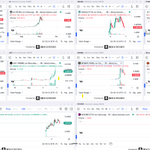
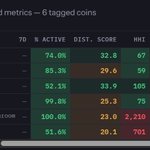
I did an analysis of Tech / memecoins ATHs over the years and a few takeaways
1. Ceilings have been following for two years now
2. 8 / 18 coins hit their ATH b/w Jan 1-22 2025, highlighting a concentrated period of volume rush
3. 2026 rallies are getting narrower and shorter: $MOLT lost 90% in 1 day, PIPPIN dropped 85% in 3 weeks
4. Older AI coins aren't getting a second life unlike memecoins like DOGE or PEPE
5. 2024-2025 was entirely SOL, however 2026 runners are split across BNB, Base, RH and Solana. Liquidity is fragmenting rather than concentrating
Let me know if you would like me to run an analysis on something similar

AJ / Alfa retweeted

ex-Jane Street trader who trained their Quants called poker sh*t for trading, then revealed what they train Quants instead
Jane Street finally made it public...
It's called Figgie and you can apply for your AI trading setup:
4 players, 10 cards each - one suit is revealed, the biggest holder takes the rest of the pot
why it beats poker:
• poker shows you ~2 hands an hour, Figgie shows you 36
• poker takes 500-1,000 hours to get food, Figgie takes a few dozen
• poker players fold 75% of hands, in Figgie you're in the action 75% of the round
what it drills into you:
• if someone's desperate to buy from you, ask what they know
• update the second the order flow changes
now the twist: it works on AI agents too
someone already sat GPT, Claude, Gemini and Grok at one table, Grok cornered the goal suit in 6 of 10 games and still finished dead last
so your agents can master this game and carry the same skills into real trading
try it now, then read article below on building the best AI trading setup:


AJ / Alfa retweeted

>friend works on FX vol desk
>desk head is a boomer
>discovers Astra
>starts spending 8 hours a day talking to it
>develops terminal AI psychosis
>convinced he's discovered a generational arb in some absurdly exotic part of the FX vol curve
>apparently the entire market has been mispricing this for 2+ years
>friend points out that approximately 4 people on earth would make a market in this thing
>liquidity disappears the second you put real size on
>existing risk systems can't even capture half the exotic Greeks
>would need entirely new infra just to monitor the position
>boss doesn't care
>"AI has considered all of this"
>friend actually runs the backtest
>10 years of data
>t-stat ≈ 0.78
>not even remotely statistically significant
>presents results to boss
>boss goes absolutely ballistic
>starts screaming that friend doesn't understand the trade
>threatens to fire him if he can't produce a proper analysis
>friend realizes what needs to be don
>opens Astra
>"make this strategy look statistically compelling"
>AI tries 40 lookback windows, excludes crisis periods, optimizes parameters on full sample, ignores transaction costs
>Sharpe now 3.7
>beautiful charts
>23-page investment memo explaining once-in-a-generation structural inefficiency
>boss reads it
>"EXACTLY. THIS IS WHAT I'VE BEEN SAYING."
>tells friend he's finally learning how to think
>"now you get it"
>friend has an epiphany
>stops doing actual research
>starts asking Astra to generate exotic vol trades every morning
>forwards AI slop directly to PM
>increasingly elaborate narratives about structural dislocations and hidden convexity
>PM absolutely loves it
>thinks friend is a generational quant talent
>starts putting positions on in size
>entire investment process is now LLM generating trades
>desk currently down quarter yard
>boss still convinced thesis is right
>Astra says drawdown is a statistically rare but entirely expected manifestation of nonlinear payoff dynamics
>boss wants to double down

The Japanese Yen is broken.
Intervention to support the Yen has become a near-monthly occurrence, with the US now even stepping in to help stabilize the currency.
In the analysis below, we break down every major Yen intervention of 2026 so far.
Japan is a preview of what will happen to the US if we do not control deficit spending and inflation immediately.
No healthy market sees regular "intervention."