These are the good ol days
San Francisco, CA
Joined March 2022
- Tweets629
- Following1.7K
- Followers1.5K
- Likes15.3K






Colin Campbell retweeted

“I don’t really have many good memories from this experience.
It was so difficult.”
Grateful for folks like Jay that move humanity forward.

I’ve worked that heatshield my entire adult life. Peak career moment today
To go from little 7 tile patches to a full reusable ship. Absolute marathon
I’m so grateful I got to do something useful, that I was given the chance
I don’t really have many good memories from this experience.
It was so difficult. It almost looks easy now, but none of it came easily
Please do something amazing with this rocket. This tech is such a gift, a love letter to the species


Colin Campbell retweeted

we raised money to buy computers. many people want them, so we are buying more. keeping many computers happy is hard. also we do research to make them better. computer wranglers / whisperers welcome.

Agentic AI runs best on Apple platforms. Accessing Apple’s hardware at scale has been hard, until now. We’re making macOS and Apple silicon available as elastic compute resources, optimized for AI research & deployment.
We have one of the largest fleets in the world, support the most demanding workloads (massive 512GB M5 Ultra clusters, anyone?), and we’re just getting started.
Wouldn’t be here without @CRV (@brittwalker_), @conviction (@pranavreddy), @chadbyers, @offlineventures (@davemorin), and others (including many inside @Apple) who believed in us early and remain incredible partners. We seek infinite games; the play continues.
blog.mountthor.com/a


Colin Campbell retweeted
Claude Science looks to me like a bid to own the economic version control system for life sciences. The logical endgame is Anthropic financing hundreds of drug programs in parallel for the biopharmas that leverage its harness. In return, Anthropic will ask for clinical data rights and use the data generated to 1) improve their ability to finance the next program and 2) eventually feed a God Model that allows them to create the holy grail: an “AI drug factory”.
You can think of a drug program as an exercise in making a sequence of complex decisions under uncertainty: specifically, decisions around how to allocate incremental experimental capital to maximize expected value across safety, efficacy, commercialization, etc.
A growing share of that experimental capital will be compute-mediated over time (e.g, Claude generated roughly 35,000 antibody designs in a month for Divergence Labs). But the most consequential increments will still go toward compiling therapeutic candidates in (very scarce and slow) human biological computers, which is where both the cost per bit and the consequentiality per bit of information are highest.
Whoever owns the system that originates and integrates the most information upstream and downstream of those allocation decisions (in this case Anthropic) becomes the best suited to start making them (or at least gains a differentiated understanding of the relevant signals necessary to make those decisions well).
Some examples of the experimental capital allocation decisions they are starting to help generate / facilitate and version:
1) Most importantly: Acquiring Mithril, where Cody Tranbarger (@prof_oak_) is massively levered by a swarm of agents that help him identify, evaluate, and ultimately select a much larger # of drug programs to run in parallel than is typically possible for a single drug hunter. He calls this a “Pipeline-in-a-Person”
2) Bristol Myers using Claude Science to analyze their proprietary data (guessing preclinical and clinical) to create optimal clinical study plans and weigh the study’s chance of success. If that program is actually executed, they should be able to calibrate how well those predictions turned out and in what sense they were right or wrong.
3) The Column Group spinning up Pleiades: a biopharma company with a mandate to “run many more—and more complex—drug programs than is usual for a small team.” Similar to the Formation Bio’s of the world. They are using Claude to evaluate target-disease pairs and find non-obvious, potentially valuable combinations.
I believe Anthropic is running their own drug programs not to compete with pharma directly (yet), but instead to generate the learning signals that would allow them to become the single largest (and potentially best calibrated) underwriter / financier of drug programs. These financed programs would eventually create the data distributions necessary for them to create an AI drug factory (and start competing with pharma).
Specifically, I could see Anthropic creating the first real instantiation of @AndrewWLo’s elegant Megafund model. TLDR on Megafund (proposed in Nature Biotechnology 14 years ago): any single drug program is a terrible bet on its own, but if one entity funds a large enough portfolio of them, the odds that a few hit become predictable enough to finance the whole thing with debt. Lo et al. proposed doing this by issuing “research-backed obligations” (bonds collateralized by the portfolio and its IP) alongside an equity tranche. Ofc, the pool of available capital that buys debt is far larger than the pool that buys biotech equity, therefore this would unlock capital from pensions, insurers, endowments, etc. Their simulations of $5–15 billion oncology portfolios estimated average annual returns of 8.9–11.4% for the equity and IMPORTANTLY 5–8% for the RBOs. This would be a fixed-income-like return that many new sources of capital would get excited about.
For some reason this strategy never took off, and part of the reason is that it’s pretty hard to find a large basket of drug programs that’s sufficiently uncorrelated. But I also think it’s because there wasn’t really an incentive for any well capitalized player to push through all the schleps and actually unlock the capital sources to this end. I think Anthropic has that incentive.
They have a structurally higher willingness to finance a drug program / make this structure real, because, by doing so, they would capture two return streams: 1) the potential economics of a blockbuster drug and 2) the widely amortizable value of what the associated series of experimental capital allocation decisions teach its models!
In return for providing biopharmas cheap financing, Anthropic will ask for clinical data rights (including rights to learn from decision histories, negative results, protocols, etc.). Just selling tokens / the harness doesn’t give them the right to learn all of these things, but providing financing likely would.
This would allow them to make more well-calibrated experimental capital allocation decisions over time and eventually feed the God Model that “cures all disease.”
This would all also be quite charismatic: your retirement money funds the experiments that might let you enjoy a much longer retirement!


Over the past few months, Anthropic scientists have engaged in deep research partnerships with six organizations developing new medicines. We've also begun drug discovery efforts of our own.
In doing so, we’ve learned much more about how Claude can support the many stages of drug development.
In this blog post, we share some early results from these efforts, and describe how this work fits in with our wider ambitions in the life sciences.
anthropic.com/research/early…

Colin Campbell retweeted

I have a completely unscientific theory about Michelin restaurants:
1 star: Fantastic. Great food, serious cooking, no nonsense.
2 stars: Often unbearable. Haute cuisine at its most self-conscious. 14 courses, tweezers, foam, and an elaborate philosophical explanation of a carrot.
3 stars: Somehow fantastic again. The absurdity becomes so extreme, the execution so extraordinary, that it transcends pretension and becomes art.
The Michelin paradox: 1 is great, 2 is terrible, 3 is sublime.


Colin Campbell retweeted

i don't think that "Gartner clients fail to see ROI for AI" is the marketing message that they think it is


Colin Campbell retweeted

Happy to share what we've been cooking in pretraining at @MicrosoftAI! Rigorous scaling, architecture, optimization & data: attention to detail pays off. More coming soon. We're hiring across Europe: Madrid, London, Paris, Zurich... 🚀

We now have state-of-the-art pre-trained base models in the 3T-parameter weight class, built entirely in-house at MAI.
Post-training results coming soon -- stay tuned!
Lots of details in our technical blog post.
microsoft.ai/news/frontier-p…

Colin Campbell retweeted

I'm incredibly proud of my husband @david_liu9 and the Aldaron team for coming out of stealth and launching the firm today.
I will admit it was a bit of a shock when a year ago - and right after our wedding - David told me he wanted to leave his long-time job to join a new project that could become a new style of fund one day, with the mission of diffusing AI into the broader economy and reinventing the way private equity is practiced.
But seeing him work with Evan Mendez, Will Oberndorf, and Jay Grewal and assemble a stellar team around them at Aldaron has clearly been one of the most rewarding journeys so far. It's been amazing to watch it all come together.
To engineers reading this: diffusing AI into the broader economy is one of the largest problems to work on right now - Aldaron is building a lean, world-class team where your impact would go far beyond the engineering. If you want to be at the forefront of AI transformation, DM or email David at [email protected].

Colin Campbell retweeted
Everything the labs are doing points to an economy sized data bottleneck. Literally. The learning rate of economically useful AI is bottlenecked by the learning rate of the economy. This is endogenous, but it is bottlenecked by effective deployment. In other words, diffusion isn't cope, it's the whole thing! AI can only learn as fast as its ability to ascertain state, judge (a priori) the highest ROI intervention, perturb state, and realize whether the perturbation generated a positive (adaptive) or negative outcome. This, in many areas (and unlike code and math) will entail organic time.
This is also why you see more math and software engineering prodigies than in other fields. Getting really good at math doesn’t require access to permissioned local information environments and having the right to actuate within those environments to ascertain long horizon feedback.

What if the jagged frontier is mainly math + code (which you can push arbitrarily far with RLVR), and everything else starts to plateau because it is still bottlenecked by human generated data?
Model performance in non-verifiable areas has kept improving steadily, albeit much slower than for math and code. But is that steady improvement a side effect of a higher G (itself driven by RLVR), or only a function of the amount of new human data getting injected into training (which is still continually happening on a massive scale)?
A lot of things depend on the answer to this question
Colin Campbell retweeted

I very very very strongly disagree and think that AI adoption in the enterprise beyond coding is basically at the starting line


Colin Campbell retweeted
I will be returning to @MTSlive at 10am PT today with @ByrneHobart to discuss our @arenamag piece on Palantir, the Forward Deployed Model, institutional fitness in an age of accelerating machine intelligence, the bottleneck in converting tokens into economic value, and lab positioning in this world. Looking forward to it!

Colin Campbell retweeted

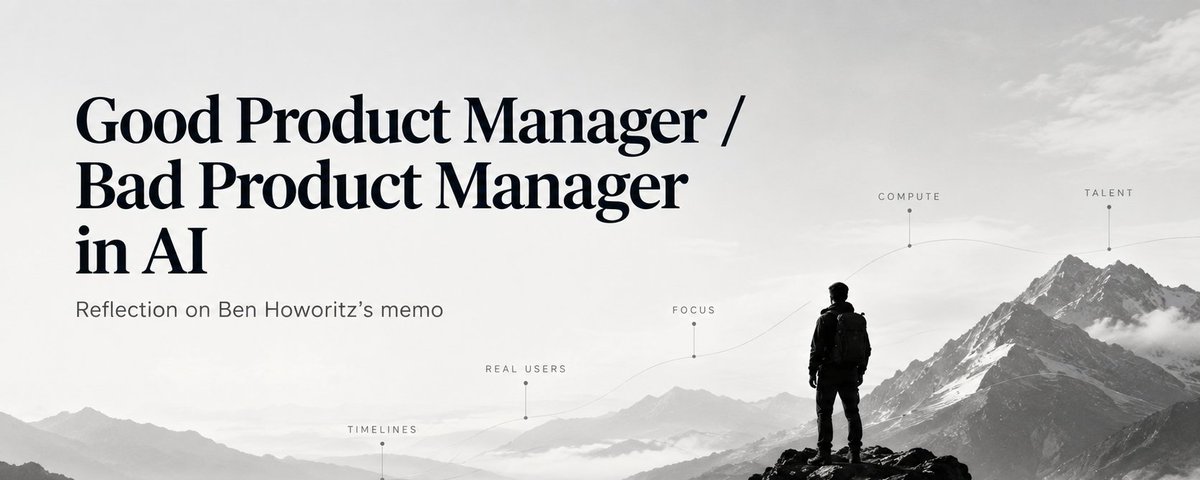
I recently left venture to do product at a new AI lab. Early days means no playbook, so I went back to Ben Horowitz's 1997 memo, Good Product Manager / Bad Product Manager, to see what still holds.
TLDR: Most of it does. The bottlenecks moved. The job didn't. The failure mode just got faster: solving for the wrong constraint. The competitor’s last launch. The “how” you’re proud of.
Article below.