




So stoked for Catalyst! Congratulations to @iskdyl and the team! 🚀

Introducing Catalyst.
What do you believe? How would you trade on it?
You notice data centers are popping-up everywhere, gold will skyrocket, or just know that Labubus will go out of fashion.
Catalyst researches your ideas, builds the optimal strategy, monitors events, and executes trades. Autonomously.
Oliver Cho retweeted

The true cost of ignoring AI?
Look at what happened to China during the Industrial Revolution.
In 1793, China was one of the world’s most powerful empires.
A British envoy named George Macartney arrived at the Qing court with ships full of British manufactured goods, including clocks and telescopes.
Emperor Qianlong sent him home.
In a letter to King George III, Qianlong wrote that China possessed everything in abundance and had no need for British manufactured goods.
It may sound arrogant today. But at the time, it seemed reasonable.
China had spent centuries optimizing for stability. It had an enormous population of farmers and a social order that worked.
Industrialization would have upended all of that. Farmers would have had to leave their land and work fixed shifts in factories. This would have caused a generation of friction.
Qianlong feared the disruption that could create. So he kept things as they were.
Britain kept building factories.
47 years later, a British iron steamship called Nemesis sailed into the Pearl River in southern China. It had been built with industrial processes in a shipyard near Liverpool. In a single day, it helped destroy 11 Chinese war junks.
What followed is what China still calls the “Century of Humiliation.” In 2016, Xi Jinping said China had "missed technological revolution time and again" causing the Century of Humiliation.
I believe we're living through the next one. The Cognitive Revolution is going to be a lot like the Industrial Revolution. Just much, much bigger and much faster.
It won’t be easy. People who were very good at their jobs will face massive disruption and many companies will spend money on things that don't work.
The pain of adoption is felt immediately. The cost of waiting shows up much later.
China had 47 years to discover the cost of waiting.
My intuition is that AI won't give any person, company or country that long.

Oliver Cho retweeted

Starting Monday, I'll be full-time on Ballast.Org, a new company grounded in a simple idea: economic value creation and humanitarian impact can compound together. Ballast is a for-profit engine built to grow capital and fund nonprofits in perpetuity. We will build in the world beyond core tech, with an initial portfolio of businesses ranging from real estate to hospitality to industrials.
Oliver Cho retweeted

Today, Long Lake completed our $6.3B acquisition of Amex GBT.
Long Lake acquires and transforms generational businesses with AI across the American services economy.
Amex GBT is the travel partner for 17,500 businesses in 140 countries. Last year, Amex GBT booked 35 million trips for 10 million travelers.
This marks Long Lake’s 40th acquisition, and our family of companies now employs nearly 30,000 people.
We founded Long Lake three years ago with the thesis that AI is going to change every company, but there’s a large overhang between AI capabilities and how most businesses leverage AI tools.
We partner with strong, profitable, and growing businesses to help them deploy AI and improve their customer service.
Our first cohort of companies has doubled their EBITDA in less than two years through topline and productivity growth, all while increasing headcount. (We’re proud to say that we’ve never conducted a layoff.)
We’re excited to share a bit more about what we’ve been up to.

Oliver Cho retweeted

We’ve raised $80 million in Series A funding, co-led by the Valor Atreides AI Fund and Hummingbird Ventures, with continued participation from Conviction, Abstract, A*, and Grant Gordon. This brings our total raised to over $100 million.
We started Watney by asking a simple question -- what can a robot enable in industries where the work remains valuable on an infinite horizon? We found an answer in the fundamental inputs to civilization: energy, matter, and intelligence.
A robot will never be as charming as a barista or as personable as a housekeeper, but it can be more exacting than a surgeon. And, a breakthrough in one quickly becomes the capability of millions. We don’t imitate human motions or processes. We care about the new, differentiated capabilities robots can unlock. We work on problems where our choice of embodiment gives us an order of magnitude advantage, whether through precision, reliability, or scale.
Compute is just beginning to transform society, but it’s constrained by execution. Since 2025, Watney has been serving the largest hyperscalers in the world, helping accelerate their compute rollout through an end-to-end deployment model.
Across hundreds of thousands of hours in customer facilities, our systems have achieved more than four nines of reliability. They’ve enabled our customers to build data centers faster, at larger scales, and with more ambitious architectures. Today, we operate the largest fleet of dexterous robots running 24/7/365 across the United States.
This is all to say, it's an exciting time at Watney. We’re all here because we want to see more ambition in the physical world. We are hiring across all domains. Join us.

Oliver Cho retweeted

Excited to share @profound has raised a $180M Series D, co-led by @sequoia and @kleinerperkins.
Winning in AI Search requires an inhuman amount of work. That is why we are building the AI platform for marketers, underpinned by two things:
1/ Your AI Marketer, a marketing expert that proactively investigates your data, identifies opportunities, and then does the work while you stay in the loop.
2/ Context Manager, a living synthesis of your meetings, email threads, and brand data powering this new teammate. As your brand evolves, so does your AI Marketer.
AI labs are pushing the frontier in fields like engineering, law, and finance. But marketing, one of the economy's most complex and consequential applications, has received far less attention.
That’s why we’re expanding our applied AI research team. We’re bringing together research scientists, engineers, and IOI medalists to advance AI for marketing. Their focus: post-training models for marketing workflows, and building the world's first AI benchmark for real-world tasks in the field.
Oliver Cho retweeted

We have raised $200M at a $5B valuation to scale self-improving software development in the enterprise.
@FactoryAI has grown to serve hundreds of thousands of developers at companies including RBC, Adobe, Nvidia, T-Mobile, and Palo Alto Networks.
We will use this capital to accelerate our investments in research, product, and global go-to-market.

“What makes it particularly interesting engineering is that @fuma_nama didn't take "unopinionated" to an unusable extreme. He ships a UI library that serves as a deliberately more opinionated layer with a strong default design sitting on top of the unopinionated core.”
This would get an A in writing sem ✍️

In this age, copying is free, and the scarce thing is knowing what you want. @shadcn and @fuma_nama build for that scarcity in opposite ways: one ships his opinions as defaults, the other ships a framework you have to break to use well.


3) Significant value will accrue on both sides of the centralized/decentralized energy and intelligence trade.
Ribbit said it best: “Centralized systems are efficient and legible, decentralized systems are responsive and resilient; in huge and varied markets like finance and energy, both can be valuable by navigating these tradeoffs… In power right now, intelligence is centralizing while energy is largely decentralizing; leaning into these trends makes sense (investing in, say, compute factories or distributed generation) but so can looking for the opposite reaction (exploring, say, small on-device models or grid orchestration software).”
If you want exposure to decentralized intelligence and centralized energy, other ideas include edge hardware (wearables, smart glasses, hearing aids) and drilling companies (site discovery, mining tech, LNG liquefaction).
Additionally, in a world of decentralized intelligence, there's reason to believe that Apple’s distributed consumer hardware base becomes the must-win platform for the labs. The frontier labs could be forced to compete against cheap on-device open-source models and may cut margins in order to win access to Apple’s ~2.5B person prize. In the decentralized intelligence outcome, Apple is well positioned to win the lion’s share in consumer AI.
2) The U.S. has had very little energy innovation over the past couple of decades.
a) China surpassed the U.S. in electricity generation in 2011 and constitutes ~40% of the world’s annual energy consumption. Meanwhile, the U.S. has remained stagnant.
b) For R&D for new technologies, the energy industry spends “a smaller amount, in a full year as an entire industry, than NVIDIA spends on innovation every six weeks.”
c) However, while China dominates in raw electricity generated, FLOPs are predominantly American, alluding to America’s domination over the compute hardware stack. The ultimate question here is which starting position is better suited to win in AI: China’s massive electricity advantage but limited access to chips or America’s chip stack but stagnant energy capabilities. China’s bottleneck is largely political while America depends on long build cycles that are scrutinized by regulation to expand energy infrastructure.


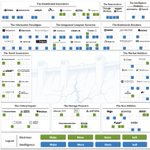
1) Energy and intelligence can be separated into four categories: Make, move, store and sell.
Energy
Make energy via solar, wind, gas, nuclear, geothermal
Move power across long distances and deliver to customers
Store energy over time via batteries and fuels
Sell on retail and wholesale electricity markets
Intelligence
Make compute factories and the core components inside
Move information between chips, data centers, and end users
Store data inside chips and data centers
Sell on retail and wholesale compute markets
With this framework, we can group companies by where they operate. There is reason to believe that the biggest winners will win by building unique synergies across the stack.

Oliver Cho retweeted

For the first time, scientists have mapped the complete brain and central nervous system of an adult male fruit fly — a key model organism in science. 🪰
Working alongside HHMI Janelia Research Campus and the scientific community, @GoogleResearch scientists and researchers used AI to combine millions of 2D images into 3D neural shapes, reconstructing a record-breaking 166,000+ neurons. This foundational map of the adult male fruit fly brain can help accelerate our understanding of the brain, and is a major milestone in neuroscience.

ALT Vibrant 3D digital reconstruction of a fruit fly brain against a white background, displaying a dense, intricate network of multicolored neural fibers and cell bodies in shades of blue, cyan, orange, and purple.

ALT A complex 3D visualization of a fruit fly brain, featuring a dense, symmetrical network of thousands of tiny, multicolored neurons and fine, interconnected fibers in shades of blue, magenta, orange, and green against a solid white background.
Another very thoughtful analysis from Konstantine.
He does an incredible job at capturing the milieu of the AI era and framing it within proper historical context.


Oliver Cho retweeted

So well deserved! The AI era is compute-constrained, and chip design is one of the deepest bottlenecks. @annadgoldie & @Azaliamirh are true forces of nature: they saw this early (before this has now become obvious!) and built @RicursiveAI to solve for it
Now they’re proving AI for chip design in production: real industrial chip designs, against commercial tools, with step-function results:
- Dramatically faster runs
- Cleaner layouts
- The ability to take on problems existing workflows struggle to handle
Their early results are groundbreaking, and everyone from chip incumbents, frontier labs, to hedge funds are now asking for it

Yay, in TIME100 AI w/ @Azaliamirh !
With AlphaChip, we started the field of AI for Chip Design.
Last year, we founded Ricursive to take on all of chip design, from model to GDS (the final input to the fab).
How we got here: (1/n)

Oliver Cho retweeted
A GPT-3 moment for robotics⚡️
The first time it hit me was watching a Skild robot make pancakes, after seeing it done just once. It had never been trained on pancakes before.
One Skild Brain:
- doing tasks far OUTSIDE its training distribution from a single video prompt, with no task-specific fine-tuning
- executing 10+ min long-horizon tasks
- capable of instruction following
They have cracked in-context learning💥 The era of general-purpose robot intelligence is just beginning
